
Installation of a GENERAL ELECTRIC Zoneline PTAC in Saint-Hugues beneath a window, integrated with the existing heating system
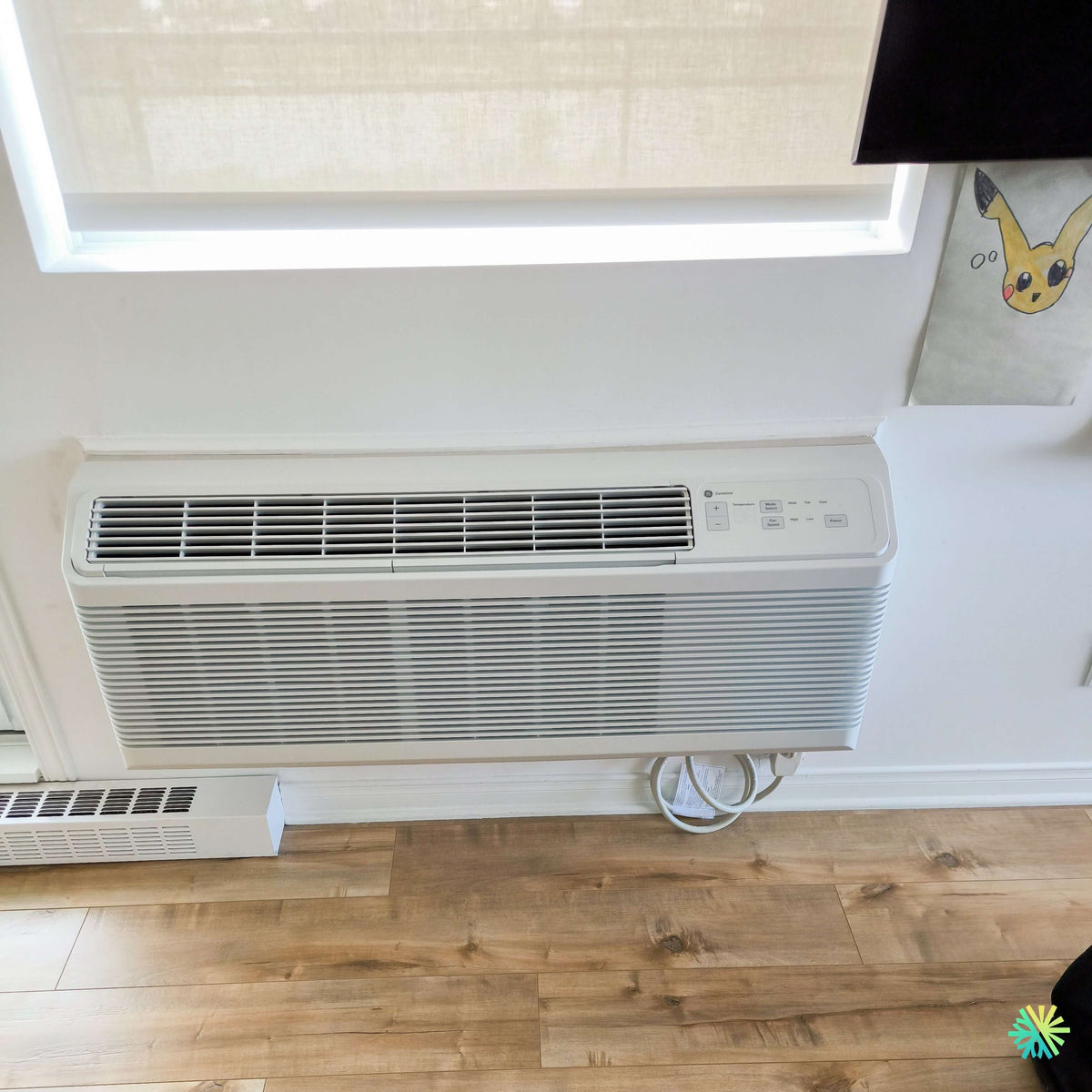
In Saint-Hugues, AirGreen installs a GENERAL ELECTRIC Zoneline PTAC beneath a window, taking into account the wall sleeve, baseboard heater, blind, drainage, and electrical connection.
- City
- Region
- Equipment
- Brand
- Challenges
- Published
The job on one screen
The article, chapter by chapter
A precise replacement in a room where every centimetre affected comfort and maintenance
In Saint-Hugues, we installed a GENERAL ELECTRIC Zoneline PTAC in a wall opening located directly beneath a window. The room's configuration imposed several practical constraints: an electric baseboard heater was located to the left of the unit, a wall outlet was positioned to the right, the power cord had to remain accessible, and a roller blind descended above the air outlet.
The result visible in the photo appears simple and streamlined. However, this type of HVAC installation relies on a series of checks that directly affect performance, noise levels, condensate management, and the equipment's service life.
The GENERAL ELECTRIC Zoneline was installed in a way that maintained adequate airflow in front of and above the unit. Its control panel, located in the upper-right section, remains easily accessible. The large front grille can also be removed for filter inspection and routine HVAC maintenance.
This Saint-Hugues project demonstrates why replacing a PTAC should never be treated as a simple operation involving removing one unit and sliding the new one into the wall. The sleeve, electrical supply, clearance, sealing, and coexistence with the electric baseboard heater must all be assessed before commissioning.
Why a PTAC was suitable for this configuration
A PTAC, or packaged terminal air conditioner, is designed to treat the air in a specific room or zone. Unlike a central system, it does not rely on a duct network. Its cabinet passes through the exterior wall inside a metal sleeve, allowing the unit to exchange air and reject heat outdoors.
In this room in Saint-Hugues, the opening beneath the window was a logical location for several reasons:
- it allowed the upper walls to remain clear;
- it avoided adding ventilation ducts;
- it reduced clutter in the room;
- it enabled local temperature control;
- it made access to the filter and controls easier;
- it used a wall opening already designed for this type of appliance.
This solution is particularly suitable for apartments, condominiums, residences, rooms, small offices, and buildings where each zone must be controlled independently.
Depending on the exact version of the GENERAL ELECTRIC Zoneline, the unit may provide cooling along with electric heating or heat pump functionality. The photograph identifies the Zoneline product line, but it cannot confirm with certainty the BTU capacity, voltage, or precise heating type.
At AirGreen, we verify this information using the complete model number and the rating plate. This verification is essential because two visually similar units may have different electrical requirements and performance characteristics.
A suspended installation that keeps the floor clear
In the photo, the PTAC is installed above the floor without resting directly on it. This configuration frees up the space below and makes it easier to clean around the unit.
It also helps maintain a certain visual continuity with the wall and the baseboard heater located on the left. The wood floor remains clear in front of the unit, helping preserve the access required for future service.
However, this installation requires stable support. The wall sleeve and surrounding structure must be able to support the weight of the PTAC without deforming.
Insufficient support can cause:
- tilting of the unit;
- vibrations transmitted to the wall;
- buzzing noises;
- improper closure of the front panel;
- a shift in the condensate pan;
- premature wear of the internal components.
We therefore verify that the sleeve is properly secured, that its frame remains rigid, and that the unit fits without placing excessive pressure on its cabinet.
The wall sleeve: the invisible component that determines project quality
The PTAC is installed inside a wall sleeve. This metal component is not merely an opening of the appropriate dimensions. It is an integral part of the system.
Dimension and compatibility verification
When replacing a unit, we never assume that an old sleeve will automatically be suitable for the new GENERAL ELECTRIC Zoneline.
Several elements must correspond:
- interior width and height;
- wall depth;
- the mounting points;
- the position of the outdoor grille;
- air separators;
- clearances around the condenser;
- drainage requirements.
A unit can physically fit into a sleeve without actually being compatible. When outdoor airflow is inadequate, the hot air discharged by the unit may be drawn back in. This reduces cooling capacity and increases the load on the compressor.
Inspection for corrosion and deformation
Older sleeves may show rust, especially on the exterior side, where they are exposed to moisture and temperature variations.
We look for, among other things:
- sagging corners;
- perforations;
- severe corrosion;
- open joints;
- a deformed rear grille;
- signs of infiltration;
- deposits that could block water drainage.
A damaged sleeve should not be kept solely to avoid a few additional repairs. Replacing it may be necessary to ensure a durable installation.
Managing condensate near a wooden floor
In cooling mode, the PTAC removes some of the moisture contained in the air. This moisture becomes condensation water inside the unit.
Managing this water is critical in a room with a wooden floor like the one shown in the photo. A minor leak can cause the boards to swell, discoloration, or damage to the bottom of the wall.
We therefore check:
- the orientation of the sleeve;
- the slope required by the manufacturer;
- the condition of the condensate pan;
- the absence of obstructions in the drainage passages;
- the stability of the unit;
- the seal between the sleeve and the wall.
The PTAC must not be tilted arbitrarily. An excessive slope may hinder its installation or operation, while a reverse slope may direct water indoors.
The proximity of the roller blind
The blind above the GENERAL ELECTRIC Zoneline descends close to the upper air outlet. This arrangement is more favorable than a flexible curtain hanging directly in front of the grille, but it still requires careful use.
Treated air exits through the long opening located on top of the PTAC. When the blind is lowered too close to this outlet, part of the airflow may be directed toward the window rather than toward the center of the room.
This situation can lead to:
- uneven temperature distribution;
- prolonged operation;
- an inaccurate temperature reading;
- an accumulation of cold or warm air near the glazing;
- reduced comfort in the rest of the room.
We recommend leaving sufficient clearance above the grille when the unit is operating. The blind must not rest on the cabinet or vibrate due to the airflow.
The large front grille must always remain clear
The front of the PTAC has a wide horizontal grille used to draw in room air. The filter accessible to the occupant is generally located behind this grille.
To operate properly, the unit must be able to draw in a sufficient volume of air. Therefore, avoid placing the following directly in front of it:
- a bed;
- a sofa;
- a dresser;
- a storage box;
- a laundry basket;
- a thick curtain;
- a television cabinet.
Even an obstacle that does not completely cover the front panel can create local recirculation and reduce the reach of the airflow.
In this installation in Saint-Hugues, the clearance in front of the PTAC facilitates both air distribution and removal of the front panel for cleaning.
Coexistence with the baseboard heater
An electric baseboard heater is installed to the left of the GENERAL ELECTRIC Zoneline. This proximity does not necessarily mean that both units should operate simultaneously.
Their use depends on the exact type of Zoneline, the intended role of the baseboard heater, and the needs of the room.
Prevent the two systems from working against each other
A common situation is to leave the baseboard heater set to a high temperature while the PTAC is operating in cooling mode. One then produces heat while the other tries to cool the room.
This conflict causes:
- unnecessary electricity consumption;
- longer cycles;
- an unstable temperature;
- increased wear;
- an issue that is difficult to diagnose.
We recommend clearly defining the role of each unit. The baseboard heater may serve as the primary, supplemental, or backup heating source, but its settings should remain consistent with those of the PTAC.
Account for the natural movement of air
Heat from the baseboard heater rises along the wall. If it operates near the PTAC, it can influence the temperature detected by the unit.
The sensor may then measure a higher temperature than what is actually felt elsewhere in the room. This detail should be considered when an occupant notices that the PTAC shuts off too early or restarts frequently.
An accessible electrical connection that must be carefully arranged
The power cord is visible beneath the right side of the unit. It forms a loop before reaching the wall outlet.
The accessibility of the cord is an advantage for inspection, but it must be positioned safely. It should not be pinched under the cabinet, pressed against a hot surface, or left in an area where it could be pulled accidentally.
We always check:
- the available voltage;
- the circuit capacity;
- the outlet type;
- the circuit breaker rating;
- the condition of the cord;
- the grounding;
- the presence of signs of overheating;
- the compatibility between the plug and the unit.
The GENERAL ELECTRIC Zoneline line includes various electrical configurations. Therefore, an existing outlet should never be considered compatible solely because the plug appears to fit.
The PTAC must have a power supply that complies with its rating plate. Using an extension cord or improvised adapter should be avoided.
Sizing the PTAC depends on more than floor area
The exact capacity of this Zoneline cannot be determined from the photo. The complete model number is required to confirm the BTU rating and performance specifications.
Sizing a PTAC must take several factors into account:
- room area;
- ceiling height;
- window dimensions;
- solar orientation;
- insulation quality;
- floor of the dwelling;
- number of occupants;
- electronic devices present;
- air infiltration;
- daily use of the room.
In this installation, the window occupies a significant portion of the exterior wall. Even with a blind, the glazing can contribute to heat gain in summer and heat loss in winter.
An oversized unit may cool quickly without providing sufficient dehumidification. An undersized unit may run almost continuously on the hottest days.
Our commissioning method
Once the GENERAL ELECTRIC Zoneline is installed, we perform a complete commissioning.
Mechanical inspection
We confirm that the cabinet is stable, the front panel is properly secured, and no unusual vibration is transmitted to the wall.
Airflow check
We observe air intake through the front grille and distribution through the upper outlet. The air-discharge louver should move freely and remain in the selected position.
Control test
The top panel allows the temperature, mode, and fan settings to be adjusted. We check that each control responds properly.
Cooling test
We check compressor startup, supply-air temperature, and operating stability.
Heating test
When the installed model has a heating function, we check its startup and response to the setpoint.
Sound level observation
A PTAC contains several components in the same cabinet. It therefore produces a different sound level from a wall-mounted system with a separate outdoor compressor.
We look for abnormal noises such as:
- metallic vibration;
- fan rubbing;
- front-panel rattling;
- electrical buzzing;
- resonance in the sleeve.
Maintaining the GENERAL ELECTRIC Zoneline
The filter should be inspected regularly, especially when the PTAC operates every day.
A dirty filter can cause:
- reduced airflow;
- reduced capacity;
- increased noise;
- increased energy consumption;
- frost on the heat exchanger;
- premature motor wear.
However, cleaning the filter does not replace periodic professional maintenance. Over time, dust can reach the heat exchanger, blower wheel, and condensate pan.
More comprehensive HVAC maintenance includes checking:
- the cleanliness of the coils;
- the condition of the drain pan;
- the electrical connections;
- the condition of the cord;
- the stability of the sleeve;
- the outdoor grille;
- signs of corrosion;
- the noises that have appeared since installation.
This Saint-Hugues project summarizes the real challenges of a successful PTAC installation
This installation of a GENERAL ELECTRIC Zoneline PTAC in Saint-Hugues shows that a clean installation depends above all on attention to detail.
The unit had to fit beneath the window without blocking the light or interfering with use of the blind. The existing baseboard heater had to remain accessible. The power cord had to be connected without being pinched. The front panel had to be removable for maintenance. The wall sleeve had to support the unit and allow for proper condensate management.
The result provides independent temperature control while preserving floor space. The white cabinet blends into the light-colored wall finish, while the control panel remains within easy reach.
At AirGreen, we carry out PTAC, heat pump, ductless air conditioner, heating, and air conditioning projects in Montréal, Laval, Longueuil, the North Shore, and the South Shore. Our work does not consist solely of installing a machine. We analyze the building, room constraints, and operating conditions so that the equipment functions properly after we leave.
Mistakes to Avoid Before Replacing an Old PTAC
Before ordering equipment, we recommend gathering the following information:
- a clear photo of the nameplate;
- the complete model number;
- the sleeve dimensions;
- the electrical voltage;
- the outlet type;
- photos of the inside and outside;
- the approximate room area;
- the function of the existing heating system.
This information helps prevent several costly mistakes, including purchasing equipment that is incompatible with the sleeve or electrical circuit.
You should also avoid choosing a PTAC solely based on its price or appearance. Capacity, physical compatibility, heating functions, and electrical requirements are much more important.
Energy Rebates and Eligibility
A PTAC should not automatically be presented as eligible for programs intended for ductless heat pumps or central systems.
Eligibility depends in particular on:
- the exact equipment category;
- the model number;
- its certifications;
- its efficiency;
- the type of building;
- the program conditions at the time of the application.
Before incorporating a subsidy into a price calculation, confirmation based on the exact installed combination must be obtained. This precaution avoids creating expectations that do not match the applicable criteria.
How the job unfolds
The main steps of this kind of job at AirGreen. Every house has its quirks: the estimate brings them out.
We look at the outside wall, the window, the space in the room and the power supply.
The unit, the sleeve and the price, in writing.
Installed following the manufacturer's instructions, so water drains to the outside.
A dedicated connection matched to the unit's voltage and amperage.
The unit slides into the sleeve; the outdoor grille stays clear.
Start-up and a check of heating and cooling.
Controls, filter, what to keep clear.
- The on-site estimateWe look at the outside wall, the window, the space in the room and the power supply.
- The quoteThe unit, the sleeve and the price, in writing.
- The wall sleeveInstalled following the manufacturer's instructions, so water drains to the outside.
- The electrical workA dedicated connection matched to the unit's voltage and amperage.
- Unit and grilleThe unit slides into the sleeve; the outdoor grille stays clear.
- TestsStart-up and a check of heating and cooling.
- The walkthroughControls, filter, what to keep clear.
What we check on a job like this one
Each number is a point we check on site. Switch between summer and winter to watch air and heat move.
Generic illustration of this type of installation, not a survey of this job site. Tap a number.
All-in-one: it heats and cools from inside the room, with no separate outdoor unit.
A box that goes through the wall and holds the unit. It is installed following the manufacturer's instructions so water drains to the outside.
This is where the unit exchanges heat with the outdoor air. It must stay clear.
A dedicated connection matched to the unit's voltage and amperage.
On the unit or through a wall thermostat, depending on the model.
Under a window, the unit must leave curtains, sill and opening free, and let air move through the room.
Is your home ready?
Check what applies at your place. A "no" is not a refusal: it is what we sort out during the estimate.
Good habits, once the unit is in place
Six simple habits that keep the unit going. Your list stays on this device.
What to do, season by season
Three habits per season for this unit. They take a few minutes and prevent many calls.
- Clean the filter.
- Clear the outdoor grille.
- Test cooling.
- Clean the filter more often.
- Check water drainage.
- Let air move in front of the unit.
- Test heating.
- Check the seal around the sleeve.
- Book maintenance.
- Keep the outdoor grille free of snow.
- Do not cover the unit with a curtain.
- Note any unusual noise.
The right pages, at the right time
Four statements: true or false?
It all comes down to details you have just seen.
1. A PTAC needs a separate outdoor unit.
It is an all-in-one unit that goes through the wall.
2. The outdoor grille must stay clear.
That is where the unit exchanges heat with the outdoor air.
3. Any electrical outlet will do.
It needs a connection matched to its voltage and amperage.
4. A PTAC can heat and cool a room.
That is its job: all-in-one, under the window, through the wall.
0 / 4 right answers
What people ask us about this kind of work
What is a PTAC?
Where does it go?
What does it need electrically?
Can the existing sleeve be reused?
Does a PTAC cool the whole house?
Does AirGreen hold the required licences?
Is the estimate free?
No question matches. Write to us: we answer.
More jobs to see, near you
By town, by equipment or by region: browse more than 4,700 published projects.
Each dot: a town where AirGreen has published projects. The glowing dot: this job.
An on-site estimate, the right capacity, the right equipment.
The on-site estimate is free and the quote follows within 24 hours.
Text and photo: a real AirGreen Climatisation & Chauffage job. The diagrams are generic illustrations of the type of installation, not a survey of this job site. Sources of the added figures: airgreen.ca product pages (NEEP / AHRI performance), Hydro-Québec (Heat pumps page, LogisVert, read on 13 October 2026), Régie de l’énergie (rate D as of 1 April 2026).