
Installation of a MIDEA EVOX G3 central heat pump in Sainte-Marthe, in Montérégie
In Sainte-Marthe, AirGreen installs a MIDEA EVOX G3 central heat pump on a narrow balcony with an elevated metal support, preserving airflow, using R-454B, and configured for Quebec heating.
Take a tour of the installation
Each number is a point we check on site. Switch between summer and winter to watch air and heat move.
In summer, the outdoor unit rejects the house's heat outside.
Generic illustration of this type of installation, not a survey of this job site. Tap a number.
It captures or rejects heat outside. It sits on a level base, above the snow, with free space all around.
The insulated refrigerant lines enter the house through a sealed opening and run to the indoor coil.
A shut-off switch near the outdoor unit isolates it safely for service.
Sitting on the indoor module, it moves heat between the house air and the refrigerant.
Electric furnace or air handler: its fan pushes air through the ducts. The electric backup takes over in extreme cold.
Supply ducts bring air to the rooms; returns bring it back to the unit. Their condition matters as much as the unit's.
It protects the coil and the fan. A dirty filter cuts airflow, so it gets checked regularly.
It runs the heat pump and the backup heat. It must be compatible with the installed system.
A central balcony installation where the structure, vibrations, and airflow required much more detailed planning than a ground-level installation
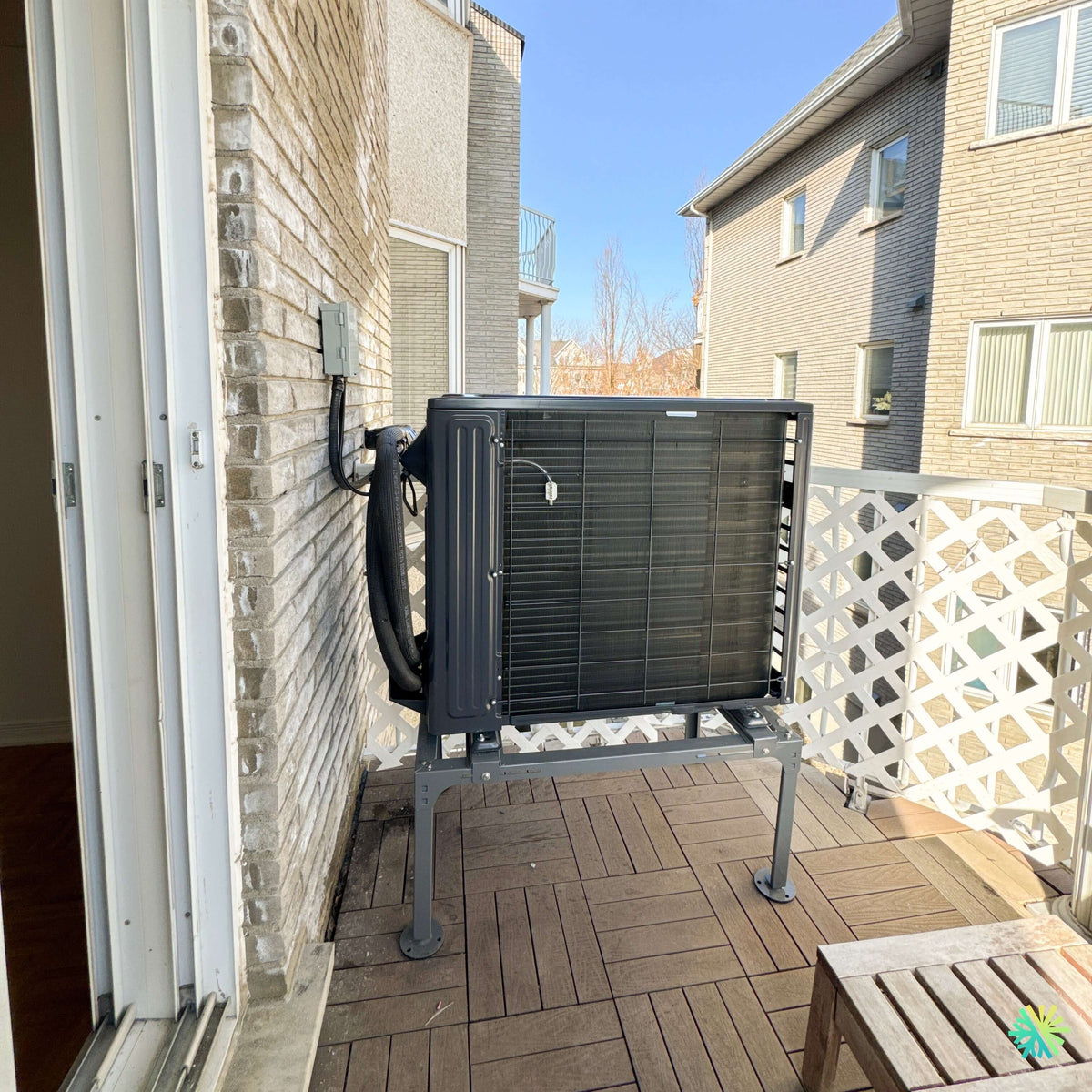
At Sainte-Marthe, we completed an installation of a MIDEA EVOX G3 central heat pump in an outdoor configuration very different from worksites where the condenser can simply be installed along a foundation. Here, the outdoor unit is positioned on a raised balcony or deck, immediately beside a door, a brick wall, and a railing, with another building located a short distance away.
The photograph of our worksite shows the back of the heat pump. The outdoor heat exchanger is fully visible, as are the insulated lines leading to the building. The unit rests on a freestanding four-legged metal support, with each leg resting on the balcony surface. An electrical disconnect is installed on the brick wall near the equipment.
This configuration appears simple once the work is complete. In reality, it requires us to consider several elements at the same time: the unit's weight, vibration transmission, clearance around the heat exchanger, movement on the balcony, access to the door, winter drainage, and the route of the refrigerant lines.
The MIDEA EVOX G3 belongs to MIDEA's range of Inverter central ducted systems, designed in particular for central heating retrofit projects and the replacement of existing equipment.
Why installing on a balcony completely changes the way we work
A heat pump installed at ground level and a heat pump installed on a deck do not present exactly the same constraints.
At ground level, we can generally work with a slab, a wall bracket, or a base above the foundation. On a balcony, we need to think more carefully about how the forces are transmitted to the structure.
In particular, we want to avoid an outdoor unit creating:
- vibrations perceptible indoors;
- resonance in the floor;
- mechanical noise amplified by the structure;
- an unnecessary concentration of load at a single point;
- an obstruction to airflow around the unit.
At this Sainte-Marthe site, the heat pump rests on a metal structure with four distinct support points. This geometry supports the unit above the ground while distributing its load across the balcony.
We must then make sure that the unit remains stable and that its position complies with the residence’s constraints.
A door right next to the heat pump: a detail not to overlook
On the left side of the photograph, a door leading onto the balcony is clearly visible.
This meant that we could not treat this area as a simple mechanical zone.
The occupants must be able to continue using the space.
The unit must therefore be positioned so that it does not turn the terrace into an area that is difficult to access. We must preserve:
- the path to the door;
- reasonable access for maintenance;
- the ability to move around the heat pump;
- the use of outdoor furniture when space allows.
This is an important part of our approach at AirGreen: an HVAC installation must work with the home, not just according to the machine’s manual.
The side visible in the photo is the heat exchanger, not the fan
This photo offers a particularly interesting viewpoint.
Here, we are primarily looking at the rear side of the outdoor unit, where the heat exchanger is located. The MIDEA EVOX G3 fan is positioned on the opposite side.
The range uses an outdoor design with horizontal discharge. MIDEA combines a horizontal fan with a vertical heat exchanger to achieve more even airflow across the exchange surface. The manufacturer indicates that this architecture is intended, among other things, to support heat exchange performance as temperatures drop.
This means that a balcony installation must be considered in both directions:
- the rear heat exchanger must be able to draw in enough air;
- the fan side must be able to discharge air without immediately encountering a significant obstacle.
In a narrow space, air recirculation becomes a real concern
The neighboring residence visible in the photograph is relatively close.
In this type of configuration, we must avoid creating an air “short circuit” in which the air expelled by the fan would return too quickly toward the heat exchanger.
A central heat pump moves a tremendous amount of outdoor air.
If airflow is unnecessarily confined, the machine may have to operate under less favorable conditions.
We therefore always examine:
- the fan orientation;
- the guardrail height;
- the distance from the walls;
- the presence of other buildings;
- possible snow accumulation;
- the way air naturally circulates through the space.
On a balcony, these details are often more important than in a completely open yard.
The refrigerant lines follow a compact route along the wall
To the left of the unit, we can see a set of insulated lines running up toward the building.
The route is relatively short and remains concentrated near the brick wall.
This is generally what we seek to achieve when a location allows for an efficient pass-through: avoiding unnecessary detours and keeping the connections grouped together.
For a central heat pump, the quality of the refrigeration circuit is essential.
Our work must include:
- the pipe diameter;
- their length;
- the elevation difference;
- proper line insulation;
- the quality of the connections;
- leak tightness;
- evacuation;
- the refrigerant charge according to the applicable requirements.
The installation visible from the outside is therefore only a small part of the actual work.
The electrical disconnect remains accessible
A disconnect switch is visible on the brick wall, right next to the outdoor unit.
Its location allows the technician to quickly access the local disconnect when an intervention is required.
In a well-organized installation, service components must remain accessible.
We therefore avoid placing permanent furniture or other landscaping elements in a way that blocks:
- the disconnect switch;
- service panels;
- refrigerant valves;
- electrical connections.
This accessibility becomes even more important when a unit is located on a balcony, where space is already limited.
EVOX G3: a central heat pump designed for heating in extreme cold
The Sainte-Marthe project is not only about summer cooling.
MIDEA documentation presents the EVOX G3 as a platform intended for heating in cold climates, with continuous operation advertised down to -30 °C. Under certain test conditions, the manufacturer indicates up to 100% heating capacity at -25 °C, with a COP of up to 1.9. MIDEA specifies that some of these figures come from a 3-ton system used for testing.
According to MIDEA, the compressor technology also uses intermediate-temperature vapor injection when conditions are very cold to increase the amount of compressed refrigerant and support heating performance.
In an area like Sainte-Marthe, this ability to keep operating at low temperatures is much more relevant than a simple summer efficiency figure.
A balcony installation must also account for defrost cycles
Winter heating brings another particularity: defrosting.
When the outdoor coil becomes covered with frost, the heat pump must periodically remove this buildup.
The water from defrosting must then go somewhere.
For a unit installed at ground level, we can generally provide space beneath the machine. On a balcony, the issue requires more attention because the water may:
- run onto the terrace;
- freeze around the support;
- create a slippery surface;
- reach a passage area;
- accumulate if natural drainage is insufficient.
This is one of the reasons why choosing the support and the exact position is particularly important.
Inverter technology that modulates capacity
The EVOX G3 is an Inverter central heat pump.
This technology allows the compressor to modulate its output according to demand rather than operating solely according to a full-power / complete-shutdown logic.
In a properly sized home, this can result in more consistent operation and better adaptation to load variations.
The heating demand of a residence is never identical throughout the season.
A day at 5 °C obviously does not require the same effort as a night at -20 °C.
Modulation allows the system to adapt much more gradually to this difference.
Up to 19 SEER2 depending on the combination
The EVOX G3 range covers several capacities.
MIDEA publishes configurations ranging approximately from 18,000 to 54,000 BTU/h in the documentation provided.
The highest published efficiencies for the range reach:
- 19 SEER2;
- 12.5 EER2;
- 10.8 HSPF2;
- COP up to 2.14 at 5 °F, or approximately -15 °C.
However, we must be very precise when citing these figures.
The MIDEA table shows that performance varies according to capacity.
For example, the documented combinations show:
- 18,000 BTU: 19 SEER2;
- 24,000 BTU: 18.6 SEER2;
- 30,000 BTU: 17.2 SEER2;
- 36,000 BTU: 17.7 SEER2;
- 48,000 BTU: 17.5 SEER2;
- 54,000 BTU: 17.5 SEER2.
Since the exact capacity of the Sainte-Marthe system cannot be read from the photo provided, we avoid arbitrarily assigning it one of these values.
Why we never guess the tonnage based on the size of the cabinet
Two heat pumps with a very similar appearance may have different capacities.
To document an installation correctly, we therefore use the indoor and outdoor model numbers.
These references make it possible to determine:
- cooling capacity;
- heating capacity;
- SEER2;
- HSPF2;
- COP;
- dimensions;
- electrical requirements;
- the applicable AHRI documentation.
This verification is particularly important for subsidy applications.
R-454B: the EVOX's new generation of refrigerant
MIDEA states that its EVOX central range uses R-454B, an A2L refrigerant with an announced global warming potential of 466.
For us, this means that the tools, service practices, and work methods must be adapted to R-454B.
When a homeowner compares quotes, it is therefore important to check that the selected company truly understands the new R-454B platforms and does not treat the equipment as a simple copy of older systems.
Behind the condenser installed on the balcony: the entire central system must be adjusted to operate as a whole
The outdoor unit is only the visible half of the installation
A MIDEA EVOX G3 central heat pump operates with an indoor air handler and a duct network.
The outdoor unit exchanges energy with the outdoor air, but actual indoor comfort also depends greatly on air circulation throughout the house.
That is why we must check:
- supply ducts;
- return-air openings;
- grilles;
- filtration;
- static pressure;
- blower settings.
Computational Constant Airflow 2.0
MIDEA uses a technology called Computational Constant Airflow 2.0 in this range.
In the brochure, the manufacturer shows an example in which the system maintains 1,200 CFM with different duct-system resistances, including between 0.4 and 1.2 in. of total static pressure in the scenarios presented.
The platform also offers up to 60 airflow adjustment levels.
This is particularly useful when we replace an old system in a house with an existing duct network.
But an intelligent blower cannot fix every problem
If a return-air opening is much too small, a duct is crushed, or several grilles are undersized, technology cannot physically eliminate these restrictions.
We must therefore always distinguish between two things:
adapting the system to the normal conditions of an existing duct network and correcting a genuinely inadequate duct network.
Proper commissioning involves measuring and adjusting, not just starting the equipment.
An indoor unit designed for several types of renovation
MIDEA designed the EVOX G3 indoor unit to facilitate certain renovations.
The documentation specifically indicates indoor compatibility with 115 V or 208/230 V, depending on the configuration, as well as widths close to several common central furnace sizes.
This approach can simplify the replacement of an old unit when a home already has a central duct network.
Up to six indoor mounting configurations
The indoor unit’s modular design allows for several orientations.
MIDEA specifically presents the following configurations:
- upflow;
- downflow;
- right horizontal;
- left horizontal;
- low-boy for spaces with limited height.
This gives us more options in basements or mechanical rooms where existing ducts strongly dictate the position of the new unit.
MERV 13 filtration available
The platform also includes a filtration module compatible with 1-, 2-, or 4-inch MERV 13 filters, depending on the installation.
Finer filtration can help capture more dust, pollen, and particles.
However, we must always check its impact on the system’s static pressure.
The best filter is not necessarily the most restrictive one that can physically be installed.
485 control, 24 V control, and wireless communication
The brochure also presents several control options, including 485 communication, 24 V control, and, for certain EVOX configurations, Sub-1 GHz wireless communication between components.
This flexibility can facilitate an upgrade when the old wiring is difficult to replace.
The final choice must nevertheless be made based on the thermostat, the indoor unit, and the level of modulation we want to maintain.
Auxiliary heating up to 25 kW depending on the configuration
MIDEA also documents auxiliary electric heating kits capable of up to 25 kW.
This maximum does not mean that a residential installation should automatically receive 25 kW.
Sizing must take into account:
- the building’s heat losses;
- the heat pump’s capacity in very cold weather;
- the available electrical capacity;
- the backup strategy.
An unnecessarily oversized auxiliary heater can significantly increase electricity demand.
Mistakes to avoid when a central heat pump must be installed on a balcony
Install the unit directly on the floor without considering vibrations
An elevated structure may require more work, but it can help organize the installation more effectively.
Neglecting defrost water drainage
An icy deck in front of a door quickly becomes a safety issue.
Obstructing the coil with furniture
The rear side visible in the photo must continue to receive sufficient airflow after installation.
Using the balcony as storage space around the unit
Boxes, covers, bicycles, and furniture must not be placed against the coil or in front of the fan.
Blocking the disconnect switch
Access to the local electrical supply must remain practical.
Forgetting that the technician will have to come back
A compact installation must not become impossible to service.
What about eligibility for rebates?
The MIDEA documentation provided describes the technical characteristics of the EVOX G3 line very precisely, but it does not, on its own, confirm eligibility for a specific Quebec financial incentive for the installation shown in the photographs.
To properly verify whether a central heat pump in Sainte-Marthe is eligible for a program such as LogisVert, it is necessary to confirm, among other things:
- the outdoor model;
- the indoor model;
- the certified combination;
- the corresponding AHRI number;
- the requirements in effect at the time of installation.
We always prefer to base the calculation on the exact combination rather than the generic name “EVOX G3.”
A project showing that a space constraint can become a very clean installation
This MIDEA EVOX G3 central heat pump project in Sainte-Marthe is interesting precisely because the location was not a large empty yard.
We had to work with:
- a relatively narrow balcony;
- a door used daily;
- a brick wall;
- a guardrail;
- a neighbouring building;
- a finished surface;
- the need to preserve future service access.
The result is an installation on an independent support, positioned to keep the unit elevated and maintain an accessible area around the system.
At AirGreen, we install central heat pumps in all kinds of configurations throughout Greater Montreal and Montérégie, including Montreal, Laval, Longueuil, the North Shore, and the South Shore.
Every project requires us to adapt the equipment to the reality of the building.
In this one, the technology of the MIDEA EVOX G3 - inverter, cold-climate heating, R-454B, and variable-airflow indoor system - was important. But the success of the project also depended on something much more concrete: installing this technology properly in an outdoor space where every square foot mattered.
The unit on this job, in figures
The range as published on airgreen.ca: pick a size to see its capacity in deep cold.
| Size | Heating at −8 °C | Heating at −15 °C | Coldest certified point | COP at −15 °C | SEER | HSPF | Indicative LogisVert aid |
|---|---|---|---|---|---|---|---|
| Midea EVOX G3 · 1.5 tons | 14,700 | 18,600 | −30 °C: 11,800 | 2.12 | 19.0 | 10.1 | $1,764 |
| Midea EVOX G3 · 2 tons | 20,800 | 20,600 | −30 °C: 12,100 | 2.14 | 18.6 | 10.0 | $2,496 |
| Midea EVOX G3 · 2.5 tons | 24,000 | 33,200 | −30 °C: 17,900 | 1.97 | 17.2 | 10.8 | $2,880 |
| Midea EVOX G3 · 3 tons | 33,000 | 37,400 | −30 °C: 27,600 | 1.9 | 18.0 | 10.0 | $3,960 |
| Midea EVOX G3 · 4 tons | 39,500 | 48,000 | −30 °C: 27,200 | 2.0 | 17.5 | 9.5 | $4,740 |
| Midea EVOX G3 · 5 tons | 45,000 | 54,000 | −30 °C: 37,300 | 1.9 | 17.5 | 9.5 | $5,400 |
Data read live from the airgreen.ca page of each size (NEEP / AHRI certified performance). When the title names the installed size, it is highlighted; otherwise the whole range is shown. The aid shown is today’s, using Hydro-Québec’s rule ($120 per 1,000 BTU/h at −8 °C); amounts quoted in the article date from its publication. Only Hydro-Québec confirms the assistance granted.
The big day, step by step
The main steps of this kind of job at AirGreen. Every house has its quirks: the estimate brings them out.
We look at the ducts, the current indoor module, the electrical panel and the planned spot for the outdoor unit.
The equipment combination, capacity and price, in writing. We check whether the combination qualifies for assistance programs.
Access protected, old unit disconnected and removed when it is being replaced.
Electric furnace or air handler, with its coil, connected to the supply and return ducts.
On a level base, raised above the snow, with free space all around.
Insulated, they enter through a sealed opening and run to the indoor coil.
Dedicated circuits, accessible disconnect, a thermostat that works with the heat pump and the backup heat.
Leak test, vacuum, start-up, airflow check and a test of both modes.
Filter, thermostat, backup heat in extreme cold: what to know before winter.
- The on-site estimateWe look at the ducts, the current indoor module, the electrical panel and the planned spot for the outdoor unit.
- The quoteThe equipment combination, capacity and price, in writing. We check whether the combination qualifies for assistance programs.
- Getting readyAccess protected, old unit disconnected and removed when it is being replaced.
- The indoor moduleElectric furnace or air handler, with its coil, connected to the supply and return ducts.
- The outdoor unitOn a level base, raised above the snow, with free space all around.
- The refrigerant linesInsulated, they enter through a sealed opening and run to the indoor coil.
- Electrical and thermostatDedicated circuits, accessible disconnect, a thermostat that works with the heat pump and the backup heat.
- Tests and start-upLeak test, vacuum, start-up, airflow check and a test of both modes.
- The walkthroughFilter, thermostat, backup heat in extreme cold: what to know before winter.
What would it look like at your place?
Two quick checks with real numbers: what heat costs, and what your current heaters add up to in BTU/h.
Baseboards and electric furnaces turn 1 kWh of electricity into 1 kWh of heat. A heat pump delivers more: that is its COP. At Hydro-Québec’s rate D (11.142¢/kWh above 40 kWh a day, since 1 April 2026):
Hydro-Québec: a heat pump can be up to three times more efficient than baseboards for heating in the colder months.
Estimate per kWh of heat, at the chosen temperature, using the certified COP from the product page. Taxes, access charge and backup heat not included.
Conversion: 1 W = 3.412 BTU/h. An indication, not a load calculation: baseboards and furnaces are often stronger than the real need, and they can stay as backup. AirGreen confirms the capacity on site.
Four mistakes we do not make
Flip each card to see what we do instead.
Your own project, step by step
What to do, season by season
Three habits per season for this unit. They take a few minutes and prevent many calls.
- Check the indoor module's filter.
- Clear winter debris from the outdoor unit.
- Test cooling before the heat arrives.
- Check the filter more often in peak season.
- Keep registers and returns clear.
- Watch condensate drainage near the coil.
- Change or clean the filter.
- Test heating and backup heat before the cold.
- Book periodic maintenance.
- Clear snow around the outdoor unit.
- Store nothing in front of the indoor module.
- Note any unusual noise or smell and call us.
Is your home ready?
Check what applies at your place. A "no" is not a refusal: it is what we sort out during the estimate.
Four statements: true or false?
It all comes down to details you have just seen.
1. A central heat pump uses the house's ducts.
It connects to the existing ducts to heat and cool everywhere.
2. In extreme cold, electric backup heat can take over.
The indoor module (furnace or air handler) works with the heat pump and takes over in extreme cold.
3. The filter only gets changed when the unit breaks down.
A dirty filter cuts airflow. It gets checked regularly.
4. You can reuse the old unit's size without checking.
The house may have changed: insulation, windows, added rooms. Capacity is confirmed on site.
0 / 4 right answers
What people ask us about this kind of work
Can I keep my current ducts?
What happens in extreme cold?
Furnace, air handler, ducted: what is the difference?
Are there grants?
Do I need a permit?
How much can I save?
How is the LogisVert assistance calculated?
Will my current thermostat work?
Central or wall units: which one?
Does AirGreen hold the required licences?
Is the estimate free?
No question matches. Write to us: we answer.
More jobs to see, near you
By town, by equipment or by region: browse more than 4,700 published projects.
Each dot: a town where AirGreen has published projects. The glowing dot: this job.
Every house has its constraints. We see them before we install.
The on-site estimate is free and the quote follows within 24 hours.
Text and photo: a real AirGreen Climatisation & Chauffage job. The diagrams are generic illustrations of the type of installation, not a survey of this job site. Sources of the added figures: airgreen.ca product pages (NEEP / AHRI performance), Hydro-Québec (Heat pumps page, LogisVert, read on 13 October 2026), Régie de l’énergie (rate D as of 1 April 2026).