
Installation of a GREE FLEXX central heat pump in Châteauguay
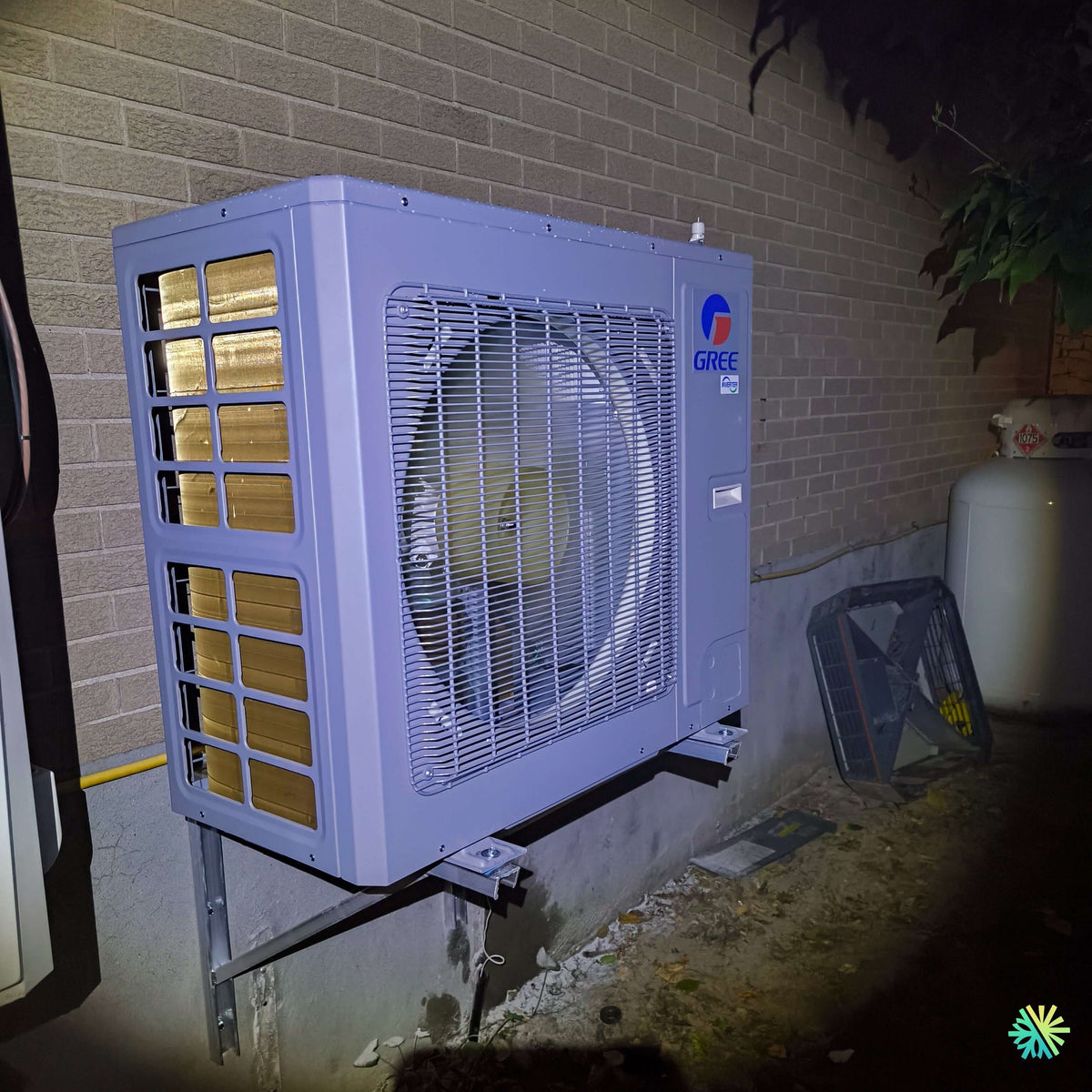
GREE FLEXX central heat pump installed in Châteauguay on a wall mount, with removal of the old condenser, integration into the ducts and subsidy support.
In summer, the outdoor unit rejects the house's heat outside.
Generic illustration of this type of installation, not a survey of this job site. Tap a number.
It captures or rejects heat outside. It sits on a level base, above the snow, with free space all around.
The insulated refrigerant lines enter the house through a sealed opening and run to the indoor coil.
A shut-off switch near the outdoor unit isolates it safely for service.
Sitting on the indoor module, it moves heat between the house air and the refrigerant.
Electric furnace or air handler: its fan pushes air through the ducts. The electric backup takes over in extreme cold.
Supply ducts bring air to the rooms; returns bring it back to the unit. Their condition matters as much as the unit's.
It protects the coil and the fan. A dirty filter cuts airflow, so it gets checked regularly.
It runs the heat pump and the backup heat. It must be compatible with the installed system.
A GREE central heat pump installed on a wall bracket to save space, limit vibrations, and prepare for winter on the South Shore
In Châteauguay, this installation of a GREE FLEXX central heat pump perfectly illustrates the type of HVAC project where the quality of the result depends as much on the chosen unit as on the precision of the outdoor installation. In the photo, we see an outdoor GREE unit solidly installed on galvanized wall brackets, against a brick wall, with the old equipment placed on the ground awaiting removal. The context was typical of many South Shore residences: limited side space, existing equipment nearby, a foundation to respect, and the need for a central system capable of ensuring comfort for both heating and cooling.
At AirGreen, we approached this project as a complete HVAC installation, not just a simple replacement of an outdoor condenser. A central heat pump must work with the entire house: ducts, air return, airflow, thermostat, insulation, electrical supply, outdoor positioning, noise, winter defrosting, and accessibility for HVAC maintenance. Every detail influences the system's actual performance.
The project context in Châteauguay: replacing old equipment without compromising clearances
The owner wanted to modernize their central system to achieve more stable air conditioning in summer and effective heating during colder months. The old unit, visible on the right of the image, had reached a stage where replacement made more sense than repeated repairs. The goal was not only to install a new machine in the same place but to correct several important points: height from the ground, airflow, noise level, service access, and protection against snow accumulation.
The brick exterior wall and concrete base provided a good structure for a bracket installation, but this choice required meticulous preparation. Our technicians validated the anchor points, alignment, support strength, and unit level. A poorly leveled outdoor unit can generate vibrations, accelerate the wear of certain components, and hinder drainage during defrost cycles. In this project, the wall installation allowed the central heat pump to be kept cleaner, better clear of the ground, and less exposed to leaves, mud, and snowbanks.
Why a GREE FLEXX for this central installation
The GREE FLEXX range is particularly well-suited for residential projects where an existing duct network needs to be maintained or adapted. According to the manufacturer's data, FLEXX systems combine inverter technology, horizontal discharge, compatibility with conventional 24V thermostats, performance up to 17 SEER2 and 10.5 HSPF2 depending on the pairing, and heating operation down to -22°F, or about -30°C.
This configuration is interesting for a Châteauguay residence because it allows the heat pump to be integrated into an existing central system while maintaining familiar air distribution in the rooms. Rather than adding multiple wall units, the customer benefits from comfort distributed through ducts, with a single, well-positioned outdoor unit.
Another point visible in the image is the presence of an outdoor exchanger with golden fins. GREE indicates that FLEXX outdoor units are equipped with a Golden Fin treatment, an appreciated feature in environments where humidity, temperature variations, and outdoor contaminants can accelerate coil wear. For an installation on the South Shore, where winters are humid, thaws are frequent, and ice accumulations are sometimes unpredictable, this protection contributes to the system's durability.
An outdoor installation designed for winter, noise, and maintenance
The decision to mount the GREE FLEXX on the wall was not made solely for aesthetics. In several projects in Montreal, Laval, Longueuil, on the North Shore, and on the South Shore, we still see outdoor units installed too low, directly on small unstable slabs or in areas where snow eventually blocks airflow. This reduces efficiency, forces the compressor to work harder, and complicates service interventions.
Here, the unit's height allows for better clearance underneath the machine. The metal supports were fixed to distribute weight and limit movement. Stable support points and proper leveling reduce vibrations transmitted to the building. This is particularly important with a central heat pump installed near a brick wall, as a neglected installation can produce resonances inside the house.
The lateral discharge of this GREE unit is also an advantage in a narrower exterior passage. Unlike some traditional top-discharge units, this type of design can facilitate integration near a wall, provided the manufacturer's recommended clearances are respected. Our technicians therefore positioned the unit taking into account air intake, air discharge, service panel access, and neighboring equipment.
Handling refrigerant lines and electrical supply
A GREE central heat pump installation is not limited to fixing the outdoor unit. Refrigerant lines must be routed cleanly, protected, and carefully insulated. Poor line insulation can lead to efficiency losses, condensation, or premature degradation of the insulation. On this type of project, we pay particular attention to bends, wall penetrations, and mechanical protection of exposed sections.
During commissioning, our teams perform essential technical steps: connection verification, tightening checks, leak testing, vacuum pull-down, charge validation according to manufacturer requirements, and then controlled startup. These steps are not spectacular in a photo, but they make all the difference between an installation that simply works initially and one that maintains its performance season after season.
The electrical supply must also be adapted to the equipment's capacity. For a central HVAC installation, we check the circuit breaker, wiring, outdoor disconnect, grounding, and compliance of connections. A modern heat pump with an inverter compressor must receive a stable power supply to operate correctly.
Interior integration: the step many owners underestimate
Even though the image mainly shows the outdoor unit, the success of a central heat pump also depends on the interior. The system must be correctly paired with the evaporator, air handler, or existing furnace depending on the house's configuration. A capacity of 24,000, 36,000, 48,000, or 60,000 BTU should never be chosen solely based on the old unit. GREE Canada also presents its central systems with different capacities, notably 24,000, 36,000, 48,000, and 60,000 BTU, which shows the importance of a choice adapted to the residence.
In this project in Châteauguay, we paid particular attention to airflow and ductwork compatibility. A central system that is too powerful for existing ducts can create noise, excessive static pressure, and uncomfortable cycles. Conversely, an undersized system may run too long without reaching the desired comfort level on very cold or very hot days.
We also check the filter condition, air returns, registers, the cleanliness of certain sections, and the thermostat's ability to manage heating and cooling correctly. The GREE FLEXX central heat pump, being compatible with 24V controls depending on the configuration, can often integrate efficiently into existing installations, reducing intrusive work inside the house.
Grants and eligibility: a check to make before finalizing the project
For homeowners in Châteauguay and the surrounding areas, eligibility for financial assistance programs is often part of the decision. Hydro-Québec indicates that the LogisVert program can offer financial assistance of up to $6,700 for the purchase of an ENERGY STAR heat pump, subject to applicable conditions.
In a project like this, the exact amount is not determined by the brand alone. It depends on the indoor-outdoor pairing, the AHRI number, the recognized heating capacity, the requirements of the current program, and the unit's status on the eligible list. At AirGreen, we support our clients with the necessary information: model numbers, detailed invoice, proof of installation, photos if needed, and advice on the application. This step avoids a common mistake: buying a high-performance heat pump without checking if the complete pairing is eligible.
What this installation in Châteauguay teaches homeowners in Montreal, Laval, Longueuil, North Shore, and South Shore
Mistakes to avoid before installing a central heat pump
Many problems we correct in the field could have been avoided during planning. The most common mistakes are:
- Choosing BTU capacity based only on the old air conditioner, without considering heating needs.
- Installing the outdoor unit too close to the ground, which increases the risk of obstruction by snow.
- Neglecting clearances around the machine, especially in narrow side passages.
- Forgetting to check the static pressure and airflow of the duct network.
- Underestimating the importance of solid, well-leveled support.
- Postponing subsidy verification until after purchase, when the exact pairing should be validated.
- Entrusting the installation to a team that does not document commissioning tests.
This GREE central heat pump installation in Châteauguay highlights the importance of clean, stable, and thoughtful work. The unit is clear, accessible, well-supported, and positioned to respect site constraints. The old equipment has been decommissioned, and the new configuration allows the owner to benefit from a modern central system without further cluttering the outdoor space.
Practical tips for extending system life
After an installation like this, we recommend keeping the area around the unit free of leaves, branches, compacted snow, and stored objects. Even an excellent central heat pump loses efficiency if its air exchanger is obstructed. The indoor filter should also be checked regularly, as a clogged filter reduces airflow and can negatively impact system performance.
Annual HVAC maintenance is highly recommended. During this maintenance, we inspect the coils, electrical connections, drains, operating pressures, supply and return temperatures, and the overall condition of the outdoor unit. For a wall-mounted installation, we also check the fastenings, level, and signs of abnormal vibration.
AirGreen's approach to central installations
At AirGreen, we install central heat pumps, central air conditioners, multi-zone systems, and complete HVAC solutions in Montreal, Laval, Longueuil, on the North Shore, and on the South Shore. Our advantage lies in a clear method: evaluating the building, recommending suitable equipment, installing with rigor, documenting technical information, and explaining to the client how to use their system effectively.
The Châteauguay project demonstrates exactly this approach. We took into account the available space, the brick wall, the old equipment, clearance constraints, and the desired performance. The installed GREE FLEXX offers a discreet, well-integrated central solution adapted to the region's climatic realities.
For an owner comparing several options, this installation reminds them of one essential thing: the best heat pump is not just the one with good technical characteristics. It's the one that is correctly chosen, well-matched, solidly installed, and maintained by a team that understands the details of the field.
How it goes, from the first call to the end
The main steps of this kind of job at AirGreen. Every house has its quirks: the estimate brings them out.
We look at the ducts, the current indoor module, the electrical panel and the planned spot for the outdoor unit.
The equipment combination, capacity and price, in writing. We check whether the combination qualifies for assistance programs.
Access protected, old unit disconnected and removed when it is being replaced.
Electric furnace or air handler, with its coil, connected to the supply and return ducts.
On a level base, raised above the snow, with free space all around.
Insulated, they enter through a sealed opening and run to the indoor coil.
Dedicated circuits, accessible disconnect, a thermostat that works with the heat pump and the backup heat.
Leak test, vacuum, start-up, airflow check and a test of both modes.
Filter, thermostat, backup heat in extreme cold: what to know before winter.
- The on-site estimateWe look at the ducts, the current indoor module, the electrical panel and the planned spot for the outdoor unit.
- The quoteThe equipment combination, capacity and price, in writing. We check whether the combination qualifies for assistance programs.
- Getting readyAccess protected, old unit disconnected and removed when it is being replaced.
- The indoor moduleElectric furnace or air handler, with its coil, connected to the supply and return ducts.
- The outdoor unitOn a level base, raised above the snow, with free space all around.
- The refrigerant linesInsulated, they enter through a sealed opening and run to the indoor coil.
- Electrical and thermostatDedicated circuits, accessible disconnect, a thermostat that works with the heat pump and the backup heat.
- Tests and start-upLeak test, vacuum, start-up, airflow check and a test of both modes.
- The walkthroughFilter, thermostat, backup heat in extreme cold: what to know before winter.
And at your place?
Two quick checks with real numbers: what heat costs, and what your current heaters add up to in BTU/h.
Conversion: 1 W = 3.412 BTU/h. An indication, not a load calculation: baseboards and furnaces are often stronger than the real need, and they can stay as backup. AirGreen confirms the capacity on site.
What to do, season by season
Three habits per season for this unit. They take a few minutes and prevent many calls.
- Check the indoor module's filter.
- Clear winter debris from the outdoor unit.
- Test cooling before the heat arrives.
- Check the filter more often in peak season.
- Keep registers and returns clear.
- Watch condensate drainage near the coil.
- Change or clean the filter.
- Test heating and backup heat before the cold.
- Book periodic maintenance.
- Clear snow around the outdoor unit.
- Store nothing in front of the indoor module.
- Note any unusual noise or smell and call us.
Which type of equipment for your project?
Pick what looks like your need.
Four mistakes we do not make
Flip each card to see what we do instead.
What people ask us about this kind of work
Can I keep my current ducts?
What happens in extreme cold?
Furnace, air handler, ducted: what is the difference?
Are there grants?
Do I need a permit?
How much can I save?
How is the LogisVert assistance calculated?
Will my current thermostat work?
Central or wall units: which one?
Does AirGreen hold the required licences?
Is the estimate free?
No question matches. Write to us: we answer.
Useful pages for what comes next
More jobs to see, near you
By town, by equipment or by region: browse more than 4,700 published projects.
Each dot: a town where AirGreen has published projects. The glowing dot: this job.
Tell us about your house. We come and see it for free.
The on-site estimate is free and the quote follows within 24 hours.
Text and photo: a real AirGreen Climatisation & Chauffage job. The diagrams are generic illustrations of the type of installation, not a survey of this job site. Sources of the added figures: airgreen.ca product pages (NEEP / AHRI performance), Hydro-Québec (Heat pumps page, LogisVert, read on 13 October 2026), Régie de l’énergie (rate D as of 1 April 2026).