
Installation of a GENERAL ELECTRIC Zoneline PTAC under a window in Upton, Montérégie
AirGreen installs a GENERAL ELECTRIC Zoneline PTAC beneath a window in Upton: checking the wall sleeve, sealing, electrical circuit, airflow, and A2L refrigerant safety.
Generic illustration of this type of installation, not a survey of this job site. Tap a number.
All-in-one: it heats and cools from inside the room, with no separate outdoor unit.
A box that goes through the wall and holds the unit. It is installed following the manufacturer's instructions so water drains to the outside.
This is where the unit exchanges heat with the outdoor air. It must stay clear.
A dedicated connection matched to the unit's voltage and amperage.
On the unit or through a wall thermostat, depending on the model.
Under a window, the unit must leave curtains, sill and opening free, and let air move through the room.
A compact installation where every detail of the wall opening mattered
In Upton, we carried out the installation of a GENERAL ELECTRIC Zoneline PTAC in a wall opening created directly beneath a window. This type of configuration is common in apartments, homes, hotels, small rental buildings, and buildings where adding ventilation ducts or a separate outdoor unit would be difficult.
A PTAC, or packaged terminal air conditioner, combines the main components needed for air conditioning and, depending on the model's exact configuration, heating in a single cabinet. Part of the unit remains indoors, while the rear communicates with the outdoors through a wall sleeve. This design makes it possible to heat or cool a room without a duct network and without a separate condenser installed on a slab or wall bracket.
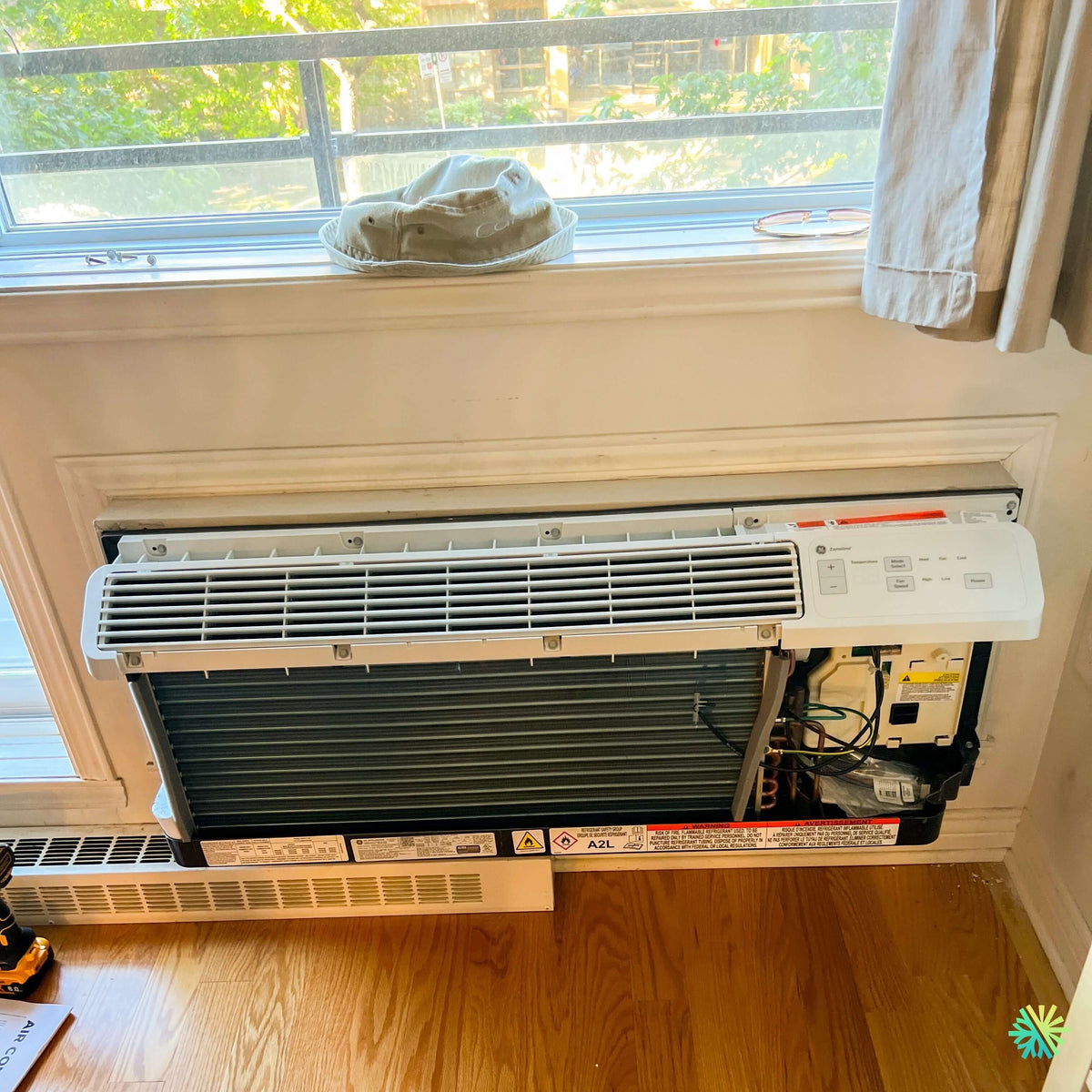
At this Upton site, the challenge was not simply to slide the unit into an opening. We had to verify the integration of the GENERAL ELECTRIC Zoneline with the window, wood finish, wall sleeve, electrical system, baseboard heater located beneath the unit, and the clearances required for air circulation.
What the unit shows during our work
The photograph was taken while the front panel was removed to allow for inspection and commissioning. This step provides access to several components normally concealed behind the front panel:
- the indoor coil;
- the upper air outlet grille;
- the GENERAL ELECTRIC Zoneline control panel;
- the side electrical compartment;
- the internal copper lines;
- the grounding connections;
- the technical labels and safety warnings;
- the surfaces that must be inspected before final closure.
The temporary removal of the front panel therefore does not mean that the installation is unfinished. It allows our technicians to check the condition of the coil, the frame fastening, cable routing, sensor positions, and the absence of abnormal contact between components that could produce vibration.
A window-level position requiring precise inspection
The available space was immediately beneath a large window, within an existing wooden frame. This configuration imposed several constraints.
First, we had to ensure that the upper part of the PTAC did not block the window or its opening mechanism. The air outlet is also located in the upper part of the unit. A sill that is too deep, a curtain that is too long, or a covering installed too close to the grille could deflect warm or cool air toward the window instead of distributing it throughout the room.
In this project, we paid particular attention to the following elements:
- The space between the PTAC and the windowsill, to maintain effective airflow.
- Protection of the trim and painted surfaces around the opening.
- Alignment of the chassis in the wall sleeve, to prevent mechanical stress.
- Future access to the filter and control panel.
- Proper closure of the front panel, without pressure on the internal pipes or wires.
A slightly off-center unit may seem acceptable at first glance, but later cause vibrations, rattling from the casing, or a front panel that is difficult to remove. We therefore aim for a stable, accessible result that is visually consistent with the room.
The presence of a baseboard heater beneath the PTAC
A baseboard heater is directly visible beneath the unit. This proximity had to be taken into consideration during installation and testing.
A baseboard heater creates an upward flow of warm air. If it operates simultaneously with a PTAC, it can influence the temperature reading near the unit. In some configurations, the warm air rising toward the PTAC sensor can make it believe that the room is warmer than it actually is.
We therefore verified that:
- the PTAC air intake was not obstructed;
- the front panel could be installed without coming into contact with the baseboard heater;
- the baseboard heater’s heat would not risk damaging any component;
- both units could be used in accordance with the building’s needs;
- the occupants understood the possible effect of two separately controlled heating sources.
In an installation similar to Montréal, Laval, Longueuil, the North Shore, or the South Shore, we always assess the existing heat sources before configuring a new unit. A baseboard heater, hot-water radiator, or convector located beneath a thermostat can affect HVAC system behavior.
The wall sleeve: an often-underestimated component
The sleeve is the metal structure that passes through the wall and receives the PTAC chassis. It plays an essential role in the installation's structural integrity, the building's watertightness, and water drainage.
Before inserting a new GENERAL ELECTRIC Zoneline, the following must be checked:
- the sleeve's interior dimensions;
- its compatibility with the chassis;
- its structural condition;
- the presence of corrosion;
- the quality of the exterior grille;
- the sealing around the perimeter;
- the slope specified by the manufacturer;
- the attachment points;
- the absence of insulating materials that would block exterior ventilation.
A common mistake is to assume that all PTACs have exactly the same dimensions. Several units use similar formats, but a difference of a few millimeters or an incompatible exterior grille can reduce condenser airflow.
An exterior air restriction increases operating pressure, noise, and electricity consumption. It can also cause protective shutdowns or reduce the compressor's service life.
Special attention to sealing
An opening intended for a PTAC passes completely through the building envelope. Poor sealing can create:
- cold air infiltration;
- water entering during wind-driven rain;
- condensation in the wall;
- a loss of comfort near the unit;
- an increase in energy consumption;
- an entry point for insects.
We therefore inspect the sleeve perimeter, seals, interior finish, and exterior junction. The goal is not to trap water inside the sleeve, but to block infiltration around it while respecting the drainage designed by the manufacturer.
A simple, accessible control panel
The control panel visible on the right includes temperature, mode, and fan speed selections. The Heat, Fan, and Cool indicators allow the occupant to choose the operation that suits their needs.
However, the exact heating function depends on the model's complete suffix: some Zoneline units use a heat pump with auxiliary heat, while other configurations may primarily use electric resistance heating. The nameplate remains the reference for confirming:
- the capacity in BTU/h;
- the supply voltage;
- the electrical current;
- the heating type;
- the heating element's power;
- the refrigerant;
- the full model;
- the serial number.
The exact capacity must never be determined solely from the unit’s exterior appearance. Two nearly identical chassis may have different capacities and electrical requirements.
A clearly visible A2L label
The safety label located at the bottom of the unit indicates the presence of an A2L-category refrigerant. This classification refers to a refrigerant with low toxicity and reduced flammability, but which still requires precise work procedures.
This information is important for future maintenance. A technician must not puncture a refrigeration circuit, perform a repair, or use a leak-detection method without considering the exact type of refrigerant.
At AirGreen, we place particular importance on the following points:
- identification of the refrigerant before any work is performed;
- adequate ventilation of the work area;
- use of compatible tools;
- control of ignition sources;
- proper refrigerant recovery;
- compliance with the manufacturer’s instructions;
- work performed by trained personnel.
The A2L label visible on this GENERAL ELECTRIC Zoneline PTAC is therefore important technical information, both for the initial installation and for future repairs.
What This Upton Installation Can Teach Owners and Property Managers
Why Choose a Zoneline PTAC
A PTAC is particularly useful when a building has no ductwork and each room must be controlled separately. It provides a compact installation without a separate outdoor unit connected by refrigerant lines.
The sought-after advantages include:
- individual temperature control;
- relatively straightforward replacement when the sleeve is compatible;
- no duct network;
- front access for maintenance;
- a solution suited to apartments and individual rooms;
- a unit that combines several functions in a single cabinet.
The GENERAL ELECTRIC Zoneline is particularly well suited to projects where outdoor space is limited or where the façade already has openings designed for this type of equipment.
Limitations to consider before purchasing
The PTAC is not automatically the best solution for every building. Since the compressor and fans are located in the same chassis as the indoor section, the sound level perceived in the room may be higher than that of a wall-mounted heat pump whose compressor is installed outdoors.
The following must also be considered:
- the precise model’s energy efficiency;
- the available capacity at low temperatures;
- the quality of the wall insulation;
- the room size;
- the glazed area;
- the building’s orientation;
- the presence of another heat source;
- electrical compatibility;
- the home’s ventilation requirements.
In Upton, the large window above the unit represents a significant thermal load. The glass can increase heat gain in summer and heat loss in winter. Sizing must therefore not be based solely on floor area.
The most common mistakes when replacing a unit
Choosing the unit based only on the exterior dimensions
A chassis that physically fits into the sleeve is not necessarily compatible with the existing outdoor grille or electrical supply.
Reusing a damaged sleeve
Corrosion, deformation, or an inadequate slope can cause water infiltration and vibrations.
Neglecting the electrical circuit
The voltage, circuit rating, plug, protection, and maximum current must match the information on the nameplate.
Blocking the air outlet with a curtain
In the photo, the curtain is near the unit. It must remain sufficiently far from the grille when the PTAC is operating. A curtain drawn toward the unit or placed in front of the air outlet reduces air distribution in the room.
Forgetting about filter access
The filter must be removable and cleanable without removing the window frame or moving heavy furniture.
Our commissioning procedure
Once the unit is positioned and connected, we do not limit ourselves to checking whether it starts. Our commissioning includes several checks:
- Checking the power supply.
- Visually inspecting the electrical compartment.
- Confirming that the chassis is securely fastened and stable.
- Testing the fan at the available speeds.
- Testing the cooling mode.
- Testing the heating mode specified for the model.
- Checking for noises and vibrations.
- Checking condensate drainage.
- Inspecting the outdoor airflow.
- Reinstalling the front panel and filter.
We also observe the unit’s behavior over several cycles. An intermittent metallic noise, a poorly positioned sensor, or a vibrating panel may not be apparent during the first few seconds.
Recommended maintenance to preserve performance
A PTAC filter should be inspected regularly, especially during periods of heavy use. In a home occupied daily, a monthly inspection is a good practice. The frequency should be increased when there are pets, dust, construction work, or commercial use.
Maintenance includes, among other things:
- cleaning the filter;
- inspecting the indoor coil;
- removing dust from the grille;
- checking the drainage;
- checking the exterior grille;
- inspecting the seals around the sleeve;
- listening for unusual vibrations;
- checking that the controls are operating properly.
A severely clogged filter reduces airflow and can cause frost to form on the coil during cooling. It can also increase operating time and make the temperature less uniform.
Rebates and eligibility
A PTAC is not automatically eligible for the same programs as a cold-climate-certified wall-mounted heat pump. Eligibility depends on the complete model number, the equipment certification, its performance, and the program conditions in effect when the application is submitted.
Before submitting an application, you must keep:
- the detailed invoice;
- the model number;
- the serial number;
- photos of the rating plate;
- proof of installation;
- the manufacturer's technical documents.
We always recommend checking eligibility before purchasing rather than assuming that a unit will be accepted because it offers a heating mode.
An HVAC installation adapted to the building, not just the equipment
This installation in Upton is a good example of our work method. We assess the PTAC, but also everything around it: the window, trim, baseboard heater, wall opening, electrical supply, drainage, filter access, and usage habits.
The same level of care applies to our installations of heat pumps, wall-mounted air conditioners, and central systems in Montreal, Laval, Longueuil, the North Shore, and the South Shore. A reliable HVAC installation depends as much on the quality of the integration as on the choice of equipment.
In this project, the GENERAL ELECTRIC Zoneline was properly integrated beneath the window, with clear access to the controls and service components. The inspection carried out with the front panel removed allowed us to confirm the chassis stability, the organization of the internal connections, and the conditions required for safe operation.
How it goes, from the first call to the end
The main steps of this kind of job at AirGreen. Every house has its quirks: the estimate brings them out.
We look at the outside wall, the window, the space in the room and the power supply.
The unit, the sleeve and the price, in writing.
Installed following the manufacturer's instructions, so water drains to the outside.
A dedicated connection matched to the unit's voltage and amperage.
The unit slides into the sleeve; the outdoor grille stays clear.
Start-up and a check of heating and cooling.
Controls, filter, what to keep clear.
- The on-site estimateWe look at the outside wall, the window, the space in the room and the power supply.
- The quoteThe unit, the sleeve and the price, in writing.
- The wall sleeveInstalled following the manufacturer's instructions, so water drains to the outside.
- The electrical workA dedicated connection matched to the unit's voltage and amperage.
- Unit and grilleThe unit slides into the sleeve; the outdoor grille stays clear.
- TestsStart-up and a check of heating and cooling.
- The walkthroughControls, filter, what to keep clear.
What to do, season by season
Three habits per season for this unit. They take a few minutes and prevent many calls.
- Clean the filter.
- Clear the outdoor grille.
- Test cooling.
- Clean the filter more often.
- Check water drainage.
- Let air move in front of the unit.
- Test heating.
- Check the seal around the sleeve.
- Book maintenance.
- Keep the outdoor grille free of snow.
- Do not cover the unit with a curtain.
- Note any unusual noise.
Which type of equipment for your project?
Pick what looks like your need.
Four mistakes we do not make
Flip each card to see what we do instead.
What people ask us about this kind of work
What is a PTAC?
Where does it go?
What does it need electrically?
Can the existing sleeve be reused?
Does a PTAC cool the whole house?
Does AirGreen hold the required licences?
Is the estimate free?
No question matches. Write to us: we answer.
Useful pages for what comes next
More jobs to see, near you
By town, by equipment or by region: browse more than 4,700 published projects.
Each dot: a town where AirGreen has published projects. The glowing dot: this job.
Tell us about your house. We come and see it for free.
The on-site estimate is free and the quote follows within 24 hours.
Text and photo: a real AirGreen Climatisation & Chauffage job. The diagrams are generic illustrations of the type of installation, not a survey of this job site. Sources of the added figures: airgreen.ca product pages (NEEP / AHRI performance), Hydro-Québec (Heat pumps page, LogisVert, read on 13 October 2026), Régie de l’énergie (rate D as of 1 April 2026).