
Installation of a TRANE ProSpace PTAC unit in Saint-Pie beneath a window with existing baseboard heating
In Saint-Pie, AirGreen installs and inspects a TRANE ProSpace PTAC beneath a window, with attention paid to dust, the sleeve, drainage, baseboard heating, and the electrical supply.
- City
- Region
- Equipment
- Brand
- Challenges
- Published
The job on one screen
The article, chapter by chapter
Replacing an aging wall-mounted unit without unnecessarily modifying the opening, window, or room layout
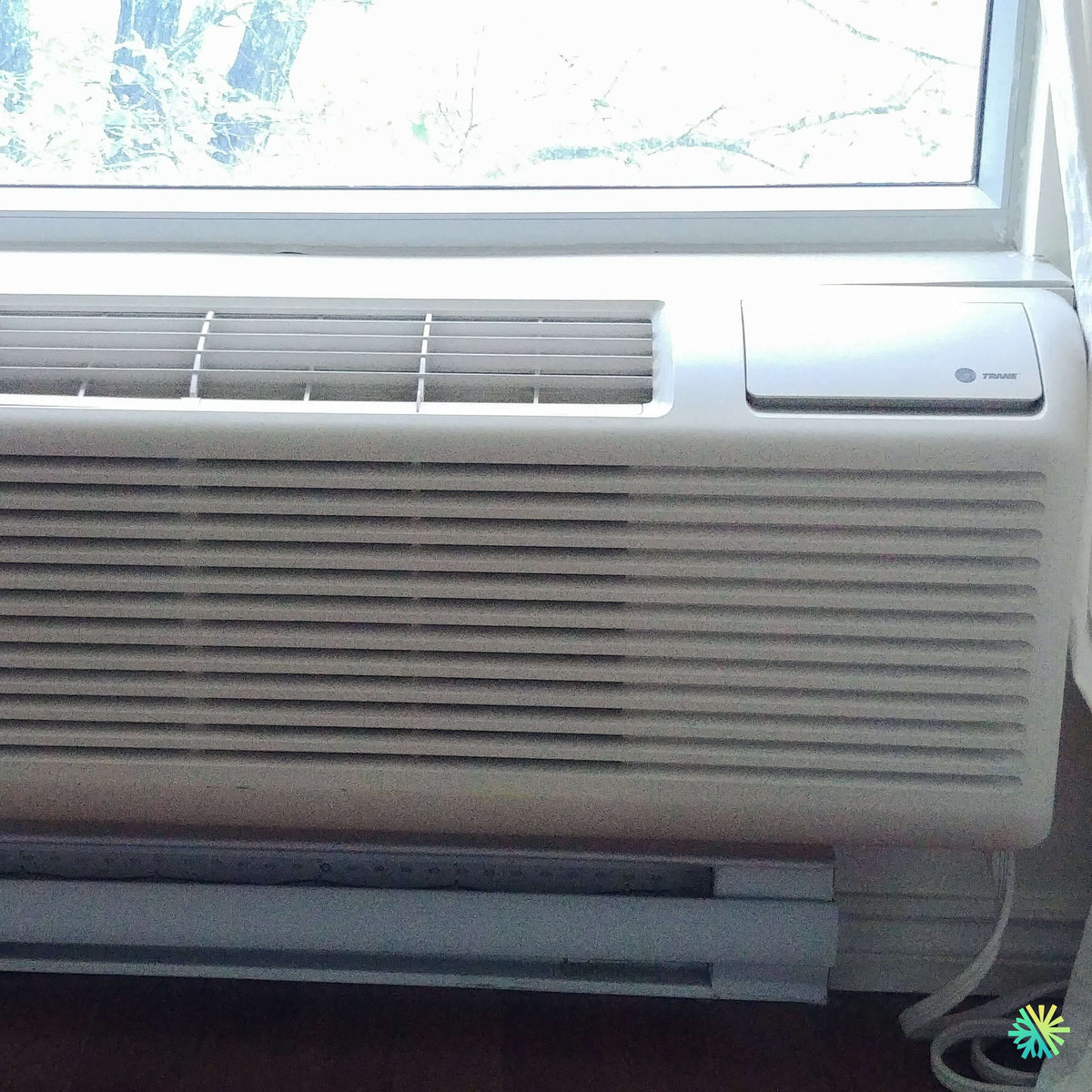
At Saint-Pie, we worked in a room equipped with a wall-mounted unit of the TRANE ProSpace PTAC type, installed directly beneath a large window. The configuration presented several technical factors to consider: a sleeve passing through the exterior wall, a baseboard heater located beneath the unit, a visible power supply on the right side, and limited space between the unit cabinet and the window frame.
The project photo also shows equipment with a notable amount of dust accumulated on its supply grille and front panel. This detail is important: on a PTAC, visible deposits on the outside often indicate that a more thorough inspection of the filter, indoor coil, blower wheel, and drainage system is warranted.
Our work therefore involved more than simply positioning a TRANE ProSpace in a wall opening. We had to ensure that the entire system could operate properly in its actual environment, without restricted airflow, infiltration around the sleeve, or problematic interaction with the electric baseboard located immediately beneath the unit.
This installation in Saint-Pie is representative of the projects we carry out in homes, residences, multi-unit buildings, and small commercial areas in Montréal, Laval, Longueuil, the North Shore, and the South Shore. A PTAC remains a practical solution, but its apparent simplicity should not obscure the mechanical, electrical, and thermal requirements that determine its performance.
Why the TRANE ProSpace was suitable for this installation
The TRANE ProSpace is a self-contained terminal unit designed to cool a specific room or zone. Unlike a central heat pump, it does not require a duct network to distribute air throughout multiple rooms.
The cabinet is installed in a sleeve passing through the wall. The indoor section draws in and conditions the room air, while the rear section exchanges heat with the outdoors. This design combines several functions in a single compact unit.
In this room in Saint-Pie, the PTAC had to meet specific requirements:
- the existing wall opening had to be preserved;
- the window above was not to be modified;
- the upper wall had to remain clear;
- no ductwork was available;
- the occupant had to be able to control the temperature directly in the room;
- maintenance had to remain accessible from inside;
- the existing baseboard heating had to be taken into consideration.
The ProSpace line includes different configurations. Depending on the complete model number, a unit may provide air conditioning, electric heating, or heat pump operation with supplemental heating.
The BTU capacity, voltage, amperage, and performance data cannot be confirmed solely from the visible façade in the photo. Before placing any order or replacing the unit, we therefore record the information shown on the nameplate.
An inspection that begins with the unit’s actual condition
Dust accumulated on the upper air outlet was one of the first visible elements. It is not merely an aesthetic issue.
A PTAC continuously draws ambient air through its large front grille. Particles trapped by the filter can gradually reach other components when cleaning is delayed or the filter is no longer properly positioned.
Components to check when dust is present
During our inspection, we pay particular attention to the following components:
- air filter;
- indoor heat exchanger;
- fan wheel or blower;
- air discharge louvers;
- condensate pan;
- drain openings;
- electrical harness;
- rear section of the cabinet;
- outdoor grille.
Accumulation on the heat exchanger restricts airflow. Even when the fan is running, the actual volume distributed into the room may be insufficient.
The unit may then exhibit several symptoms:
- extended operation;
- uneven temperature;
- low airflow;
- increased noise;
- slow cooling;
- increased electricity consumption;
- frost formation;
- odors at startup.
Cleaning the façade is not enough when deposits have reached the internal components. A complete HVAC maintenance service must be adapted to the condition of the unit and performed without damaging the heat exchanger fins or electrical connections.
The opening beneath the window had to remain watertight
Positioning the unit beneath a window is common for PTACs. It makes use of a section of wall rarely occupied by tall furniture and directs the air toward the center of the room.
However, this position creates a sensitive area in the building envelope. The window, the PTAC sleeve, and the surrounding seals are located very close to one another.
We therefore inspect:
- the connection between the sleeve and the wall;
- the upper corners of the opening;
- the condition of the exterior sealant;
- the signs of moisture;
- the cracks;
- the insulation around the sleeve;
- the alignment of the cabinet;
- the presence of drafts.
A small gap around the sleeve can cause significant discomfort during Quebec winters. Cold air does not need to pass through the unit itself: it can simply pass between the metal frame and the wall.
In summer, an infiltration of hot, humid air increases the cooling load. It can also cause condensation on cold surfaces near the opening.
Sleeve compatibility cannot be determined with a tape measure alone
When replacing an old PTAC, many homeowners assume that a new unit will fit as long as its width and height roughly match the opening.
This method is insufficient.
The sleeve must be suitable for the configuration of the TRANE ProSpace, particularly the arrangement of the outdoor-side air inlets and outlets. A poor combination of the unit, sleeve, and rear grille can cause recirculation of the discharged hot air.
The system then draws in some of its own heat instead of using outdoor air efficiently. Possible consequences include:
- reduced cooling capacity;
- higher operating temperature;
- protective shutdowns;
- compressor wear;
- increased energy consumption;
- unstable performance on hot days.
The points we validate before installation
We specifically check:
- the interior dimensions of the sleeve;
- its depth;
- its structural condition;
- the attachment points;
- the compatibility of the exterior grille;
- the presence of the required air separators;
- the recommended slope;
- the space required to remove the unit.
A rusty or deformed sleeve should not be kept solely because it still allows the cabinet to be inserted. The support must remain rigid and durable.
Essential condensate management above the baseboard heater
In cooling mode, moisture removed from the air turns into water. This water is collected in the lower section of the PTAC before being drained or managed according to the model's design.
In this Saint-Pie installation, the presence of a baseboard heater directly beneath the unit made any leak particularly concerning.
Water flowing onto an electric baseboard heater can:
- accelerate corrosion;
- produce stains;
- damage the wall;
- reach the floor;
- create an electrical hazard;
- cause odors when the heating is operating.
We therefore check that the condensate pan is clean, that the water passages are clear, and that the sleeve follows the required orientation.
The PTAC must not be tilted improvisedly. Excessive slope can move water toward an unintended area, deform the seals, or make the cabinet unstable. A slope toward the interior increases the risk of leakage into the room.
Baseboard heating beneath the PTAC: two systems to coordinate
The photo clearly shows an electric baseboard heater installed beneath the TRANE ProSpace. This configuration is common in buildings where the existing electric heating was retained when an air-conditioning unit was added or replaced.
The baseboard heater can serve different roles:
- primary heating;
- supplementary heating;
- takes over at low temperatures;
- independent system controlled by its own thermostat.
The presence of both pieces of equipment is not necessarily problematic, but their settings must be consistent.
Avoiding conflicting operation
When the baseboard heater operates while the PTAC is cooling, consumption increases without improving comfort. The unit attempts to remove heat produced just a few centimeters below its cabinet.
This situation can occur when:
- the baseboard heater thermostat remains set too high;
- the occupant changes the PTAC mode without adjusting the heating;
- the controls for the two units are located in different places;
- the temperature near the wall does not match the temperature in the center of the room.
We therefore recommend establishing a clear operating method. During the cooling season, the baseboard heater thermostat should be adjusted to prevent unnecessary operation. During the heating season, the respective roles of the two systems should be defined according to the capabilities of the installed model.
Rising heat can affect the PTAC sensor
The warm air produced by a baseboard heater naturally rises along the wall. Since the PTAC is located directly above it, its sensor may detect a higher temperature than the one felt elsewhere in the room.
This can cause the PTAC heating to shut off prematurely or the air conditioning to start more frequently.
When commissioning the unit, we therefore observe its behavior under the room’s actual conditions, rather than only during a test lasting a few seconds.
An air outlet immediately below the window
The long grille on the upper part of the TRANE ProSpace distributes treated air. Its orientation is important because the window is generally a warmer surface in summer and a colder one in winter than the rest of the wall.
Directing some of the airflow toward the glazed area can help reduce discomfort near the window. However, you must prevent air from becoming trapped between the PTAC and a curtain, blind, or excessively deep sill.
In this installation, the air outlet had to remain completely clear. No object was to be placed on top of the cabinet.
Common mistakes include:
- place clothing on the unit;
- install a curtain hanging down over the grille;
- place a shelf too close to the outlet;
- use the top as a storage surface;
- block the louvers with dust or debris.
These situations reduce the airflow range and can distort the temperature detected by the unit.
The ProSpace control panel
In the photo, the control panel is located beneath a cover in the upper-right section. This design protects the buttons from accidental adjustments and provides a more uniform appearance.
However, access to the panel must remain easy. The cabinet must not be pushed against the side wall or hidden behind furniture.
Depending on the installed version, the controls may allow you to adjust:
- operating mode;
- temperature;
- fan speed;
- air conditioning;
- heating;
- fan-only mode;
- automatic operation.
When restarting the unit, we explain the essential settings to avoid unnecessary temperature fluctuations. Setting the air conditioning to the minimum does not cool the room instantly; it mainly forces the unit to run longer.
The electrical connection on the right side
The cable visible on the right side of the unit had to be positioned so that it would not be pinched between the cabinet, baseboard, and wall.
PTACs may require different power supplies depending on their capacity and heating type. The outlet, cord, and circuit breaker must correspond exactly to the unit’s requirements.
We check:
- rated voltage;
- maximum current;
- plug type;
- grounding;
- circuit rating;
- the condition of the outlet;
- the presence of overheating marks;
- cord clearance;
- connection stability.
The use of an extension cord, an unapproved adapter, or a loose outlet must be avoided. A built-in electric heater can represent a significant load, even when the unit appears to be operating normally in fan mode.
How we determine the appropriate capacity
The exact BTU capacity of the TRANE ProSpace installed in Saint-Pie must be confirmed from its rating plate. We avoid assigning a capacity based on the unit’s width or the appearance of its front panel.
Sizing must take several characteristics into account:
- room area;
- ceiling height;
- window orientation;
- solar exposure;
- glazing type;
- wall insulation;
- air infiltration;
- number of occupants;
- room use;
- heat-producing electrical appliances;
- building floor.
An undersized unit will run for a long time without maintaining the setpoint during hot periods. An oversized unit may reach the requested temperature quickly, but with short cycles that reduce dehumidification.
In a room with a large window directly above the PTAC, solar gains and winter heat losses must be carefully considered.
Our post-installation commissioning
An HVAC installation is not complete when the unit is simply powered on.
We perform a series of checks to confirm that the TRANE ProSpace is operating properly in its sleeve and in the room.
Cabinet inspection
We make sure the unit is stable, properly aligned, and free of any metal contact that could cause vibrations.
Fan test
The airflow must be even along the length of the grille. Significantly weaker airflow on one side may indicate an obstruction or internal buildup.
Controls check
Every button and mode is tested. The control panel must respond without abnormal delay or electrical interruption.
Cooling test
We check compressor startup, the drop in the temperature of the discharged air, and the absence of unusual noises.
Heating test
When the configuration includes heating, we check its response to the setpoint as well as its interaction with the existing baseboard.
Drainage inspection
We look for any trace of water beneath the cabinet, near the baseboard, or around the sleeve.
Acoustic assessment
A PTAC houses the compressor and fans in the same cabinet. It is therefore naturally more audible than a wall-mounted air conditioner whose compressor is located outside.
However, we distinguish normal noise from issues such as:
- sheet-metal vibration;
- blower wheel rubbing;
- loose panel;
- electrical humming;
- sleeve resonance;
- start-up clatter.
A Saint-Pie project focused on reliability rather than a simple cosmetic replacement
This installation of a TRANE ProSpace PTAC in Saint-Pie illustrates the importance of considering the unit’s entire environment.
The visible dust required particular attention to airflow quality. The sleeve beneath the window had to remain airtight. The electric baseboard beneath the unit had to be protected against any condensate leakage. The connection on the right side had to remain safe and accessible. The air outlet could not be blocked by the window sill or by objects placed on the cabinet.
At AirGreen, we carry out this type of work using the same method as for our installations of heat pumps, wall-mounted air conditioners, central systems, PTACs, and heating equipment in Montreal, Laval, Longueuil, the North Shore, and the South Shore.
We do not consider a PTAC an interchangeable box. We verify sleeve compatibility, capacity, electrical requirements, drainage, and operating conditions before confirming the solution.
Recommended maintenance after installation
The filter should be inspected regularly. The frequency depends on room use, the presence of pets, ambient dust, and the number of operating hours.
More thorough maintenance becomes necessary when we observe:
- reduced airflow;
- a rapid accumulation of dust;
- a persistent odor;
- a water leak;
- frost;
- an increase in noise level;
- very short cycles;
- difficulty reaching the requested temperature.
The front panel, filter, and grilles are accessible from the room, but cleaning the heat exchanger, blower wheel, and condensate pan requires greater care.
Using a water jet or household cleaner directly in the unit can damage the electrical components. Professional maintenance cleans the relevant areas while protecting the circuits and controls.
Information to collect before replacing an old ProSpace
To efficiently prepare for a PTAC replacement, we recommend providing:
- a photo of the front panel;
- a clear photo of the nameplate;
- the complete model number;
- the listed voltage;
- the sleeve dimensions;
- the type of outlet;
- a photo of the outdoor grille;
- the room area;
- the baseboard heater function;
- a photo showing the clearances around the unit.
This information helps distinguish a direct replacement from a project requiring new ductwork, electrical modifications, or finish adjustments.
Subsidies and energy performance
A TRANE ProSpace PTAC should not be assumed to qualify for assistance programs intended for wall-mounted heat pumps, central systems, or equipment certified for cold climates.
Eligibility depends on the complete model, product category, applicable certifications, and the rules in effect when the project is carried out.
Before including financial assistance in the price calculation, we verify:
- the exact equipment reference;
- its category recognized by the program;
- performance criteria;
- the type of building;
- the purchase and installation date;
- required documents.
This validation protects the owner from an estimate based on a subsidy that would not apply to the selected PTAC.
How the job unfolds
The main steps of this kind of job at AirGreen. Every house has its quirks: the estimate brings them out.
We look at the outside wall, the window, the space in the room and the power supply.
The unit, the sleeve and the price, in writing.
Installed following the manufacturer's instructions, so water drains to the outside.
A dedicated connection matched to the unit's voltage and amperage.
The unit slides into the sleeve; the outdoor grille stays clear.
Start-up and a check of heating and cooling.
Controls, filter, what to keep clear.
- The on-site estimateWe look at the outside wall, the window, the space in the room and the power supply.
- The quoteThe unit, the sleeve and the price, in writing.
- The wall sleeveInstalled following the manufacturer's instructions, so water drains to the outside.
- The electrical workA dedicated connection matched to the unit's voltage and amperage.
- Unit and grilleThe unit slides into the sleeve; the outdoor grille stays clear.
- TestsStart-up and a check of heating and cooling.
- The walkthroughControls, filter, what to keep clear.
What we check on a job like this one
Each number is a point we check on site. Switch between summer and winter to watch air and heat move.
Generic illustration of this type of installation, not a survey of this job site. Tap a number.
All-in-one: it heats and cools from inside the room, with no separate outdoor unit.
A box that goes through the wall and holds the unit. It is installed following the manufacturer's instructions so water drains to the outside.
This is where the unit exchanges heat with the outdoor air. It must stay clear.
A dedicated connection matched to the unit's voltage and amperage.
On the unit or through a wall thermostat, depending on the model.
Under a window, the unit must leave curtains, sill and opening free, and let air move through the room.
Is your home ready?
Check what applies at your place. A "no" is not a refusal: it is what we sort out during the estimate.
Good habits, once the unit is in place
Six simple habits that keep the unit going. Your list stays on this device.
What to do, season by season
Three habits per season for this unit. They take a few minutes and prevent many calls.
- Clean the filter.
- Clear the outdoor grille.
- Test cooling.
- Clean the filter more often.
- Check water drainage.
- Let air move in front of the unit.
- Test heating.
- Check the seal around the sleeve.
- Book maintenance.
- Keep the outdoor grille free of snow.
- Do not cover the unit with a curtain.
- Note any unusual noise.
The right pages, at the right time
Four statements: true or false?
It all comes down to details you have just seen.
1. A PTAC needs a separate outdoor unit.
It is an all-in-one unit that goes through the wall.
2. The outdoor grille must stay clear.
That is where the unit exchanges heat with the outdoor air.
3. Any electrical outlet will do.
It needs a connection matched to its voltage and amperage.
4. A PTAC can heat and cool a room.
That is its job: all-in-one, under the window, through the wall.
0 / 4 right answers
What people ask us about this kind of work
What is a PTAC?
Where does it go?
What does it need electrically?
Can the existing sleeve be reused?
Does a PTAC cool the whole house?
Does AirGreen hold the required licences?
Is the estimate free?
No question matches. Write to us: we answer.
More jobs to see, near you
By town, by equipment or by region: browse more than 4,700 published projects.
Each dot: a town where AirGreen has published projects. The glowing dot: this job.
An on-site estimate, the right capacity, the right equipment.
The on-site estimate is free and the quote follows within 24 hours.
Text and photo: a real AirGreen Climatisation & Chauffage job. The diagrams are generic illustrations of the type of installation, not a survey of this job site. Sources of the added figures: airgreen.ca product pages (NEEP / AHRI performance), Hydro-Québec (Heat pumps page, LogisVert, read on 13 October 2026), Régie de l’énergie (rate D as of 1 April 2026).