
Installation of an ELIOS FEA24HIAHUU230X7 Electric Furnace and Air Handler in Montréal
See how AirGreen installed a cutting-edge ELIOS 2-ton air handler in Montréal, combining innovation, efficiency, and peace of mind. Upgrade your HVAC system today!
- City
- Region
- Equipment
- Brand
- Challenges
- Published
The job on one screen
The article, chapter by chapter
A Seamless Blend of Efficiency and Innovation: How We Transformed Comfort in a Montréal Home
At AirGreen, we are passionate about delivering cutting-edge HVAC solutions tailored to the unique demands of Québec’s climate. Our recent project in Montréal involved installing a state-of-the-art ELIOS FEA24HIAHUU230X7 Electric Furnace and Air Handler, an intelligent choice for both heating and cooling needs. This unit was paired with a central heat pump model DEA24HOS20230E7, creating a dynamic system that redefines indoor comfort. Here’s the story of how we executed this installation and why it’s a perfect match for the customer.
Why ELIOS Stands Out: The Perfect Machine for the Job
The ELIOS FEA24HIAHUU230X7 is a top-tier HVAC solution designed for maximum efficiency and reliability, especially in demanding Canadian winters and humid summers. Let’s delve into some key specifications that make this machine the ultimate choice:
-
Performance Metrics:
- SEER2: 20.0 for cooling efficiency.
- HSPF2: 8.0 for heating efficiency.
- EER2: 11.7, ensuring reduced energy consumption.
-
Quiet Operation: Operating at a whisper-quiet 33-39 dB(A), this system ensures a tranquil home environment.
-
Size and Power:
- Capacity: 2 Tons (24,000 BTU).
- Dimensions: 17.52 x 45 x 21.02 inches, offering a compact yet powerful design.
-
Refrigerant and Compatibility:
- Gas: R-410A, an eco-friendly refrigerant.
- Integrated with Central Heat Pump DEA24HOS20230E7 for year-round comfort.
-
Warranty:
- Standard: 10 years on compressor and parts.
- Optional upgrade: 10-10-10 coverage (including labor).
This robust system offers unmatched energy savings and comfort, qualifying for a generous $2,304 LogisVert grant by Hydro-Québec, making it an environmentally and financially smart investment.

The Challenges: Optimizing Space and Functionality
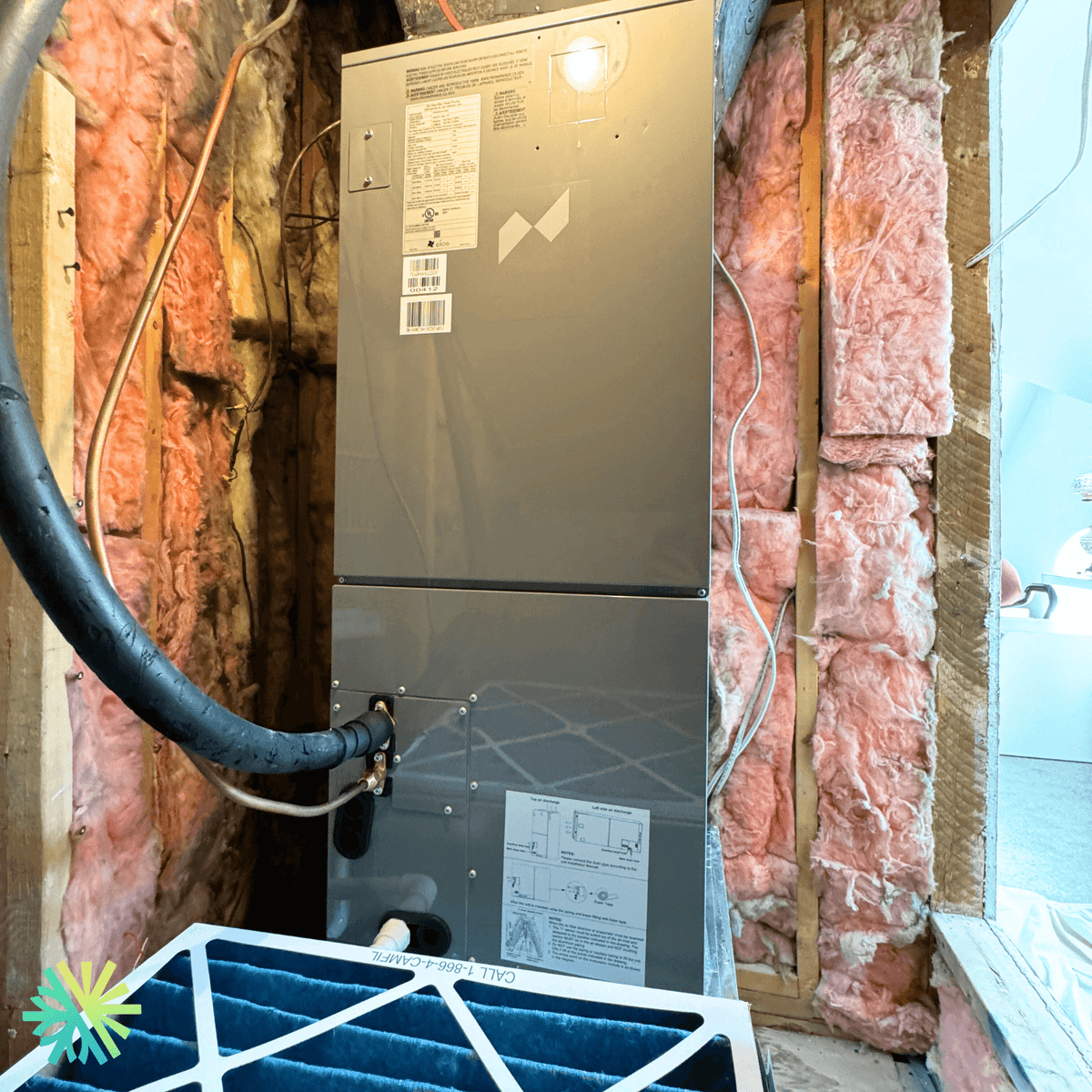
The project presented a unique challenge: installing the ELIOS system in a relatively compact mechanical room while ensuring optimal airflow and accessibility. The homeowner, who had previously experienced inconsistent heating, was eager to invest in a dependable solution. Our goal was to install a system that harmonizes with the space while maximizing efficiency.
Our Approach to Installation: Precision Meets Expertise
Step 1: Initial Assessment
Our team conducted a detailed inspection of the home to assess ductwork compatibility, insulation, and overall airflow. This step was crucial to ensuring the system’s efficiency post-installation.
Step 2: Strategic Placement
Given the limited space, we installed the air handler on a raised platform to optimize drainage and reduce wear over time. The compact dimensions of the ELIOS unit proved to be a significant advantage, fitting seamlessly into the allocated space.
Step 3: Electrical and Piping Work
The system operates on 220V power and required meticulous wiring to meet safety standards. We used 3/8-inch and 3/4-inch piping to connect the refrigerant lines, ensuring durability and leak prevention.
Step 4: Integration with Central Heat Pump
The DEA24HOS20230E7 heat pump was installed to complement the air handler, forming a unified system that delivers superior performance during both summer and winter. This integration ensures consistent heating even during Québec’s harshest winters, with optional electric resistance heating for temperatures below -15°C.
Step 5: Final Testing
Post-installation, our technicians conducted comprehensive testing, including airflow measurement, noise level checks, and thermostat calibration. We also walked the customer through operating the system, highlighting energy-saving tips.

Key Benefits for the Homeowner
1. Energy Efficiency
The homeowner can now enjoy lower energy bills, thanks to the high SEER2 and HSPF2 ratings. The system is tailored for Québec’s fluctuating climate, offering consistent performance regardless of season.
2. Silent Operation
One of the standout features of the ELIOS system is its whisper-quiet operation. Whether it’s heating during the chilly winters or cooling in summer, the system runs without disrupting the household’s peace.
3. Financial Incentives
The $2,304 LogisVert grant significantly reduced the installation cost, making this high-performance system an affordable upgrade.
4. Durability and Reliability
With its robust design and extended warranty options, the ELIOS system ensures long-term reliability, giving the homeowner peace of mind for years to come.
Why Choose AirGreen for Your HVAC Needs?
At AirGreen, we pride ourselves on offering tailored solutions that combine innovation, efficiency, and sustainability. With years of experience serving Montréal, Laval, Longueuil, and the surrounding areas, we understand the unique HVAC needs of our clients. Here’s what sets us apart:
- Expertise: Our technicians are trained in the latest HVAC technologies, ensuring flawless installations.
- Customer-Centric Approach: We prioritize your comfort and satisfaction, offering transparent pricing and detailed consultations.
- Eco-Conscious Solutions: All our installations focus on reducing environmental impact while enhancing energy efficiency.
Final Thoughts: The ELIOS Difference
The installation of the ELIOS FEA24HIAHUU230X7 Electric Furnace and Air Handler in this Montréal home showcases the perfect blend of technology and craftsmanship. With its exceptional efficiency, silent operation, and compact design, the ELIOS system is a game-changer for homeowners looking to upgrade their HVAC systems. Whether you’re battling icy winters or humid summers, the ELIOS system promises year-round comfort with significant energy savings.
If you’re considering an HVAC upgrade, now is the time to act. Take advantage of Hydro-Québec’s grants and join the countless satisfied customers who trust AirGreen for their heating and cooling needs.
The job tools
Two quick checks with real numbers: what heat costs, and what your current heaters add up to in BTU/h.
Conversion: 1 W = 3.412 BTU/h. An indication, not a load calculation: baseboards and furnaces are often stronger than the real need, and they can stay as backup. AirGreen confirms the capacity on site.
How the job unfolds
The main steps of this kind of job at AirGreen. Every house has its quirks: the estimate brings them out.
We look at the ducts, the current indoor module, the electrical panel and the planned spot for the outdoor unit.
The equipment combination, capacity and price, in writing. We check whether the combination qualifies for assistance programs.
Access protected, old unit disconnected and removed when it is being replaced.
Electric furnace or air handler, with its coil, connected to the supply and return ducts.
On a level base, raised above the snow, with free space all around.
Insulated, they enter through a sealed opening and run to the indoor coil.
Dedicated circuits, accessible disconnect, a thermostat that works with the heat pump and the backup heat.
Leak test, vacuum, start-up, airflow check and a test of both modes.
Filter, thermostat, backup heat in extreme cold: what to know before winter.
- The on-site estimateWe look at the ducts, the current indoor module, the electrical panel and the planned spot for the outdoor unit.
- The quoteThe equipment combination, capacity and price, in writing. We check whether the combination qualifies for assistance programs.
- Getting readyAccess protected, old unit disconnected and removed when it is being replaced.
- The indoor moduleElectric furnace or air handler, with its coil, connected to the supply and return ducts.
- The outdoor unitOn a level base, raised above the snow, with free space all around.
- The refrigerant linesInsulated, they enter through a sealed opening and run to the indoor coil.
- Electrical and thermostatDedicated circuits, accessible disconnect, a thermostat that works with the heat pump and the backup heat.
- Tests and start-upLeak test, vacuum, start-up, airflow check and a test of both modes.
- The walkthroughFilter, thermostat, backup heat in extreme cold: what to know before winter.
What we check on a job like this one
Each number is a point we check on site. Switch between summer and winter to watch air and heat move.
In summer, the outdoor unit rejects the house's heat outside.
Generic illustration of this type of installation, not a survey of this job site. Tap a number.
It captures or rejects heat outside. It sits on a level base, above the snow, with free space all around.
The insulated refrigerant lines enter the house through a sealed opening and run to the indoor coil.
A shut-off switch near the outdoor unit isolates it safely for service.
Sitting on the indoor module, it moves heat between the house air and the refrigerant.
Electric furnace or air handler: its fan pushes air through the ducts. The electric backup takes over in extreme cold.
Supply ducts bring air to the rooms; returns bring it back to the unit. Their condition matters as much as the unit's.
It protects the coil and the fan. A dirty filter cuts airflow, so it gets checked regularly.
It runs the heat pump and the backup heat. It must be compatible with the installed system.
Is your home ready?
Check what applies at your place. A "no" is not a refusal: it is what we sort out during the estimate.
Good habits, once the unit is in place
Six simple habits that keep the unit going. Your list stays on this device.
What to do, season by season
Three habits per season for this unit. They take a few minutes and prevent many calls.
- Check the indoor module's filter.
- Clear winter debris from the outdoor unit.
- Test cooling before the heat arrives.
- Check the filter more often in peak season.
- Keep registers and returns clear.
- Watch condensate drainage near the coil.
- Change or clean the filter.
- Test heating and backup heat before the cold.
- Book periodic maintenance.
- Clear snow around the outdoor unit.
- Store nothing in front of the indoor module.
- Note any unusual noise or smell and call us.
The right pages, at the right time
Four statements: true or false?
It all comes down to details you have just seen.
1. A central heat pump uses the house's ducts.
It connects to the existing ducts to heat and cool everywhere.
2. In extreme cold, electric backup heat can take over.
The indoor module (furnace or air handler) works with the heat pump and takes over in extreme cold.
3. The filter only gets changed when the unit breaks down.
A dirty filter cuts airflow. It gets checked regularly.
4. You can reuse the old unit's size without checking.
The house may have changed: insulation, windows, added rooms. Capacity is confirmed on site.
0 / 4 right answers
What people ask us about this kind of work
Can I keep my current ducts?
What happens in extreme cold?
Furnace, air handler, ducted: what is the difference?
Are there grants?
Do I need a permit?
How much can I save?
How is the LogisVert assistance calculated?
Will my current thermostat work?
Central or wall units: which one?
Does AirGreen hold the required licences?
Is the estimate free?
No question matches. Write to us: we answer.
More jobs to see, near you
By town, by equipment or by region: browse more than 4,700 published projects.
Each dot: a town where AirGreen has published projects. The glowing dot: this job.
An on-site estimate, the right capacity, the right equipment.
The on-site estimate is free and the quote follows within 24 hours.
Text and photo: a real AirGreen Climatisation & Chauffage job. The diagrams are generic illustrations of the type of installation, not a survey of this job site. Sources of the added figures: airgreen.ca product pages (NEEP / AHRI performance), Hydro-Québec (Heat pumps page, LogisVert, read on 13 October 2026), Régie de l’énergie (rate D as of 1 April 2026).