
Installation of a MIDEA EVOX G3 3-Ton Electric Furnace with Air Handler on Montreal's South Shore
AirGreen installed a 3-ton MIDEA EVOX G3 electric furnace with air handler on the South Shore of Montreal, in a compact mechanical room requiring precision, technical access, and careful integration into existing ductwork.
- City
- Region
- Equipment
- Brand
- Challenges
- Published
The job on one screen
The article, chapter by chapter
A MIDEA EVOX G3 Central System Designed to Maximize Comfort, Technical Access, and Long-Term Reliability
For this installation on Montreal's South Shore, our AirGreen team installed a MIDEA EVOX G3 3-ton electric furnace, integrated into a central system with an air handler. This type of HVAC installation requires particular attention, as it's not simply a matter of replacing a unit: the new unit must be adapted to the existing ductwork, clearances validated, efficient air transition ensured, electrical and refrigeration connections secured, and then the whole system optimized to provide stable heating and cooling throughout the residence.
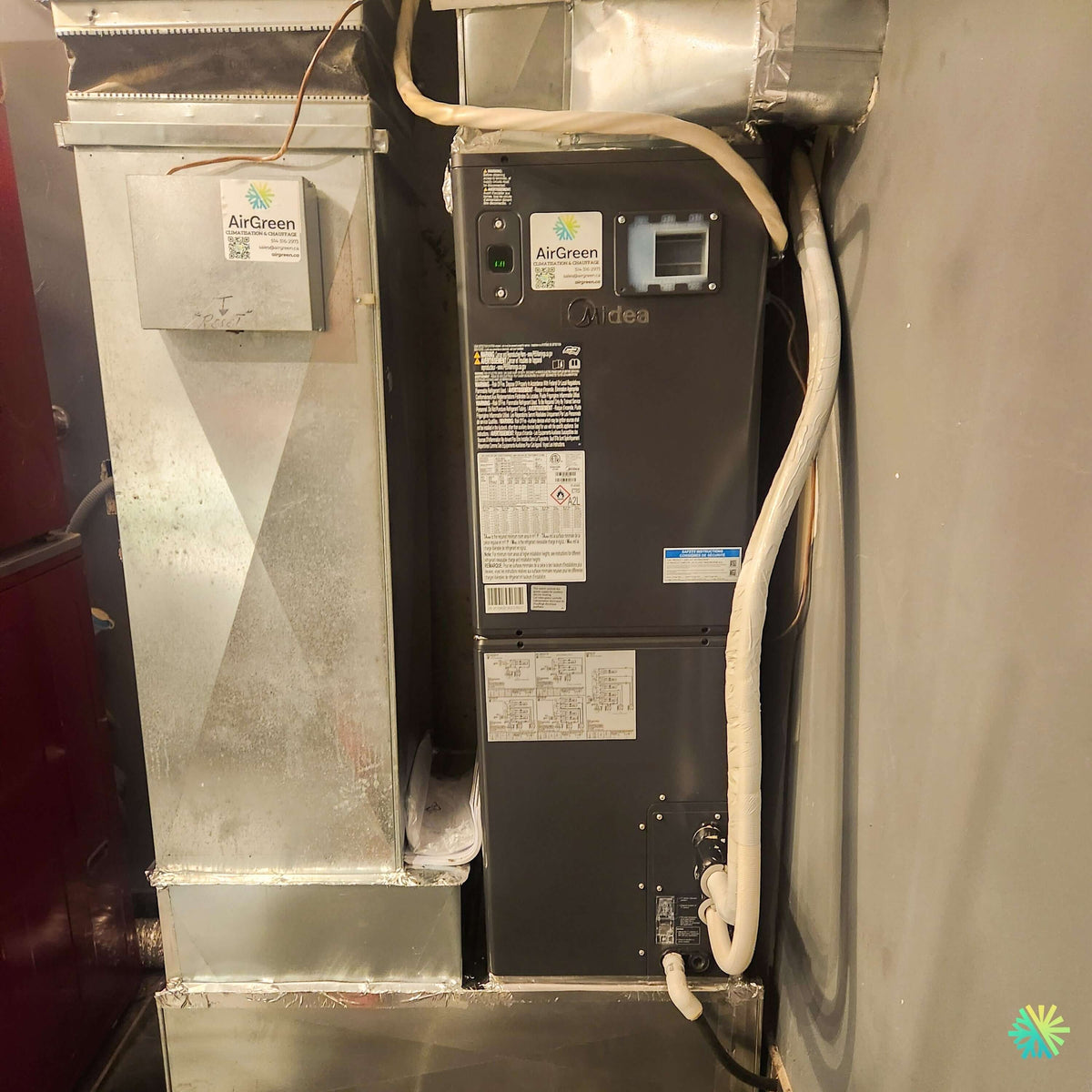
The photo of this installation clearly illustrates the real-world context of the project: a narrow mechanical room, existing ductwork, limited lateral space, existing metallic transitions, and a very tight fit between the central unit and surrounding walls. In this type of configuration, the technician's experience is as important as the quality of the machine. A poorly designed installation could create vibrations, reduce airflow, complicate future maintenance, or cause a loss of performance. Our role was therefore to deliver a clean, safe, and functional installation, while respecting the physical constraints of the building.
This MIDEA EVOX G3 3-ton electric furnace is a particularly attractive solution for homeowners on the South Shore, in Montreal, Laval, Longueuil, the North Shore, and surrounding areas who are looking for a modern central system, compatible with both winter heating and summer cooling needs. In a home already equipped with a ductwork system, this type of system can improve air distribution, reduce temperature variations between rooms, and provide a solid foundation for a durable HVAC solution.
Why choose a MIDEA EVOX G3 3-ton central electric furnace?
The choice of a MIDEA EVOX G3 3-ton central system addresses several common needs among homeowners of single-family homes and residential buildings in the metropolitan area. Firstly, the 3-ton capacity is generally suitable for residences requiring a significant volume of air, especially when the goal is to serve multiple rooms through an existing ductwork system.
Unlike a simple wall-mounted unit that treats a specific area, a central air handler can distribute air throughout the entire house. This becomes a considerable advantage in properties where occupants want to avoid temperature differences between floors, the main level, the basement, or more distant rooms.
In this project on Montreal's South Shore, the existing configuration clearly showed that the air distribution network was already well-established. The challenge was therefore to integrate the new MIDEA unit into this environment without creating unnecessary restrictions. A poor transition between the unit and the plenum, an overly abrupt connection, or misalignment can hinder airflow. This is why our team paid particular attention to the metallic junctions visible above and around the unit.
A compact mechanical room: a frequent challenge in central installations
One of the most striking elements of this installation is the available space. The MIDEA EVOX G3 electric furnace is installed in a technical room where every inch counts. To the right, the wall is very close to the unit. To the left, the existing ductwork occupies a large part of the width. Above, metallic transitions must remain accessible and properly sealed. In front, sufficient access must be maintained to service panels, technical labels, connections, and internal components.
This type of constraint is very common in homes on the South Shore, particularly in properties where the mechanical room was originally designed for older, sometimes simpler equipment, or installed according to different standards. When an owner decides to modernize their HVAC system, the installation must be adapted to the reality of the building, and not the other way around.
At AirGreen, we always take the time to evaluate:
- the space available for the unit;
- the clearances required for maintenance;
- the quality of existing ducts;
- the condition of joints and transitions;
- the routing of refrigeration lines;
- the electrical connection;
- condensation drainage and management;
- the possibility of accessing service panels without unnecessarily demolishing or moving other components.
In the photo, several wrapped or insulated ducts and connections are also visible. This is important to reduce thermal losses, protect certain lines, limit condensation, and maintain a cleaner appearance in an already busy mechanical space.
The importance of connecting to the existing ductwork system
A central system with an air handler relies heavily on the quality of the ductwork. Even the best electric furnace or central unit cannot deliver its full performance if air circulation is poor. In this installation, the MIDEA unit was positioned in direct alignment with the existing ducts, which required respecting planned heights, alignments, and air volumes.
A ductwork system can sometimes have flaws invisible at first glance: air leaks, improperly sized sections, weakened joints, poorly insulated areas, insufficient return air, or poorly distributed grilles. During a central HVAC installation, our team checks essential elements to reduce performance losses and prevent the client from investing in a new unit without fully benefiting from its capabilities.
In this project on Montreal's South Shore, the work involved maintaining the logic of the existing network while improving the integration of the new equipment. The visible metallic transitions and junctions were handled with care, because good sealing directly influences:
- the static pressure of the system;
- comfort in distant rooms;
- operating noise;
- energy consumption;
- the lifespan of components;
- temperature consistency in the home.
A central unit adapted to the Quebec climate
The climate of the Montreal, Laval, Longueuil, North Shore, and South Shore regions places specific demands on HVAC systems. Homes must be able to cope with cold winters, prolonged periods of frost, rapid temperature fluctuations in spring and autumn, and humid summer periods where air conditioning plays a central role in indoor comfort.
The MIDEA EVOX G3 3-ton unit fits this logic of versatility. In a central configuration, it allows for working with the entire building rather than just one zone. For many owners, this represents a tangible advantage: more homogeneous temperature, less reliance on auxiliary appliances, and better coordination between heating, ventilation, and air conditioning.
However, the installation of a central unit should never be reduced to its nominal power. A 3-ton capacity must be consistent with the surface area, insulation, solar exposure, floor configuration, window condition, occupancy habits, and ductwork system. An oversized unit can lead to short cycling, discomfort, and less effective dehumidification. An undersized unit can run too long without achieving the desired comfort. This is why AirGreen places great importance on project analysis before installation.
Visible installation details: what the photo reveals
This installation photo is interesting because it shows a reality often absent from technical sheets: the real environment in which the appliance must operate. We see a central MIDEA unit installed compactly, with lateral connections, metal ducts above, an accessible service panel, and protected lines on the side.
Several elements are worth highlighting:
- the unit is positioned to maintain access to the front panel;
- the upper ducts are connected in a confined space;
- the insulated lines follow an organized path despite the proximity of the wall;
- integration is done with an existing network rather than a completely open new installation;
- the casing and technical access remain visible for future interventions;
- the AirGreen labeling clearly identifies the company responsible for the installation.
This type of finish is not just aesthetic. In the HVAC field, a clean installation facilitates future diagnostics, reduces the risk of errors during maintenance, and gives the owner better visibility into their system.
An AirGreen Approach Focused on Precision, Durability, and After-Sales Service
Every AirGreen project is treated as a unique installation. Even when two clients choose the same model, the building's constraints always change: available height, condition of ducts, access to the electrical panel, distances to cover, outdoor unit location if applicable, type of thermostat, return air, insulation quality, and occupant comfort habits.
In this installation of a MIDEA EVOX G3 3-ton electric furnace on Montreal's South Shore, our team had to combine three priorities: performance, accessibility, and reliability. The unit had to be well integrated into the existing central system, but also remain accessible for maintenance. This is a point that many homeowners underestimate. An installation that seems correct on the day of work can become problematic if the filter, panels, connections, or certain components become difficult to reach.
Site preparation before installation
Before installing a central air handler, we analyze the mechanical environment. This step helps avoid costly errors. In a space like the one visible in the photo, it is necessary to plan for unit movements, surface protection, connection sequencing, and necessary duct adjustments.
Preparation generally includes:
- Verification of mechanical space and clearances.
- Analysis of the existing ductwork.
- Validation of available electrical connections.
- Planning the routing of lines and drains.
- Verification of service panel access.
- Protection of sensitive areas around the unit.
- Coordination of connection and startup steps.
This rigor is particularly important on the South Shore, where many homes have central systems installed a long time ago, sometimes modified over the years. During a replacement or modernization, it is often necessary to deal with existing elements that were not all designed to accommodate a modern appliance.
Physical installation of the MIDEA EVOX G3 unit
The installation of a central unit like the MIDEA EVOX G3 3-ton requires precision. The unit must be stably positioned, aligned with the ducts, and secured to limit vibrations. Connections must be made cleanly, without excessive tension on the lines, without unnecessary bends, and without obstructing front access.
In this installation, the proximity of the wall on the right required careful management of insulated lines. Poor routing could have created pressure on fittings or made maintenance more complex. Our team therefore organized the routing of lines to maintain visual and technical access, while respecting the constraints of the space.
The upper ducts also required particular attention. In a central system, air losses at junctions can reduce overall efficiency. Even a small repeated leak over several fittings can affect comfort and increase operating costs. The goal is therefore to create a solid, well-fitted, and durable transition.
Startup: a step as important as installation
Once the unit is installed, the work is not finished. Startup verifies that the system is operating as expected and that the basic parameters are consistent with the building.
During this step, our technicians particularly check:
- unit startup;
- thermostat response;
- fan operation;
- airflow;
- abnormal noises;
- vibrations;
- electrical safety;
- visible connections;
- operational stability;
- accessibility to maintenance components.
This step is essential to prevent a minor problem from becoming a source of discomfort for the client. In a central system, incorrect configuration can be felt throughout the house: insufficient airflow in certain rooms, too frequent cycles, noise in the ducts, or unstable temperature.
Practical advice for homeowners considering a central installation
For homeowners on Montreal's South Shore, in Montreal, Laval, Longueuil, or on the North Shore who are considering a central HVAC installation, several points must be considered before choosing a unit.
Do not choose solely based on tonnage capacity
The mention of 3 tons gives an indication of capacity, but it is not enough on its own. The entire house must be evaluated. A very well-insulated residence will not have the same needs as an older house with significant thermal losses.
Check the condition of the ductwork
A new unit connected to faulty ducts will not yield the expected results. Before installation, it is recommended to check for air leaks, restrictions, crushed sections, or insufficient returns.
Plan for future access for HVAC maintenance
A central unit requires maintenance. The filter, panels, and components must remain accessible. An installation that is too tight or poorly oriented can complicate maintenance visits and increase long-term costs.
Choose a company that understands local constraints
Homes in the metropolitan area often have specific features: finished basements, compact mechanical rooms, old ducts, electrical panels with limited capacity, condominiums with strict rules, or restricted outdoor access. An HVAC company active in Montreal, Laval, Longueuil, on the North Shore and South Shore better understands these realities.
Common mistakes to avoid during a central replacement
In our experience, several problems encountered with central installations stem from decisions made too quickly. Here are the mistakes we systematically strive to avoid.
Installing a unit without validating the ducts
A high-performing unit cannot compensate for a poorly designed air duct system. Static pressure, air returns, and transitions must be analyzed.
Neglecting joint sealing
Air leaks in a mechanical room may seem minor, but they reduce system efficiency and can create uncomfortable zones in the house.
Blocking access to service panels
An installation that is too tight can make maintenance difficult. In the presented project, front access to the MIDEA unit remains a central element of the installation's quality.
Poor management of isolated lines
Lines must be protected, well-supported, and positioned without excessive tension. Their path influences durability and ease of intervention.
Choosing a contractor based solely on price
Price is important, but a poorly executed central installation can cost much more in the long run: discomfort, premature repairs, performance loss, noise, service callbacks, and dissatisfaction.
Subsidies, efficiency, and support
Depending on the exact model, final configuration, and programs in effect at the time of work, certain central system installations may be eligible for subsidies or energy efficiency programs. Criteria change over time and must be validated based on model numbers, certified performance, and the requirements of the applicable program.
At AirGreen, we assist our clients with this verification when the project is suitable. For a MIDEA EVOX G3 3-ton electric furnace or a related central system, it is important to confirm eligibility based on the exact technical data of the installed unit, rather than relying on general information. This approach avoids unpleasant surprises and allows the client to better understand the true value of their investment.
Why AirGreen for a central MIDEA installation on the South Shore?
AirGreen regularly performs HVAC installations in various residential contexts: single-family homes, condominiums, plexes, central system replacements, wall-mounted installations, multi-zone heat pumps, ducted units, and ducted systems. This field experience allows us to adapt our method to each building.
For this installation on Montreal's South Shore, our team focused on:
- clean integration into the existing ductwork;
- a compact yet accessible installation;
- organized routing of lines;
- particular attention to metallic joints;
- a meticulous finish;
- rigorous commissioning;
- a sustainable approach to facilitate future HVAC maintenance.
This level of detail makes a concrete difference. A central system is not just a unit placed in a mechanical room: it is the heart of home comfort. When properly installed, it operates more stably, quietly, and predictably.
An installation that truly illustrates on-the-ground reality
This project of a MIDEA EVOX G3 3-ton electric furnace with air handler on the South Shore of Montreal perfectly illustrates the type of work that homeowners do not always see in a quote. Behind the choice of brand and model, there is a series of technical decisions: where to place the unit, how to connect the ducts, how to maintain access, how to organize the lines, how to avoid air restrictions, how to ensure a durable finish.
It is in these details that the quality of an HVAC installation is built. For the client, the result is a central system that is better integrated, easier to maintain, and better suited to the actual needs of the home. For AirGreen, this is exactly the type of project where our local expertise becomes paramount.
Homeowners in Montreal, Laval, Longueuil, on the North Shore and South Shore who are considering installing or replacing a central system benefit from having their existing configuration analyzed before choosing their unit. A good recommendation is not based solely on a technical sheet: it is based on the building, its constraints, its ducts, its daily use, and the occupants' comfort expectations.
The job tools
Two quick checks with real numbers: what heat costs, and what your current heaters add up to in BTU/h.
Conversion: 1 W = 3.412 BTU/h. An indication, not a load calculation: baseboards and furnaces are often stronger than the real need, and they can stay as backup. AirGreen confirms the capacity on site.
How the job unfolds
The main steps of this kind of job at AirGreen. Every house has its quirks: the estimate brings them out.
We look at the ducts, the current indoor module, the electrical panel and the planned spot for the outdoor unit.
The equipment combination, capacity and price, in writing. We check whether the combination qualifies for assistance programs.
Access protected, old unit disconnected and removed when it is being replaced.
Electric furnace or air handler, with its coil, connected to the supply and return ducts.
On a level base, raised above the snow, with free space all around.
Insulated, they enter through a sealed opening and run to the indoor coil.
Dedicated circuits, accessible disconnect, a thermostat that works with the heat pump and the backup heat.
Leak test, vacuum, start-up, airflow check and a test of both modes.
Filter, thermostat, backup heat in extreme cold: what to know before winter.
- The on-site estimateWe look at the ducts, the current indoor module, the electrical panel and the planned spot for the outdoor unit.
- The quoteThe equipment combination, capacity and price, in writing. We check whether the combination qualifies for assistance programs.
- Getting readyAccess protected, old unit disconnected and removed when it is being replaced.
- The indoor moduleElectric furnace or air handler, with its coil, connected to the supply and return ducts.
- The outdoor unitOn a level base, raised above the snow, with free space all around.
- The refrigerant linesInsulated, they enter through a sealed opening and run to the indoor coil.
- Electrical and thermostatDedicated circuits, accessible disconnect, a thermostat that works with the heat pump and the backup heat.
- Tests and start-upLeak test, vacuum, start-up, airflow check and a test of both modes.
- The walkthroughFilter, thermostat, backup heat in extreme cold: what to know before winter.
What we check on a job like this one
Each number is a point we check on site. Switch between summer and winter to watch air and heat move.
In summer, the outdoor unit rejects the house's heat outside.
Generic illustration of this type of installation, not a survey of this job site. Tap a number.
It captures or rejects heat outside. It sits on a level base, above the snow, with free space all around.
The insulated refrigerant lines enter the house through a sealed opening and run to the indoor coil.
A shut-off switch near the outdoor unit isolates it safely for service.
Sitting on the indoor module, it moves heat between the house air and the refrigerant.
Electric furnace or air handler: its fan pushes air through the ducts. The electric backup takes over in extreme cold.
Supply ducts bring air to the rooms; returns bring it back to the unit. Their condition matters as much as the unit's.
It protects the coil and the fan. A dirty filter cuts airflow, so it gets checked regularly.
It runs the heat pump and the backup heat. It must be compatible with the installed system.
Is your home ready?
Check what applies at your place. A "no" is not a refusal: it is what we sort out during the estimate.
Good habits, once the unit is in place
Six simple habits that keep the unit going. Your list stays on this device.
What to do, season by season
Three habits per season for this unit. They take a few minutes and prevent many calls.
- Check the indoor module's filter.
- Clear winter debris from the outdoor unit.
- Test cooling before the heat arrives.
- Check the filter more often in peak season.
- Keep registers and returns clear.
- Watch condensate drainage near the coil.
- Change or clean the filter.
- Test heating and backup heat before the cold.
- Book periodic maintenance.
- Clear snow around the outdoor unit.
- Store nothing in front of the indoor module.
- Note any unusual noise or smell and call us.
The right pages, at the right time
Four statements: true or false?
It all comes down to details you have just seen.
1. A central heat pump uses the house's ducts.
It connects to the existing ducts to heat and cool everywhere.
2. In extreme cold, electric backup heat can take over.
The indoor module (furnace or air handler) works with the heat pump and takes over in extreme cold.
3. The filter only gets changed when the unit breaks down.
A dirty filter cuts airflow. It gets checked regularly.
4. You can reuse the old unit's size without checking.
The house may have changed: insulation, windows, added rooms. Capacity is confirmed on site.
0 / 4 right answers
What people ask us about this kind of work
Can I keep my current ducts?
What happens in extreme cold?
Furnace, air handler, ducted: what is the difference?
Are there grants?
Do I need a permit?
How much can I save?
How is the LogisVert assistance calculated?
Will my current thermostat work?
Central or wall units: which one?
Does AirGreen hold the required licences?
Is the estimate free?
No question matches. Write to us: we answer.
More jobs to see, near you
By town, by equipment or by region: browse more than 4,700 published projects.
Each dot: a town where AirGreen has published projects. The glowing dot: this job.
An on-site estimate, the right capacity, the right equipment.
The on-site estimate is free and the quote follows within 24 hours.
Text and photo: a real AirGreen Climatisation & Chauffage job. The diagrams are generic illustrations of the type of installation, not a survey of this job site. Sources of the added figures: airgreen.ca product pages (NEEP / AHRI performance), Hydro-Québec (Heat pumps page, LogisVert, read on 13 October 2026), Régie de l’énergie (rate D as of 1 April 2026).