
Installation of a Samsung Premium FJM dual-zone heat pump with WindFree wall-mounted units in Boucherville
In Boucherville, AirGreen installs a Samsung Premium FJM dual-zone heat pump with a WindFree unit in a home undergoing renovations, coordinating clearances, drainage, concealed lines, and commissioning.
- City
- Region
- Equipment
- Brand
- Challenges
- Published
The job on one screen
The article, chapter by chapter
A Samsung multi-zone solution precisely integrated into a residence under renovation in Boucherville
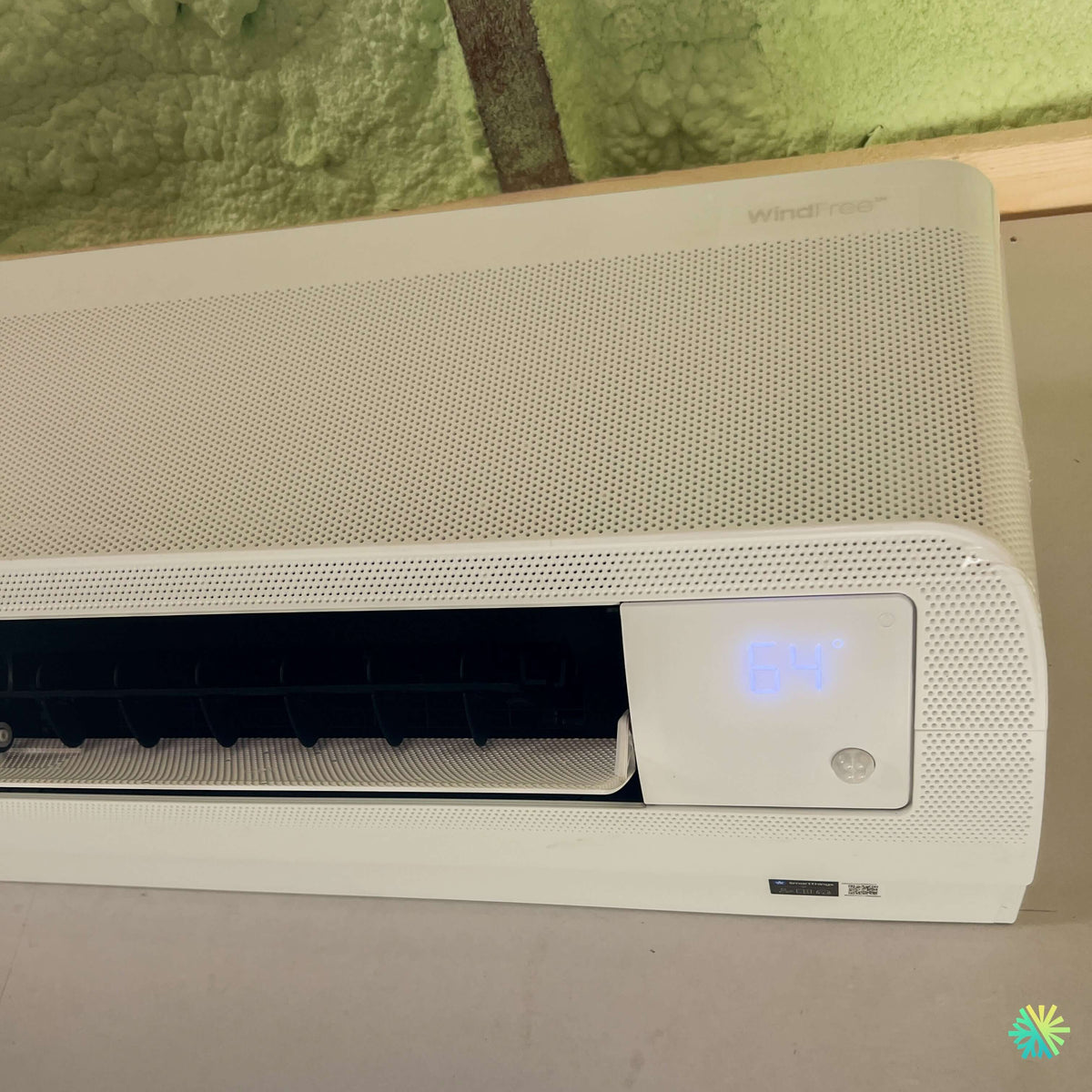
In Boucherville, we installed a Samsung Premium FJM dual-zone heat pump designed to provide heating and cooling for two distinct spaces from a single outdoor unit. The project was part of an interior renovation that was still underway, allowing us to coordinate the routing of the refrigerant lines, wiring, and drains before the walls were completely closed up.
The indoor unit visible in the photograph is a Samsung WindFree wall-mounted model, easily recognizable by its façade covered with thousands of microperforations. The appliance was already operating when the photo was taken, with a displayed temperature of 64 °F, or approximately 18 °C. This detail confirms that operational testing and commissioning had begun despite the room still being unfinished.
The photograph also shows several important features of the project: an exposed wood structure, green spray-foam insulation, a prepared drywall surface behind the unit, and limited space between the top of the appliance and the framing. This configuration required a carefully measured installation. In a renovation, a few centimeters can determine whether the unit will be able to operate properly, remain easy to service, and maintain a harmonious appearance once the ceiling and walls are finished.
Our role therefore involved more than simply installing a Samsung wall-mounted heat pump. We had to plan the entire final result before the surfaces were closed up.
Why a dual-zone heat pump was suitable for this property
A dual-zone heat pump consists of an outdoor unit connected to two indoor units. Each unit serves a specific room or section of the home, with its own temperature control and fan speed.
This setup is particularly useful when the two zones have different needs. In Boucherville, this may include, for example:
- a ground floor and an upper floor;
- an open-plan area and a bedroom;
- a main residence and an addition;
- a room beneath the roof and a lower-level space;
- two zones with different sun exposure;
- an older part of the home and a recently renovated section.
Heating and cooling loads rarely vary uniformly throughout a property. A large window, a sloped ceiling, recent insulation, or a south-facing orientation can significantly change a room’s needs.
With a single indoor unit, air often has to travel through corridors, around partitions, or up a staircase. In some homes, this distribution remains insufficient. The Samsung Premium FJM dual-zone system instead delivers conditioned air directly to both priority areas.
The homeowner therefore benefits from:
- more precise temperature control;
- better air distribution;
- a single outdoor unit;
- fewer visible units around the property;
- demand-based modulation;
- independent operation of the indoor fans;
- better comfort in spaces that are far apart from one another.
However, it should be noted that a multizone system generally operates in a common mode. The two units can have different set temperatures, but they typically cannot heat one zone and cool the other simultaneously.
A Samsung WindFree unit designed for gentler comfort
The highly distinctive front panel of the indoor unit is one of the most visible elements of this installation. Unlike a traditional wall-mounted unit that primarily distributes air through a lower louver, Samsung WindFree technology can distribute air through a multitude of small openings on the front panel.
Operation typically takes place in two stages. The unit first uses more direct airflow to quickly bring the room to the desired temperature. It can then maintain comfort with gentler air circulation through the microperforations.
This approach is appreciated in spaces where occupants spend extended periods near the unit, including:
- bedrooms;
- offices;
- living rooms;
- reading areas;
- family rooms;
- rooms with lower ceilings;
- areas where a direct air jet would be uncomfortable.
At the Boucherville project, the unit was installed relatively high on the wall. WindFree distribution then allows the air to spread gradually throughout the room without relying solely on a concentrated airflow.
WindFree mode does not mean that the unit stops circulating air. It continues to maintain the temperature, but with a less direct sensation. This distinction is important for homeowners seeking a discreet unit without sacrificing cooling capacity.
The main challenge: installing the unit before the ceiling was fully finished
The photo shows that the top of the wall and the ceiling were not yet finished. The spray foam insulation and framing components remained visible. This stage of the project offered an excellent opportunity to conceal the technical components, but it also required precise coordination with the future work.
Before installing the unit, we had to consider:
- the thickness of the future ceiling;
- the position of the wood furring strips;
- the final clearance above the unit;
- the ability to remove and clean the filters;
- the opening of the front panel;
- the route of the refrigerant lines;
- the slope of the condensate drain;
- the location of the studs;
- the drywall finish around the unit;
- the access required for potential servicing.
A common mistake during renovations is to calculate the unit’s height based on the unfinished structure, without considering the materials that will be added. Once the drywall, mouldings, or suspended ceiling are installed, the clearance may become insufficient.
A wall-mounted unit generally draws in some of its air from the top. If it is placed too close to the ceiling, several problems may arise:
- reduced airflow;
- lower performance;
- increased noise;
- more difficult maintenance;
- more difficult filter removal;
- faster dust accumulation;
- risk of recirculation of the discharged air.
At AirGreen, we always assess the location based on the room’s planned final state, not solely on what is visible on the day of installation.
A mounting system that must remain secure after the walls are closed
A heat pump indoor unit must not be supported solely by a thin sheet of drywall. Its wall plate must be secured to a structure capable of withstanding the weight of the unit, vibrations, and the handling required during maintenance.
With the work area open, we were able to confirm the position of the wooden elements behind the mounting surface. This visibility is a major advantage. In a closed wall, the studs must be located precisely or the appropriate anchors must be added. Here, the structure could be observed directly before final installation.
Proper fastening helps prevent:
- vibrations;
- cracking;
- the gradual shifting of the unit;
- gaps between the unit and the wall;
- leveling problems;
- drainage errors;
- noise transmitted to the framing.
Leveling is particularly important because the indoor condensate pan must drain water toward the designated drain. A poorly positioned unit may retain water or cause an overflow.
Condensate drainage: an invisible detail that protects the entire renovation
In cooling mode, the indoor unit removes moisture from the air. This moisture turns into water on the heat exchanger and then flows into a collection pan. It must then be discharged through a drainage line.
During a renovation, the drain can often be concealed inside the wall. This finish is more aesthetically pleasing, but it makes installation quality even more important. A hidden line with a back slope, a weak connection, or a sag can cause damage long after the work is complete.
We specifically check:
- that the downward slope remains constant;
- that the line has no constrictions;
- that the connections are secure;
- that water flows freely;
- that the outlet does not back up;
- that the drain remains accessible where necessary;
- that condensation cannot damage the wood or drywall.
A drainage test is performed before final commissioning. This check confirms that water leaves the unit properly, even when most of the route is concealed.
Two zones mean two technical routes to coordinate
The Samsung Premium FJM heat pump supplies two indoor units from a single outdoor unit. Each unit has its own connection circuit.
The installation therefore includes, for each zone:
- a refrigerant liquid line;
- a refrigerant gas line;
- adequate thermal insulation;
- a communication cable;
- a power supply compliant with the Samsung diagram;
- a condensate drain;
- an identified route to the outdoor unit.
Precision is essential. The two circuits must be correctly identified to avoid connecting an indoor unit to the wrong port on the outdoor unit. A connection error can cause communication faults, commissioning problems, or inconsistent operation.
Before opening the service valves, we perform the required technical steps, including:
- checking the connections;
- tightening to the appropriate torque;
- performing a leak test;
- pulling a vacuum;
- checking vacuum stability;
- validating the wiring;
- testing each unit;
- checking the discharge air temperatures;
- testing the remote controls and available modes.
These operations are not always visible to the homeowner, but they play a major role in the compressor’s service life and the reliability of the entire multizone system.
The technical choices that ensure long-term performance
The BTU capacity must be calculated for each zone
The capacity of a dual-zone heat pump should not be determined solely based on the total area of the house. Each room must be analyzed separately.
We take several factors into account:
- the floor area;
- the ceiling height;
- the air volume;
- the insulation level;
- the number of windows;
- the building’s orientation;
- sun exposure;
- the number of occupants;
- the electrical appliances present;
- the door configuration;
- the desired winter temperature;
- low-temperature heat loss.
The presence of spray foam insulation visible in the photo is a positive factor. When installed correctly and continuously, it can improve the building envelope’s airtightness and reduce air infiltration.
However, good insulation does not replace a precise calculation. A room with extensive glazing or one located directly beneath the roof may still experience a high solar load in summer.
For a multizone installation, we must also verify compatibility between:
- the outdoor unit’s capacity;
- the rated capacities of the indoor units;
- the total permitted connection ratio;
- the available capacity when both zones operate simultaneously;
- low-temperature heating performance.
It is not enough to add up the BTUs listed on the indoor units. The actual capacity delivered depends on the combination approved by Samsung and the operating conditions.
Why we do not recommend operating the unit during dusty work
The unit shown in the photo was installed while the finishing work was still incomplete. In this situation, we strongly recommend not using the heat pump during stages that generate a lot of dust.
Sanding drywall, cutting wood, plaster work, and certain insulation operations can release very fine particles. These can penetrate:
- the filters;
- the heat exchanger;
- the blower wheel;
- the drain pan;
- the WindFree microperforations;
- the internal components of the unit.
A dust-covered heat exchanger transfers heat less efficiently. A dirty blower wheel can also become noisy or unbalanced.
To protect the installation, we recommend:
- to disconnect power to the unit;
- to temporarily protect the unit;
- not to obstruct or deform the front panel;
- to remove the protection after the work is complete;
- to check the filters before normal use;
- to inspect the microperforations;
- to clean it if particles have entered inside.
This precaution is particularly important with a WindFree unit because its front panel has a very large number of small openings designed to distribute air.
The 64 °F display and operation check
The display visible on the unit shows a setpoint of 64 °F, or approximately 18 °C. The ability to display the temperature in degrees Fahrenheit or Celsius depends on the remote control settings or the device configuration.
During commissioning, we do not limit ourselves to confirming that the unit starts. We check:
- response to the remote control;
- mode switching;
- louver opening;
- fan operation;
- WindFree air distribution;
- heating;
- cooling;
- communication stability;
- the absence of abnormal vibrations;
- drainage;
- the response of both zones.
In a dual-zone system, each unit must be tested on its own and then operating simultaneously with the other unit. This method confirms that the outdoor unit correctly modulates its capacity according to demand.
Common mistakes to avoid in a similar project
Choosing the location after the walls have been closed
A late decision may require installing visible pipe covers or reopening newly finished surfaces.
Placing the unit too close to the finished ceiling
The exposed structure does not necessarily represent the final available height.
Neglecting the drain slope
Insufficient slope can cause a leak inside the wall.
Run the heat pump during sanding
Dust can contaminate the heat exchanger and micro-perforations.
Sizing both zones according to a quick rule
Actual needs vary according to volume, insulation, and windows.
Confusing temperature independence with mode independence
The two units may have different temperature settings, but they generally must remain in the same heating or cooling mode.
Hide the connections in an inaccessible location
Aesthetics should never prevent maintenance and future inspections.
Subsidy eligibility: verify the exact model numbers
A Samsung heat pump may be eligible for certain financial assistance programs in Quebec, but eligibility always depends on the complete installed combination.
For a multi-zone heat pump, the following must be confirmed:
- the outdoor unit model number;
- the number of each indoor unit;
- the corresponding AHRI reference;
- the capacity recognized at low temperatures;
- the type of residence;
- the program in effect;
- the purchase and installation date;
- the required documents.
The commercial name Premium FJM is not sufficient on its own to determine a subsidy amount. Several capacities and combinations may belong to the same product line. We therefore verify the exact references before confirming eligibility to the homeowner.
An installation designed to disappear into the finished decor
Once the renovation is complete, the insulation, wood framing, and drywall edges visible in the photo will be covered. The Samsung WindFree unit will remain integrated into a clean surface, with concealed lines and positioning suited to the room’s architecture.
This is one of the advantages of carrying out an HVAC installation during a renovation. We can coordinate the work with the structure rather than working around walls that have already been finished.
This installation in Boucherville reflects the approach we apply at AirGreen for our dual-zone heat pump projects in Montreal, Laval, Longueuil, the North Shore, and the South Shore. We analyze not only the equipment, but also the building, airflow, service access, drainage, future work, and occupants’ habits.
The desired result is simple: an efficient, discreet, and affordable heating and cooling system that continues to operate properly long after the renovation work is complete.
The job tools
Two quick checks with real numbers: what heat costs, and what your current heaters add up to in BTU/h.
Conversion: 1 W = 3.412 BTU/h. An indication, not a load calculation: baseboards and furnaces are often stronger than the real need, and they can stay as backup. AirGreen confirms the capacity on site.
How the job unfolds
The main steps of this kind of job at AirGreen. Every house has its quirks: the estimate brings them out.
We look at the room, the outside wall, the line route and where the outdoor unit will go. That is where the capacity gets chosen.
Model, capacity and price, in writing. We also check whether the model qualifies for assistance programs.
Floors and furniture protected, wall plate position marked level, wall opening located.
A single opening, with the slope the drain needs to flow outside.
Set on a stand raised above the snow, with the clearances the manufacturer requires.
Connected, insulated and protected. The opening is then sealed against water, cold air and insects.
A dedicated circuit and an accessible disconnect near the outdoor unit.
Leak test, vacuum, then start-up and a check of heating and cooling.
Remote, modes, filters: we show you the essentials before we leave.
- The on-site estimateWe look at the room, the outside wall, the line route and where the outdoor unit will go. That is where the capacity gets chosen.
- The quoteModel, capacity and price, in writing. We also check whether the model qualifies for assistance programs.
- Getting readyFloors and furniture protected, wall plate position marked level, wall opening located.
- The wall openingA single opening, with the slope the drain needs to flow outside.
- The outdoor unitSet on a stand raised above the snow, with the clearances the manufacturer requires.
- Lines, cable and drainConnected, insulated and protected. The opening is then sealed against water, cold air and insects.
- The electrical workA dedicated circuit and an accessible disconnect near the outdoor unit.
- Tests and start-upLeak test, vacuum, then start-up and a check of heating and cooling.
- The walkthroughRemote, modes, filters: we show you the essentials before we leave.
What we check on a job like this one
Each number is a point we check on site. Switch between summer and winter to watch air and heat move.
In summer, the outdoor unit rejects the house's heat outside.
Generic illustration of this type of installation, not a survey of this job site. Tap a number.
Mounted level on a wall plate, high enough for the air to reach the whole room, with enough space around it to slide the filters out easily.
The refrigerant lines, the communication cable and the drain go through the wall in a single opening, sealed against water, cold air and insects.
Two insulated copper pipes connect the two units. Outside, a line cover can protect them from sun, knocks and weather.
A shut-off switch near the outdoor unit isolates it safely for service. It must stay accessible at all times.
The compressor and the fan. In heating mode it captures heat from the outdoor air, even in winter, and moves it inside.
On the ground or on the wall, it keeps the unit above accumulated snow. The unit stays clear and defrost water can drain away.
The fan needs to blow freely. Storage, a fence or a wall too close, and efficiency drops while noise goes up.
Is your home ready?
Check what applies at your place. A "no" is not a refusal: it is what we sort out during the estimate.
Good habits, once the unit is in place
Six simple habits that keep the unit going. Your list stays on this device.
What to do, season by season
Three habits per season for this unit. They take a few minutes and prevent many calls.
- Clean the indoor unit's filters.
- Clear leaves and debris left on the outdoor unit by winter.
- Test cooling before the first hot days.
- Clean the filters more often when the unit runs a lot.
- Keep plants away from the outdoor unit.
- Check that no water drips from the indoor unit.
- Rake the leaves around the outdoor unit.
- Test heating before the first cold days.
- Book periodic maintenance before winter.
- Keep snow away from the stand and the front of the unit.
- Let the unit defrost: it is normal.
- Never hit the ice on the fins; call us if the unit stays iced up.
The right pages, at the right time
Four statements: true or false?
It all comes down to details you have just seen.
1. In heating mode, the outdoor unit can produce water.
During defrost cycles. That water must drain away without forming ice.
2. You pick the capacity with a simple square-footage rule.
Windows, insulation, orientation and how the room is used all count. Capacity is chosen on site.
3. A multi-zone connects several indoor heads to a single condenser.
One head per room, all on the same condenser. Each room keeps its own temperature.
4. The disconnect can sit behind the patio furniture.
It must stay accessible: it is what shuts the unit off for service.
0 / 4 right answers
What people ask us about this kind of work
Does a wall-mounted heat pump heat in winter?
Wall-mounted or multi-zone: how do I choose?
Where does the outdoor unit go?
Are there grants?
Do I need a permit?
How cold can it heat?
How much can I save?
How is the LogisVert assistance calculated?
Is it noisy?
The outdoor unit is covered in ice: is that normal?
Does AirGreen hold the required licences?
Is the estimate free?
No question matches. Write to us: we answer.
More jobs to see, near you
By town, by equipment or by region: browse more than 4,700 published projects.
Each dot: a town where AirGreen has published projects. The glowing dot: this job.
An on-site estimate, the right capacity, the right equipment.
The on-site estimate is free and the quote follows within 24 hours.
Text and photo: a real AirGreen Climatisation & Chauffage job. The diagrams are generic illustrations of the type of installation, not a survey of this job site. Sources of the added figures: airgreen.ca product pages (NEEP / AHRI performance), Hydro-Québec (Heat pumps page, LogisVert, read on 13 October 2026), Régie de l’énergie (rate D as of 1 April 2026).