
Installation of a MIDEA EVOX G3 3-ton electric furnace with central Air Handler system in Saint-Constant
AirGreen installs a 3-ton MIDEA EVOX G3 electric furnace in Saint-Constant: central air handler system, adjusted ducts, clean and durable HVAC installation.
Take a tour of the installation
Each number is a point we check on site. Switch between summer and winter to watch air and heat move.
In summer, the outdoor unit rejects the house's heat outside.
Generic illustration of this type of installation, not a survey of this job site. Tap a number.
It captures or rejects heat outside. It sits on a level base, above the snow, with free space all around.
The insulated refrigerant lines enter the house through a sealed opening and run to the indoor coil.
A shut-off switch near the outdoor unit isolates it safely for service.
Sitting on the indoor module, it moves heat between the house air and the refrigerant.
Electric furnace or air handler: its fan pushes air through the ducts. The electric backup takes over in extreme cold.
Supply ducts bring air to the rooms; returns bring it back to the unit. Their condition matters as much as the unit's.
It protects the coil and the fan. A dirty filter cuts airflow, so it gets checked regularly.
It runs the heat pump and the backup heat. It must be compatible with the installed system.
A central installation designed for a compact mechanical space, without compromising on quality
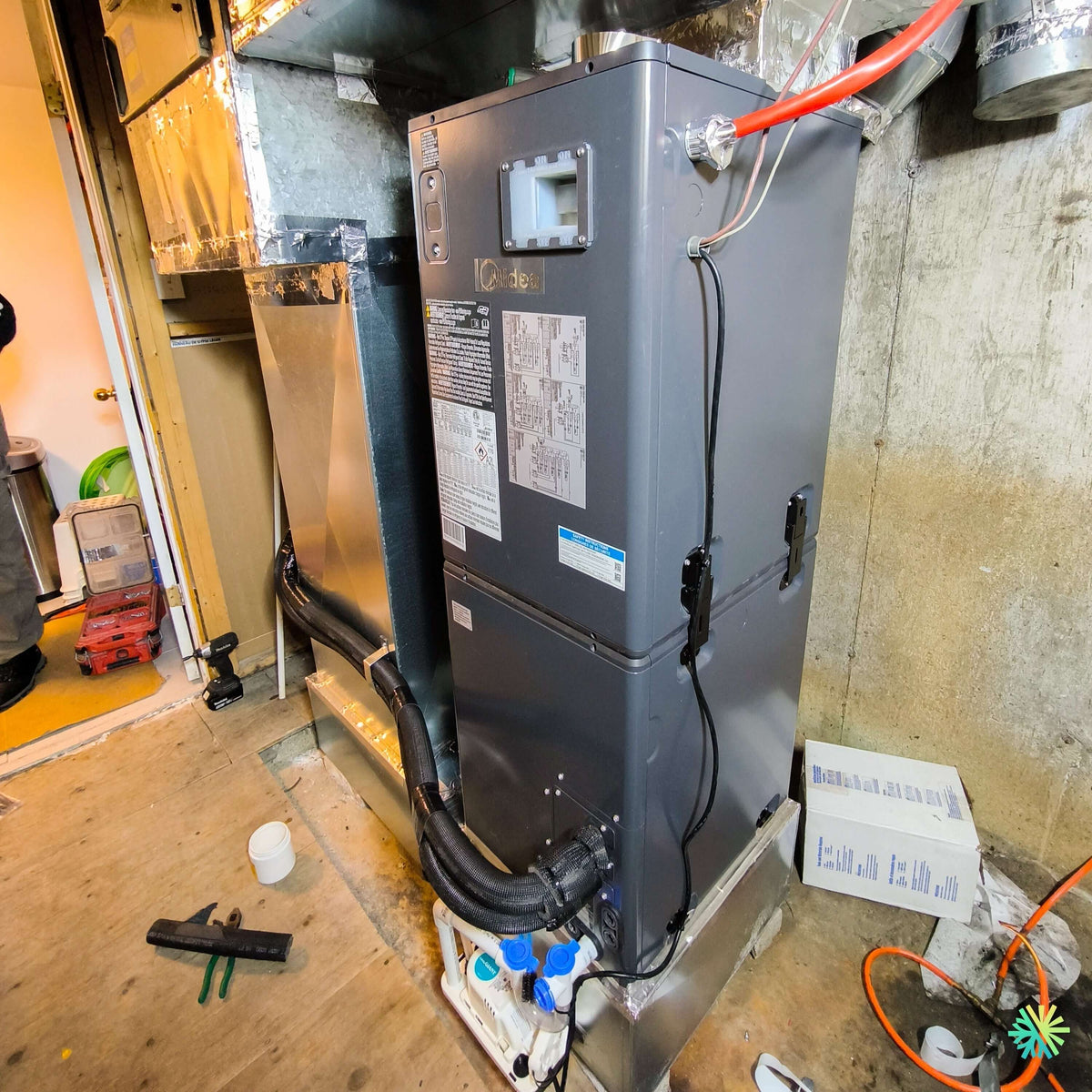
In Saint-Constant, our AirGreen team recently completed the installation of a MIDEA EVOX G3 3-ton electric furnace, configured as a central system with an air handler, in a confined mechanical space where every detail mattered. Upon arrival on site, the main challenge was clear: integrate a modern, high-performance central unit, properly connected to an existing duct network, while maintaining a clean, accessible, and durable installation.
The project image clearly shows the reality on the ground: a narrow mechanical room, existing ducts, a raised metal base, multiple connections to coordinate, and very little margin for error around the equipment. It is precisely in this type of context that the experience of a team specializing in HVAC installation becomes essential.
A 3-ton MIDEA EVOX G3 adapted to the needs of a Saint-Constant home
The MIDEA EVOX G3 3-ton is a central solution designed to provide uniform air distribution throughout the house. Unlike a wall-mounted unit, this type of system works with existing ducts to distribute heating and air conditioning to multiple rooms from a single central unit.
In this project in Saint-Constant, the choice of a MIDEA air handler allowed for the modernization of the installation while maintaining a centralized comfort logic. For homeowners who want to avoid the proliferation of wall-mounted units, this type of system represents a very relevant solution, especially when the house already has a functional duct network.
Key technical points of the project
This installation notably included:
- A MIDEA EVOX G3 3-ton electric furnace
- A configuration as a central air handler system
- Connection to existing ducts
- An installation on an adapted metal base
- Integration into a compact mechanical room
- Sealing adjustments around the ducts
- Particular attention to accessibility for HVAC maintenance
The unit was installed with care to respect clearance, stability, and connection constraints. In such a confined space, poor planning can easily complicate future maintenance, create vibrations, impair air circulation, or make certain components difficult to access.
A clean installation despite a demanding technical space
One of the most interesting aspects of this project is the precision required around the unit. The furnace is installed in close proximity to a concrete wall, metal ducts, and a restricted passage. Our team therefore had to position the unit to optimize the available space, while maintaining efficient air circulation.
The connection to the ducts required particular attention. The visible joints around the plenum and ducts were treated to limit air loss and improve the overall efficiency of the system. In several homes in Saint-Constant, Montreal, Laval, Longueuil, on the North Shore and South Shore, we often observe significant losses in existing ducts. Even with excellent equipment, poor sealing can reduce comfort and increase energy consumption.
Why duct sealing changes everything
When a central system is installed, the equipment is only one part of the performance. The distribution network is just as important. An air leak in a duct, poor alignment, or a poorly sealed transition can create several problems:
- Some rooms receive too little air
- The system runs longer
- Comfort becomes uneven
- Electricity consumption increases
- The equipment undergoes more operating cycles
In this project, we paid particular attention to the transitions between the new unit and the existing ducts. The objective was simple: ensure that the air produced by the MIDEA EVOX G3 electric furnace is actually delivered to the rooms of the house, without unnecessary losses in the mechanical room.
A solid base to reduce vibrations and protect the equipment
The furnace was installed on a stable metal base, which allows the unit to remain well positioned and facilitates connection to the ducts. This base also plays an important role in the durability of the installation. A central unit that is poorly seated or misaligned can generate vibrations, parasitic noises, and unnecessary stress on the connections.
At AirGreen, we consider the installation base an important technical element, and not just a simple support. In a central installation, stability directly influences sound quality, the longevity of connections, and the overall appearance of the final work.
The importance of access for future maintenance
Another important point visible in this installation is the space provided around the service panels. Even in a narrow mechanical room, future considerations are essential: filter changes, component inspection, connection checks, cleaning, and eventual diagnosis.
A common mistake in central system installations is to place the equipment too tightly against an obstacle, which then complicates interventions. In this project in Saint-Constant, our team worked to maintain a compact, but still accessible, installation.
Good HVAC maintenance directly depends on this accessibility. A well-installed unit is easier to maintain, simpler to diagnose, and generally more reliable in the long run.
An interesting central solution for South Shore homes
In Saint-Constant and several sectors of the South Shore, homes equipped with central ducts can greatly benefit from a system like the MIDEA EVOX G3 3-ton. For homeowners, the main advantage is uniform comfort. Air is distributed throughout the house, which avoids significant disparities between rooms.
This type of installation is particularly relevant when:
- The duct network is already in place
- The client wishes to modernize an old furnace
- The house requires complete air distribution
- Wall space is not suitable for multiple wall-mounted units
- The owner is looking for a discreet and centralized solution
In this project, the modernization of the central system allowed for the retention of the existing air distribution approach, while improving equipment quality and installation precision.
Mistakes to avoid with a central electric furnace
When an owner compares quotes for an HVAC installation in Saint-Constant, Montreal, Laval, Longueuil, on the North Shore or South Shore, it is important not to look only at the price of the appliance. Several mistakes can be costly in the medium term.
Neglecting the condition of existing ducts
Even if the appliance is new, the ducts must be inspected. A poorly insulated, poorly sealed, or improperly sized network can impair performance.
Installing without considering technical access
A central system must remain accessible for maintenance. An appliance stuck in a corner without sufficient clearance quickly becomes problematic.
Underestimating the importance of drainage and connections
Pipes, cables, ducts, and accessories must be organized neatly. A disorganized installation increases the risk of future problems.
Choosing a team without experience in central systems
An electric furnace with an air handler is not just a box to connect. It must be integrated into a complete system: ducts, electrical supply, air circulation, control, filtration, and service access.
The AirGreen approach: precision, cleanliness, and long-term vision
On this project, our team applied a simple method: analyze the space, respect existing constraints, install the equipment with precision, then verify that each connection contributes to the overall proper functioning of the system.
We don't just aim to install an appliance. We aim to deliver a complete, reliable, and well-thought-out HVAC solution. It is this approach that allows us to intervene effectively in Saint-Constant as well as Montreal, Laval, Longueuil, on the North Shore and South Shore.
Each house has its own peculiarities. Some have spacious mechanical rooms, others require very tight access. Some have recent ducts, others need more meticulous adjustments. Our role is to adapt the installation to the reality of the building, without sacrificing quality.
A functional, clean, and ready-for-demanding-seasons final result
At the end of the installation, the MIDEA EVOX G3 3-ton electric furnace was solidly in place, well connected to the duct system and ready to provide centralized comfort to the home. The final result reflects what we seek in every project: a clean, logical, durable installation designed for the client's daily life.
For homeowners in Saint-Constant considering a modernization of their central system, this project clearly illustrates the importance of entrusting the work to a team that understands both the equipment and the building. Good HVAC installation is not limited to replacing a machine. It involves integrating a complete system into a real space, with its constraints, ducts, access points, and comfort needs.
At AirGreen, we install central systems, electric furnaces, heat pumps, air conditioners, and complete HVAC solutions with the same objective: to provide a reliable, clear, and durable installation, adapted to the homes of Greater Montreal.
The big day, step by step
The main steps of this kind of job at AirGreen. Every house has its quirks: the estimate brings them out.
We look at the ducts, the current indoor module, the electrical panel and the planned spot for the outdoor unit.
The equipment combination, capacity and price, in writing. We check whether the combination qualifies for assistance programs.
Access protected, old unit disconnected and removed when it is being replaced.
Electric furnace or air handler, with its coil, connected to the supply and return ducts.
On a level base, raised above the snow, with free space all around.
Insulated, they enter through a sealed opening and run to the indoor coil.
Dedicated circuits, accessible disconnect, a thermostat that works with the heat pump and the backup heat.
Leak test, vacuum, start-up, airflow check and a test of both modes.
Filter, thermostat, backup heat in extreme cold: what to know before winter.
- The on-site estimateWe look at the ducts, the current indoor module, the electrical panel and the planned spot for the outdoor unit.
- The quoteThe equipment combination, capacity and price, in writing. We check whether the combination qualifies for assistance programs.
- Getting readyAccess protected, old unit disconnected and removed when it is being replaced.
- The indoor moduleElectric furnace or air handler, with its coil, connected to the supply and return ducts.
- The outdoor unitOn a level base, raised above the snow, with free space all around.
- The refrigerant linesInsulated, they enter through a sealed opening and run to the indoor coil.
- Electrical and thermostatDedicated circuits, accessible disconnect, a thermostat that works with the heat pump and the backup heat.
- Tests and start-upLeak test, vacuum, start-up, airflow check and a test of both modes.
- The walkthroughFilter, thermostat, backup heat in extreme cold: what to know before winter.
What would it look like at your place?
Two quick checks with real numbers: what heat costs, and what your current heaters add up to in BTU/h.
Conversion: 1 W = 3.412 BTU/h. An indication, not a load calculation: baseboards and furnaces are often stronger than the real need, and they can stay as backup. AirGreen confirms the capacity on site.
Four mistakes we do not make
Flip each card to see what we do instead.
Your own project, step by step
What to do, season by season
Three habits per season for this unit. They take a few minutes and prevent many calls.
- Check the indoor module's filter.
- Clear winter debris from the outdoor unit.
- Test cooling before the heat arrives.
- Check the filter more often in peak season.
- Keep registers and returns clear.
- Watch condensate drainage near the coil.
- Change or clean the filter.
- Test heating and backup heat before the cold.
- Book periodic maintenance.
- Clear snow around the outdoor unit.
- Store nothing in front of the indoor module.
- Note any unusual noise or smell and call us.
Is your home ready?
Check what applies at your place. A "no" is not a refusal: it is what we sort out during the estimate.
Four statements: true or false?
It all comes down to details you have just seen.
1. A central heat pump uses the house's ducts.
It connects to the existing ducts to heat and cool everywhere.
2. In extreme cold, electric backup heat can take over.
The indoor module (furnace or air handler) works with the heat pump and takes over in extreme cold.
3. The filter only gets changed when the unit breaks down.
A dirty filter cuts airflow. It gets checked regularly.
4. You can reuse the old unit's size without checking.
The house may have changed: insulation, windows, added rooms. Capacity is confirmed on site.
0 / 4 right answers
What people ask us about this kind of work
Can I keep my current ducts?
What happens in extreme cold?
Furnace, air handler, ducted: what is the difference?
Are there grants?
Do I need a permit?
How much can I save?
How is the LogisVert assistance calculated?
Will my current thermostat work?
Central or wall units: which one?
Does AirGreen hold the required licences?
Is the estimate free?
No question matches. Write to us: we answer.
More jobs to see, near you
By town, by equipment or by region: browse more than 4,700 published projects.
Each dot: a town where AirGreen has published projects. The glowing dot: this job.
Every house has its constraints. We see them before we install.
The on-site estimate is free and the quote follows within 24 hours.
Text and photo: a real AirGreen Climatisation & Chauffage job. The diagrams are generic illustrations of the type of installation, not a survey of this job site. Sources of the added figures: airgreen.ca product pages (NEEP / AHRI performance), Hydro-Québec (Heat pumps page, LogisVert, read on 13 October 2026), Régie de l’énergie (rate D as of 1 April 2026).