
Installation of a GREE All Match Slim Duct R32 Ducted System in Côte-des-Neiges–Notre-Dame-de-Grâce, Montreal
Installation of a GREE Ducted System in Côte-des-Neiges–Notre-Dame-de-Grâce: discreet Slim Duct solution, integrated into the ceiling, with optimized ducts and neat finishing.
In summer, the outdoor unit rejects the house's heat outside.
Generic illustration of this type of installation, not a survey of this job site. Tap a number.
It captures or rejects heat outside. It sits on a level base, above the snow, with free space all around.
The insulated refrigerant lines enter the house through a sealed opening and run to the indoor coil.
A shut-off switch near the outdoor unit isolates it safely for service.
Sitting on the indoor module, it moves heat between the house air and the refrigerant.
Electric furnace or air handler: its fan pushes air through the ducts. The electric backup takes over in extreme cold.
Supply ducts bring air to the rooms; returns bring it back to the unit. Their condition matters as much as the unit's.
It protects the coil and the fan. A dirty filter cuts airflow, so it gets checked regularly.
It runs the heat pump and the backup heat. It must be compatible with the installed system.
A GREE Gainable installation in an open ceiling in the heart of Côte-des-Neiges–Notre-Dame-de-Grâce
In Côte-des-Neiges–Notre-Dame-de-Grâce, our AirGreen team carried out a particularly technical HVAC installation with a GREE Gainable system, also called ducted conduit, Slim Duct, or ductable system. The project took place in a typically Montreal context: an existing building, limited ceiling space, exposed wood structure, walls already finished around the work area, and a clear need to integrate comfort without adding a visible wall unit in the main rooms.
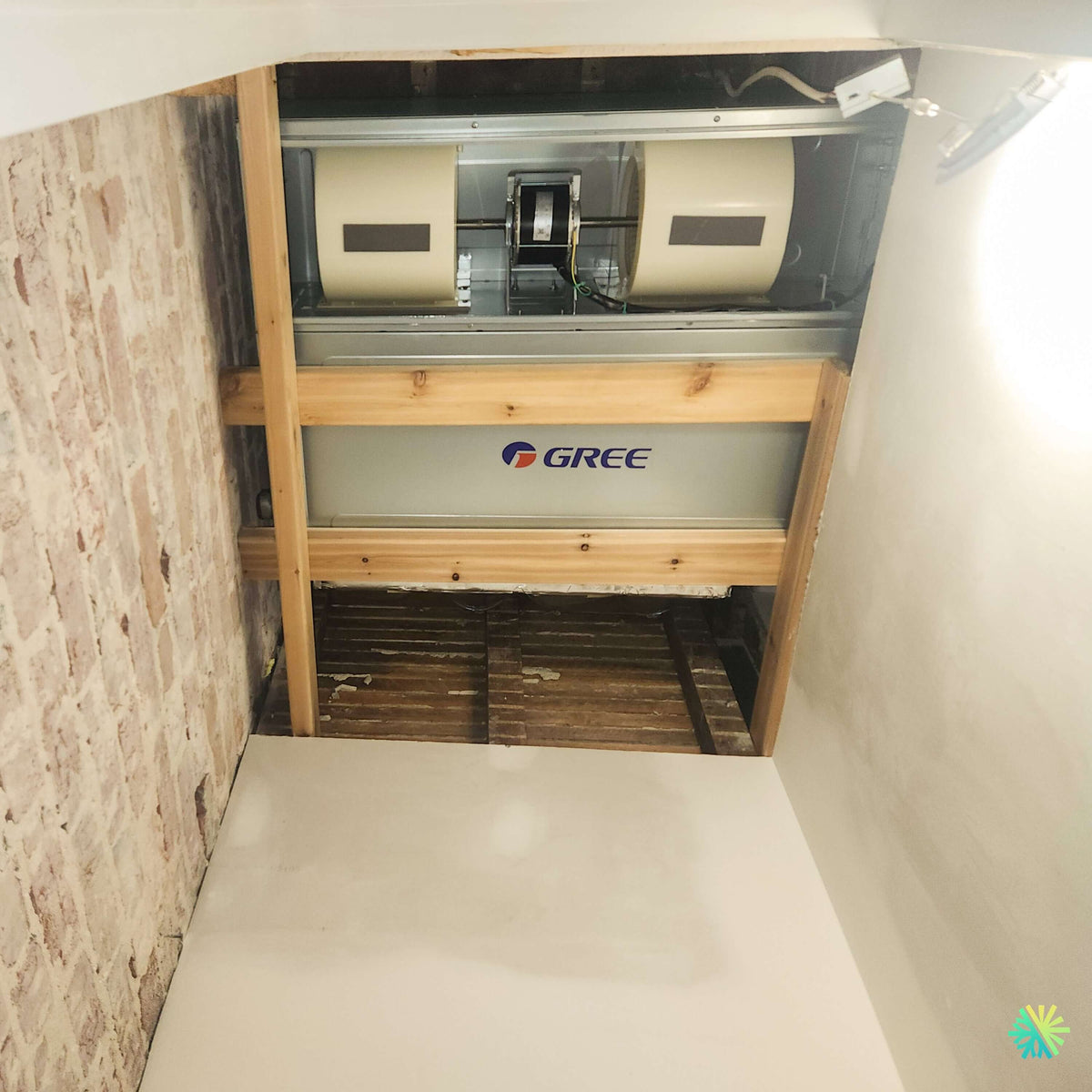
The construction photo clearly shows the nature of the task: the GREE indoor unit was positioned in a ceiling opening, between wooden framing elements, with access to the ventilation section and the mechanical box. This setup requires great precision because a ducted system does not forgive approximations. Unlike a wall heat pump or a wall air conditioner, the device is hidden in a technical area, then air is distributed through ducts to strategically placed grilles.
In this project, the client wanted a solution more discreet than a conventional wall system. The goal was to achieve uniform comfort, stable air circulation, and an almost invisible visual integration in the living space. The choice of a GREE All Match Slim Duct R32 met this expectation well: a slim indoor unit, suitable for ceilings, soffits, false ceilings, and configurations where interior aesthetics matter as much as performance.
The main challenge: install without losing service access
In buildings in Montreal, especially in dense areas like Côte-des-Neiges, Notre-Dame-de-Grâce, Outremont, Le Plateau-Mont-Royal, or Rosemont, HVAC installations often have to deal with tight spaces. Ceilings are not always perfectly straight, existing openings do not always match ideal dimensions, and duct passages must respect the building's structure.
For this project, our first priority was to maintain functional access to the unit. A ducted system must remain accessible for HVAC maintenance, checking the condensation drain, inspecting electrical connections, cleaning filters, and future diagnostics. An installation that looks clean on the first day but blocks access to the service panel quickly becomes problematic.
Our technicians therefore worked with a maintenance logic from the start. The unit was positioned to allow panel opening, fan control, connection checks, and post-installation interventions. This step is essential for any GREE Ducted system, especially when installed above a finished ceiling or in a closed cavity.
A wooden structure to integrate precisely
The presence of wooden studs and crosspieces around the unit added a significant constraint. The device had to be properly supported, vibration points avoided, and stable integration with the future finish planned. Ducted systems can be very quiet, but only if the mechanical installation is well executed.
We therefore paid special attention to:
- stability of the unit in its location;
- reduction of vibrations transmitted to the structure;
- alignment with future ducts;
- preservation of necessary clearances;
- easy access to the service panel;
- protection of surfaces around the work area.
This type of installation is not limited to hanging a machine. You have to consider air behavior, vibrations, noise, drainage, and architectural finishing. This is precisely where AirGreen's experience with HVAC ducted systems becomes crucial.
Why choose a GREE Ducted system rather than a wall unit
In several condos and houses in Montreal, the wall available for a wall unit is not always ideal. It may be occupied by windows, cabinets, wall art, condominium restrictions, or an interior layout that would make the device too visible. A GREE Ducted system allows you to bypass this difficulty by placing the equipment in a hidden area.
The desired result is more discreet: only the supply and return grilles are visible. Air is distributed into the rooms instead of coming out of a single wall unit. For clients who want to preserve interior design, this solution often represents an excellent compromise between comfort, efficiency, and discretion.
On this site in Côte-des-Neiges–Notre-Dame-de-Grâce, the ducted system also allowed better air distribution in the space. In a residential setup with adjacent rooms, corridors, or open areas, a single wall air outlet does not always provide a uniform feeling. With well-designed ducts, comfort becomes more consistent and temperature variations are better controlled.
The GREE Ducted models available at AirGreen
AirGreen offers several GREE Ducted systems suited for residential and light commercial needs. The range includes low static pressure models, high static pressure models, and the GREE All Match Slim Duct R32 series, available in several capacities, including 9,000, 12,000, 18,000, 24,000, 30,000, and 36,000 BTU depending on the chosen configuration.
The final capacity of a unit should never be chosen solely based on the area. For a ducted system, we also evaluate:
- the number of rooms served;
- the length and shape of the ducts;
- the pressure losses;
- the available static pressure;
- the building insulation;
- the sun exposure;
- the ceiling height;
- the number of windows;
- the actual heating and cooling needs;
- the expected noise level.
This analysis is essential. An oversized unit can cause too short cycles and poor humidity control. An undersized unit may run almost continuously during heat or cold peaks. Proper sizing allows for a more stable, comfortable, and durable heat pump.
The role of static pressure in a ducted installation
Static pressure is one of the most important points of a ducted system. It determines the fan's ability to push air through the duct network. If the ducts are too long, too narrow, or poorly aligned, the air flows less efficiently. This can create less comfortable rooms, increased noise, and reduced efficiency.
In a ceiling like the one in this project, the room for maneuver is limited. The ducts must be planned intelligently to avoid unnecessary bends, restrictions, and air losses. Our team therefore worked considering the air path from the unit installation, so that the distribution is consistent with the existing structure.
R32, efficiency and performance in Quebec climate
The GREE All Match Slim Duct R32 series represents a modern approach to HVAC systems. The refrigerant R32 is increasingly used in new generations of heat pumps, notably for its performance characteristics and its role in improving high-efficiency systems.
Depending on the models and unit combinations, some GREE Ducted systems can offer performance suited to Quebec winters, with versions designed to maintain effective heating capacity in cold weather. At AirGreen, we always verify the exact combination of indoor and outdoor units before confirming performance, potential eligibility for subsidies, and the suitability of the model for the building.
For clients in Montreal, Laval, Longueuil, the North Shore, and the South Shore, this step is essential. The needs of a well-insulated condo in NDG are not the same as those of a detached house in Boucherville or an older plex in Villeray. Our recommendation always depends on the actual building, not just a technical sheet.
A discreet integration that requires true HVAC expertise
This project clearly illustrates why a ducted installation must be entrusted to a team experienced with this type of equipment. A Slim Duct system can deliver a very clean result, but only if the planning is thorough. The unit must be well positioned, the ducts must be properly sized, the air return must be sufficient, the drainage must be reliable, and technical access must remain practical.
Mistakes to avoid with a ducted system
A poorly installed ducted system can create problems that are not always immediately visible. Among the most common mistakes, we find:
Reducing air return too much
Insufficient air return forces the system to operate under poor conditions. This can increase noise, reduce airflow, and affect comfort in the served rooms.
Installing the device without service access
A unit hidden in a ceiling must remain accessible. The opening, workspace, and access path to the main components must be planned.
Neglecting the condensation drain
Drainage is essential in cooling mode. An inadequate slope, a poorly protected drain, or difficult access can cause water damage and avoidable service calls.
Choosing the wrong static pressure
A low static pressure model is not always suitable for a more complex network. Conversely, a high static pressure model must be used with appropriate design to avoid overly noisy ventilation.
Underestimating acoustics
Noise does not only come from the device. It can come from the ducts, grilles, vibrations, or an unbalanced airflow. That is why we analyze the installation as a complete system.
A customer experience focused on clarity
Before installation, we took the time to explain to the client the constraints related to the ceiling, the framework, and mechanical access. This type of project often requires coordination with other finishing work: closing the ceiling, future access, grille positioning, integration of hatches, and finishing around openings.
At AirGreen, we prioritize clear communication from the start. The client must understand where the unit will be placed, how the air will be distributed, which parts will remain accessible, and what the building's technical limits are. This transparency avoids surprises and allows for a delivery of an installation that meets expectations.
An ideal solution for many Montreal buildings
The GREE Ducted systems are particularly suitable for properties where the interior aesthetics need to be preserved. In Côte-des-Neiges–Notre-Dame-de-Grâce, many homes have ceilings, load-bearing walls, corridors, and partitions that make wall installations more complex. The ducted system then becomes an elegant and efficient solution.
We install this type of system in various contexts:
- condos with aesthetic restrictions;
- renovated houses with false ceilings;
- Montreal multiplexes with limited technical spaces;
- residential extensions;
- offices and small commercial spaces;
- homes where several rooms need to be served discreetly.
Each project requires an accurate reading of the building. The same machine can produce very different results depending on the quality of the installation, the design of the ducts, and the air balancing.
Subsidies and eligibility: a case-by-case validation
Clients who choose a ducted heat pump often ask us if their installation can be eligible for a subsidy. The answer depends on the exact model, the indoor-outdoor combination, energy efficiency, current criteria, and the program applicable at the time of installation.
AirGreen supports its clients in this verification. When a model is eligible, we provide the necessary information to facilitate the process. For GREE systems, some configurations may meet performance criteria, but validation must always be done with exact model numbers and program requirements.
AirGreen, specialist in GREE Ducted installations in Montreal
This installation in Côte-des-Neiges–Notre-Dame-de-Grâce demonstrates the importance of a technical and careful approach. The GREE Ducted All Match Slim Duct R32 system was integrated into a complex ceiling space, with particular attention paid to service access, structure, airflow, and future finishing.
AirGreen installs heat pumps, wall air conditioners, central systems, multi-zone systems, and GREE ducted solutions in Montreal, Laval, Longueuil, on the North Shore and the South Shore. Our job is to recommend a solution truly suited to the building, then install it with the necessary rigor to ensure comfort, reliability, and easy maintenance.
In this project, the client got exactly what they were looking for: a discreet, well-integrated system capable of providing stable comfort without adding any visible units in the rooms. For owners who want a clean, durable, and technically solid result, the GREE Ducted remains a very interesting option when installed by a team that masters the constraints of ducts, ceilings, and Montreal buildings.
How it goes, from the first call to the end
The main steps of this kind of job at AirGreen. Every house has its quirks: the estimate brings them out.
We look at the ducts, the current indoor module, the electrical panel and the planned spot for the outdoor unit.
The equipment combination, capacity and price, in writing. We check whether the combination qualifies for assistance programs.
Access protected, old unit disconnected and removed when it is being replaced.
Electric furnace or air handler, with its coil, connected to the supply and return ducts.
On a level base, raised above the snow, with free space all around.
Insulated, they enter through a sealed opening and run to the indoor coil.
Dedicated circuits, accessible disconnect, a thermostat that works with the heat pump and the backup heat.
Leak test, vacuum, start-up, airflow check and a test of both modes.
Filter, thermostat, backup heat in extreme cold: what to know before winter.
- The on-site estimateWe look at the ducts, the current indoor module, the electrical panel and the planned spot for the outdoor unit.
- The quoteThe equipment combination, capacity and price, in writing. We check whether the combination qualifies for assistance programs.
- Getting readyAccess protected, old unit disconnected and removed when it is being replaced.
- The indoor moduleElectric furnace or air handler, with its coil, connected to the supply and return ducts.
- The outdoor unitOn a level base, raised above the snow, with free space all around.
- The refrigerant linesInsulated, they enter through a sealed opening and run to the indoor coil.
- Electrical and thermostatDedicated circuits, accessible disconnect, a thermostat that works with the heat pump and the backup heat.
- Tests and start-upLeak test, vacuum, start-up, airflow check and a test of both modes.
- The walkthroughFilter, thermostat, backup heat in extreme cold: what to know before winter.
And at your place?
Two quick checks with real numbers: what heat costs, and what your current heaters add up to in BTU/h.
Conversion: 1 W = 3.412 BTU/h. An indication, not a load calculation: baseboards and furnaces are often stronger than the real need, and they can stay as backup. AirGreen confirms the capacity on site.
What to do, season by season
Three habits per season for this unit. They take a few minutes and prevent many calls.
- Check the indoor module's filter.
- Clear winter debris from the outdoor unit.
- Test cooling before the heat arrives.
- Check the filter more often in peak season.
- Keep registers and returns clear.
- Watch condensate drainage near the coil.
- Change or clean the filter.
- Test heating and backup heat before the cold.
- Book periodic maintenance.
- Clear snow around the outdoor unit.
- Store nothing in front of the indoor module.
- Note any unusual noise or smell and call us.
Which type of equipment for your project?
Pick what looks like your need.
Four mistakes we do not make
Flip each card to see what we do instead.
What people ask us about this kind of work
Can I keep my current ducts?
What happens in extreme cold?
Furnace, air handler, ducted: what is the difference?
Are there grants?
Do I need a permit?
How much can I save?
How is the LogisVert assistance calculated?
Will my current thermostat work?
Central or wall units: which one?
Does AirGreen hold the required licences?
Is the estimate free?
No question matches. Write to us: we answer.
Useful pages for what comes next
More jobs to see, near you
By town, by equipment or by region: browse more than 4,700 published projects.
Each dot: a town where AirGreen has published projects. The glowing dot: this job.
Tell us about your house. We come and see it for free.
The on-site estimate is free and the quote follows within 24 hours.
Text and photo: a real AirGreen Climatisation & Chauffage job. The diagrams are generic illustrations of the type of installation, not a survey of this job site. Sources of the added figures: airgreen.ca product pages (NEEP / AHRI performance), Hydro-Québec (Heat pumps page, LogisVert, read on 13 October 2026), Régie de l’énergie (rate D as of 1 April 2026).