
Installation of a MIDEA EVOX G3 electric furnace in Roxton with a 12 × 20 × 4 filter and complete adaptation of the central ductwork system
In Roxton, AirGreen installs a MIDEA EVOX G3 electric furnace with a 12 × 20 × 4 filter, accessible trap, R-454B lines, and central ductwork adaptation for precise airflow and simplified maintenance.
- City
- Region
- Equipment
- Brand
- Challenges
- Published
The job on one screen
The article, chapter by chapter
In Roxton, the challenge was to integrate a new-generation central furnace into a basement where every component had to find its place
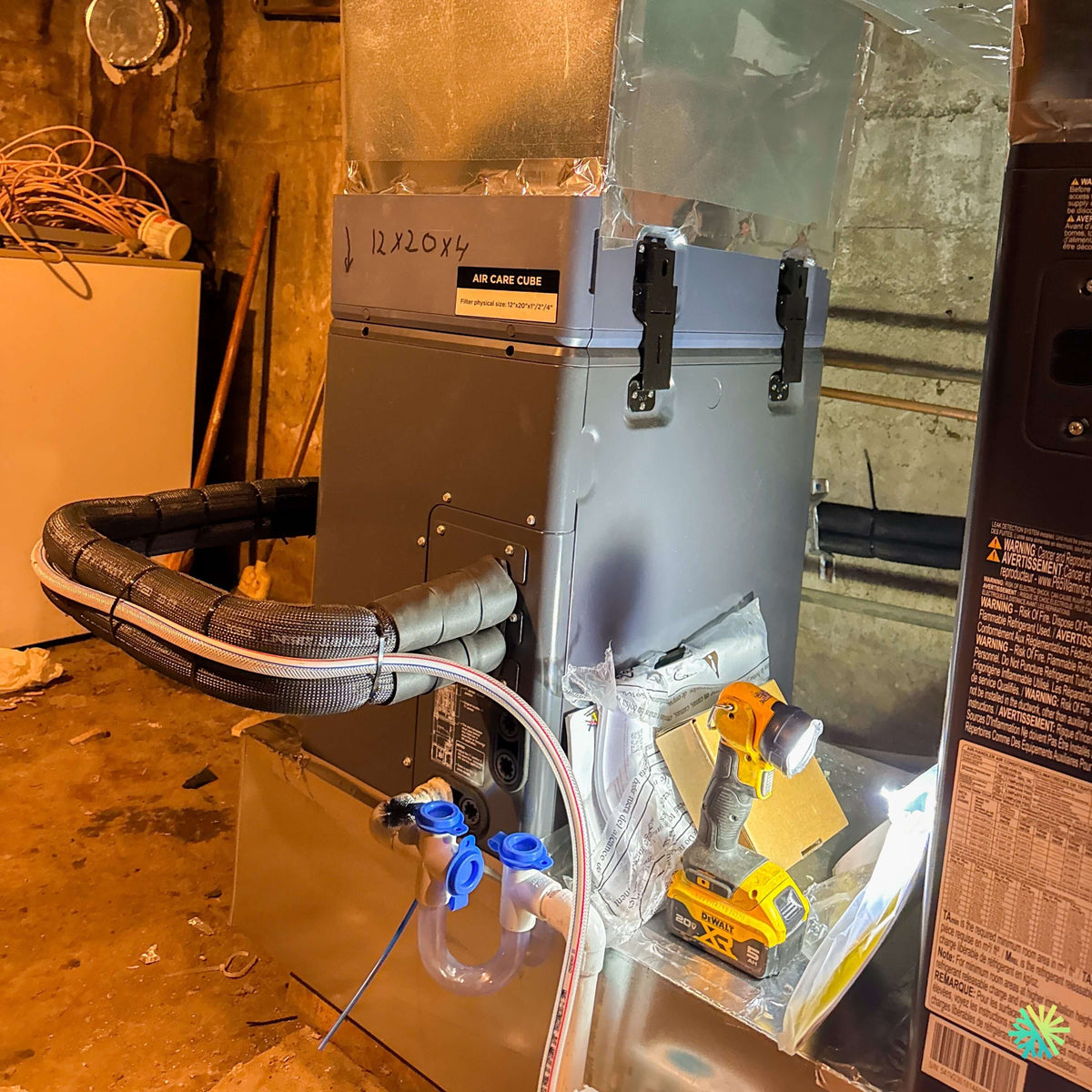
At this job in Roxton, we were not working in a new, empty mechanical room perfectly sized for the new equipment. Instead, the photograph taken during the work shows the reality of an HVAC installation in an existing home: existing metal ductwork, foundation walls, limited clearance, existing piping, and several connections to organize around the new MIDEA EVOX G3 electric furnace.
The new unit had to be integrated vertically into the central ductwork while keeping the coil, condensate drainage, refrigerant lines, and filtration system accessible. One detail immediately draws attention in the photo: above the MIDEA EVOX G3, we have a clearly identified AIR CARE CUBE filtration section, accompanied by a handwritten indication of 12 × 20 × 4. This dimension, visible at the job site, reminds us of an aspect too often overlooked when replacing a furnace: the filter and airflow are part of the system design; they should not be treated as an afterthought.
The photograph was taken during the work, which makes it possible to see elements that are usually hidden once the installation is complete: the transparent drain trap, refrigerant connections, insulated lines, access panels, new sheet-metal transitions, and even the tools used by our technicians.
For us, this type of photo is particularly representative of our work at AirGreen. An electric furnace installation is not simply a matter of setting a metal cabinet in place and connecting it to electricity. We must ensure that the equipment operates properly within the actual building around it.
A vertical MIDEA EVOX G3 with filtration clearly integrated into the project
The new indoor unit is installed vertically, with the supply-air ductwork continuing upward.
At the top, the filtration section and metal transitions were integrated into the existing system. This approach places the filtration within the intended airflow path rather than improvising a small-surface filter in an awkward, difficult-to-access opening.
In the photo, the 12 × 20 × 4 indication is particularly interesting. A four-inch filter generally offers a much larger media surface area than a thin standard filter, provided, of course, that the cabinet and ductwork were designed for this dimension.
MIDEA EVOX G3 documentation specifically indicates that the platform can be used with 1-, 2-, or 4-inch filtration solutions, including MERV 13 filters depending on the configuration. MIDEA notes that this type of filtration can help capture more dust, pollen, particles, and pet-related contaminants while helping keep the coil cleaner.
Nevertheless, a common mistake must be avoided: assuming that the higher the MERV rating, the better the system will automatically operate.
A filter always creates resistance to airflow. We must therefore consider its surface area and thickness, the airflow required by the unit, and the system’s static pressure simultaneously.
Airflow was a central concern in this installation
The performance of a central heat pump depends directly on the amount of air passing through its indoor coil.
Insufficient airflow can affect heat transfer, increase certain operating stresses, and reduce comfort. Excessive airflow, on the other hand, can create noise in the ductwork and uncomfortable air speeds at the grilles.
This is where the EVOX G3’s architecture becomes particularly interesting for a renovation.
MIDEA uses its Computational Constant Airflow 2.0 technology, designed to adjust the fan’s capacity and speed to the conditions of the ductwork. The documentation indicates an adaptation capacity of up to approximately 1.2 in. of external static pressure, along with adjustment of up to 60 airflow levels.
In an existing home in Roxton, this flexibility is far more valuable than it would be in a laboratory.
The actual ductwork may include multiple duct lengths, elbows, transitions, thicker filtration, and branches serving rooms located at different distances from the furnace.
The electronics and ECM motor can help compensate for normal resistance variations. However, they cannot make a completely undersized duct acceptable. That is why we continue to consider the ductwork and furnace as a single system.
A sheet-metal transition designed around the unit, not the other way around
The upper section visible in the photo shows several sheet-metal sections connecting the new unit to the existing ductwork.
These components are important.
When the outlet size of a new furnace does not exactly match the size of the home's ductwork, we must create a transition. Its geometry affects airflow.
A transition that is too abrupt can create turbulence and increase pressure loss. A properly planned transition, on the other hand, allows it to connect to the ductwork while maintaining a more consistent airflow.
This is precisely the type of detail that homeowners rarely see when comparing two quotes based solely on the brand and the number of BTUs.
The refrigerant lines reveal that this is a true central heat pump system
To the left of the MIDEA EVOX G3, the two refrigerant lines leading to the indoor module are clearly visible.
The main line is protected by insulation and an outer jacket, while the smaller copper line follows the same path.
These lines connect the indoor unit to the outdoor heat pump.
We must meet several criteria when installing them: bend radius, mechanical protection, insulation, accessible connections, and the absence of unnecessary strain on the connections.
In the photograph, the lines were arranged neatly before entering the coil section.
This arrangement also matters for future servicing. A technician must be able to check the connections without having to cut or dismantle everything around them.
A transparent trap with a cleaning access point: small component, major importance
At the bottom of the unit, the transparent condensate trap is one of the easiest components to recognize in the photo.
It has several access points fitted with blue caps.
This type of configuration makes it easier to visualize the condition of the drain and facilitates cleaning during HVAC maintenance.
When the heat pump operates in cooling mode, the moisture in the air condenses on the coil. This water must be continuously drained away.
A poorly designed drain can lead to problems disproportionate to its cost: water accumulation, overflow, biological obstruction, odors, or damage to surrounding materials.
For our installations, we therefore want the drainage to be not only functional on the day of commissioning, but also accessible several years later.
The modular design of the EVOX G3 makes work in a basement easier
One of the most distinctive technical advantages of the MIDEA EVOX G3 is its Block N Lock design.
The manufacturer's documentation presents a modular cabinet that can be configured in several ways. MIDEA provides six installation orientations, including vertical and horizontal positions and certain low-height configurations. The manufacturer also emphasizes ease of handling in difficult spaces such as basements and attics.
This feature is directly relevant on a job site like the one in Roxton.
Before a furnace can even be connected, it has to be brought to its intended location.
In some homes, access involves a narrow staircase, a limited doorway, a tight turn, or several pieces of equipment that are already installed. The ability to work with a modular architecture can greatly simplify this step.
A platform also designed for replacement projects
Page 5 of the MIDEA documentation specifically presents the EVOX G3 as a solution suited to replacing existing central systems.
The manufacturer announces cabinet widths of approximately 14.5 to 21.5 inches, depending on capacity, as well as a multivoltage architecture for the relevant modules.
These dimensions are appealing for renovations because many homes already have a mechanical space defined by the old furnace and existing ductwork.
This allows us to focus our modifications on the areas where they are truly necessary rather than unnecessarily rebuilding the entire mechanical room.
What this MIDEA EVOX G3 installation brings to a home in Roxton in terms of heating, efficiency, and flexibility
An electric furnace that works with the outdoor heat pump
The term electric furnace can sometimes be confusing.
In a central installation like this one, the indoor unit includes the blower and coil and can incorporate auxiliary electric heating. However, when the system is paired with a heat pump, the electric resistance does not necessarily have to provide all the heat during the winter.
The outdoor heat pump transfers heat into the home. The electric heating can then supplement this capacity when demand increases.
MIDEA offers, for the EVOX G3 line, a three-stage auxiliary heating kit capable of providing up to 25 kW, with 10, 15, and 25 kW options depending on the configuration. The manufacturer states that these stages can be activated and adjusted according to temperature variations.
We cannot determine from this photograph the exact auxiliary electrical capacity installed for this Roxton project. We therefore do not present an unconfirmed value as a characteristic of this project.
Why we never automatically choose 25 kW
The maximum available capacity is not necessarily the appropriate capacity.
We must consider the building’s heating load, the heat pump’s low-temperature performance, the electrical panel, and the control strategy.
An excessively large electric resistance heater can unnecessarily increase power draw when multiple stages are activated.
Conversely, auxiliary heating that is too small may not meet certain load conditions.
The right choice therefore comes from system sizing, not from a rule that “bigger is always better.”
Heating performance designed for very cold temperatures
The EVOX G3 documentation places strong emphasis on low-temperature operation.
MIDEA indicates continuous operation down to -30 °C for its Extreme Heat platform. The manufacturer also reports up to 100% heating capacity at -25 °C and a COP of approximately 1.9 under the stated test conditions.
This data is particularly relevant for a Quebec residence.
However, two concepts must be distinguished: the minimum temperature at which the heat pump can operate and the amount of heat it actually delivers at that temperature.
When choosing a system, we consider both.
Up to 19 SEER2 and 10.8 HSPF2 depending on the pairing
The MIDEA EVOX G3 lineup covers several capacities and efficiency levels.
Depending on the indoor-outdoor combination, the manufacturer advertises performance of up to 19 SEER2, 12.5 EER2, 10.8 HSPF2, and a COP at 5 °F of up to 2.14.
The brochure’s technical page also shows several combinations ranging from approximately 18,000 to 54,000 BTU/h, with different performance levels depending on the models.
This is important information for homeowners shopping for a MIDEA central heat pump.
The name EVOX G3 alone is not enough to establish the SEER2, HSPF2, or exact capacity.
The indoor and outdoor model numbers must be known.
The exact capacity of this Roxton installation must not be fabricated
The photograph confirms the equipment series and many installation details, but the visible rating plate does not allow the complete model number to be read with sufficient certainty.
We therefore cannot claim that this installation is specifically 24,000, 30,000, 36,000, or 48,000 BTU based on the image alone.
For us, this caution is important.
Technical data published simply to fill an article is far less useful than a correct explanation of how the system should be selected.
R-454B changes certain installation practices
MIDEA documentation indicates that the range uses R-454B refrigerant, classified as A2L, with a reported global warming potential of 466.
This shift toward new refrigerants affects certain work procedures.
The tools, practices, and service methods must be adapted to the refrigerant actually used. For our technicians, an R-454B system must therefore not be treated exactly like an older R-410A unit.
A conventional 24 V thermostat may be possible depending on the configuration
The EVOX G3 also offers some flexibility in terms of controls.
MIDEA mentions 485 communication, as well as configurations that can work with a 24 V thermostat, including certain third-party thermostats.
This flexibility can be very appealing in an existing home.
Running a new communication cable to the thermostat can be difficult when the walls and ceilings are already finished. If the existing wiring is suitable for the selected configuration, it can sometimes be reused.
However, compatibility must always be verified before installation.
What about the LogisVert grant?
The MIDEA brochure provided for this project indicates that the range shown exceeds the ENERGY STAR Most Efficient criteria mentioned by the manufacturer.
However, this information alone does not confirm the amount or even the specific eligibility of this Roxton installation for financial assistance from Hydro-Québec.
For a central heat pump, the exact combination of the indoor and outdoor units must be verified, along with the applicable certification reference.
Since the complete model numbers are not legible in the photograph, we cannot determine a precise grant amount here without additional information.
This is precisely one of the mistakes we recommend avoiding: accepting a grant amount simply because a quote mentions a brand or series.
The visible details on this job that will make a difference later
This installation in Roxton shows several choices that become particularly important after a few years of use.
The filter is labeled and accessible. The condensate trap has cleaning openings. The refrigerant connections remain visible. The lines have been grouped and protected. The different sections of the unit remain accessible.
These are the details that simplify future electric furnace maintenance, drain cleaning, pressure checks, or diagnostics.
The best time to make a system easy to service is the day it is installed.
The errors we seek to avoid on a similar central-system project
When a homeowner replaces an old furnace with a MIDEA EVOX G3, we pay particular attention to several risks:
- Keeping a filter that is too small simply because it was already there;
- Changing the airflow without considering the existing ductwork;
- Choosing the maximum auxiliary heating capacity without analyzing the electrical load;
- Creating a sheet-metal transition that is too restrictive;
- Routing refrigerant lines in front of the service panels;
- Installing a drain that is impossible to clean;
- Announcing a capacity or rebate without verifying the model numbers;
- Sizing the new heat pump solely according to the capacity of the old unit.
These errors can be avoided when the project is considered a complete HVAC installation rather than simply replacing a unit.
In Roxton, integrating the system was just as important as choosing the MIDEA EVOX G3.
This project clearly illustrates our approach at AirGreen.
We integrated a new generation of electric furnace and central heat pump into an existing mechanical room, paying close attention to the ductwork, airflow, filtration, drainage, and technical access.
The presence of the 12 × 20 × 4 filter visible in the photo, the transparent trap, the properly grouped refrigerant lines, and the upper transition show that the work goes beyond the MIDEA cabinet itself.
Every component affects how the system operates.
This is the same approach we apply to our electric furnace, central heat pump, and HVAC installation projects throughout Greater Montreal, including Montreal, Laval, Longueuil, the North Shore, and the South Shore, as well as to projects such as the one completed here in Roxton.
Our goal is for an installation to function properly at startup, but above all, to remain logical, accessible, and efficient when a technician returns to service it several years later.
The job tools
Two quick checks with real numbers: what heat costs, and what your current heaters add up to in BTU/h.
Conversion: 1 W = 3.412 BTU/h. An indication, not a load calculation: baseboards and furnaces are often stronger than the real need, and they can stay as backup. AirGreen confirms the capacity on site.
How the job unfolds
The main steps of this kind of job at AirGreen. Every house has its quirks: the estimate brings them out.
We look at the ducts, the current indoor module, the electrical panel and the planned spot for the outdoor unit.
The equipment combination, capacity and price, in writing. We check whether the combination qualifies for assistance programs.
Access protected, old unit disconnected and removed when it is being replaced.
Electric furnace or air handler, with its coil, connected to the supply and return ducts.
On a level base, raised above the snow, with free space all around.
Insulated, they enter through a sealed opening and run to the indoor coil.
Dedicated circuits, accessible disconnect, a thermostat that works with the heat pump and the backup heat.
Leak test, vacuum, start-up, airflow check and a test of both modes.
Filter, thermostat, backup heat in extreme cold: what to know before winter.
- The on-site estimateWe look at the ducts, the current indoor module, the electrical panel and the planned spot for the outdoor unit.
- The quoteThe equipment combination, capacity and price, in writing. We check whether the combination qualifies for assistance programs.
- Getting readyAccess protected, old unit disconnected and removed when it is being replaced.
- The indoor moduleElectric furnace or air handler, with its coil, connected to the supply and return ducts.
- The outdoor unitOn a level base, raised above the snow, with free space all around.
- The refrigerant linesInsulated, they enter through a sealed opening and run to the indoor coil.
- Electrical and thermostatDedicated circuits, accessible disconnect, a thermostat that works with the heat pump and the backup heat.
- Tests and start-upLeak test, vacuum, start-up, airflow check and a test of both modes.
- The walkthroughFilter, thermostat, backup heat in extreme cold: what to know before winter.
What we check on a job like this one
Each number is a point we check on site. Switch between summer and winter to watch air and heat move.
In summer, the outdoor unit rejects the house's heat outside.
Generic illustration of this type of installation, not a survey of this job site. Tap a number.
It captures or rejects heat outside. It sits on a level base, above the snow, with free space all around.
The insulated refrigerant lines enter the house through a sealed opening and run to the indoor coil.
A shut-off switch near the outdoor unit isolates it safely for service.
Sitting on the indoor module, it moves heat between the house air and the refrigerant.
Electric furnace or air handler: its fan pushes air through the ducts. The electric backup takes over in extreme cold.
Supply ducts bring air to the rooms; returns bring it back to the unit. Their condition matters as much as the unit's.
It protects the coil and the fan. A dirty filter cuts airflow, so it gets checked regularly.
It runs the heat pump and the backup heat. It must be compatible with the installed system.
Is your home ready?
Check what applies at your place. A "no" is not a refusal: it is what we sort out during the estimate.
Good habits, once the unit is in place
Six simple habits that keep the unit going. Your list stays on this device.
What to do, season by season
Three habits per season for this unit. They take a few minutes and prevent many calls.
- Check the indoor module's filter.
- Clear winter debris from the outdoor unit.
- Test cooling before the heat arrives.
- Check the filter more often in peak season.
- Keep registers and returns clear.
- Watch condensate drainage near the coil.
- Change or clean the filter.
- Test heating and backup heat before the cold.
- Book periodic maintenance.
- Clear snow around the outdoor unit.
- Store nothing in front of the indoor module.
- Note any unusual noise or smell and call us.
The right pages, at the right time
Four statements: true or false?
It all comes down to details you have just seen.
1. A central heat pump uses the house's ducts.
It connects to the existing ducts to heat and cool everywhere.
2. In extreme cold, electric backup heat can take over.
The indoor module (furnace or air handler) works with the heat pump and takes over in extreme cold.
3. The filter only gets changed when the unit breaks down.
A dirty filter cuts airflow. It gets checked regularly.
4. You can reuse the old unit's size without checking.
The house may have changed: insulation, windows, added rooms. Capacity is confirmed on site.
0 / 4 right answers
What people ask us about this kind of work
Can I keep my current ducts?
What happens in extreme cold?
Furnace, air handler, ducted: what is the difference?
Are there grants?
Do I need a permit?
How much can I save?
How is the LogisVert assistance calculated?
Will my current thermostat work?
Central or wall units: which one?
Does AirGreen hold the required licences?
Is the estimate free?
No question matches. Write to us: we answer.
More jobs to see, near you
By town, by equipment or by region: browse more than 4,700 published projects.
Each dot: a town where AirGreen has published projects. The glowing dot: this job.
An on-site estimate, the right capacity, the right equipment.
The on-site estimate is free and the quote follows within 24 hours.
Text and photo: a real AirGreen Climatisation & Chauffage job. The diagrams are generic illustrations of the type of installation, not a survey of this job site. Sources of the added figures: airgreen.ca product pages (NEEP / AHRI performance), Hydro-Québec (Heat pumps page, LogisVert, read on 13 October 2026), Régie de l’énergie (rate D as of 1 April 2026).