
Installation of a MIDEA EVOX G3 electric furnace in a low-boy configuration in Repentigny, Lanaudière
In Repentigny, AirGreen installs a MIDEA EVOX G3 in a low-boy configuration: two modules side by side, top connections, and a custom plenum to integrate a central heat pump into a challenging space.
Take a tour of the installation
Each number is a point we check on site. Switch between summer and winter to watch air and heat move.
In summer, the outdoor unit rejects the house's heat outside.
Generic illustration of this type of installation, not a survey of this job site. Tap a number.
It captures or rejects heat outside. It sits on a level base, above the snow, with free space all around.
The insulated refrigerant lines enter the house through a sealed opening and run to the indoor coil.
A shut-off switch near the outdoor unit isolates it safely for service.
Sitting on the indoor module, it moves heat between the house air and the refrigerant.
Electric furnace or air handler: its fan pushes air through the ducts. The electric backup takes over in extreme cold.
Supply ducts bring air to the rooms; returns bring it back to the unit. Their condition matters as much as the unit's.
It protects the coil and the fan. A dirty filter cuts airflow, so it gets checked regularly.
It runs the heat pump and the backup heat. It must be compatible with the installed system.
In Repentigny, we used the EVOX G3's modularity to solve a constraint that conventional central installations have difficulty handling
This MIDEA EVOX G3 electric furnace installation in Repentigny perfectly illustrates why two central-heating projects using exactly the same equipment range can be completely different in the field.
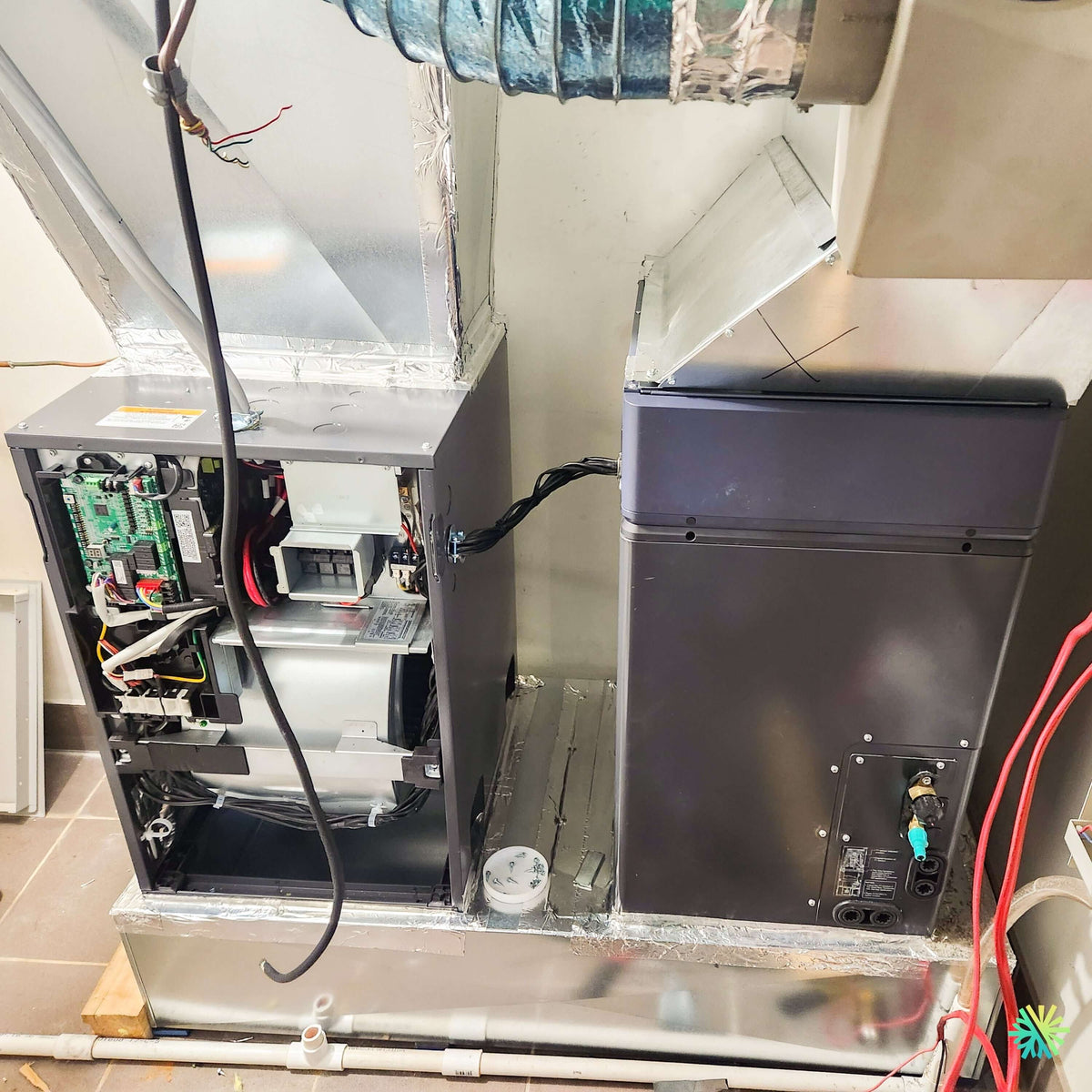
In the job-site photo, one detail immediately stands out: the indoor unit is not installed as the tall vertical column usually associated with a central furnace. Instead, we have two MIDEA modules installed side by side, connected by a lower transition section and separately connected to the duct network from above.
This is precisely the kind of application for which the modular design of theEVOX G3 becomes particularly interesting. MIDEA provides a configuration known as "low-boy" with top return and supply, in addition to the conventional vertical and horizontal configurations. The manufacturer's documentation presents six installation options and explains that the modules can be reconfigured using the Block N Lock system.
In this residence in Repentigny, this architecture allowed us to work with the physical constraints of the existing ductwork rather than forcing a vertical installation that would have required much more extensive modifications.
Two modules side by side: this is not two furnaces
The photograph can easily be confusing for someone who does not work with new central systems every day.
We see two black cabinets placed side by side. However, they are not two independent systems.
The MIDEA EVOX G3 uses a modular design that allows certain functions of the air handling unit to be separated and the airflow path to be modified according to the available space.
In this installation, the left-hand module is photographed with its front panel removed. We can clearly observe:
- the electronic control board;
- the electrical connections;
- the fan section;
- the wiring harnesses;
- the components required to control the system.
The module on the right has the refrigerant connections associated with the coil. The two sections work together as a single central air-handling unit.
This design offers a very practical advantage: when there is not enough height to stack the sections, we can make greater use of the available width.
The airflow path had to be redesigned around the mechanical room
In a conventional vertical configuration, the airflow path is generally quite intuitive: air returns through the lower or side portion of the furnace, passes through the system, and then exits through the upper plenum.
Here, the situation is different.
The low-boy configuration makes it possible to use upper return and supply connections, while the two sections communicate through the lower cabinet. MIDEA documentation specifically identifies this option among the six possible configurations of the EVOX G3.
The site photo shows this architecture in a real installation.
At the top:
- each section receives its sheet-metal transition;
- the ducts then connect to the existing installation;
- the dimensional changes are made gradually;
- the assembly remains compact enough to fit within the available height.
At the bottom, the modules rest on a custom-made connecting plenum.
This component is not decorative. It is part of the airflow path and must therefore be sized to allow the system to move its airflow without creating excessive restriction.
Why not simply install a smaller conventional furnace?
Because width is only one of the constraints in a mechanical room.
The following must also be considered:
- the total available height;
- the return-air position;
- the starting point of the supply duct;
- the beams and joists;
- the plumbing;
- the drains;
- the refrigerant lines;
- the electrical supply;
- the ability to open the panels;
- the space required for future HVAC maintenanceHVAC maintenance.
A smaller machine that requires building several highly restrictive transitions is not necessarily a better solution.
In this Repentigny project, we instead used the machine’s architecture to adapt to the building.
A design truly conceived for replacement projects
Page 5 of the EVOX G3 documentation shows another interesting aspect for renovations: depending on their capacities, the cabinets use widths corresponding to the common formats of several existing furnaces, namely approximately 14.5 to 21.5 inches. MIDEA also provides, depending on the model, built-in 115 V or 208/230 V multi-voltage management.
This does not mean that every replacement becomes automatic.
We must always measure the installation precisely and determine how the dimensions of the new equipment will affect:
- the return;
- the plenum;
- filtration;
- airflow;
- access to the components;
- the arrangement of the wiring and piping.
But when a mechanical room presents a particular constraint, modularity provides an additional tool for achieving a clean installation without compromising the mechanical system.
Custom sheet metal fabrication is at the heart of this Repentigny project
The photo shows a significant amount of new sheet metal around the EVOX G3.
This is one of the aspects we consider essential in a central heat pump installation.
The equipment may have excellent certified efficiency ratings, but the air still has to move through the system and reach every room in the house.
A poor transition can result in:
- pressure losses;
- more turbulence;
- noticeable air noise;
- poor air supply to some branches;
- an increase in the effort required from the blower.
On this installation, the lower plenum also had to ensure proper communication between the two modules. We are therefore dealing with much more specific geometry than a simple straight connection between a furnace and a duct.
A detail visible on the floor: drainage must also be integrated into the project
At the bottom of the installation, the PVC drainage piping network is also visible.
A central heat pump produces condensate during cooling. This water must be managed from the design stage, especially when the coil position differs from that of a conventional vertical installation.
In particular, we must check:
- the drain slope;
- the route to the discharge point;
- the presence of the necessary fittings;
- accessibility for cleaning;
- overflow protection depending on the application.
A poorly designed drain may work for a few weeks before turning into a water problem in a mechanical room. That is why it is an integral part of our commissioning process.
Why this MIDEA EVOX G3 configuration deserves particular attention to airflow, heating, and settings
The system must handle a duct network that existed before the new equipment
In renovation projects Repentigny, Montreal, Laval, Longueuil, on the North Shore and the South Shore, we do not always start with a new duct system.
The ducts were sometimes designed several decades ago for a furnace from another generation.
The EVOX G3 uses the technology Computational Constant Airflow 2.0, designed to adjust blower operation according to the resistance encountered in the system. MIDEA indicates that the technology can adapt to variations related to the ductwork, filters, or certain restrictions, with advertised static pressure reaching 1.2 in. of water column and up to 60 airflow adjustment levels.
For us, this feature does not replace duct sizing. Rather, it makes it possible to achieve much more precise control once the system has been properly prepared.
We are not trying to operate the blower against a restriction
This is an important distinction.
A motor capable of compensating for high static pressure does not mean it is desirable to create that pressure.
We always seek to reduce avoidable causes:
- transitions that are too narrow;
- undersized filters;
- insufficient returns;
- crushed ducts;
- unnecessary elbows;
- improperly positioned registers.
In this Repentigny low-boy configuration, the lower cabinet connecting the two modules therefore had to be treated as a functional part of the system, not simply as a metal base.
Up to 19 SEER2 depending on the selected combination
The MIDEA EVOX G3 lineup includes several capacities.
The manufacturer’s technical table notably presents combinations of 18,000, 24,000, 30,000, 36,000, 48,000, and 54,000 BTU/h, depending on the associated indoor and outdoor units. Performance also varies by combination: MIDEA publishes values reaching 19 SEER2, 12.5 EER2 and 10.8 HSPF2.
The job-site photograph does not make it possible to read this unit’s complete model number reliably enough to assign a precise capacity without risking an error.
We prefer never to infer a system’s tonnage solely from the cabinet size.
For a central installation, the correct reference is always the exact combination:
- indoor model;
- outdoor model;
- AHRI number;
- rated capacity;
- available capacity at low temperature;
- certified performance of this combination.
Heating down to -30 °C: particularly relevant for Repentigny
Lanaudière winters obviously impose very different requirements than a temperate climate.
The EVOX G3 Extreme Heat documentation announces continuous heating operation down to -30 °C. For the tests cited by MIDEA on a three-ton system, the manufacturer also indicates up to 100% capacity around -25 °C, with a COP that can reach approximately 1.9 under the test conditions presented.
These data must be read correctly: they do not mean that all EVOX G3 combinations deliver exactly the same capacity at -25 °C.
That is why we examine the heating curve of the exact model.
A heat pump capable of continuing to operate at -30 °C does not necessarily deliver its full capacity down to that temperature. Proper selection therefore involves comparing the home’s needs with the capacity actually available as the temperature drops.
Auxiliary electric heating supplements the heat pump
The EVOX G3 indoor unit can be equipped with an auxiliary electric heating kit.
MIDEA provides three-stage configurations capable of reaching 25 kW, with activation modulated according to the configuration and needs.
At AirGreen, our goal is not to automatically select the maximum electrical capacity.
We must verify:
- the home’s heat loss;
- the heat pump’s performance in cold weather;
- the electrical panel;
- the conductor gauge;
- the circuit breaker;
- the available airflow;
- the control sequence of the components.
When auxiliary heating is properly configured, it supplements the heat pump during periods when demand becomes too high, rather than unnecessarily taking over as soon as the outdoor temperature drops slightly.
R-454B is part of this new generation of equipment
The EVOX G3 platform uses R-454B, an A2L refrigerant.
MIDEA states that this refrigerant has a global warming potential, or GWP of 466.
This change does not require a new routine from the homeowner, but it changes several aspects of the installer’s work.
Technicians must be equipped and trained for procedures involving A2L refrigerants, particularly during:
- connections;
- leak testing;
- evacuation;
- refrigerant handling;
- before commissioning.
For a homeowner comparing quotes in 2026, it is therefore important to verify that the company truly understands next-generation central systems before commissioning. R-454B.
Effective filtration should never choke the system
MIDEA also provides a filtration module that can accept, depending on the configuration, filters measuring 1, 2, or 4 inches, with MERV 13 compatibility in the intended applications.
An efficient filter can reduce the amount of dust and particles that reach the coil.
However, we pay particular attention to its resistance.
A filter that is too restrictive or left in place too long can alter airflow. With constant-airflow technology, the fan will then try to compensate by increasing its effort.
The best scenario therefore remains:
- a properly sized filter;
- a sufficient filter surface area;
- replacement at an appropriate interval;
- an adequately sized return-air path.
An open installation like the one shown in the photo is an important step in our commissioning process
The panel of the left-hand module has been removed in the photo. Conductors are also still visible around the units.
This image was therefore taken during the work, at a time when we needed direct access to the components.
Commissioning makes it possible to verify, among other things:
- the wiring;
- control settings;
- the motor and airflow;
- the behavior of the various heating demands;
- heat pump operation;
- auxiliary electric heating;
- drainage;
- refrigerant pressures and temperatures;
- communication with the thermostat;
- the overall operation of the system.
Closing the panels is not the final technical step. We must first confirm that the settings match the actual installation.
Multiple communication modes make it possible to adapt to renovations
MIDEA documentation indicates that the EVOX G3 can use communication 485 or operate with controls 24 V depending on the configuration. MIDEA also provides, with certain components, Sub-1 GHz wireless communication between the indoor unit, inverter outdoor unit, and communicating thermostat.
This is particularly practical during renovations.
In an existing home, running a new thermostat cable may require opening finished walls or ceilings. A platform offering multiple control methods gives the installer more options.
However, the final configuration must be carefully programmed so that the heat pump and auxiliary heating operate according to the planned strategy.
LogisVert: the EVOX G3 furnace alone is not enough to determine the financial assistance
When a homeowner in Repentigny considers central heat pumpthe LogisVert subsidy is naturally an important consideration.
As of 2026, Hydro-Québec provides assistance of $50 per 1,000 BTU/h at -8°C for an eligible ENERGY STAR-certified heat pump with $120 per 1,000 BTU/h at -8°C when it is ENERGY STAR certified and rated cold climatewhen all program requirements are met. The amount is determined according to the actual installation date.
One clarification is essential: eligibility cannot be confirmed simply because the indoor unit bears the name MIDEA EVOX G3.
Hydro-Québec also indicates that replacing only one indoor unit, one outdoor unit, or one coil is not eligible for this program.
We therefore verify the complete combination and its certification file before determining the applicable amount.
What we take away from this Repentigny installation
This project is an excellent example of what the new generation of HVAC systems brings to renovation projects.
The most interesting feature is not a screen or a mobile app function. It is the ability to physically adapt the MIDEA EVOX G3 electric furnace a situation in which a conventional stacked installation would have been much less practical.
Here we have:
- two modules installed side by side;
- a true configuration low-boy;
- a return and supply arranged through the top;
- a lower plenum connecting the sections;
- sheet metal fabricated to match the existing ductwork;
- a condensate drain integrated into the available space;
- an inverter platform designed for heating in cold climates;
- access to the components required for configuration and maintenance.
This is exactly what we mean at AirGreen when we talk about an building-adapted HVAC installation.
To Repentignybut also Montreal, Laval, Longueuil, on the North Shore and the South Shorethe best replacement projects are not necessarily those in which the fewest things are changed. They are those in which every modification has a clear mechanical reason.
In this installation, the unusual positioning of the two modules is therefore not a compromise. It is precisely the solution provided by the modular design of the EVOX G3 for this type of constraint.
The desired outcome remains the same as in all our central installations: adequate airflow, effective heating, clean integration with the existing system, and a system that remains accessible for years of maintenance to come.
The big day, step by step
The main steps of this kind of job at AirGreen. Every house has its quirks: the estimate brings them out.
We look at the ducts, the current indoor module, the electrical panel and the planned spot for the outdoor unit.
The equipment combination, capacity and price, in writing. We check whether the combination qualifies for assistance programs.
Access protected, old unit disconnected and removed when it is being replaced.
Electric furnace or air handler, with its coil, connected to the supply and return ducts.
On a level base, raised above the snow, with free space all around.
Insulated, they enter through a sealed opening and run to the indoor coil.
Dedicated circuits, accessible disconnect, a thermostat that works with the heat pump and the backup heat.
Leak test, vacuum, start-up, airflow check and a test of both modes.
Filter, thermostat, backup heat in extreme cold: what to know before winter.
- The on-site estimateWe look at the ducts, the current indoor module, the electrical panel and the planned spot for the outdoor unit.
- The quoteThe equipment combination, capacity and price, in writing. We check whether the combination qualifies for assistance programs.
- Getting readyAccess protected, old unit disconnected and removed when it is being replaced.
- The indoor moduleElectric furnace or air handler, with its coil, connected to the supply and return ducts.
- The outdoor unitOn a level base, raised above the snow, with free space all around.
- The refrigerant linesInsulated, they enter through a sealed opening and run to the indoor coil.
- Electrical and thermostatDedicated circuits, accessible disconnect, a thermostat that works with the heat pump and the backup heat.
- Tests and start-upLeak test, vacuum, start-up, airflow check and a test of both modes.
- The walkthroughFilter, thermostat, backup heat in extreme cold: what to know before winter.
What would it look like at your place?
Two quick checks with real numbers: what heat costs, and what your current heaters add up to in BTU/h.
Conversion: 1 W = 3.412 BTU/h. An indication, not a load calculation: baseboards and furnaces are often stronger than the real need, and they can stay as backup. AirGreen confirms the capacity on site.
Four mistakes we do not make
Flip each card to see what we do instead.
Your own project, step by step
What to do, season by season
Three habits per season for this unit. They take a few minutes and prevent many calls.
- Check the indoor module's filter.
- Clear winter debris from the outdoor unit.
- Test cooling before the heat arrives.
- Check the filter more often in peak season.
- Keep registers and returns clear.
- Watch condensate drainage near the coil.
- Change or clean the filter.
- Test heating and backup heat before the cold.
- Book periodic maintenance.
- Clear snow around the outdoor unit.
- Store nothing in front of the indoor module.
- Note any unusual noise or smell and call us.
Is your home ready?
Check what applies at your place. A "no" is not a refusal: it is what we sort out during the estimate.
Four statements: true or false?
It all comes down to details you have just seen.
1. A central heat pump uses the house's ducts.
It connects to the existing ducts to heat and cool everywhere.
2. In extreme cold, electric backup heat can take over.
The indoor module (furnace or air handler) works with the heat pump and takes over in extreme cold.
3. The filter only gets changed when the unit breaks down.
A dirty filter cuts airflow. It gets checked regularly.
4. You can reuse the old unit's size without checking.
The house may have changed: insulation, windows, added rooms. Capacity is confirmed on site.
0 / 4 right answers
What people ask us about this kind of work
Can I keep my current ducts?
What happens in extreme cold?
Furnace, air handler, ducted: what is the difference?
Are there grants?
Do I need a permit?
How much can I save?
How is the LogisVert assistance calculated?
Will my current thermostat work?
Central or wall units: which one?
Does AirGreen hold the required licences?
Is the estimate free?
No question matches. Write to us: we answer.
More jobs to see, near you
By town, by equipment or by region: browse more than 4,700 published projects.
Each dot: a town where AirGreen has published projects. The glowing dot: this job.
Every house has its constraints. We see them before we install.
The on-site estimate is free and the quote follows within 24 hours.
Text and photo: a real AirGreen Climatisation & Chauffage job. The diagrams are generic illustrations of the type of installation, not a survey of this job site. Sources of the added figures: airgreen.ca product pages (NEEP / AHRI performance), Hydro-Québec (Heat pumps page, LogisVert, read on 13 October 2026), Régie de l’énergie (rate D as of 1 April 2026).