
Installation of a Fujitsu Aquila R32 MultiZone heat pump in Le Sud-Ouest (Griffintown)
In Griffintown, AirGreen installs two Fujitsu Aquila R32 MultiZone rooftop heat pumps : stability, roof-through sealing, bundled lines, and documented commissioning. A sustainable HVAC installation for Greater Montreal.
Take a tour of the installation
Each number is a point we check on site. Switch between summer and winter to watch air and heat move.
In summer, the outdoor unit rejects the house's heat outside.
Generic illustration of this type of installation, not a survey of this job site. Tap a number.
Mounted level on a wall plate, high enough for the air to reach the whole room, with enough space around it to slide the filters out easily.
The refrigerant lines, the communication cable and the drain go through the wall in a single opening, sealed against water, cold air and insects.
Two insulated copper pipes connect the two units. Outside, a line cover can protect them from sun, knocks and weather.
A shut-off switch near the outdoor unit isolates it safely for service. It must stay accessible at all times.
The compressor and the fan. In heating mode it captures heat from the outdoor air, even in winter, and moves it inside.
On the ground or on the wall, it keeps the unit above accumulated snow. The unit stays clear and defrost water can drain away.
The fan needs to blow freely. Storage, a fence or a wall too close, and efficiency drops while noise goes up.
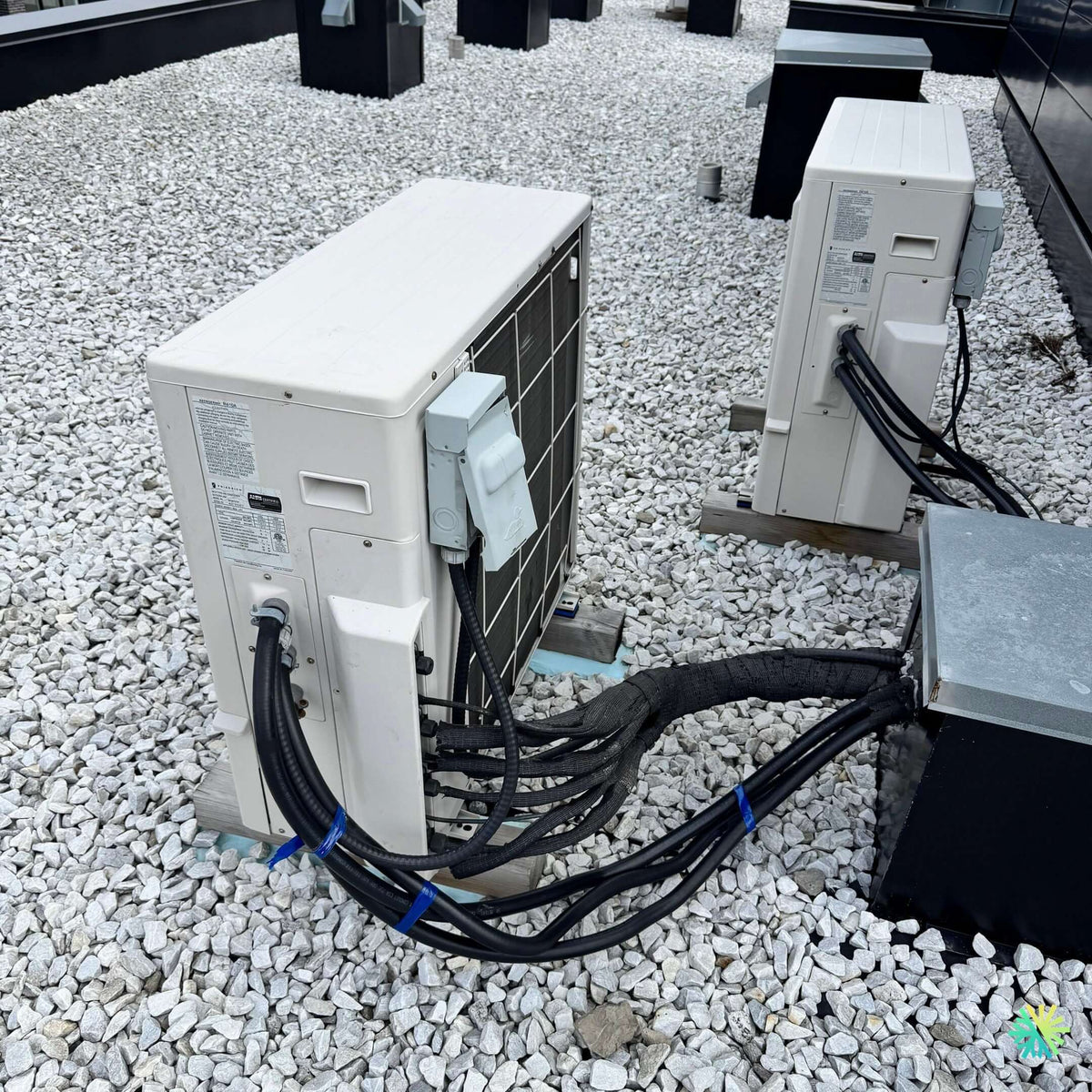
The white gravel roof of a modern building, dark railings, and clear mechanical access: the ideal setting for an exemplary HVAC installation . Here, our team is deploying a Fujitsu Aquila R32 MultiZone heat pump , designed to provide four-season comfort to several homes in the Le Sud-Ouest (Griffintown) sector, while respecting the constraints of an urban roof exposed to the wind.
Two compact condensers, quiet multi-room comfort
The chosen solution combines two Fujitsu Aquila R32 MultiZone outdoor units powering several indoor heads. This architecture distributes the load between living areas and bedrooms, with inverter modulation to continuously adjust the power. The result: a stable temperature, contained consumption and controlled noise levels, a major asset in a dense Montreal neighborhood.
Why Aquila R32 for this type of building?
-
R-32 : higher seasonal efficiency and reduced global warming potential compared to previous generations.
-
Low temperature operating range adapted to the climate of Greater Montreal.
-
Compatibility with ENERGY STAR criteria depending on the configuration, facilitating access to assistance programs applicable in Montreal , Laval , Longueuil , on the North Shore and the South Shore .
-
Tropicalized electronic cards and intelligent defrosting, useful on a roof exposed to frost and wind.
Roof integration: stability, waterproofing, maintenance
The condensers rest on anti-vibration pads installed on crossbars, with insulating shims that distribute the load and protect the membrane. This installation reduces vibration transmission to the structure and secures the roof's watertightness.
-
Power supply : Each unit has a waterproof disconnect switch accessible from the front, connected by rigid conduit and compressed cable gland. Circuit identification facilitates inspections and future interventions.
-
Refrigeration path : The refrigeration lines are bundled, high-density insulated, and UV-sleeved; they terminate neatly in a metalized roof box that serves as the building's entry point. The hose clamps are UV- and frost-resistant.
-
Clearances : respect the distances around and above the condensers to avoid air recirculation in heating mode and simplify defrosting.
-
Wind management : the compactness of the frames and their orientation reduce the sail effect on the roof; the cables are secured to withstand gusts.
Key steps of our methodology
-
Laser installation to ensure clearances between units, guardrails and technical outlets.
-
Roof passage coring and finishing with flashing, elastomeric mastic and apron, for a lasting seal.
-
Nitrogen bench and deep vacuum (< 500 microns) with stabilization; recording of values for the customer file.
-
Commissioning : measurement of supply/return temperatures by zone, intensity reading, verification of superheating and subcooling .
-
Finishing touches : beam alignment, UV protection, circuit labeling and delivery of a maintenance plan.
Interior distribution: custom multi-zones
Each dwelling or service area receives compact wall-mounted heads positioned to optimize airflow. The sleeping areas benefit from reduced speed and a directed shutter to limit drafts. The living rooms benefit from the dehumidification mode in summer, which is very relevant in a riverside environment.
-
Condensates : gravity drains to internal downpipes when the configuration allows; otherwise, silent pumps with level detector, protected from access.
-
Controls : Room-specific remote controls, eco-timer, and Wi-Fi option for time scenarios.
Results: measured performance and tangible comfort
-
Stable temperature in summer and winter thanks to continuous modulation.
-
Noise controlled on the roof and inside; no disturbance for the shared terraces.
-
Neat aesthetics : grouped beams, aligned crosspieces, disconnectors at maintenance height.
Particularities of an urban roof and technical responses
UV exposure and freeze/thaw cycles
→ EPDM insulation + butyl tape on the fittings, capping and touch-up paint on sensitive parts.
Access limited by guardrails and hatches
→ Location close to maintenance paths, without obstructing roof drains; clearance left around outlets.
Multiplicity of zones
→ Balanced distribution of line lengths, optimization of diameters to respect refrigerant loads and maintain heat pump efficiency.
HVAC Maintenance: Recommended Schedule
To preserve the efficiency and longevity of the system in Greater Montreal:
-
Spring : cleaning the external exchanger, checking the fins, tightening the connections, amperage test.
-
Autumn : inspection of refrigeration bundles, checking of flashings and condition of pads, defrosting check.
-
Interior : quarterly washing of filters, cleaning of head exchangers, calibration of remote controls.
AirGreen offers HVAC maintenance contracts tailored to condominiums and rental properties: planned visits, photo reports, budget recommendations.
Grants and Compliance
Depending on capacity, efficiency ratings and head configuration, the Aquila R32 range can meet the requirements of efficient heating assistance programs. We support applications for Montreal , Laval , Longueuil , the North Shore and the South Shore : technical data sheets, photos, proof of commissioning and serial information.
Best practices for a successful MultiZone project
-
Plan, from the design stage, a grouped routing of lines and a dedicated roof box for maintenance.
-
Respect a continuous slope of the condensates from the interior heads, with access to the service siphon.
-
Maintain clearances higher than the manufacturer's minimums on the roof to avoid recirculation and facilitate snow removal.
-
Document the commissioning measurements (pressures, temperatures, intensities) and file the file with the trustee.
At AirGreen, we size each MultiZone heat pump based on actual loads, permissible roof noise, and the building's maintenance plan. Whether you're in Montreal , Laval , Longueuil , on the North Shore or the South Shore , our expertise guarantees a durable, efficient, and easy-to-maintain HVAC installation .
Keywords worked on : heat pump , MultiZone heat pump , HVAC installation , HVAC maintenance , Montreal , Laval , Longueuil , North Shore , South Shore .
The big day, step by step
The main steps of this kind of job at AirGreen. Every house has its quirks: the estimate brings them out.
We look at the room, the outside wall, the line route and where the outdoor unit will go. That is where the capacity gets chosen.
Model, capacity and price, in writing. We also check whether the model qualifies for assistance programs.
Floors and furniture protected, wall plate position marked level, wall opening located.
A single opening, with the slope the drain needs to flow outside.
Set on a stand raised above the snow, with the clearances the manufacturer requires.
Connected, insulated and protected. The opening is then sealed against water, cold air and insects.
A dedicated circuit and an accessible disconnect near the outdoor unit.
Leak test, vacuum, then start-up and a check of heating and cooling.
Remote, modes, filters: we show you the essentials before we leave.
- The on-site estimateWe look at the room, the outside wall, the line route and where the outdoor unit will go. That is where the capacity gets chosen.
- The quoteModel, capacity and price, in writing. We also check whether the model qualifies for assistance programs.
- Getting readyFloors and furniture protected, wall plate position marked level, wall opening located.
- The wall openingA single opening, with the slope the drain needs to flow outside.
- The outdoor unitSet on a stand raised above the snow, with the clearances the manufacturer requires.
- Lines, cable and drainConnected, insulated and protected. The opening is then sealed against water, cold air and insects.
- The electrical workA dedicated circuit and an accessible disconnect near the outdoor unit.
- Tests and start-upLeak test, vacuum, then start-up and a check of heating and cooling.
- The walkthroughRemote, modes, filters: we show you the essentials before we leave.
What would it look like at your place?
Two quick checks with real numbers: what heat costs, and what your current heaters add up to in BTU/h.
Conversion: 1 W = 3.412 BTU/h. An indication, not a load calculation: baseboards and furnaces are often stronger than the real need, and they can stay as backup. AirGreen confirms the capacity on site.
Four mistakes we do not make
Flip each card to see what we do instead.
Your own project, step by step
What to do, season by season
Three habits per season for this unit. They take a few minutes and prevent many calls.
- Clean the indoor unit's filters.
- Clear leaves and debris left on the outdoor unit by winter.
- Test cooling before the first hot days.
- Clean the filters more often when the unit runs a lot.
- Keep plants away from the outdoor unit.
- Check that no water drips from the indoor unit.
- Rake the leaves around the outdoor unit.
- Test heating before the first cold days.
- Book periodic maintenance before winter.
- Keep snow away from the stand and the front of the unit.
- Let the unit defrost: it is normal.
- Never hit the ice on the fins; call us if the unit stays iced up.
Is your home ready?
Check what applies at your place. A "no" is not a refusal: it is what we sort out during the estimate.
Four statements: true or false?
It all comes down to details you have just seen.
1. In heating mode, the outdoor unit can produce water.
During defrost cycles. That water must drain away without forming ice.
2. You pick the capacity with a simple square-footage rule.
Windows, insulation, orientation and how the room is used all count. Capacity is chosen on site.
3. A multi-zone connects several indoor heads to a single condenser.
One head per room, all on the same condenser. Each room keeps its own temperature.
4. The disconnect can sit behind the patio furniture.
It must stay accessible: it is what shuts the unit off for service.
0 / 4 right answers
What people ask us about this kind of work
Does a wall-mounted heat pump heat in winter?
Wall-mounted or multi-zone: how do I choose?
Where does the outdoor unit go?
Are there grants?
Do I need a permit?
How cold can it heat?
How much can I save?
How is the LogisVert assistance calculated?
Is it noisy?
The outdoor unit is covered in ice: is that normal?
Does AirGreen hold the required licences?
Is the estimate free?
No question matches. Write to us: we answer.
More jobs to see, near you
By town, by equipment or by region: browse more than 4,700 published projects.
Each dot: a town where AirGreen has published projects. The glowing dot: this job.
Every house has its constraints. We see them before we install.
The on-site estimate is free and the quote follows within 24 hours.
Text and photo: a real AirGreen Climatisation & Chauffage job. The diagrams are generic illustrations of the type of installation, not a survey of this job site. Sources of the added figures: airgreen.ca product pages (NEEP / AHRI performance), Hydro-Québec (Heat pumps page, LogisVert, read on 13 October 2026), Régie de l’énergie (rate D as of 1 April 2026).