
Installation of a Sharp ZU1 wall-mounted heat pump in Rosemont–La Petite-Patrie (Montreal)
Sharp ZU1 wall-mounted heat pump installed in Rosemont–La Petite-Patrie: four-season comfort, careful integration and high efficiency. AirGreen operates in Montreal, Laval, Longueuil, North Shore and South Shore.
- City
- Region
- Equipment
- Brand
- Challenges
- Published
The job on one screen
The unit’s data sheet
The range as published on airgreen.ca: pick a size to see its capacity in deep cold.
| Size | Heating at −8 °C | Heating at −15 °C | Coldest certified point | COP at −15 °C | SEER | HSPF | Indicative LogisVert aid |
|---|---|---|---|---|---|---|---|
| Sharp ZU1 12 000 | 14,500 | 12,000 | −27 °C: 7,200 | 2.11 | 22.0 | 11.0 | $1,740 |
| Sharp ZU1 15 000 | 18,100 | 15,300 | −27 °C: 10,100 | 2.1 | 24.0 | 11.0 | $2,172 |
| Sharp ZU1 18 000 | 22,000 | 18,000 | −27 °C: 11,500 | 2.2 | 24.0 | 11.0 | $2,640 |
| Sharp ZU1 24 000 | 22,400 | 19,000 | −27 °C: 12,300 | 2.2 | 22.0 | 11.0 | $2,688 |
According to NEEP, it delivers 14,500 BTU/h at −8 °C (17 °F), more than at 8 °C (14,000 BTU/h). It heats as hard in moderate cold as in mild weather.
According to NEEP, its certified maximum capacity at −27 °C (−17 °F) is 7,200 BTU/h, 60% of its nominal 12,000 BTU size.
At 8 °C, its certified maximum capacity reaches 17,100 BTU/h, 42% more than its nominal 12,000 BTU size.
According to NEEP, it delivers 18,100 BTU/h at −8 °C (17 °F), more than at 8 °C (18,000 BTU/h). It heats as hard in moderate cold as in mild weather.
According to NEEP, its certified maximum capacity at −27 °C (−17 °F) is 10,100 BTU/h, 67% of its nominal 15,000 BTU size.
At 8 °C, its certified maximum capacity reaches 21,800 BTU/h, 45% more than its nominal 15,000 BTU size.
According to NEEP, it delivers 22,000 BTU/h at −8 °C (17 °F), more than at 8 °C (21,600 BTU/h). It heats as hard in moderate cold as in mild weather.
According to NEEP, its COP at −27 °C is 1.88: the highest of the ZU1 line, which ranges from 1.79 to 1.82 at that temperature.
According to NEEP, its certified maximum capacity at −27 °C (−17 °F) is 11,500 BTU/h, 64% of its nominal 18,000 BTU size.
At −27 °C, its certified minimum capacity is 3,200 BTU/h (5,500 at 8 °C). It slows down instead of cycling on and off.
According to NEEP, its certified heating capacity at −15 °C (5 °F) is 19,000 BTU/h, 79% of its nominal 24,000 BTU size. Its COP there is 2.20.
Data read live from the airgreen.ca page of each size (NEEP / AHRI certified performance). When the title names the installed size, it is highlighted; otherwise the whole range is shown. The aid shown is today’s, using Hydro-Québec’s rule ($120 per 1,000 BTU/h at −8 °C); amounts quoted in the article date from its publication. Only Hydro-Québec confirms the assistance granted.
The article, chapter by chapter
A wall-mounted headboard perfectly integrated into a bright space, for stable comfort all year round
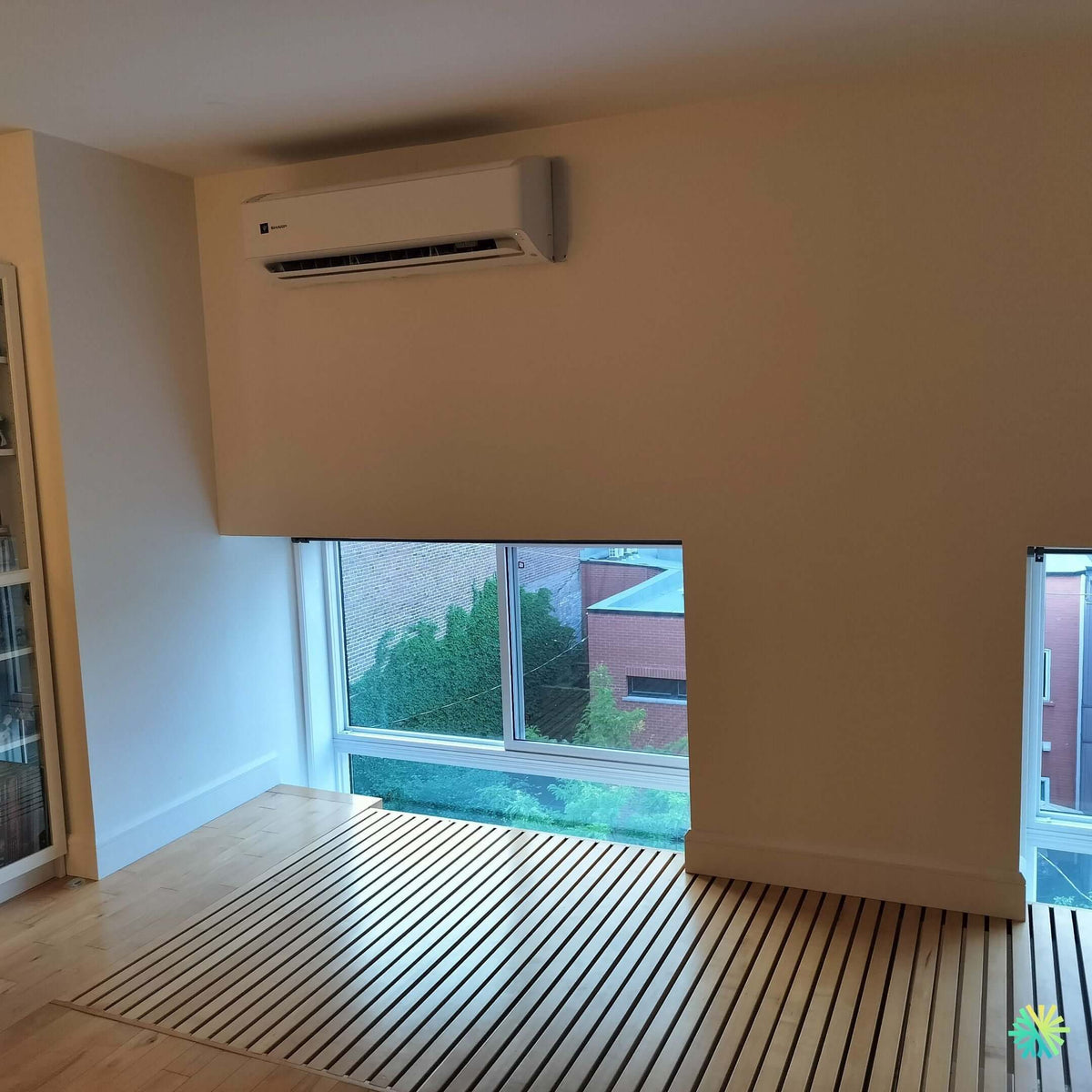
At AirGreen , we favor HVAC systems that blend seamlessly into the interior design. This condo in Rosemont–La Petite-Patrie features large full-wall windows , a clear ceiling , and a recessed niche . We installed a Sharp ZU1 wall-mounted heat pump to provide efficient heating and cooling without compromising the room's aesthetics.
Background and objectives
The owner wanted:
-
efficient heating in the Montreal cold , without annoying noise;
-
precise air conditioning for hot periods;
-
higher energy efficiency than electric baseboards;
-
a discreet integration into a mezzanine living room overlooking low windows.
After calculating the thermal loads (volume, southwest exposure, glazing, infiltration), a capacity of 12,000 to 15,000 BTU perfectly meets the needs of the living area. The Sharp ZU1 (R-32) range is essential for its stability in the cold and its fine modulation thanks to the Inverter compressor.
Why the Sharp ZU1 here?
-
High seasonal efficiency (competitive SEER/HSPF), therefore savings compared to baseboards and portable air conditioners.
-
Reliable heating in very cold weather (useful power maintained below -20°C), very relevant for Montreal and its North Shore .
-
Quiet operation : ideal for an open living room.
-
Optimized defrosting and progressive starts limiting electrical peaks.
-
R-32 refrigerant , with lower GWP than R-410A, consistent with current requirements.
Architectural integration: placement, airflow and aesthetics
The indoor unit is placed in the upper part , above the niche that covers the window. This positioning:
-
frees up traffic and does not block the view;
-
exploits the Coanda effect : the blown air runs along the ceiling, then descends uniformly into the living area;
-
prevents any direct blowing onto the occupants.
We maintain sufficient lateral and upper clearance for maintenance and proper air intake. The existing formwork does not disrupt intake thanks to the head being set back from the edge of the recess.
Condensate management
The configuration allows for gravity flow of the drain with a continuous slope , which reduces maintenance and the risk of odors. The tube is insulated to prevent condensation in cold mode. In case of architectural constraints, we provide a silent lifting pump ; here, it was not necessary.
Route of refrigeration and electrical connections
The single hole (approx. 65 mm ) is made with a watertight bulkhead and sheath . The insulated copper lines run directly to the outside, with a correct bend radius to protect the compressor. Outside, the route is capped to protect the insulation and ensure a clean finish on the facade or towards the flat roof, depending on the configuration chosen with the customer.
AirGreen installation procedure: rigor and traceability
-
Protection of the premises : tarpaulins, masking tape, laser tracing of the wall template.
-
Support : fixing plate anchored in uprights; check at level.
-
Drilling and sealing : controlled angle to promote evacuation.
-
Soldering/crimping according to manufacturer's specifications; nitrogen flushing during soldering to prevent internal oxidation.
-
Nitrogen pressure test ; deep vacuum (< 300 microns) with recorder.
-
Commissioning : opening of valves, checking of overheating/subcooling if applicable, checking of intensities , supply/return temperatures and condensates .
-
Settings : ventilation curves, auto mode, eco programming , and (if desired) Wi-Fi control .
Each step is documented in the installation voucher given to the customer, useful for guarantees and subsidies .
Results obtained and on-site measurements
-
Temperature difference measured between intake and blowing: 8 to 12°C in air conditioning mode, ensuring rapid cooling despite the glass surfaces.
-
Uniformity of comfort in the mezzanine and seating area thanks to vertical/horizontal sweep.
-
Very low perceived noise level in automatic speed: ideal for evenings and teleworking.
-
Responsiveness in heating : gradual, smooth temperature rise.
Operating tips for this type of glass space
-
Auto mode with stable setpoint (e.g. 22°C) to let the algorithm modulate the power.
-
In summer, gradually lower the setting at the end of the afternoon to anticipate the solar gain from the windows.
-
Use medium ventilation during heat waves: perceived comfort is better without creating drafts.
-
Keep the shutters open to circulate the air near the ceiling; close them slightly at night if an area is cooler.
Recommended HVAC maintenance
Annual maintenance by our AirGreen technicians extends the life of the system:
-
Antibacterial cleaning of coils and condensate tray;
-
Dusting and disinfection of filters;
-
Checking the fan torque , bearings , temperatures , electrical connections ;
-
Inspection of the exterior cover (UV, weather) and the drain .
For urban environments in Montreal , Laval and Longueuil , a light cleaning of the filters every 2 to 3 months is recommended, especially if there are pets or an open kitchen.
Grants and Compliance
High-efficiency wall-mounted heat pumps like the Sharp ZU1 are generally eligible for provincial or municipal financial assistance, subject to performance criteria and installation by an RBQ/CMMTQ licensed contractor . We support our customers in:
-
eligibility verification ;
-
photography of the work and proof of performance ;
-
submission of the necessary documents .
These procedures are valid in the Greater Montreal area, including the North Shore and South Shore .
Common mistakes… that we avoid
-
Undersizing in very glazed rooms: we calculate the load on the actual glazed surface and the solar factor .
-
Head too close to the ceiling : we maintain clearances to facilitate sweeping and maintenance.
-
Drain without slope : cause of odors and overflows; here, gravity is preferred.
-
Elbows too tight on the connections: pressure losses and noise; our spokes are compliant .
Multi-zone variant: when to consider it
If other rooms (bedrooms, office) require independent control, the Sharp multi-zone range allows you to add 2 to 3 heads on a single condenser. We then validate:
-
the total length of the lines;
-
the ratio of devices vs. external capacity;
-
balancing between day and night zones.
Investment and return
Compared to electric baseboards , a well-sized wall-mounted heat pump :
-
reduces annual heating consumption ;
-
adds summer comfort without additional equipment;
-
enhances the property thanks to a recognized HVAC system, popular in condominiums in Montreal and the surrounding areas.
Conclusion
This installation of a Sharp ZU1 in Rosemont–La Petite-Patrie shows how AirGreen combines energy efficiency , visual discretion and reliability . The room retains its refined aesthetic, while gaining four-season comfort . Our teams operate throughout Greater Montreal , from Laval to the South Shore , with the same requirement: a lasting, measurable and easy-to-live-with result .
Need a similar project?
We quickly assess the feasibility (sizing, connection routes, cover options, subsidies) and offer a turnkey commissioning , compliant with standards and ready for future maintenance.
The job tools
Two quick checks with real numbers: what heat costs, and what your current heaters add up to in BTU/h.
Baseboards and electric furnaces turn 1 kWh of electricity into 1 kWh of heat. A heat pump delivers more: that is its COP. At Hydro-Québec’s rate D (11.142¢/kWh above 40 kWh a day, since 1 April 2026):
Hydro-Québec: a heat pump can be up to three times more efficient than baseboards for heating in the colder months.
Estimate per kWh of heat, at the chosen temperature, using the certified COP from the product page. Taxes, access charge and backup heat not included.
Conversion: 1 W = 3.412 BTU/h. An indication, not a load calculation: baseboards and furnaces are often stronger than the real need, and they can stay as backup. AirGreen confirms the capacity on site.
How the job unfolds
The main steps of this kind of job at AirGreen. Every house has its quirks: the estimate brings them out.
We look at the room, the outside wall, the line route and where the outdoor unit will go. That is where the capacity gets chosen.
Model, capacity and price, in writing. We also check whether the model qualifies for assistance programs.
Floors and furniture protected, wall plate position marked level, wall opening located.
A single opening, with the slope the drain needs to flow outside.
Set on a stand raised above the snow, with the clearances the manufacturer requires.
Connected, insulated and protected. The opening is then sealed against water, cold air and insects.
A dedicated circuit and an accessible disconnect near the outdoor unit.
Leak test, vacuum, then start-up and a check of heating and cooling.
Remote, modes, filters: we show you the essentials before we leave.
- The on-site estimateWe look at the room, the outside wall, the line route and where the outdoor unit will go. That is where the capacity gets chosen.
- The quoteModel, capacity and price, in writing. We also check whether the model qualifies for assistance programs.
- Getting readyFloors and furniture protected, wall plate position marked level, wall opening located.
- The wall openingA single opening, with the slope the drain needs to flow outside.
- The outdoor unitSet on a stand raised above the snow, with the clearances the manufacturer requires.
- Lines, cable and drainConnected, insulated and protected. The opening is then sealed against water, cold air and insects.
- The electrical workA dedicated circuit and an accessible disconnect near the outdoor unit.
- Tests and start-upLeak test, vacuum, then start-up and a check of heating and cooling.
- The walkthroughRemote, modes, filters: we show you the essentials before we leave.
What we check on a job like this one
Each number is a point we check on site. Switch between summer and winter to watch air and heat move.
In summer, the outdoor unit rejects the house's heat outside.
Generic illustration of this type of installation, not a survey of this job site. Tap a number.
Mounted level on a wall plate, high enough for the air to reach the whole room, with enough space around it to slide the filters out easily.
The refrigerant lines, the communication cable and the drain go through the wall in a single opening, sealed against water, cold air and insects.
Two insulated copper pipes connect the two units. Outside, a line cover can protect them from sun, knocks and weather.
A shut-off switch near the outdoor unit isolates it safely for service. It must stay accessible at all times.
The compressor and the fan. In heating mode it captures heat from the outdoor air, even in winter, and moves it inside.
On the ground or on the wall, it keeps the unit above accumulated snow. The unit stays clear and defrost water can drain away.
The fan needs to blow freely. Storage, a fence or a wall too close, and efficiency drops while noise goes up.
Is your home ready?
Check what applies at your place. A "no" is not a refusal: it is what we sort out during the estimate.
Good habits, once the unit is in place
Six simple habits that keep the unit going. Your list stays on this device.
What to do, season by season
Three habits per season for this unit. They take a few minutes and prevent many calls.
- Clean the indoor unit's filters.
- Clear leaves and debris left on the outdoor unit by winter.
- Test cooling before the first hot days.
- Clean the filters more often when the unit runs a lot.
- Keep plants away from the outdoor unit.
- Check that no water drips from the indoor unit.
- Rake the leaves around the outdoor unit.
- Test heating before the first cold days.
- Book periodic maintenance before winter.
- Keep snow away from the stand and the front of the unit.
- Let the unit defrost: it is normal.
- Never hit the ice on the fins; call us if the unit stays iced up.
The right pages, at the right time
Four statements: true or false?
It all comes down to details you have just seen.
1. In heating mode, the outdoor unit can produce water.
During defrost cycles. That water must drain away without forming ice.
2. You pick the capacity with a simple square-footage rule.
Windows, insulation, orientation and how the room is used all count. Capacity is chosen on site.
3. A multi-zone connects several indoor heads to a single condenser.
One head per room, all on the same condenser. Each room keeps its own temperature.
4. The disconnect can sit behind the patio furniture.
It must stay accessible: it is what shuts the unit off for service.
0 / 4 right answers
What people ask us about this kind of work
Does a wall-mounted heat pump heat in winter?
Wall-mounted or multi-zone: how do I choose?
Where does the outdoor unit go?
Are there grants?
Do I need a permit?
How cold can it heat?
How much can I save?
How is the LogisVert assistance calculated?
Is it noisy?
The outdoor unit is covered in ice: is that normal?
Does AirGreen hold the required licences?
Is the estimate free?
No question matches. Write to us: we answer.
More jobs to see, near you
By town, by equipment or by region: browse more than 4,700 published projects.
Each dot: a town where AirGreen has published projects. The glowing dot: this job.
An on-site estimate, the right capacity, the right equipment.
The on-site estimate is free and the quote follows within 24 hours.
Text and photo: a real AirGreen Climatisation & Chauffage job. The diagrams are generic illustrations of the type of installation, not a survey of this job site. Sources of the added figures: airgreen.ca product pages (NEEP / AHRI performance), Hydro-Québec (Heat pumps page, LogisVert, read on 13 October 2026), Régie de l’énergie (rate D as of 1 April 2026).