
Installation of a GREE Livo R32 wall-mounted heat pump in Chomedey (Laval)
In Chomedey, AirGreen installs a GREE Livo R32 wall-mounted heat pump : short path, wall brackets, white capping, and rigorous commissioning. Four-season comfort and HVAC maintenance for Montreal, Laval, Longueuil, North Shore, and South Shore.
- City
- Region
- Equipment
- Brand
- Challenges
- Published
The job on one screen
The unit’s data sheet
The range as published on airgreen.ca: pick a size to see its capacity in deep cold.
| Size | Heating at −8 °C | Heating at −15 °C | Coldest certified point | COP at −15 °C | SEER | HSPF | Indicative LogisVert aid |
|---|---|---|---|---|---|---|---|
| Gree Livo R32 9 000 (115 V) | 10,000 | 7,600 | −25 °C: 5,700 | 1.86 | 20.5 | 8.8 | – |
| Gree Livo R32 9 000 | 9,600 | 7,600 | −25 °C: 5,500 | 1.94 | 20.5 | 8.8 | – |
| Gree Livo R32 12 000 (115 V) | 9,700 | 8,500 | −25 °C: 6,500 | 1.75 | 19.0 | 8.5 | – |
| Gree Livo R32 12 000 | 9,700 | 9,100 | −25 °C: 6,500 | 1.8 | 19.0 | 8.5 | $1,164 |
| Gree Livo R32 18 000 | 15,300 | 12,100 | −25 °C: 10,200 | 1.85 | 20.0 | 8.5 | $1,836 |
| Gree Livo R32 24 000 | 19,200 | 15,700 | −25 °C: 10,500 | 1.75 | 19.0 | 8.5 | $2,304 |
| Gree Livo R32 30 000 | 24,000 | 23,000 | −25 °C: 16,900 | 1.8 | 22.0 | 9.0 | $2,880 |
| Gree Livo R32 36 000 | 27,400 | 24,600 | −25 °C: 21,000 | 1.8 | 21.0 | 8.5 | $3,288 |
According to NEEP, it delivers 10,000 BTU/h at −8 °C (17 °F), as much as at 8 °C. It heats as hard in moderate cold as in mild weather.
According to NEEP, its certified maximum capacity at −25 °C (−13 °F) is 5,700 BTU/h, 63% of its nominal 9,000 BTU size.
At 8 °C, its certified maximum capacity reaches 13,300 BTU/h, 48% more than its nominal 9,000 BTU size.
According to NEEP, its COP at −15 °C is 1.94: the highest of the Livo R32 line, which ranges from 1.75 to 1.86 at that temperature.
According to NEEP, its certified maximum capacity at −25 °C (−13 °F) is 5,500 BTU/h, 61% of its nominal 9,000 BTU size.
At 8 °C, its certified maximum capacity reaches 13,136 BTU/h, 46% more than its nominal 9,000 BTU size.
According to NEEP, it delivers 8,500 BTU/h at −15 °C, against 9,100 for the Gree Livo R32 12 000.
At −25 °C, its certified minimum capacity is 1,800 BTU/h (3,070 at 8 °C). It slows down instead of cycling on and off.
According to NEEP, its certified heating capacity at −15 °C (5 °F) is 8,500 BTU/h, 71% of its nominal 12,000 BTU size. Its COP there is 1.75.
According to NEEP, it delivers 9,100 BTU/h at −15 °C, against 8,500 for the Gree Livo R32 12 000 (115 V).
At −25 °C, its certified minimum capacity is 1,800 BTU/h (3,070 at 8 °C). It slows down instead of cycling on and off.
According to NEEP, its certified heating capacity at −15 °C (5 °F) is 9,100 BTU/h, 76% of its nominal 12,000 BTU size. Its COP there is 1.80.
At 8 °C, its certified maximum capacity reaches 22,500 BTU/h, 25% more than its nominal 18,000 BTU size.
According to NEEP, its certified minimum capacity is at least 7,000 BTU/h at every temperature. In a small, well-insulated room it will cycle on and off more often: size it carefully.
According to NEEP, its certified heating capacity at −15 °C (5 °F) is 12,100 BTU/h, 67% of its nominal 18,000 BTU size. Its COP there is 1.85.
At −25 °C, its certified minimum capacity is 3,100 BTU/h (5,800 at 8 °C). It slows down instead of cycling on and off.
According to NEEP, its certified heating capacity at −15 °C (5 °F) is 15,700 BTU/h, 65% of its nominal 24,000 BTU size. Its COP there is 1.75.
According to NEEP, its certified heating capacity at −15 °C (5 °F) is 23,000 BTU/h, 77% of its nominal 30,000 BTU size. Its COP there is 1.80.
According to NEEP, its COP at −25 °C is 1.54: the highest of the Livo R32 line, which ranges from 1.30 to 1.52 at that temperature.
At −25 °C, its certified minimum capacity is 7,000 BTU/h (10,000 at 8 °C). It slows down instead of cycling on and off.
According to NEEP, its certified heating capacity at −15 °C (5 °F) is 24,600 BTU/h, 68% of its nominal 36,000 BTU size. Its COP there is 1.80.
Data read live from the airgreen.ca page of each size (NEEP / AHRI certified performance). When the title names the installed size, it is highlighted; otherwise the whole range is shown. The aid shown is today’s, using Hydro-Québec’s rule ($120 per 1,000 BTU/h at −8 °C); amounts quoted in the article date from its publication. Only Hydro-Québec confirms the assistance granted.A dash in the aid column: amount to be confirmed for this model.
The article, chapter by chapter
A neat HVAC upgrade on a light brick facade, designed for four-season comfort and simplified maintenance
Background and objectives
In Chomedey (Laval) , we are modernizing the comfort of a single-story light brick house with a GREE Livo R32 wall-mounted heat pump . The owner was looking for a discreet system, efficient in heating in winter and cooling in summer, with a clean, durable and easy-to-maintain HVAC installation . Our intervention focuses on:
-
energy performance and stability in cold weather;
-
aesthetic integration on the visible facade of the side passage;
-
the reliability of refrigeration connections and condensate drainage;
-
minimal noise level in the neighborhood and indoors.
Why the GREE Livo R32 for this residence
The Livo R32 belongs to the recent generations with R-32 refrigerant , more efficient and with a lower GWP than older fluids. Its advantages for a Laval home:
-
High-precision inverter : fine modulation, long cycles, controlled consumption;
-
Four-season comfort with low temperature capacity maintenance;
-
Silence in night mode and gentle interior ventilation;
-
Compact size ideal for narrow side aisles and close windows;
-
Compatibility with Wi-Fi options for easy control.
AirGreen Approach : We size BTU capacity based on actual heat loss (envelope, solar orientation, glazing, infiltration). The goal is never overcapacity, but a balance between comfort, efficiency, and component longevity.
Reading the site and external installation
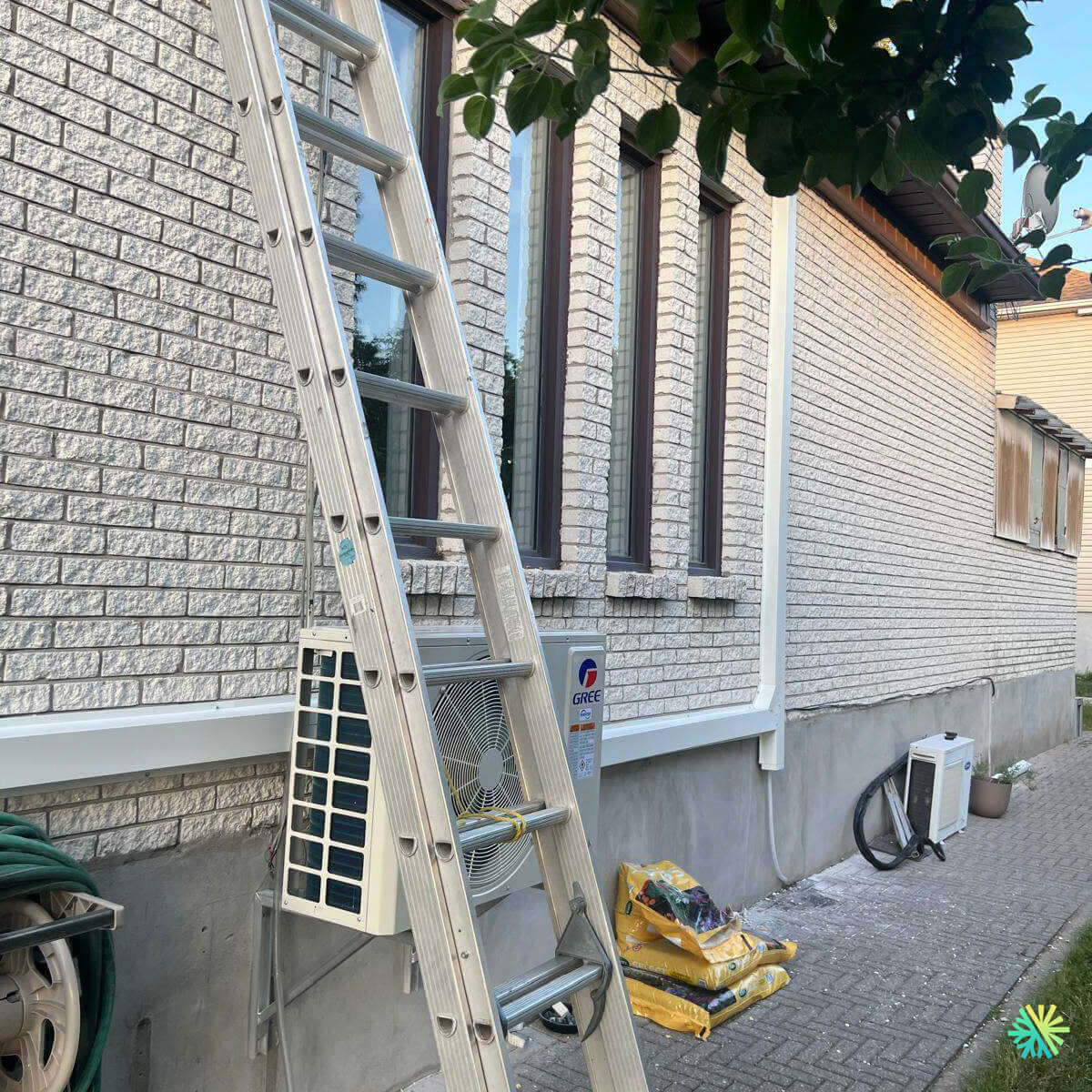
The pale brick facade and closely spaced vertical windows require precise positioning. The single-fan outdoor unit is mounted on galvanized wall brackets , raised off the ground for:
-
protect the device from water splashes and dust;
-
facilitate the evacuation of frost in winter;
-
reduce the transmission of vibrations to the ground and foundations.
We keep it away from openings (windows) and the roof drain to respect the suction/blowing clearances . Since the environment is a busy side passage , we add anti-vibration pads and sufficient service space on the valves and electrical housing side.
Route of connections and finishes (construction site view)
The white capping follows a vertical descent from the inner head to the condenser. This trajectory:
-
shortens the equivalent length (≈ 3 to 5 m);
-
limits changes in direction, therefore pressure losses ;
-
unifies the aesthetics with light masonry and woodwork.
Insulated copper tubing is bent to the specified radius without crushing; the insulation is continuous to the fittings. Communication and power wiring runs in a dedicated conduit to prevent stray induction . A circuit breaker and an external circuit breaker compliant with the nameplate are installed in accordance with the current electrical code .
The holes are made to the adjusted diameter with a sheath , low-expansion foam and a membrane ensuring air/vapor barrier continuity. The external joints receive a polyurethane sealant resistant to UV and freezing/thawing.
Condensate management: gravity as a priority
The floor configuration and the slope of the passage allow for gravity drainage of condensates in air conditioning mode. We ensure:
-
a constant slope without counter-slope;
-
a siphon where necessary to prevent odors from rising;
-
antifreeze protection at the exit point if exposed to cold.
If geometry requires it on other sites, we integrate low-noise lifting pumps with accessible tank and non-return valve. Here, gravity ensures quiet and reliable operation.
Instrumented commissioning
Commissioning follows the AirGreen procedure:
-
Nitrogen test at stabilized pressure, leak test;
-
Deep vacuum draw (microns) and ascent test ;
-
Charge opening and subcooling/superheat check;
-
Electrical checks (continuity, intensity, tightening);
-
Setting of optimal summer/winter modes, flow rates and settings ;
-
Customer training : best practices, maintenance, code reading and advanced functions.
A commissioning sheet (serial numbers, measurements, photos) is archived for warranty and, where applicable, for assistance programs .
Result: performance, silence and preserved facade
The compact outdoor unit preserves circulation in the side corridor. The blowing is free, without recirculation against the brick. Inside, the wall-mounted head delivers a uniform flow , limiting gradients between the living area and passageways. Initial measurements confirm:
-
temperature stability in heating mode on cool evenings;
-
effective dehumidification during summer humidity peaks;
-
reduced noise levels , particularly appreciated at night.
HVAC Maintenance: Recommended Schedule
To preserve the performance of the heat pump and air quality:
-
Filters : cleaning every 4 to 8 weeks in season;
-
Outdoor unit : clearing of leaves and dust, visual check of capping and fixings;
-
Annual AirGreen inspection : cleanliness of coils, electrical tightening, operating measurements (temperatures, intensities), verification of the load rate by indirect methods;
-
Winter : Maintain free space under the unit and in front of the fan to ensure efficient defrosting.
AirGreen Tip : A clogged filter increases consumption and reduces heating capacity in cold weather. Simple, regular maintenance makes all the difference.
Technical points to remember for your project
-
Sizing : The correct BTU capacity ensures long and quiet cycles;
-
Equivalent length : a short, well-bent path protects compressor reliability;
-
Clearances : they determine the yield in summer as well as in winter;
-
Sealing of the envelope : essential to prevent infiltration and thermal bridges;
-
Quality of the supports : galvanized brackets and anchors adapted to the brick for durability.
Grants and Compliance
Recent high-efficiency heat pumps using R-32 are potentially eligible for financial assistance programs when performance and installation criteria are met. We support our clients in:
-
validate eligibility ;
-
compile the file (detailed quote, photos, serial numbers);
-
submit the request and follow up until payment.
Safety and Neighborhood
The construction site is being carried out on ladders with facade protection and corridor markings. Tests are taking place at agreed times to limit noise impact. Fasteners and silent blocks reduce vibration transmission to living areas and the immediate neighbors.
What the owner earns every day
-
Immediate and measurable comfort ;
-
Better controlled electricity bills compared to baseboards;
-
A connectable and easy-to-control system;
-
A clean facade thanks to the white capping aligned with the existing elements.
Our service coverage
Our AirGreen teams operate in Laval , Montreal , Longueuil , the North Shore and the South Shore for HVAC installation , HVAC maintenance and troubleshooting . Each project benefits from post-installation monitoring and recommended maintenance to ensure the sustainability of the investment.
Conclusion
This HVAC installation of a GREE Livo R32 in Chomedey (Laval) illustrates our method: precise load study, short and protected routing , robust brackets , matching capping , instrumented commissioning and skills transfer to the client. The result: stable comfort , tangible energy efficiency and aesthetic integration on a light brick facade - ready to face the seasons of Greater Montreal .
The job tools
Two quick checks with real numbers: what heat costs, and what your current heaters add up to in BTU/h.
Baseboards and electric furnaces turn 1 kWh of electricity into 1 kWh of heat. A heat pump delivers more: that is its COP. At Hydro-Québec’s rate D (11.142¢/kWh above 40 kWh a day, since 1 April 2026):
Hydro-Québec: a heat pump can be up to three times more efficient than baseboards for heating in the colder months.
Estimate per kWh of heat, at the chosen temperature, using the certified COP from the product page. Taxes, access charge and backup heat not included.
Conversion: 1 W = 3.412 BTU/h. An indication, not a load calculation: baseboards and furnaces are often stronger than the real need, and they can stay as backup. AirGreen confirms the capacity on site.
How the job unfolds
The main steps of this kind of job at AirGreen. Every house has its quirks: the estimate brings them out.
We look at the room, the outside wall, the line route and where the outdoor unit will go. That is where the capacity gets chosen.
Model, capacity and price, in writing. We also check whether the model qualifies for assistance programs.
Floors and furniture protected, wall plate position marked level, wall opening located.
A single opening, with the slope the drain needs to flow outside.
Set on a stand raised above the snow, with the clearances the manufacturer requires.
Connected, insulated and protected. The opening is then sealed against water, cold air and insects.
A dedicated circuit and an accessible disconnect near the outdoor unit.
Leak test, vacuum, then start-up and a check of heating and cooling.
Remote, modes, filters: we show you the essentials before we leave.
- The on-site estimateWe look at the room, the outside wall, the line route and where the outdoor unit will go. That is where the capacity gets chosen.
- The quoteModel, capacity and price, in writing. We also check whether the model qualifies for assistance programs.
- Getting readyFloors and furniture protected, wall plate position marked level, wall opening located.
- The wall openingA single opening, with the slope the drain needs to flow outside.
- The outdoor unitSet on a stand raised above the snow, with the clearances the manufacturer requires.
- Lines, cable and drainConnected, insulated and protected. The opening is then sealed against water, cold air and insects.
- The electrical workA dedicated circuit and an accessible disconnect near the outdoor unit.
- Tests and start-upLeak test, vacuum, then start-up and a check of heating and cooling.
- The walkthroughRemote, modes, filters: we show you the essentials before we leave.
What we check on a job like this one
Each number is a point we check on site. Switch between summer and winter to watch air and heat move.
In summer, the outdoor unit rejects the house's heat outside.
Generic illustration of this type of installation, not a survey of this job site. Tap a number.
Mounted level on a wall plate, high enough for the air to reach the whole room, with enough space around it to slide the filters out easily.
The refrigerant lines, the communication cable and the drain go through the wall in a single opening, sealed against water, cold air and insects.
Two insulated copper pipes connect the two units. Outside, a line cover can protect them from sun, knocks and weather.
A shut-off switch near the outdoor unit isolates it safely for service. It must stay accessible at all times.
The compressor and the fan. In heating mode it captures heat from the outdoor air, even in winter, and moves it inside.
On the ground or on the wall, it keeps the unit above accumulated snow. The unit stays clear and defrost water can drain away.
The fan needs to blow freely. Storage, a fence or a wall too close, and efficiency drops while noise goes up.
Is your home ready?
Check what applies at your place. A "no" is not a refusal: it is what we sort out during the estimate.
Good habits, once the unit is in place
Six simple habits that keep the unit going. Your list stays on this device.
What to do, season by season
Three habits per season for this unit. They take a few minutes and prevent many calls.
- Clean the indoor unit's filters.
- Clear leaves and debris left on the outdoor unit by winter.
- Test cooling before the first hot days.
- Clean the filters more often when the unit runs a lot.
- Keep plants away from the outdoor unit.
- Check that no water drips from the indoor unit.
- Rake the leaves around the outdoor unit.
- Test heating before the first cold days.
- Book periodic maintenance before winter.
- Keep snow away from the stand and the front of the unit.
- Let the unit defrost: it is normal.
- Never hit the ice on the fins; call us if the unit stays iced up.
The right pages, at the right time
Four statements: true or false?
It all comes down to details you have just seen.
1. In heating mode, the outdoor unit can produce water.
During defrost cycles. That water must drain away without forming ice.
2. You pick the capacity with a simple square-footage rule.
Windows, insulation, orientation and how the room is used all count. Capacity is chosen on site.
3. A multi-zone connects several indoor heads to a single condenser.
One head per room, all on the same condenser. Each room keeps its own temperature.
4. The disconnect can sit behind the patio furniture.
It must stay accessible: it is what shuts the unit off for service.
0 / 4 right answers
What people ask us about this kind of work
Does a wall-mounted heat pump heat in winter?
Wall-mounted or multi-zone: how do I choose?
Where does the outdoor unit go?
Are there grants?
Do I need a permit?
How cold can it heat?
How much can I save?
How is the LogisVert assistance calculated?
Is it noisy?
The outdoor unit is covered in ice: is that normal?
Does AirGreen hold the required licences?
Is the estimate free?
No question matches. Write to us: we answer.
More jobs to see, near you
By town, by equipment or by region: browse more than 4,700 published projects.
Each dot: a town where AirGreen has published projects. The glowing dot: this job.
An on-site estimate, the right capacity, the right equipment.
The on-site estimate is free and the quote follows within 24 hours.
Text and photo: a real AirGreen Climatisation & Chauffage job. The diagrams are generic illustrations of the type of installation, not a survey of this job site. Sources of the added figures: airgreen.ca product pages (NEEP / AHRI performance), Hydro-Québec (Heat pumps page, LogisVert, read on 13 October 2026), Régie de l’énergie (rate D as of 1 April 2026).