
Installation of a GREE LIVO R32 Wall-Mounted Heat Pump - Air Conditioner - Mini Split in Ahuntsic-Cartierville, Montreal
AirGreen installs a GREE LIVO R32 wall-mounted heat pump in Ahuntsic-Cartierville, with an outdoor unit on supports, protected ducts, and neat integration into an urban courtyard in Montreal.
In summer, the outdoor unit rejects the house's heat outside.
Generic illustration of this type of installation, not a survey of this job site. Tap a number.
Mounted level on a wall plate, high enough for the air to reach the whole room, with enough space around it to slide the filters out easily.
The refrigerant lines, the communication cable and the drain go through the wall in a single opening, sealed against water, cold air and insects.
Two insulated copper pipes connect the two units. Outside, a line cover can protect them from sun, knocks and weather.
A shut-off switch near the outdoor unit isolates it safely for service. It must stay accessible at all times.
The compressor and the fan. In heating mode it captures heat from the outdoor air, even in winter, and moves it inside.
On the ground or on the wall, it keeps the unit above accumulated snow. The unit stays clear and defrost water can drain away.
The fan needs to blow freely. Storage, a fence or a wall too close, and efficiency drops while noise goes up.
A compact and clean outdoor installation in an urban yard in Ahuntsic-Cartierville
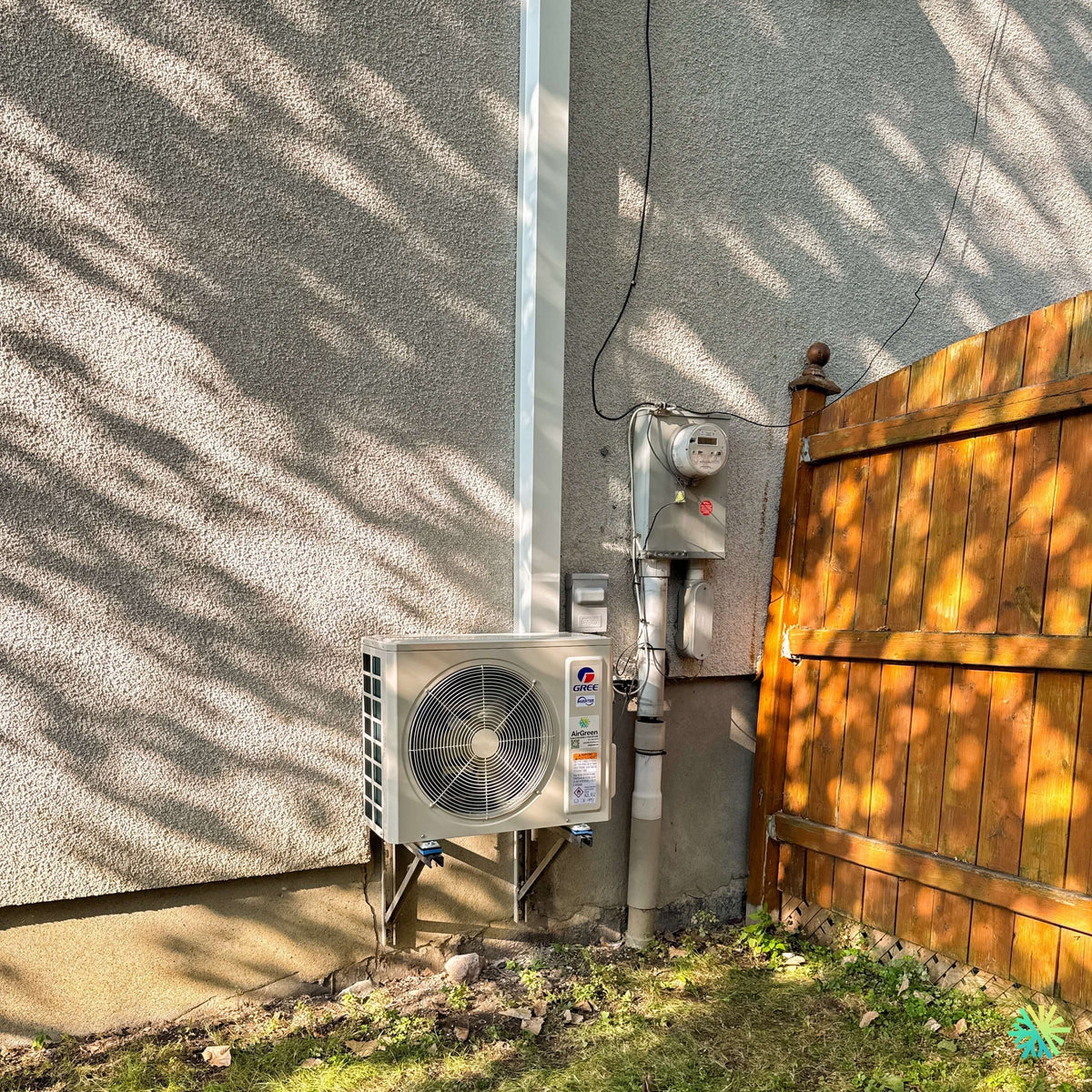
This wall-mounted heat pump GREE LIVO R32 installation carried out by AirGreen in Ahuntsic-Cartierville, in the north of Montreal, perfectly illustrates the type of residential project where execution quality makes all the difference. The photo shows the outdoor unit installed on a stucco wall, in a narrow side space near a wooden fence, with an electrical meter nearby, a well-aligned white vertical conduit, and carefully managed clearance above the ground. In an urban area like Ahuntsic-Cartierville, this kind of configuration is very common: yards are often compact, side accesses are limited, and the available space for a HVAC installation must be used precisely.
In this project, the goal was clear: to install a GREE LIVO R32, used as a wall-mounted heat pump, wall air conditioner, and mini split system, while respecting the existing outdoor environment. The client wanted a reliable solution to improve indoor comfort without cluttering the yard, without hindering access to electrical equipment, and without creating a visually disorderly installation. The outdoor unit was therefore positioned on wall mounts, at a height that protects it from the ground, leaves, stagnant moisture, and minor accumulations around the foundation.
The outdoor scene is revealing: textured wall, nearby fence, natural shading, grassy area, electrical meter, and technical space already occupied. This is exactly the type of context where AirGreen’s expertise becomes essential. A heat pump can perform well on paper, but if its outdoor unit is poorly placed, poorly cleared, or poorly connected, comfort and durability can suffer. Here, the installation was designed to provide a clean, stable result adapted to the reality of a Montreal residence.
A GREE LIVO R32 installed with particular attention to outdoor clearance
The outdoor unit of a wall-mounted heat pump needs a well-cleared environment to breathe properly. The fan must be able to expel air without obstruction, and the back of the unit must maintain the required space to allow good heat exchange. In the photo, the unit is installed near a fence, but its positioning keeps the front clear, which is essential for operation.
In neighborhoods like Ahuntsic-Cartierville, Villeray, Rosemont, Laval, Longueuil, the North Shore and the South Shore, we often see yards where every square foot counts. Some owners want to hide the unit as much as possible, sometimes behind a fence, a storage bin, or plants. This intention is understandable, but it can harm performance if it reduces airflow too much. For this project, our team chose an installation that respects the available space while keeping the device functional and accessible.
The wall mount also plays an important role. By keeping the unit above ground level, risks related to debris, water, packed snow, dead leaves, and small terrain obstacles are limited. This method is particularly relevant in Montreal, where freeze-thaw, rain, and snow cycles can quickly affect poorly positioned equipment.
Choosing a clean, well-integrated vertical conduit
One of the most visible details in the photo is the white conduit running vertically along the wall. This type of conduit cover protects the refrigerant lines, communication cable, and associated drainage, while giving the installation a cleaner finish. In a residential project, especially on a facade or side wall visible from the yard, this finish is far from secondary.
Poor exterior finishing can give the impression of a makeshift job, even if the device works properly. At AirGreen, we place great importance on conduit alignment, connection protection, and the visual coherence of the whole. Here, the vertical conduit contrasts slightly with the textured wall, but it remains straight, simple, and organized. It follows a clear path, without unnecessary zigzags, which improves both appearance and ease of future inspection.
This detail also matters for HVAC maintenance. When the pipes are well protected and well positioned, it is easier to quickly identify the system’s path, check connections, and intervene if needed. A clean installation today simplifies service tomorrow.
An installation near the electrical meter: coordination and caution
The proximity of the electrical meter and existing conduits required special attention. In this type of situation, it is not enough to find a free space on the wall. You must also consider safety clearances, access zones, existing equipment, and how a technician will be able to work around the installation in the future.
Our technicians therefore assessed the location to avoid blocking access to the meter and to keep the outdoor unit in a stable position. Electrical connections related to a wall-mounted heat pump must be made according to applicable rules, with the necessary protections and proper coordination with the entire installation. A device like the GREE LIVO R32 operates with a dedicated power supply according to the chosen capacity, and this step must always be handled rigorously.
In a house in Ahuntsic-Cartierville, where electrical installations may sometimes have been modified over the years, this check is important. Every project requires a complete understanding of the existing context. This is especially true in established neighborhoods of Montreal, where you find renovated houses, extensions, textured exterior walls, and varied technical configurations.
Why the GREE LIVO R32 is suitable for this type of residential project
The GREE LIVO R32 is a popular solution for residential projects that require a simple-to-use, discreet wall unit that is effective for common cooling and supplemental heating needs. As a wall air conditioner, it can cool a targeted area during hot days. As a heat pump, it can contribute to heating comfort depending on the installed capacity, house configuration, and usage conditions.
The refrigerant R32 is an important element of this generation of units. It is used in many modern mini split and wall-mounted heat pump systems, especially to meet current design and efficiency requirements. For a homeowner who wants to improve comfort without installing ductwork, this type of system offers a flexible solution.
The BTU capacity must always be chosen based on an actual evaluation of the building. At AirGreen, we do not recommend capacity based solely on an approximate area. We consider several factors:
- the insulation of the house;
- the size and height of the rooms;
- sun exposure;
- the presence of large windows;
- the number of occupants;
- air circulation between rooms;
- the primary use of the system for cooling, heating, or both;
- the possible location of the indoor unit and the outdoor unit.
In this project in Ahuntsic-Cartierville, the choice of outdoor location was as important as the choice of the unit. A well-selected unit must be accompanied by a coherent installation to deliver the best result.
Challenges of installation in a narrow side yard
Montreal side yards often impose specific constraints. The space can be limited by a fence, a service entrance, a meter, an irregular foundation, or vegetation. In the photo, it is clear that the outdoor unit was installed in an area where clearance had to be carefully calculated. The wooden fence on the right limits the space, while the stucco wall and existing electrical equipment reduce placement options.
In such a configuration, several mistakes must be avoided:
Placing the unit too close to an obstacle
An outdoor unit placed too close to a fence, wall, bin, or hedge can lose efficiency. The fan must be able to expel air freely. Poor air circulation can increase operating cycles, reduce comfort, and wear out the equipment.
Installing the unit directly on the ground without adequate protection
In a yard where leaves, rain, snow, and ground movements occur, an installation that is too low can create long-term problems. The wall mounts visible on this installation help keep the unit cleaner and more stable.
Neglecting maintenance access
An HVAC system must remain accessible. Service panels, connections, and the environment around the unit must allow for future intervention. An installation that is too tight can complicate diagnostics, maintenance, or repairs.
Improvising duct passage
Ducts must be protected and installed logically. The white vertical duct visible here provides a neater finish and protects the system's sensitive components.
This project in Ahuntsic-Cartierville demonstrates the importance of a HVAC installation adapted to Montreal
A wall-mounted heat pump installation in Montreal cannot be treated as a simple equipment setup. Buildings vary, outdoor spaces are often limited, and client expectations are high. In this project, the final result shows a structured approach: outdoor unit on wall mounts, protected ducts, thoughtful placement, controlled clearance, and clean integration next to an existing technical area.
A useful solution for owners who want to modernize their comfort
In several homes in Ahuntsic-Cartierville, owners are looking to improve the comfort of a specific area without undertaking major work. A GREE LIVO R32 wall-mounted heat pump can meet this need when properly sized and installed. It allows temperature control of a room, a floor, or a particular area of the house with more direct control than a single central system.
This approach is particularly interesting for:
- houses with hot rooms in summer;
- upstairs bedrooms;
- sun-exposed living rooms;
- home offices;
- extensions;
- homes without ducts;
- houses where the existing heating lacks flexibility.
In Montreal, Laval, Longueuil, on the North Shore and the South Shore, AirGreen regularly operates in this kind of context. The key is to fully understand the house before installing the unit.
Subsidies and eligibility: validate the exact model before promising an amount
Clients shopping for a heat pump are often interested in available subsidies. This is normal, as aid programs can reduce the net cost of the project. However, eligibility always depends on the exact model, the combination of units, capacity, certifications, and the rules in effect at the time of installation.
For a GREE LIVO R32, AirGreen checks the applicable technical data before presenting information to the client. The range name alone is not enough to confirm a subsidy. The model numbers, certified performance, and program requirements must be validated. This rigor avoids misunderstandings and allows the client to make a clear decision.
An installation that respects the exterior of the house
The textured wall visible in the photo requires precise installation. Drilling, fixing, and routing the conduits on a stucco surface requires clean work to avoid cracks, leaks, and rough finishes. The support must be stable, the unit must be level, and the passages must be protected.
The final result shows a functional outdoor installation, but also a neat one. The GREE unit is well seated on its supports, the duct rises straight, and the whole remains compact despite the proximity of the fence and the meter. In a residential environment, this level of finish distinguishes a professional installation from a simply functional setup.
HVAC maintenance after installation
Once the wall-mounted heat pump is installed, maintenance remains essential. The outdoor unit must be kept clear: no leaves accumulated against the fan, no objects placed in front of the unit, no dense vegetation around the grille. In winter, snow or ice must also be prevented from blocking air circulation.
The indoor unit, for its part, must be regularly maintained by cleaning the filters and through periodic checks. Good HVAC maintenance helps maintain performance, reduce odors, improve air quality, and extend the unit’s lifespan.
In this project, the outdoor location precisely allows for reasonable access for future inspections. This is a point we consider from the start, because a hard-to-access installation can become costly and frustrating over time.
What AirGreen brings to this type of project
AirGreen installs wall-mounted heat pumps, wall air conditioners, mini split systems, multi-zone systems, and other HVAC solutions throughout the greater Montréal area. Our expertise is especially useful when space is limited, when the exterior wall has constraints, or when several units are already in the same area.
This project in Ahuntsic-Cartierville demonstrates an approach we apply on every site: analyze, plan, install neatly, and verify operation. The choice of the outdoor location, protection of the pipes, stability of the supports, and future accessibility are all part of the same goal: to offer the client a durable, comfortable, and well-integrated solution.
For owners in Montréal, Laval, Longueuil, the North Shore and the South Shore, this installation reminds us of a simple truth: the performance of a GREE LIVO R32 heat pump depends as much on the quality of the product as on the precision of the installation. A well-installed, well-connected, and well-positioned unit offers more stable comfort and better peace of mind.
How it goes, from the first call to the end
The main steps of this kind of job at AirGreen. Every house has its quirks: the estimate brings them out.
We look at the room, the outside wall, the line route and where the outdoor unit will go. That is where the capacity gets chosen.
Model, capacity and price, in writing. We also check whether the model qualifies for assistance programs.
Floors and furniture protected, wall plate position marked level, wall opening located.
A single opening, with the slope the drain needs to flow outside.
Set on a stand raised above the snow, with the clearances the manufacturer requires.
Connected, insulated and protected. The opening is then sealed against water, cold air and insects.
A dedicated circuit and an accessible disconnect near the outdoor unit.
Leak test, vacuum, then start-up and a check of heating and cooling.
Remote, modes, filters: we show you the essentials before we leave.
- The on-site estimateWe look at the room, the outside wall, the line route and where the outdoor unit will go. That is where the capacity gets chosen.
- The quoteModel, capacity and price, in writing. We also check whether the model qualifies for assistance programs.
- Getting readyFloors and furniture protected, wall plate position marked level, wall opening located.
- The wall openingA single opening, with the slope the drain needs to flow outside.
- The outdoor unitSet on a stand raised above the snow, with the clearances the manufacturer requires.
- Lines, cable and drainConnected, insulated and protected. The opening is then sealed against water, cold air and insects.
- The electrical workA dedicated circuit and an accessible disconnect near the outdoor unit.
- Tests and start-upLeak test, vacuum, then start-up and a check of heating and cooling.
- The walkthroughRemote, modes, filters: we show you the essentials before we leave.
What the unit delivers when it is cold
The range as published on airgreen.ca: pick a size to see its capacity in deep cold.
| Size | Heating at −8 °C | Heating at −15 °C | Coldest certified point | COP at −15 °C | SEER | HSPF | Indicative LogisVert aid |
|---|---|---|---|---|---|---|---|
| Gree Livo R32 9 000 (115 V) | 10,000 | 7,600 | −25 °C: 5,700 | 1.86 | 20.5 | 8.8 | – |
| Gree Livo R32 9 000 | 9,600 | 7,600 | −25 °C: 5,500 | 1.94 | 20.5 | 8.8 | – |
| Gree Livo R32 12 000 (115 V) | 9,700 | 8,500 | −25 °C: 6,500 | 1.75 | 19.0 | 8.5 | – |
| Gree Livo R32 12 000 | 9,700 | 9,100 | −25 °C: 6,500 | 1.8 | 19.0 | 8.5 | $1,164 |
| Gree Livo R32 18 000 | 15,300 | 12,100 | −25 °C: 10,200 | 1.85 | 20.0 | 8.5 | $1,836 |
| Gree Livo R32 24 000 | 19,200 | 15,700 | −25 °C: 10,500 | 1.75 | 19.0 | 8.5 | $2,304 |
| Gree Livo R32 30 000 | 24,000 | 23,000 | −25 °C: 16,900 | 1.8 | 22.0 | 9.0 | $2,880 |
| Gree Livo R32 36 000 | 27,400 | 24,600 | −25 °C: 21,000 | 1.8 | 21.0 | 8.5 | $3,288 |
According to NEEP, it delivers 10,000 BTU/h at −8 °C (17 °F), as much as at 8 °C. It heats as hard in moderate cold as in mild weather.
According to NEEP, its certified maximum capacity at −25 °C (−13 °F) is 5,700 BTU/h, 63% of its nominal 9,000 BTU size.
At 8 °C, its certified maximum capacity reaches 13,300 BTU/h, 48% more than its nominal 9,000 BTU size.
According to NEEP, its COP at −15 °C is 1.94: the highest of the Livo R32 line, which ranges from 1.75 to 1.86 at that temperature.
According to NEEP, its certified maximum capacity at −25 °C (−13 °F) is 5,500 BTU/h, 61% of its nominal 9,000 BTU size.
At 8 °C, its certified maximum capacity reaches 13,136 BTU/h, 46% more than its nominal 9,000 BTU size.
According to NEEP, it delivers 8,500 BTU/h at −15 °C, against 9,100 for the Gree Livo R32 12 000.
At −25 °C, its certified minimum capacity is 1,800 BTU/h (3,070 at 8 °C). It slows down instead of cycling on and off.
According to NEEP, its certified heating capacity at −15 °C (5 °F) is 8,500 BTU/h, 71% of its nominal 12,000 BTU size. Its COP there is 1.75.
According to NEEP, it delivers 9,100 BTU/h at −15 °C, against 8,500 for the Gree Livo R32 12 000 (115 V).
At −25 °C, its certified minimum capacity is 1,800 BTU/h (3,070 at 8 °C). It slows down instead of cycling on and off.
According to NEEP, its certified heating capacity at −15 °C (5 °F) is 9,100 BTU/h, 76% of its nominal 12,000 BTU size. Its COP there is 1.80.
At 8 °C, its certified maximum capacity reaches 22,500 BTU/h, 25% more than its nominal 18,000 BTU size.
According to NEEP, its certified minimum capacity is at least 7,000 BTU/h at every temperature. In a small, well-insulated room it will cycle on and off more often: size it carefully.
According to NEEP, its certified heating capacity at −15 °C (5 °F) is 12,100 BTU/h, 67% of its nominal 18,000 BTU size. Its COP there is 1.85.
At −25 °C, its certified minimum capacity is 3,100 BTU/h (5,800 at 8 °C). It slows down instead of cycling on and off.
According to NEEP, its certified heating capacity at −15 °C (5 °F) is 15,700 BTU/h, 65% of its nominal 24,000 BTU size. Its COP there is 1.75.
According to NEEP, its certified heating capacity at −15 °C (5 °F) is 23,000 BTU/h, 77% of its nominal 30,000 BTU size. Its COP there is 1.80.
According to NEEP, its COP at −25 °C is 1.54: the highest of the Livo R32 line, which ranges from 1.30 to 1.52 at that temperature.
At −25 °C, its certified minimum capacity is 7,000 BTU/h (10,000 at 8 °C). It slows down instead of cycling on and off.
According to NEEP, its certified heating capacity at −15 °C (5 °F) is 24,600 BTU/h, 68% of its nominal 36,000 BTU size. Its COP there is 1.80.
Data read live from the airgreen.ca page of each size (NEEP / AHRI certified performance). When the title names the installed size, it is highlighted; otherwise the whole range is shown. The aid shown is today’s, using Hydro-Québec’s rule ($120 per 1,000 BTU/h at −8 °C); amounts quoted in the article date from its publication. Only Hydro-Québec confirms the assistance granted.A dash in the aid column: amount to be confirmed for this model.
And at your place?
Two quick checks with real numbers: what heat costs, and what your current heaters add up to in BTU/h.
Baseboards and electric furnaces turn 1 kWh of electricity into 1 kWh of heat. A heat pump delivers more: that is its COP. At Hydro-Québec’s rate D (11.142¢/kWh above 40 kWh a day, since 1 April 2026):
Hydro-Québec: a heat pump can be up to three times more efficient than baseboards for heating in the colder months.
Estimate per kWh of heat, at the chosen temperature, using the certified COP from the product page. Taxes, access charge and backup heat not included.
Conversion: 1 W = 3.412 BTU/h. An indication, not a load calculation: baseboards and furnaces are often stronger than the real need, and they can stay as backup. AirGreen confirms the capacity on site.
What to do, season by season
Three habits per season for this unit. They take a few minutes and prevent many calls.
- Clean the indoor unit's filters.
- Clear leaves and debris left on the outdoor unit by winter.
- Test cooling before the first hot days.
- Clean the filters more often when the unit runs a lot.
- Keep plants away from the outdoor unit.
- Check that no water drips from the indoor unit.
- Rake the leaves around the outdoor unit.
- Test heating before the first cold days.
- Book periodic maintenance before winter.
- Keep snow away from the stand and the front of the unit.
- Let the unit defrost: it is normal.
- Never hit the ice on the fins; call us if the unit stays iced up.
Which type of equipment for your project?
Pick what looks like your need.
Four mistakes we do not make
Flip each card to see what we do instead.
What people ask us about this kind of work
Does a wall-mounted heat pump heat in winter?
Wall-mounted or multi-zone: how do I choose?
Where does the outdoor unit go?
Are there grants?
Do I need a permit?
How cold can it heat?
How much can I save?
How is the LogisVert assistance calculated?
Is it noisy?
The outdoor unit is covered in ice: is that normal?
Does AirGreen hold the required licences?
Is the estimate free?
No question matches. Write to us: we answer.
Useful pages for what comes next
More jobs to see, near you
By town, by equipment or by region: browse more than 4,700 published projects.
Each dot: a town where AirGreen has published projects. The glowing dot: this job.
Tell us about your house. We come and see it for free.
The on-site estimate is free and the quote follows within 24 hours.
Text and photo: a real AirGreen Climatisation & Chauffage job. The diagrams are generic illustrations of the type of installation, not a survey of this job site. Sources of the added figures: airgreen.ca product pages (NEEP / AHRI performance), Hydro-Québec (Heat pumps page, LogisVert, read on 13 October 2026), Régie de l’énergie (rate D as of 1 April 2026).