
Installation of a GREE (R-32) wall-mounted heat pump in Chomedey (Laval)
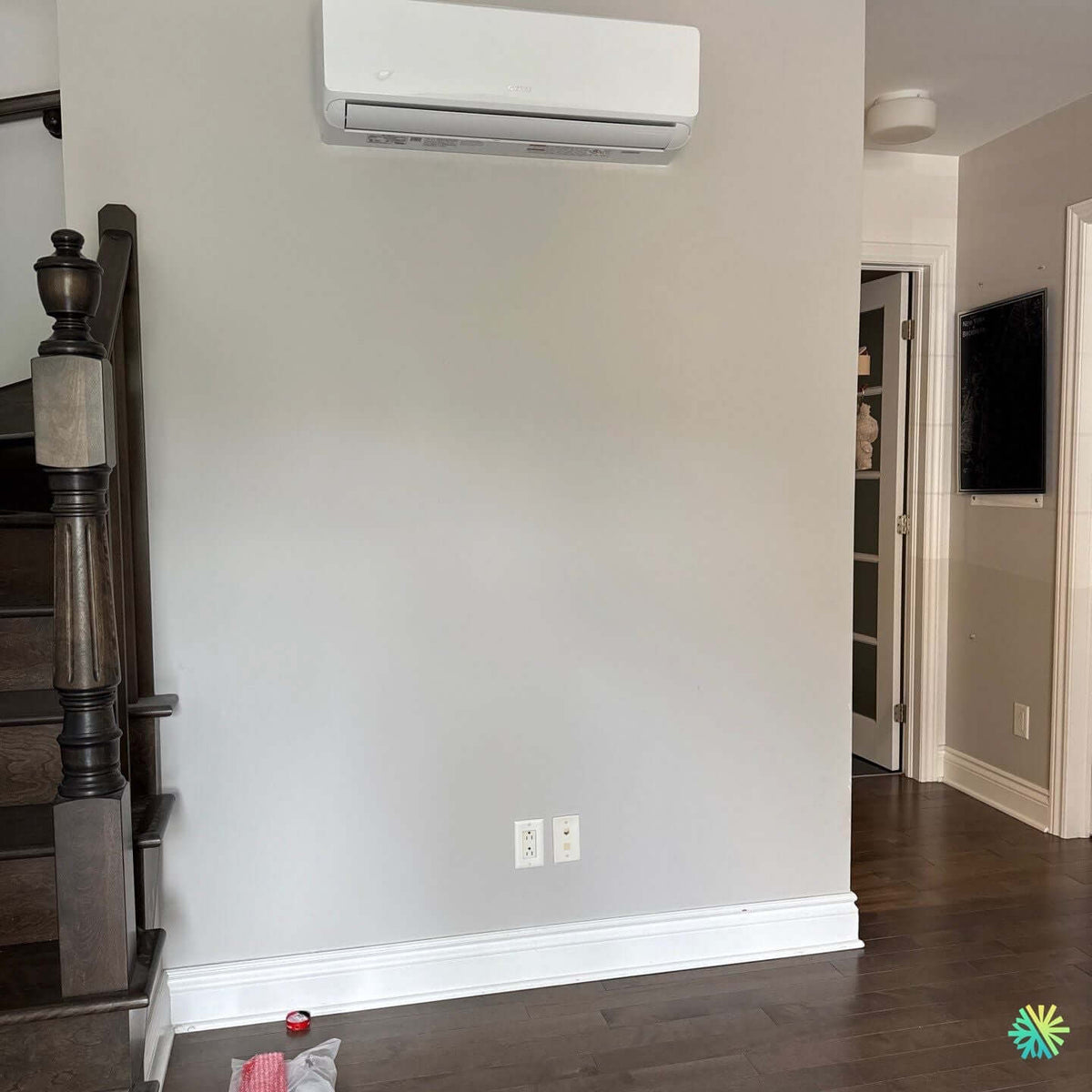
GREE R-32 wall-mounted heat pump installation in Chomedey: high head in the axis of the staircase, short run , gravity drain and discreet finish. An efficient and neat HVAC installation for Greater Montreal.
Take a tour of the installation
Each number is a point we check on site. Switch between summer and winter to watch air and heat move.
In summer, the outdoor unit rejects the house's heat outside.
Generic illustration of this type of installation, not a survey of this job site. Tap a number.
Mounted level on a wall plate, high enough for the air to reach the whole room, with enough space around it to slide the filters out easily.
The refrigerant lines, the communication cable and the drain go through the wall in a single opening, sealed against water, cold air and insects.
Two insulated copper pipes connect the two units. Outside, a line cover can protect them from sun, knocks and weather.
A shut-off switch near the outdoor unit isolates it safely for service. It must stay accessible at all times.
The compressor and the fan. In heating mode it captures heat from the outdoor air, even in winter, and moves it inside.
On the ground or on the wall, it keeps the unit above accumulated snow. The unit stays clear and defrost water can drain away.
The fan needs to blow freely. Storage, a fence or a wall too close, and efficiency drops while noise goes up.
A wall-mounted head perfectly positioned along the circulation axis – staircase, hall and living area – for consistent comfort upstairs and downstairs, created with AirGreen precision.
The context: opening up comfort to the entire living area
In a family home in Chomedey , the main living area is organized around a wooden staircase , a hall, and an open living room. In winter, air movement was poorly channeled: the staircase drew heat upstairs, leaving cooler areas near the entrance. In summer, the heat stagnated at the top of the stairs. Our mission: to install a GREE R-32 wall-mounted heat pump whose air diffusion could benefit the hall, living room, and staircase, without drafts affecting the occupants.
Why the GREE R-32 solution is essential here
Technical advantages
-
Inverter technology : the machine finely modulates its capacity; fewer short cycles, more efficient dehumidification in summer.
-
R-32 refrigerant : higher seasonal efficiency and reduced charge compared to older R-410A; lower environmental footprint.
-
Extreme cold design of the recent GREE platform: rapid defrosting, protected electronic cards, stable heating in mid-season and at low temperatures.
-
Low noise level at low speed, ideal for installation in passage areas.
Objective achieved: four-season comfort on the strategic staircase-hall-lounge axis with controlled operating costs.
The location choices that make the difference
Precise positioning of the wall head
The head is placed high on the clear wall along the staircase. This choice:
-
exploits the Coanda effect : the jet hugs the ceiling then gently descends, which stretches the airflow towards the living room and the hall;
-
avoids blowing directly on the occupants;
-
frees up the bottom of the wall for outlets and furniture.
We maintain a ceiling clearance in accordance with GREE recommendations in order to prevent air recirculation and maintain efficient recovery.
Short and clean refrigeration route
-
Single hole behind the head, sleeved, insulated and steam sealed .
-
Minimal white capping (hidden in the right return of the head then outside), for a discreet look in this light room.
-
Continuous insulation on the suction line; bending radii respected to avoid pressure drops and refrigerant noise.
Drainage and electricity: reliability first
-
Gravity drain preferred thanks to the natural slope available. Drain insulation to prevent condensation on the paint.
-
Dedicated electrical circuit with external disconnect switch near the condenser; conductor identification and polarity controlled.
-
Ground and torque the terminal blocks to manufacturer's tolerances.
The AirGreen method on the construction site
Before commissioning
-
Calibrated and controlled flares ; sharpened tube cutter to preserve ovality.
-
Deep vacuum (target ≤ 300 microns) maintained at a standstill to confirm the absence of moisture and non-condensables.
-
Leakage control on all connections using foam solution and pressure measurement.
-
Checking clearances around the head and condenser.
Start-up and fine-tuning
-
ΔT measurements in cold and hot mode; validation of intensities .
-
Setting the shutters to sweep the staircase obliquely without drafts into the hall.
-
Automatic night speed limitation to maintain low noise levels .
File submitted to the client
-
Serial numbers, technical photos, route diagram, usage recommendations and HVAC maintenance schedule.
Observed results
-
Even heating of the staircase-hall-living room axis: less gap between the foot and head of the stairs.
-
Stable air conditioning in summer: long cycles at low speed, better dehumidification , constant comfort in the living room.
-
Neat aesthetics : aligned head, invisible screws, discreet capping, electrical wall socket left free.
Operating tips to maximize efficiency
-
In winter, let the heat pump modulate at continuous low speed : this is when it is most energy efficient.
-
In summer, aim for 23–24°C ; activate the Dry function at the end of the day if humidity rises.
-
Filters : Clean every 4–8 weeks in season.
-
In front of the head, keep 1 m clear so as not to disturb the recovery; avoid tall furniture or prominent decorations under the facade.
Technical points monitored in a configuration with stairs
-
Vertical stratification : measurements at the top and bottom of the steps; adjustment of the shutters to break the pocket of hot air upstairs in winter.
-
Chimney effect : setting the speed in mid-season to prevent the staircase from draining all the heat.
-
Cross-flow distribution : in summer, the jet is directed to push fresh air towards the living room, with the staircase serving as a return sail .
Common Mistakes to Avoid — Our Approach
-
Oversizing : short cycles, degraded comfort. We size based on the actual load and occupant usage.
-
Head too close to the ceiling : recirculation and noise. We respect the manufacturer's clearance .
-
Drain without slope : risk of odors and stains. Here, gravity-fed and insulated.
-
Winding refrigeration route : losses and vibrations. Our route is short and has large radii.
-
Poorly positioned disconnect switch : complicated maintenance. We place it within immediate reach of the technician.
Deadlines and progress
-
Technical visit : 30–60 minutes (surveys, locations, finishing options).
-
HVAC installation : generally one day for one area, including testing and training.
-
Cleaning : protection, site vacuuming, tidying up and demonstrating the controls.
Recommended HVAC maintenance
-
Seasonal : filter cleaning, visual inspection of capping, checking clearance around the condenser.
-
Annual (by AirGreen):
-
cleaning indoor/outdoor coils;
-
Inverter intensity and modulation control;
-
defrost test, drain and disconnect check;
-
review of parameters according to household habits.
-
Who is this type of installation best suited for?
-
Houses and plexes with open space and central staircase .
-
Need efficient air conditioning in summer and economical supplementary heating in winter.
-
Projects seeking discreet integration (light paint, clean moldings, minimal capping).
For homes with several rooms located far apart, we also offer GREE MultiZone systems with R-32 or additional heads ( cassette , ducted , console ) to balance the whole.
Grants and Eligibility
Several GREE R-32 wall-mounted heat pumps with high efficiencies may be eligible for current assistance programs. Upon submission , we assess eligibility and prepare the required documents. Our methodology (deep void, clearances, drainage, and compliant connections) meets expected best practices .
In short
This HVAC installation in Chomedey combines an ideally positioned GREE R-32 wall-mounted header , a short and protected refrigeration path , and careful adjustments to take advantage of the staircase's dynamics. The result: consistent comfort, energy savings , and impeccable aesthetics—the AirGreen signature in Greater Montreal.
The big day, step by step
The main steps of this kind of job at AirGreen. Every house has its quirks: the estimate brings them out.
We look at the room, the outside wall, the line route and where the outdoor unit will go. That is where the capacity gets chosen.
Model, capacity and price, in writing. We also check whether the model qualifies for assistance programs.
Floors and furniture protected, wall plate position marked level, wall opening located.
A single opening, with the slope the drain needs to flow outside.
Set on a stand raised above the snow, with the clearances the manufacturer requires.
Connected, insulated and protected. The opening is then sealed against water, cold air and insects.
A dedicated circuit and an accessible disconnect near the outdoor unit.
Leak test, vacuum, then start-up and a check of heating and cooling.
Remote, modes, filters: we show you the essentials before we leave.
- The on-site estimateWe look at the room, the outside wall, the line route and where the outdoor unit will go. That is where the capacity gets chosen.
- The quoteModel, capacity and price, in writing. We also check whether the model qualifies for assistance programs.
- Getting readyFloors and furniture protected, wall plate position marked level, wall opening located.
- The wall openingA single opening, with the slope the drain needs to flow outside.
- The outdoor unitSet on a stand raised above the snow, with the clearances the manufacturer requires.
- Lines, cable and drainConnected, insulated and protected. The opening is then sealed against water, cold air and insects.
- The electrical workA dedicated circuit and an accessible disconnect near the outdoor unit.
- Tests and start-upLeak test, vacuum, then start-up and a check of heating and cooling.
- The walkthroughRemote, modes, filters: we show you the essentials before we leave.
What would it look like at your place?
Two quick checks with real numbers: what heat costs, and what your current heaters add up to in BTU/h.
Conversion: 1 W = 3.412 BTU/h. An indication, not a load calculation: baseboards and furnaces are often stronger than the real need, and they can stay as backup. AirGreen confirms the capacity on site.
Four mistakes we do not make
Flip each card to see what we do instead.
Your own project, step by step
What to do, season by season
Three habits per season for this unit. They take a few minutes and prevent many calls.
- Clean the indoor unit's filters.
- Clear leaves and debris left on the outdoor unit by winter.
- Test cooling before the first hot days.
- Clean the filters more often when the unit runs a lot.
- Keep plants away from the outdoor unit.
- Check that no water drips from the indoor unit.
- Rake the leaves around the outdoor unit.
- Test heating before the first cold days.
- Book periodic maintenance before winter.
- Keep snow away from the stand and the front of the unit.
- Let the unit defrost: it is normal.
- Never hit the ice on the fins; call us if the unit stays iced up.
Is your home ready?
Check what applies at your place. A "no" is not a refusal: it is what we sort out during the estimate.
Four statements: true or false?
It all comes down to details you have just seen.
1. In heating mode, the outdoor unit can produce water.
During defrost cycles. That water must drain away without forming ice.
2. You pick the capacity with a simple square-footage rule.
Windows, insulation, orientation and how the room is used all count. Capacity is chosen on site.
3. A multi-zone connects several indoor heads to a single condenser.
One head per room, all on the same condenser. Each room keeps its own temperature.
4. The disconnect can sit behind the patio furniture.
It must stay accessible: it is what shuts the unit off for service.
0 / 4 right answers
What people ask us about this kind of work
Does a wall-mounted heat pump heat in winter?
Wall-mounted or multi-zone: how do I choose?
Where does the outdoor unit go?
Are there grants?
Do I need a permit?
How cold can it heat?
How much can I save?
How is the LogisVert assistance calculated?
Is it noisy?
The outdoor unit is covered in ice: is that normal?
Does AirGreen hold the required licences?
Is the estimate free?
No question matches. Write to us: we answer.
More jobs to see, near you
By town, by equipment or by region: browse more than 4,700 published projects.
Each dot: a town where AirGreen has published projects. The glowing dot: this job.
Every house has its constraints. We see them before we install.
The on-site estimate is free and the quote follows within 24 hours.
Text and photo: a real AirGreen Climatisation & Chauffage job. The diagrams are generic illustrations of the type of installation, not a survey of this job site. Sources of the added figures: airgreen.ca product pages (NEEP / AHRI performance), Hydro-Québec (Heat pumps page, LogisVert, read on 13 October 2026), Régie de l’énergie (rate D as of 1 April 2026).