
Installation of a Gree central heat pump in Sainte-Rose (Laval)
AirGreen installed a Gree central heat pump in Sainte-Rose (Laval): raised wall brackets, protective cage, careful clearances and complete commissioning for four-season comfort throughout Greater Montreal.
- City
- Region
- Equipment
- Brand
- Challenges
- Published
The job on one screen
The article, chapter by chapter
Reliable heating and gentle air conditioning: an outdoor installation designed for snow and silence
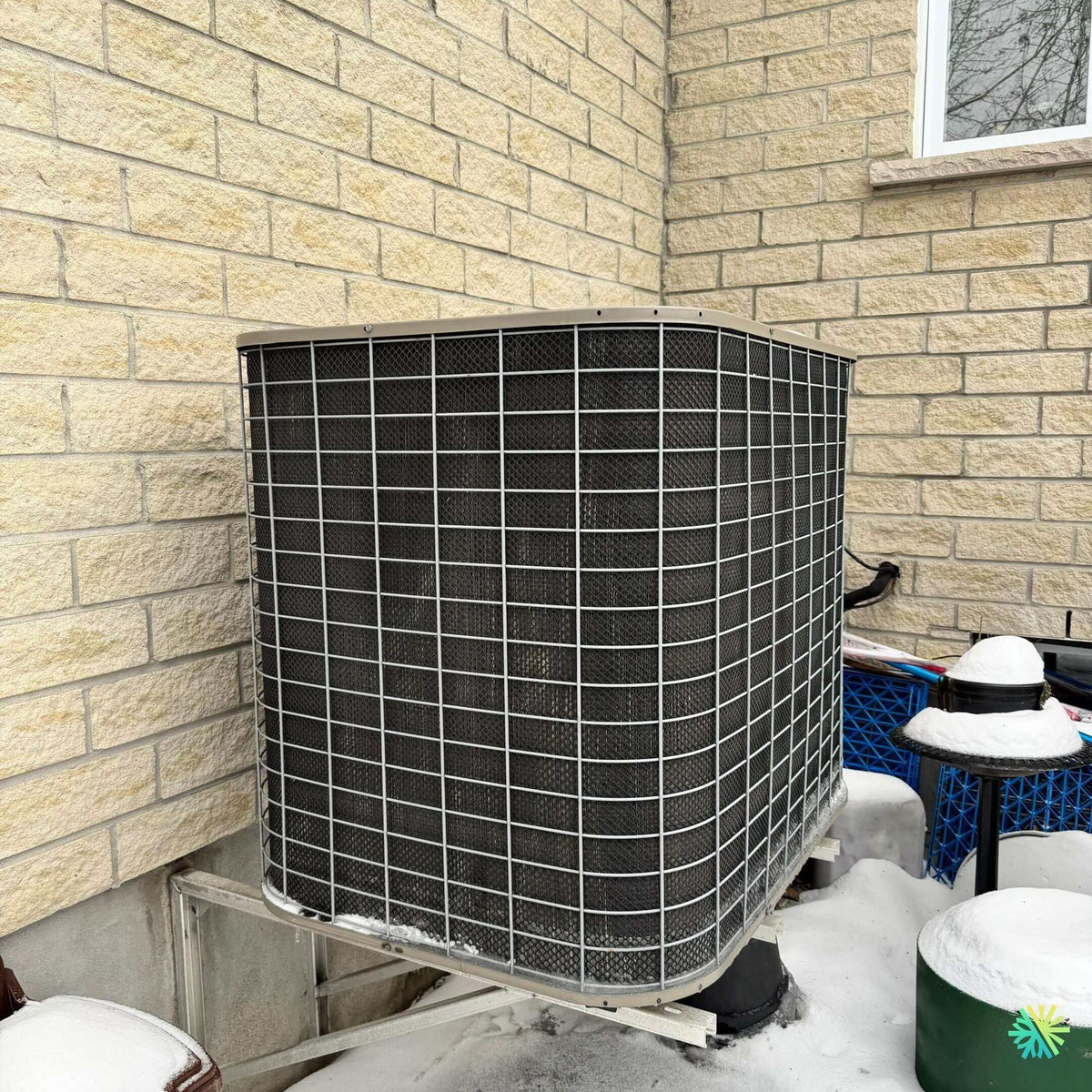
In a residential neighborhood of Sainte-Rose (Laval) , our team modernized the comfort of a single-family home with the installation of a Gree central heat pump . The goal: to provide efficient heating in cold weather, consistent air conditioning in the summer, and a clean, durable, and quiet exterior integration—essential in a suburban environment where winters are long and snowy.
Steps to an Exemplary HVAC Installation
Home context and client needs
The owner wanted to replace an aging system, reduce his energy bill, and improve comfort throughout the home (living room, upstairs bedrooms, and finished basement). We chose a central heat pump coupled with the existing ductwork to ensure even air distribution and maintain the interior aesthetics.
Why the Gree brand? A global leader in central heat pumps , Gree stands out with its variable-speed compressor (inverter) , precise temperature control, and robust design for northern climates. It's an excellent performance/price compromise for homes on the North Shore .
Condenser positioning: clearances and snow management
The outdoor unit is installed on sturdy wall brackets — a strategic choice in the greater Montreal area:
-
Ground clearance : the raised area protects the unit from snow and ice accumulations, ensures free air circulation under the base and facilitates the flow of defrosting .
-
Leveling and anti-vibration : pads and spacers limit the transmission of vibrations to the wall; the neighborhood benefits from quieter operation.
-
Side clearances : We maintain a minimum of 30 to 45 cm on the sides and 60 cm at the rear to meet airflow requirements and facilitate maintenance.
-
Orientation : choice of a wall sheltered from prevailing winds and snowdrifts; no direct roof descent above, to avoid falling ice.
Mechanical protection and security
The unit is surrounded by a protective grille . This enclosure prevents impacts (balloons, garden equipment, snow removal), protects the exchanger and deters accidental handling. The grille can be removed for access to the panels during HVAC maintenance .
Refrigeration path and wiring
-
Refrigerant lines : Direct run through the load-bearing wall, with weather-stripping caps , continuous cellular insulation and UV-blocking tape. The total length is within the standard range for a suburban home (approximately 15 to 25 ft between the outdoor unit and the air handler ).
-
Vapor barrier and waterproofing : careful sealing of holes (fire-resistant foam + exterior mastic) to prevent air and moisture infiltration , ensuring performance and durability.
-
Electricity : dedicated 240 V circuit breaker , outdoor disconnect box and frost-resistant whip ; verified grounding. This safety diagram complies with the Quebec Electrical Code.
Commissioning and controls
We follow a strict commissioning procedure:
-
Nitrogen test and leak detection.
-
Deep vacuum (≈ 500 microns) to remove moisture from the circuit.
-
Checking for superheat/subcooling , calibrating airflows and controlling refrigerant pressures .
-
Test in heating mode (correct defrosting, free water drainage) and in air conditioning mode (stability of the blowing temperature).
Result: stable operation, controlled consumption and consistent comfort on all floors.
Everyday sizing and comfort
The sizing takes into account the house envelope (insulation, windows), orientation and occupancy habits. The inverter continuously adapts the power:
-
Winter : maintaining a regular temperature without jolts, with an electrical booster controlled only during very cold weather.
-
Summer : efficient dehumidification and uniform temperatures in each area served by the ducts.
-
Mid-season : minimal consumption thanks to reduced compressor and fan speeds.
Clean and aesthetic finishes
Even outdoors, aesthetics count. The caps and hardware match the pale brick of the facade. The ducts are aligned and fixed at regular intervals; the protective grille follows a straight profile for a clean appearance from the courtyard.
AirGreen Recommended HVAC Maintenance
To preserve yields and lifespan :
-
Spring : gentle cleaning of the external exchanger (water, low pressure), checking the grid , checking the whip and disconnection .
-
Autumn : 60 cm clearance around the unit, inspection of fixings, check of wall brackets .
-
Interior filters : maintenance of the air manager (filters and coils) at the recommended frequencies.
-
Annual professional service : reading of parameters, electrical and refrigeration inspection, updating of usage instructions.
Points of attention (not to be neglected)
-
Never obstruct the base of the device in winter: the heat pump needs to evacuate defrost water.
-
Avoid closed shelters around the condenser: they restrict the air and reduce capacity .
-
Maintain sufficient access for maintenance; the cage must be removable .
-
Mandatory elevation on the North Shore : placing on the ground in a snow basin is a source of breakdowns and abnormal noise .
Performance and savings
Compared to an old air conditioner + resistive furnace, a modern central heat pump can significantly reduce electricity consumption for supplemental heating and cooling. Long cycles at low speed improve acoustic comfort and limit wear . Depending on the exact model, the equipment may be eligible for current provincial programs , particularly when seasonal efficiency thresholds are met. We always validate these criteria on a case-by-case basis for Montreal, Laval, Longueuil, South Shore and North Shore .
What the customer gains on a daily basis
-
Four-season comfort throughout the home via existing ductwork.
-
Perceptible silence inside and outside thanks to the inverter and anti-vibration .
-
Peace of mind in winter: elevation, clearances and compliant HVAC installation .
-
Simplified maintenance : clear access, removable cage, organized connections.
-
Added value : careful installation and traceability of commissioning by AirGreen.
Our AirGreen signature
At AirGreen, we don't just "install a machine." We design a coherent package: location , supports , clearance templates , protections , refrigeration path , electricity , commissioning . This approach reduces service calls, stabilizes performance , and extends the life of your central heat pump .
Need a similar project?
Whether you are in Laval , Montreal , Longueuil , on the North Shore or the South Shore , our experts analyze your home, suggest the right power and install your system with the same level of requirement. AirGreen remains your trusted partner for lasting comfort and a profitable investment .
The job tools
Two quick checks with real numbers: what heat costs, and what your current heaters add up to in BTU/h.
Conversion: 1 W = 3.412 BTU/h. An indication, not a load calculation: baseboards and furnaces are often stronger than the real need, and they can stay as backup. AirGreen confirms the capacity on site.
How the job unfolds
The main steps of this kind of job at AirGreen. Every house has its quirks: the estimate brings them out.
We look at the ducts, the current indoor module, the electrical panel and the planned spot for the outdoor unit.
The equipment combination, capacity and price, in writing. We check whether the combination qualifies for assistance programs.
Access protected, old unit disconnected and removed when it is being replaced.
Electric furnace or air handler, with its coil, connected to the supply and return ducts.
On a level base, raised above the snow, with free space all around.
Insulated, they enter through a sealed opening and run to the indoor coil.
Dedicated circuits, accessible disconnect, a thermostat that works with the heat pump and the backup heat.
Leak test, vacuum, start-up, airflow check and a test of both modes.
Filter, thermostat, backup heat in extreme cold: what to know before winter.
- The on-site estimateWe look at the ducts, the current indoor module, the electrical panel and the planned spot for the outdoor unit.
- The quoteThe equipment combination, capacity and price, in writing. We check whether the combination qualifies for assistance programs.
- Getting readyAccess protected, old unit disconnected and removed when it is being replaced.
- The indoor moduleElectric furnace or air handler, with its coil, connected to the supply and return ducts.
- The outdoor unitOn a level base, raised above the snow, with free space all around.
- The refrigerant linesInsulated, they enter through a sealed opening and run to the indoor coil.
- Electrical and thermostatDedicated circuits, accessible disconnect, a thermostat that works with the heat pump and the backup heat.
- Tests and start-upLeak test, vacuum, start-up, airflow check and a test of both modes.
- The walkthroughFilter, thermostat, backup heat in extreme cold: what to know before winter.
What we check on a job like this one
Each number is a point we check on site. Switch between summer and winter to watch air and heat move.
In summer, the outdoor unit rejects the house's heat outside.
Generic illustration of this type of installation, not a survey of this job site. Tap a number.
It captures or rejects heat outside. It sits on a level base, above the snow, with free space all around.
The insulated refrigerant lines enter the house through a sealed opening and run to the indoor coil.
A shut-off switch near the outdoor unit isolates it safely for service.
Sitting on the indoor module, it moves heat between the house air and the refrigerant.
Electric furnace or air handler: its fan pushes air through the ducts. The electric backup takes over in extreme cold.
Supply ducts bring air to the rooms; returns bring it back to the unit. Their condition matters as much as the unit's.
It protects the coil and the fan. A dirty filter cuts airflow, so it gets checked regularly.
It runs the heat pump and the backup heat. It must be compatible with the installed system.
Is your home ready?
Check what applies at your place. A "no" is not a refusal: it is what we sort out during the estimate.
Good habits, once the unit is in place
Six simple habits that keep the unit going. Your list stays on this device.
What to do, season by season
Three habits per season for this unit. They take a few minutes and prevent many calls.
- Check the indoor module's filter.
- Clear winter debris from the outdoor unit.
- Test cooling before the heat arrives.
- Check the filter more often in peak season.
- Keep registers and returns clear.
- Watch condensate drainage near the coil.
- Change or clean the filter.
- Test heating and backup heat before the cold.
- Book periodic maintenance.
- Clear snow around the outdoor unit.
- Store nothing in front of the indoor module.
- Note any unusual noise or smell and call us.
The right pages, at the right time
Four statements: true or false?
It all comes down to details you have just seen.
1. A central heat pump uses the house's ducts.
It connects to the existing ducts to heat and cool everywhere.
2. In extreme cold, electric backup heat can take over.
The indoor module (furnace or air handler) works with the heat pump and takes over in extreme cold.
3. The filter only gets changed when the unit breaks down.
A dirty filter cuts airflow. It gets checked regularly.
4. You can reuse the old unit's size without checking.
The house may have changed: insulation, windows, added rooms. Capacity is confirmed on site.
0 / 4 right answers
What people ask us about this kind of work
Can I keep my current ducts?
What happens in extreme cold?
Furnace, air handler, ducted: what is the difference?
Are there grants?
Do I need a permit?
How much can I save?
How is the LogisVert assistance calculated?
Will my current thermostat work?
Central or wall units: which one?
Does AirGreen hold the required licences?
Is the estimate free?
No question matches. Write to us: we answer.
More jobs to see, near you
By town, by equipment or by region: browse more than 4,700 published projects.
Each dot: a town where AirGreen has published projects. The glowing dot: this job.
An on-site estimate, the right capacity, the right equipment.
The on-site estimate is free and the quote follows within 24 hours.
Text and photo: a real AirGreen Climatisation & Chauffage job. The diagrams are generic illustrations of the type of installation, not a survey of this job site. Sources of the added figures: airgreen.ca product pages (NEEP / AHRI performance), Hydro-Québec (Heat pumps page, LogisVert, read on 13 October 2026), Régie de l’énergie (rate D as of 1 April 2026).