
Installation of a Samsung wall-mounted heat pump (R-32) in Villeray
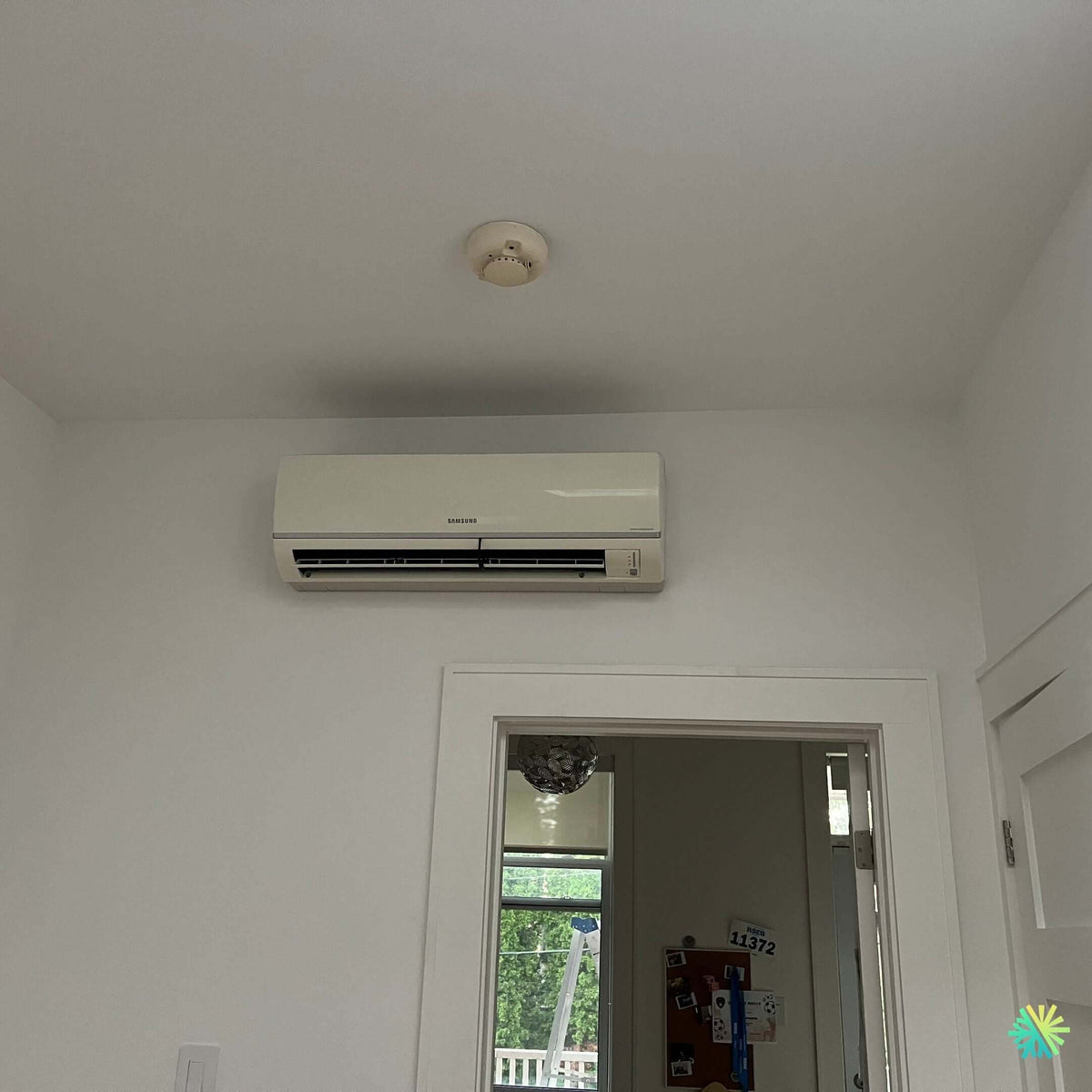
Samsung wall-mounted heat pump (R-32) installed in Villeray: neat integration above the door, short connections and gravity drain . AirGreen — HVAC installation experts in Montreal, Laval, Longueuil, North Shore and South Shore.
- City
- Region
- Equipment
- Brand
- Challenges
- Published
The job on one screen
The article, chapter by chapter
Precise comfort in a room with high ceilings: a clean and sustainable interior integration, carried out by AirGreen
In a bright apartment in Villeray–Saint-Michel–Parc-Extension , our team installed a Samsung wall-mounted heat pump (R-32) to stabilize the temperature of a bedroom/office overlooking the courtyard. The client's objective was clear: efficient summer cooling , reliable supplemental heating in winter , and quiet operation , all with careful installation that respected the minimalist aesthetic of the room.
Why this choice of device is essential in the Villeray residential park
Housing in the area often combines interior gypsum walls , raised doors and windows overlooking trees or balconies . In this context, a recent wall-mounted heat pump with R-32 refrigerant offers:
-
High seasonal efficiency thanks to the Inverter compressor, which modulates power and avoids energy-consuming short cycles.
-
A contained noise level , essential for a room with mixed use (work, rest).
-
Precise directional blowing to cover the area evenly without unpleasant drafts.
-
Reduced environmental impact compared to older generations with R-410A.
The capacity chosen for this type of room is generally around 9,000 to 12,000 BTU , subject to the load calculation carried out on site (surface, insulation, orientation, air infiltration, presence of electronic devices and occupants). We always size the machine to the actual need , never on instinct.
Room analysis: ceiling height and centered door
The room has a clear white ceiling , an interior door positioned under the unit and a window overlooking the courtyard providing moderate solar gain. Our technical priorities:
-
Maintain sufficient overhead clearance for free air intake and easy access to filters.
-
Direct the blowing towards the useful volume, without direct impact on the occupied area near the door.
-
Optimize the gravity drain path to reduce maintenance and noise risks.
-
Minimize the length of refrigerant lines to maintain efficiency and simplify future interventions.
Installation details: a readable AirGreen signature in each finish
Implantation of the inner head
-
Installation in the upper part , level , respecting the clearances recommended by the manufacturer.
-
Fixing to reinforcements in the partition, with anchors suitable for gypsum; tightening torque control to avoid vibrations.
-
Airflow management : orientation of horizontal flaps for transverse sweeping of the room; adjustment of vertical flaps to limit the impact on the passage area above the door.
Connections, drilling and drain
-
Single hole through the exterior wall with insulated sheath and peripheral sealing (closed cell foam + mastic), limiting thermal bridges and air inlets.
-
Gravity drainage with continuous slope towards the outside; no condensate pump required, therefore less maintenance and no noise pollution.
-
Short refrigerant lines and communication cabling neatly routed outside to reach the condenser; exterior capping harmonised with the façade (laid with a line, clean angles).
Power supply and compliance
-
Dedicated circuit according to the appliance's nominal currents, calibrated circuit breaker and connection box positioned for safe service access.
-
Implementation compliant with RBQ / CSA requirements, with clear identification of conductors.
Commissioning
-
Nitrogen leak test , deep vacuum until stabilization, then release of the load according to the actual length of the connections.
-
Functional checks : delta T in cold and hot conditions, absorbed intensity, communication between cards, shutter response.
-
Customer briefing : filter cleaning, Auto/Heat/Cool modes, humidity management, seasonal best practices.
Measurable result for the client
-
Uniform temperature without noticeable stratification thanks to the head elevation and optimized sweeping.
-
Minimal noise at low speeds, compatible with teleworking and sleeping .
-
Controlled consumption : the machine stabilizes the thermal load instead of chaining full-throttle starts.
-
Aesthetics respected : no visible trunking inside, invisible connections and perfectly aligned equipment.
What we systematically monitor in a room like this
Sizing
Oversizing by 30-40% would cause short cycling , poor humidity management and premature wear. Our load calculation takes into account solar gains through the window , air permeability and actual occupancy.
Air return and obstacles
-
No shelf or molding near the top of the unit.
-
No vertical obstacles within the minimum lateral distance (bookcases, projecting uprights).
-
Temperature sensor control to avoid readings skewed by door airflow.
Drain
-
Slope > 1%, siphon if required by the external configuration, anti-freeze protection at the passage.
-
Flow test with clear water before closing the finishes.
Vibes
-
Checking the partition wall , installing spacers if necessary, silent blocks on the condenser side.
HVAC Maintenance: Keeping Performance at Day 1 Levels
Proper HVAC maintenance extends performance:
-
Filters : rinse every 4 to 8 weeks during heavy use.
-
Annual inspection : exchanger, condensate tray, fan, probes; electrical tightening ; visual inspection of external connections.
-
Dust prevention : avoid obstruction around the unit; dust the room before heat waves.
-
Winter : clear the outdoor condenser area (snow, ice), keep clearances for air intake/expulsion.
We offer maintenance plans with proactive reminders and visit reports to preserve seasonal indices and the lifespan of the device.
Grants and technical files
Recent R-32 wall-mounted heat pumps can qualify for financial assistance when the SEER/SEER2 and HSPF/HSPF2 ratings are at the required level. We support our customers in:
-
Verification of the eligibility of the installed model.
-
Collecting evidence (serial numbers, installation photos, detailed invoices).
-
Submission of the file within the deadlines announced by the programs in force.
AirGreen Tips for Rooms with Aligned Doors and Windows
-
Position the head so that it blows parallel to the natural airflow rather than directly onto the occupant.
-
Respect the ceiling distance to preserve air intake and avoid immediate recirculation.
-
Favor gravity drain ; the condensate pump remains a solution of last resort.
-
Take into account actual solar gains (curtains, blinds, trees) to adjust the sizing.
-
Provide service access from the design stage: filters, front cover, fixing screws, space for instruments.
AirGreen: methodology, finishes and local monitoring
Our approach can be summed up in three clear steps:
-
On-site technical study with load calculation and connection layout.
-
Clean and compliant HVAC installation , neat finishes inside and out.
-
Documented commissioning and support during the first season of use.
We operate weekly in Montreal, Laval, Longueuil, North Shore and South Shore , with teams continuously trained on the R-32/R-454B generations and the winter requirements of Greater Montreal .
AirGreen — Wall-mounted heat pumps: installation, maintenance and HVAC modernization throughout Greater Montreal.
The job tools
Two quick checks with real numbers: what heat costs, and what your current heaters add up to in BTU/h.
Conversion: 1 W = 3.412 BTU/h. An indication, not a load calculation: baseboards and furnaces are often stronger than the real need, and they can stay as backup. AirGreen confirms the capacity on site.
How the job unfolds
The main steps of this kind of job at AirGreen. Every house has its quirks: the estimate brings them out.
We look at the room, the outside wall, the line route and where the outdoor unit will go. That is where the capacity gets chosen.
Model, capacity and price, in writing. We also check whether the model qualifies for assistance programs.
Floors and furniture protected, wall plate position marked level, wall opening located.
A single opening, with the slope the drain needs to flow outside.
Set on a stand raised above the snow, with the clearances the manufacturer requires.
Connected, insulated and protected. The opening is then sealed against water, cold air and insects.
A dedicated circuit and an accessible disconnect near the outdoor unit.
Leak test, vacuum, then start-up and a check of heating and cooling.
Remote, modes, filters: we show you the essentials before we leave.
- The on-site estimateWe look at the room, the outside wall, the line route and where the outdoor unit will go. That is where the capacity gets chosen.
- The quoteModel, capacity and price, in writing. We also check whether the model qualifies for assistance programs.
- Getting readyFloors and furniture protected, wall plate position marked level, wall opening located.
- The wall openingA single opening, with the slope the drain needs to flow outside.
- The outdoor unitSet on a stand raised above the snow, with the clearances the manufacturer requires.
- Lines, cable and drainConnected, insulated and protected. The opening is then sealed against water, cold air and insects.
- The electrical workA dedicated circuit and an accessible disconnect near the outdoor unit.
- Tests and start-upLeak test, vacuum, then start-up and a check of heating and cooling.
- The walkthroughRemote, modes, filters: we show you the essentials before we leave.
What we check on a job like this one
Each number is a point we check on site. Switch between summer and winter to watch air and heat move.
In summer, the outdoor unit rejects the house's heat outside.
Generic illustration of this type of installation, not a survey of this job site. Tap a number.
Mounted level on a wall plate, high enough for the air to reach the whole room, with enough space around it to slide the filters out easily.
The refrigerant lines, the communication cable and the drain go through the wall in a single opening, sealed against water, cold air and insects.
Two insulated copper pipes connect the two units. Outside, a line cover can protect them from sun, knocks and weather.
A shut-off switch near the outdoor unit isolates it safely for service. It must stay accessible at all times.
The compressor and the fan. In heating mode it captures heat from the outdoor air, even in winter, and moves it inside.
On the ground or on the wall, it keeps the unit above accumulated snow. The unit stays clear and defrost water can drain away.
The fan needs to blow freely. Storage, a fence or a wall too close, and efficiency drops while noise goes up.
Is your home ready?
Check what applies at your place. A "no" is not a refusal: it is what we sort out during the estimate.
Good habits, once the unit is in place
Six simple habits that keep the unit going. Your list stays on this device.
What to do, season by season
Three habits per season for this unit. They take a few minutes and prevent many calls.
- Clean the indoor unit's filters.
- Clear leaves and debris left on the outdoor unit by winter.
- Test cooling before the first hot days.
- Clean the filters more often when the unit runs a lot.
- Keep plants away from the outdoor unit.
- Check that no water drips from the indoor unit.
- Rake the leaves around the outdoor unit.
- Test heating before the first cold days.
- Book periodic maintenance before winter.
- Keep snow away from the stand and the front of the unit.
- Let the unit defrost: it is normal.
- Never hit the ice on the fins; call us if the unit stays iced up.
The right pages, at the right time
Four statements: true or false?
It all comes down to details you have just seen.
1. In heating mode, the outdoor unit can produce water.
During defrost cycles. That water must drain away without forming ice.
2. You pick the capacity with a simple square-footage rule.
Windows, insulation, orientation and how the room is used all count. Capacity is chosen on site.
3. A multi-zone connects several indoor heads to a single condenser.
One head per room, all on the same condenser. Each room keeps its own temperature.
4. The disconnect can sit behind the patio furniture.
It must stay accessible: it is what shuts the unit off for service.
0 / 4 right answers
What people ask us about this kind of work
Does a wall-mounted heat pump heat in winter?
Wall-mounted or multi-zone: how do I choose?
Where does the outdoor unit go?
Are there grants?
Do I need a permit?
How cold can it heat?
How much can I save?
How is the LogisVert assistance calculated?
Is it noisy?
The outdoor unit is covered in ice: is that normal?
Does AirGreen hold the required licences?
Is the estimate free?
No question matches. Write to us: we answer.
More jobs to see, near you
By town, by equipment or by region: browse more than 4,700 published projects.
Each dot: a town where AirGreen has published projects. The glowing dot: this job.
An on-site estimate, the right capacity, the right equipment.
The on-site estimate is free and the quote follows within 24 hours.
Text and photo: a real AirGreen Climatisation & Chauffage job. The diagrams are generic illustrations of the type of installation, not a survey of this job site. Sources of the added figures: airgreen.ca product pages (NEEP / AHRI performance), Hydro-Québec (Heat pumps page, LogisVert, read on 13 October 2026), Régie de l’énergie (rate D as of 1 April 2026).