
Installation of a Sharp ECO Inverter wall-mounted heat pump in LaSalle
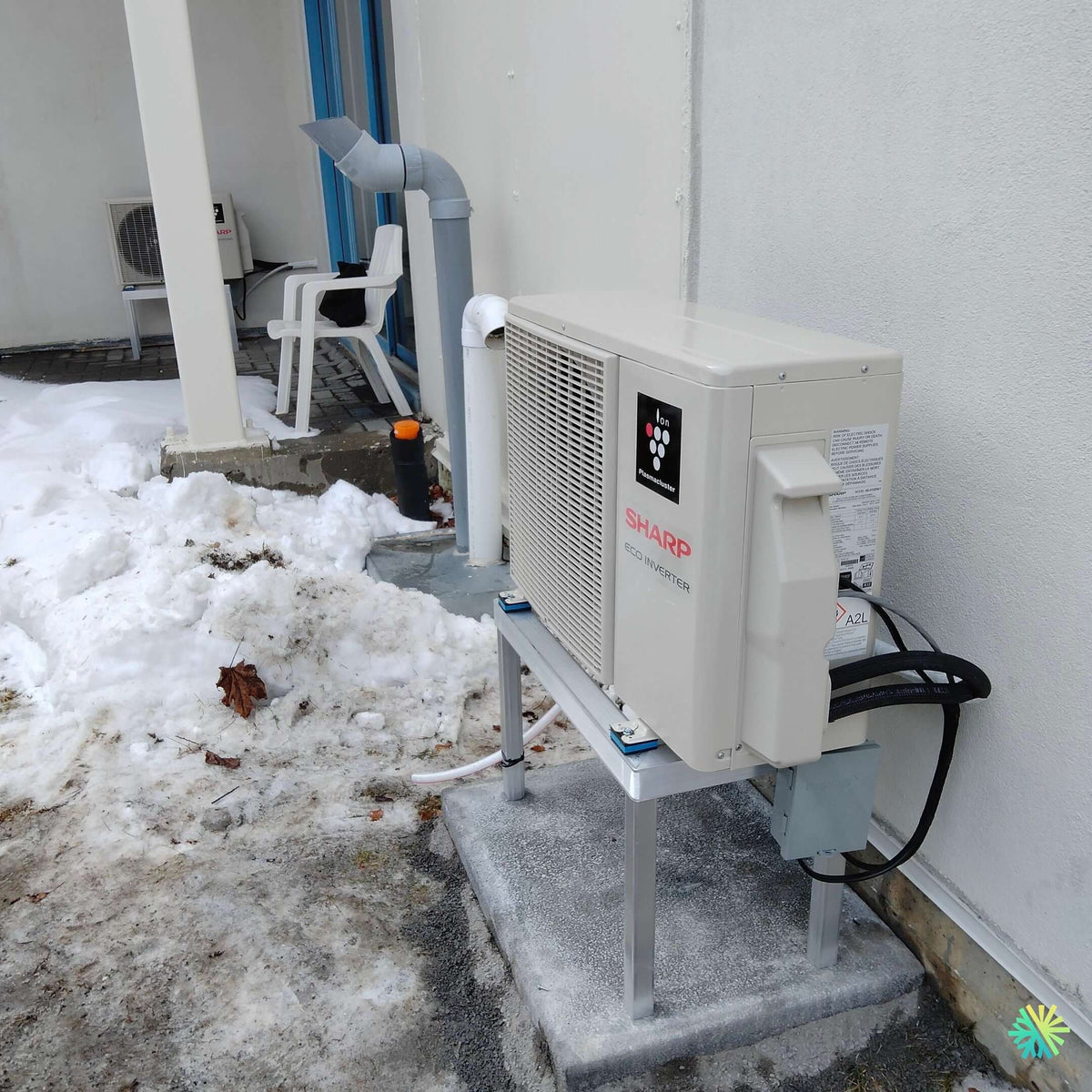
In LaSalle , AirGreen installs a Sharp ECO Inverter (R-32) on a raised support and dedicated slab : short path, perfect sealing, gravity drain and exemplary silence. An HVAC installation designed for Montreal winters.
- City
- Region
- Equipment
- Brand
- Challenges
- Published
The job on one screen
The article, chapter by chapter
An exemplary winter installation: performance, silence and cleanliness around a garden-level condo
In the LaSalle area, our AirGreen teams installed a Sharp ECO Inverter wall-mounted heat pump ( R-32 – A2L refrigerant) for a condominium with outdoor access on one level. The work took place in snowy conditions, which allowed us to illustrate all the best practices for an HVAC installation designed for the Montreal climate : raised support, defrost water management, short refrigeration path and careful electrical integration.
Site reading and comfort objectives
The condo features a light-colored plaster facade, blue joinery , a small awning , and a concrete slab extending the threshold. In the background, a second condenser serves another apartment: cohabitation in a condominium therefore requires an impeccable acoustic and aesthetic approach. The client's objective: stable heating in winter , precise air conditioning in summer , controlled consumption , and as little noise as possible for the terrace.
Choice of location: efficiency and sustainability
Raised support and dedicated slab
-
The condenser rests on an aluminum support fixed to an independent slab .
-
Blue anti-vibration pads decouple the unit, reducing the transmission of vibrations to the structure.
-
The ground clearance is deliberately generous in order to cross the snow line , facilitate the flow of frost and protect the group from splashes.
Short and protected refrigerated path
-
The insulated copper connections and the communication/power cable exit directly from the wall to the right of the condenser: less than 1 m of visible bundle, minimized pressure losses and impeccable aesthetics .
-
The single hole is caulked and sealed to prevent thermal bridges and infiltration.
-
The indoor unit's condensate drain adopts a gravity slope towards the outside, eliminating the need for a pump and keeping the installation quiet .
Defrost water management
-
In winter, the defrost cycle releases water at the base of the condenser; the dedicated slab and compacted gravel base limit the formation of ice around the base.
-
We maintain peripheral clearance to promote dispersion, and we recommend light winter maintenance (breaking the ice crust if there is an accumulation).
Sharp ECO Inverter Platform (R-32 – A2L): Why choose LaSalle?
Even without specifying the exact reference, the Sharp ECO Inverter range currently delivered to Quebec operates on R-32 (class A2L) and benefits from very fine inverter modulation . The concrete benefits for a condo in Greater Montreal:
-
Heating in cold weather with optimized defrost cycles and maintenance of good airflow.
-
High seasonal efficiency and reduced GWP compared to R-410A, therefore lower environmental impact .
-
Low exterior and interior noise level ; ideal when units are close to a relaxation area or bedroom window .
-
Advanced indoor head-side air filtration with Plasmacluster Ion technology , popular in open-plan living room-kitchen areas.
AirGreen methodology: rigor at every stage
1) Pre-visit and sizing
We analyze orientation , glass area , insulation , occupancy habits and electrical control (dedicated circuit breaker, rating, grounding). This study determines the adequate BTU capacity and optimal location of the head.
2) Mechanical and refrigeration installation
-
Anchors adapted to the substrate, level and squareness control of the support.
-
Calibrated and lubricated flares , respecting the radius of curvature of the tubes.
-
Deep vacuum , leak test and vacuum resistance before opening the service valves.
3) Commissioning and balancing
-
Checking blown temperatures , intensities , superheating/subcooling .
-
Orientation of the interior head flaps , adjustment of modes (heating, air conditioning, dehumidification, ventilation).
-
Tips for using to avoid short cycles and maximize energy savings .
Results obtained on this project in LaSalle
-
Superior thermal reactivity thanks to the very short refrigeration path .
-
Quiet operation on the terrace and for the neighborhood, even during defrosting.
-
Neat aesthetics : no unnecessary external chute, discreet sealing.
-
Easy maintenance access : clearance under the unit, electrical disconnection within reach, simplified exchanger cleaning.
Maintenance: What we recommend
By the client (monthly to quarterly)
-
Clean the inner head filters .
-
Clear leaves/snow from around the condenser; never cover the unit.
By AirGreen (annual)
-
Refrigeration inspection (pressures, temperatures, vacuum gauge if suspected).
-
Cleaning the exchanger and checking the drain .
-
Check electrical connections , update settings if necessary.
Regular maintenance preserves seasonal efficiency , reduces compressor wear and extends the life of the unit.
Compliance, warranties and subsidies
We carry out our work according to RBQ and CSA requirements, with compliant electrical declarations . Depending on the capacity and certified performance, this wall-mounted heat pump may be eligible for efficiency programs in Quebec. We support our customers in Montreal, Laval, Longueuil, North Shore and South Shore to verify eligibility , prepare documents (detailed invoice, serial numbers) and finalize the application .
AirGreen Best Practices to Remember for Condos and Plexes
-
Raised support above the snow line, on independent slab .
-
Shortest possible route between head and condenser.
-
Gravity slope of the drain for reliability and silence .
-
Drilling sealant compatible with plaster/brick to prevent cracks and infiltration.
-
Respect for clearances around the condenser: performance and longevity guaranteed.
Your project in Greater Montreal
Whether you live in LaSalle, Verdun, Lachine, Montreal , Laval , Longueuil , on the North Shore or the South Shore , AirGreen designs and installs wall-mounted heat pumps adapted to your envelope and your uses. Our promise: four-season comfort , a clean and durable installation , and maintenance monitoring that protects your investment.
The job tools
Two quick checks with real numbers: what heat costs, and what your current heaters add up to in BTU/h.
Conversion: 1 W = 3.412 BTU/h. An indication, not a load calculation: baseboards and furnaces are often stronger than the real need, and they can stay as backup. AirGreen confirms the capacity on site.
How the job unfolds
The main steps of this kind of job at AirGreen. Every house has its quirks: the estimate brings them out.
We look at the room, the outside wall, the line route and where the outdoor unit will go. That is where the capacity gets chosen.
Model, capacity and price, in writing. We also check whether the model qualifies for assistance programs.
Floors and furniture protected, wall plate position marked level, wall opening located.
A single opening, with the slope the drain needs to flow outside.
Set on a stand raised above the snow, with the clearances the manufacturer requires.
Connected, insulated and protected. The opening is then sealed against water, cold air and insects.
A dedicated circuit and an accessible disconnect near the outdoor unit.
Leak test, vacuum, then start-up and a check of heating and cooling.
Remote, modes, filters: we show you the essentials before we leave.
- The on-site estimateWe look at the room, the outside wall, the line route and where the outdoor unit will go. That is where the capacity gets chosen.
- The quoteModel, capacity and price, in writing. We also check whether the model qualifies for assistance programs.
- Getting readyFloors and furniture protected, wall plate position marked level, wall opening located.
- The wall openingA single opening, with the slope the drain needs to flow outside.
- The outdoor unitSet on a stand raised above the snow, with the clearances the manufacturer requires.
- Lines, cable and drainConnected, insulated and protected. The opening is then sealed against water, cold air and insects.
- The electrical workA dedicated circuit and an accessible disconnect near the outdoor unit.
- Tests and start-upLeak test, vacuum, then start-up and a check of heating and cooling.
- The walkthroughRemote, modes, filters: we show you the essentials before we leave.
What we check on a job like this one
Each number is a point we check on site. Switch between summer and winter to watch air and heat move.
In summer, the outdoor unit rejects the house's heat outside.
Generic illustration of this type of installation, not a survey of this job site. Tap a number.
Mounted level on a wall plate, high enough for the air to reach the whole room, with enough space around it to slide the filters out easily.
The refrigerant lines, the communication cable and the drain go through the wall in a single opening, sealed against water, cold air and insects.
Two insulated copper pipes connect the two units. Outside, a line cover can protect them from sun, knocks and weather.
A shut-off switch near the outdoor unit isolates it safely for service. It must stay accessible at all times.
The compressor and the fan. In heating mode it captures heat from the outdoor air, even in winter, and moves it inside.
On the ground or on the wall, it keeps the unit above accumulated snow. The unit stays clear and defrost water can drain away.
The fan needs to blow freely. Storage, a fence or a wall too close, and efficiency drops while noise goes up.
Is your home ready?
Check what applies at your place. A "no" is not a refusal: it is what we sort out during the estimate.
Good habits, once the unit is in place
Six simple habits that keep the unit going. Your list stays on this device.
What to do, season by season
Three habits per season for this unit. They take a few minutes and prevent many calls.
- Clean the indoor unit's filters.
- Clear leaves and debris left on the outdoor unit by winter.
- Test cooling before the first hot days.
- Clean the filters more often when the unit runs a lot.
- Keep plants away from the outdoor unit.
- Check that no water drips from the indoor unit.
- Rake the leaves around the outdoor unit.
- Test heating before the first cold days.
- Book periodic maintenance before winter.
- Keep snow away from the stand and the front of the unit.
- Let the unit defrost: it is normal.
- Never hit the ice on the fins; call us if the unit stays iced up.
The right pages, at the right time
Four statements: true or false?
It all comes down to details you have just seen.
1. In heating mode, the outdoor unit can produce water.
During defrost cycles. That water must drain away without forming ice.
2. You pick the capacity with a simple square-footage rule.
Windows, insulation, orientation and how the room is used all count. Capacity is chosen on site.
3. A multi-zone connects several indoor heads to a single condenser.
One head per room, all on the same condenser. Each room keeps its own temperature.
4. The disconnect can sit behind the patio furniture.
It must stay accessible: it is what shuts the unit off for service.
0 / 4 right answers
What people ask us about this kind of work
Does a wall-mounted heat pump heat in winter?
Wall-mounted or multi-zone: how do I choose?
Where does the outdoor unit go?
Are there grants?
Do I need a permit?
How cold can it heat?
How much can I save?
How is the LogisVert assistance calculated?
Is it noisy?
The outdoor unit is covered in ice: is that normal?
Does AirGreen hold the required licences?
Is the estimate free?
No question matches. Write to us: we answer.
More jobs to see, near you
By town, by equipment or by region: browse more than 4,700 published projects.
Each dot: a town where AirGreen has published projects. The glowing dot: this job.
An on-site estimate, the right capacity, the right equipment.
The on-site estimate is free and the quote follows within 24 hours.
Text and photo: a real AirGreen Climatisation & Chauffage job. The diagrams are generic illustrations of the type of installation, not a survey of this job site. Sources of the added figures: airgreen.ca product pages (NEEP / AHRI performance), Hydro-Québec (Heat pumps page, LogisVert, read on 13 October 2026), Régie de l’énergie (rate D as of 1 April 2026).