
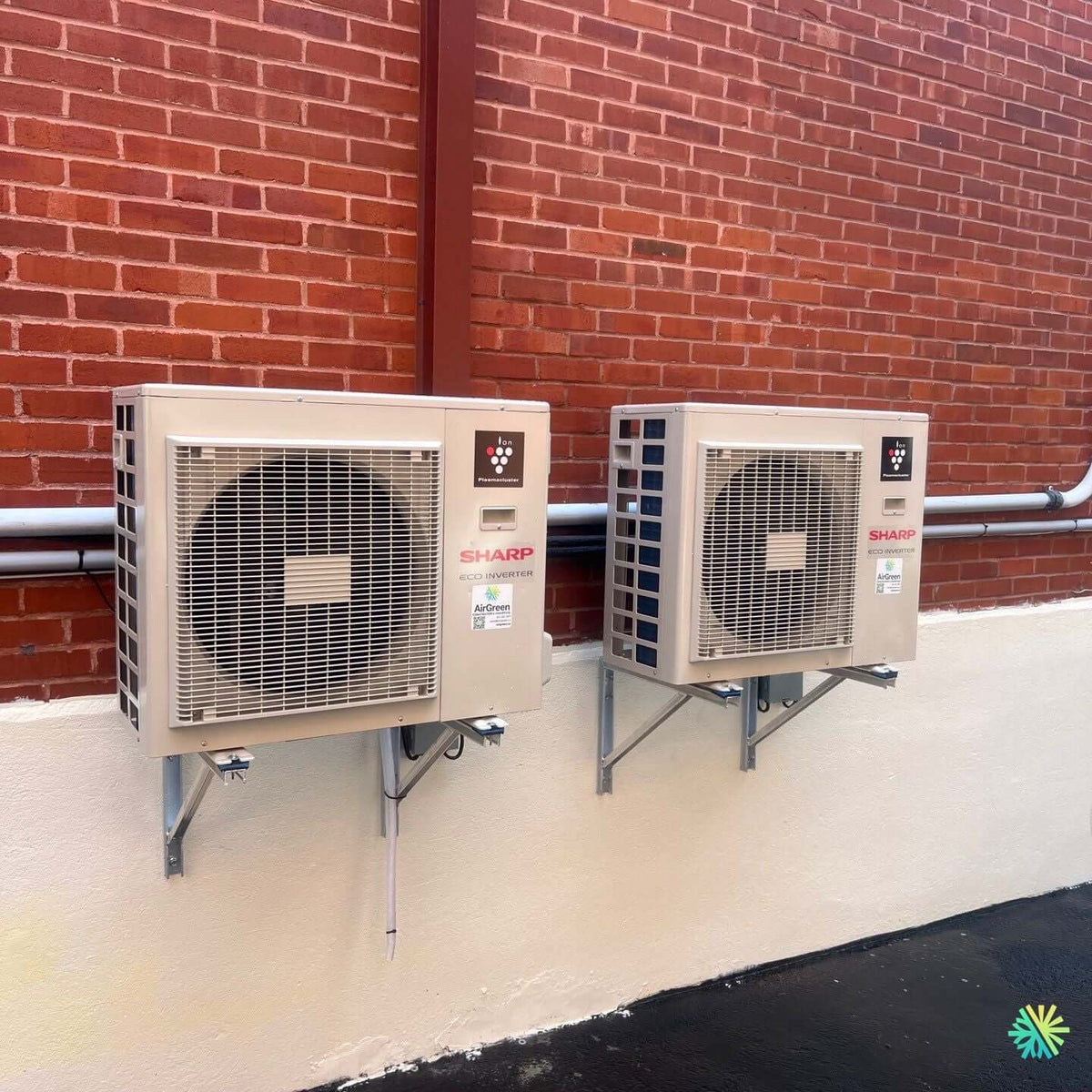
Installation of a Sharp Eco Inverter wall-mounted heat pump in Rosemont–La Petite-Patrie
Two Sharp Eco Inverter wall-mounted heat pumps installed on brackets in Rosemont–La Petite-Patrie: clean finish, optimized clearances, and four-season comfort. AirGreen, HVAC installation specialist in Greater Montreal.
In summer, the outdoor unit rejects the house's heat outside.
Generic illustration of this type of installation, not a survey of this job site. Tap a number.
Mounted level on a wall plate, high enough for the air to reach the whole room, with enough space around it to slide the filters out easily.
The refrigerant lines, the communication cable and the drain go through the wall in a single opening, sealed against water, cold air and insects.
Two insulated copper pipes connect the two units. Outside, a line cover can protect them from sun, knocks and weather.
A shut-off switch near the outdoor unit isolates it safely for service. It must stay accessible at all times.
The compressor and the fan. In heating mode it captures heat from the outdoor air, even in winter, and moves it inside.
On the ground or on the wall, it keeps the unit above accumulated snow. The unit stays clear and defrost water can drain away.
The fan needs to blow freely. Storage, a fence or a wall too close, and efficiency drops while noise goes up.
Two outdoor units on wall brackets for four-season comfort
In a brick building in Rosemont–La Petite-Patrie , we installed two Sharp Eco Inverter wall-mounted heat pumps . The goal: to provide independentheating and cooling for two units/zonings, while preserving the aesthetics of the facade and circulation in a narrow driveway. The outdoor units are mounted on galvanized brackets at strategic heights, with clearances optimized for airflow and maintenance. The refrigeration lines run neatly in a rigid cover along the wall, then descend vertically to sealed holes.
Client context and needs
-
Residential masonry building, rear driveway limited for traffic and snow removal.
-
Request for two autonomous zones to separately manage the temperature of two apartments/living areas.
-
Priorities: silence , reliability in Montreal winters, discreet HVAC installation respecting local and co-ownership regulations.
Why the Sharp Eco Inverter range?
Sharp is known for its sophisticated electronics and stable inverter compressors. In this project, the Eco Inverter range provides:
-
Fine power modulation to maintain temperature smoothly.
-
Very good seasonal heating and cooling efficiency , favorable to energy savings.
-
Protected electronic cards and design thought out for service, an asset in the climate of Greater Montreal .
-
Compatibility with grant program requirements when configurations meet current efficiency criteria.
Sizing and technical approach
Before proposing a tonnage, we perform a load calculation taking into account the surface area, orientation, insulation, and air infiltration. For this type of application, typical power outputs range from 9,000 to 18,000 BTU per zone, depending on actual needs. The two systems are independent : each outdoor unit powers its dedicated indoor head, simplifying control and maintenance.
Salient installation details
-
Mounting : Robust galvanized steel wall brackets, anchored to the brick with suitable sealing. The chosen height places the machines above snow and dirt, while reducing the unevenness of the asphalt.
-
Vibration management : anti-vibration pads under the frames and controlled tightening to prevent transmission to the brick facing.
-
Refrigeration path : horizontal paths under rigid UV cover, then clean vertical descent ; bending radius respected to preserve the integrity of the copper.
-
Drilling : precise coring with slope for flow and closed vapor barrier (sealing return) to avoid any thermal bridge or infiltration.
-
Electrical : Power supply on dedicated circuit breakers and disconnect boxes near maintenance, in accordance with RBQ/CSA standards.
-
Condensate drainage : gravity drainage preferred when possible; otherwise, sized and insulated condensate pump (here, gravity sufficient thanks to the slope and height of the brackets).
-
Clearances : free space at the front and sides to ensure air flow and winter defrosting ; center distance studied between the two machines to avoid recirculation.
Construction site challenges… and our solutions
-
Narrow aisle and traffic : the wall bracket option frees up the floor and protects the units from impacts (garbage cans, snow plow).
-
Brick facade : suitable anchors, careful sealing and restoration of the facing for a clean and durable finish.
-
Noise management : fan orientation and height calculated to limit sound reflection on the opposite wall; sound levels checked in reduced operation using the inverter.
-
Montreal winter : installation protected from falling ice and sufficient height to keep the grid out of snow banks ; advice for use during storms.
Result: two comfortable and autonomous areas
Each occupant has their own thermostat and remote control to precisely adjust the temperature. The inverter maintains stable settings, reducing electricity costs and the feeling of drafts. In summer, the air conditioning keeps rooms dry; in mid-season and winter, the heat pump provides efficient heating at controlled operating costs.
Good practices for use and maintenance
-
Filters : Clean the filters of the interior heads every 4 to 8 weeks depending on use.
-
Winter defrosting : allow the units to work freely; do not obstruct the grilles with objects or snow drifts.
-
Annual HVAC maintenance **: pressure inspection, electrical test, support and drainage check; this preventive visit extends the lifespan and preserves performance.
-
Programming : favor stable setpoints rather than significant deviations so that the inverter can do its optimization work.
Grants and Compliance
When the configurations and performance meet current criteria, these wall-mounted heat pumps may be eligible for provincial and municipal incentives . We guide our customers through the required procedures, installation certificates , and technical documents , whether you are in Montreal, Laval, Longueuil, on the North Shore, or the South Shore .
What sets AirGreen apart in this type of project?
-
On-site study and transparent recommendations (single unit vs. multi-zone, power, layout).
-
Neat finish : aligned hood, clean seals, secure wiring, clearances respected.
-
Respecting deadlines : coordination with condominiums and planning to minimize the impact on residents.
-
After-sales service : parts availability, team of HVAC technicians trained in Sharp ranges and other brands served by AirGreen.
Tips for a masonry building in Rosemont
-
Use brackets when the driveway is narrow or subject to snow removal.
-
Maintain an aesthetic line : aligned hoods, colors coordinated with the facing.
-
Check electrical capacity and sufficient clearance around units.
-
Anticipate maintenance : clear access to disconnections and underside of machine for drainage inspection.
Conclusion
This Sharp Eco Inverter installation in Rosemont–La Petite-Patrie demonstrates our approach: precise analysis , clean integration , and sustainable performance . Two independent wall systems deliver controlled comfort, attractive energy efficiency , and a finish that enhances the building. For a similar project in Montreal, Laval, Longueuil, the North Shore, or the South Shore , our team will support you from design to commissioning and annual HVAC maintenance .
How it goes, from the first call to the end
The main steps of this kind of job at AirGreen. Every house has its quirks: the estimate brings them out.
We look at the room, the outside wall, the line route and where the outdoor unit will go. That is where the capacity gets chosen.
Model, capacity and price, in writing. We also check whether the model qualifies for assistance programs.
Floors and furniture protected, wall plate position marked level, wall opening located.
A single opening, with the slope the drain needs to flow outside.
Set on a stand raised above the snow, with the clearances the manufacturer requires.
Connected, insulated and protected. The opening is then sealed against water, cold air and insects.
A dedicated circuit and an accessible disconnect near the outdoor unit.
Leak test, vacuum, then start-up and a check of heating and cooling.
Remote, modes, filters: we show you the essentials before we leave.
- The on-site estimateWe look at the room, the outside wall, the line route and where the outdoor unit will go. That is where the capacity gets chosen.
- The quoteModel, capacity and price, in writing. We also check whether the model qualifies for assistance programs.
- Getting readyFloors and furniture protected, wall plate position marked level, wall opening located.
- The wall openingA single opening, with the slope the drain needs to flow outside.
- The outdoor unitSet on a stand raised above the snow, with the clearances the manufacturer requires.
- Lines, cable and drainConnected, insulated and protected. The opening is then sealed against water, cold air and insects.
- The electrical workA dedicated circuit and an accessible disconnect near the outdoor unit.
- Tests and start-upLeak test, vacuum, then start-up and a check of heating and cooling.
- The walkthroughRemote, modes, filters: we show you the essentials before we leave.
And at your place?
Two quick checks with real numbers: what heat costs, and what your current heaters add up to in BTU/h.
Conversion: 1 W = 3.412 BTU/h. An indication, not a load calculation: baseboards and furnaces are often stronger than the real need, and they can stay as backup. AirGreen confirms the capacity on site.
What to do, season by season
Three habits per season for this unit. They take a few minutes and prevent many calls.
- Clean the indoor unit's filters.
- Clear leaves and debris left on the outdoor unit by winter.
- Test cooling before the first hot days.
- Clean the filters more often when the unit runs a lot.
- Keep plants away from the outdoor unit.
- Check that no water drips from the indoor unit.
- Rake the leaves around the outdoor unit.
- Test heating before the first cold days.
- Book periodic maintenance before winter.
- Keep snow away from the stand and the front of the unit.
- Let the unit defrost: it is normal.
- Never hit the ice on the fins; call us if the unit stays iced up.
Which type of equipment for your project?
Pick what looks like your need.
Four mistakes we do not make
Flip each card to see what we do instead.
What people ask us about this kind of work
Does a wall-mounted heat pump heat in winter?
Wall-mounted or multi-zone: how do I choose?
Where does the outdoor unit go?
Are there grants?
Do I need a permit?
How cold can it heat?
How much can I save?
How is the LogisVert assistance calculated?
Is it noisy?
The outdoor unit is covered in ice: is that normal?
Does AirGreen hold the required licences?
Is the estimate free?
No question matches. Write to us: we answer.
Useful pages for what comes next
More jobs to see, near you
By town, by equipment or by region: browse more than 4,700 published projects.
Each dot: a town where AirGreen has published projects. The glowing dot: this job.
Tell us about your house. We come and see it for free.
The on-site estimate is free and the quote follows within 24 hours.
Text and photo: a real AirGreen Climatisation & Chauffage job. The diagrams are generic illustrations of the type of installation, not a survey of this job site. Sources of the added figures: airgreen.ca product pages (NEEP / AHRI performance), Hydro-Québec (Heat pumps page, LogisVert, read on 13 October 2026), Régie de l’énergie (rate D as of 1 April 2026).