
Installation of a Sharp Eco Inverter wall-mounted heat pump in Rosemont–La Petite-Patrie
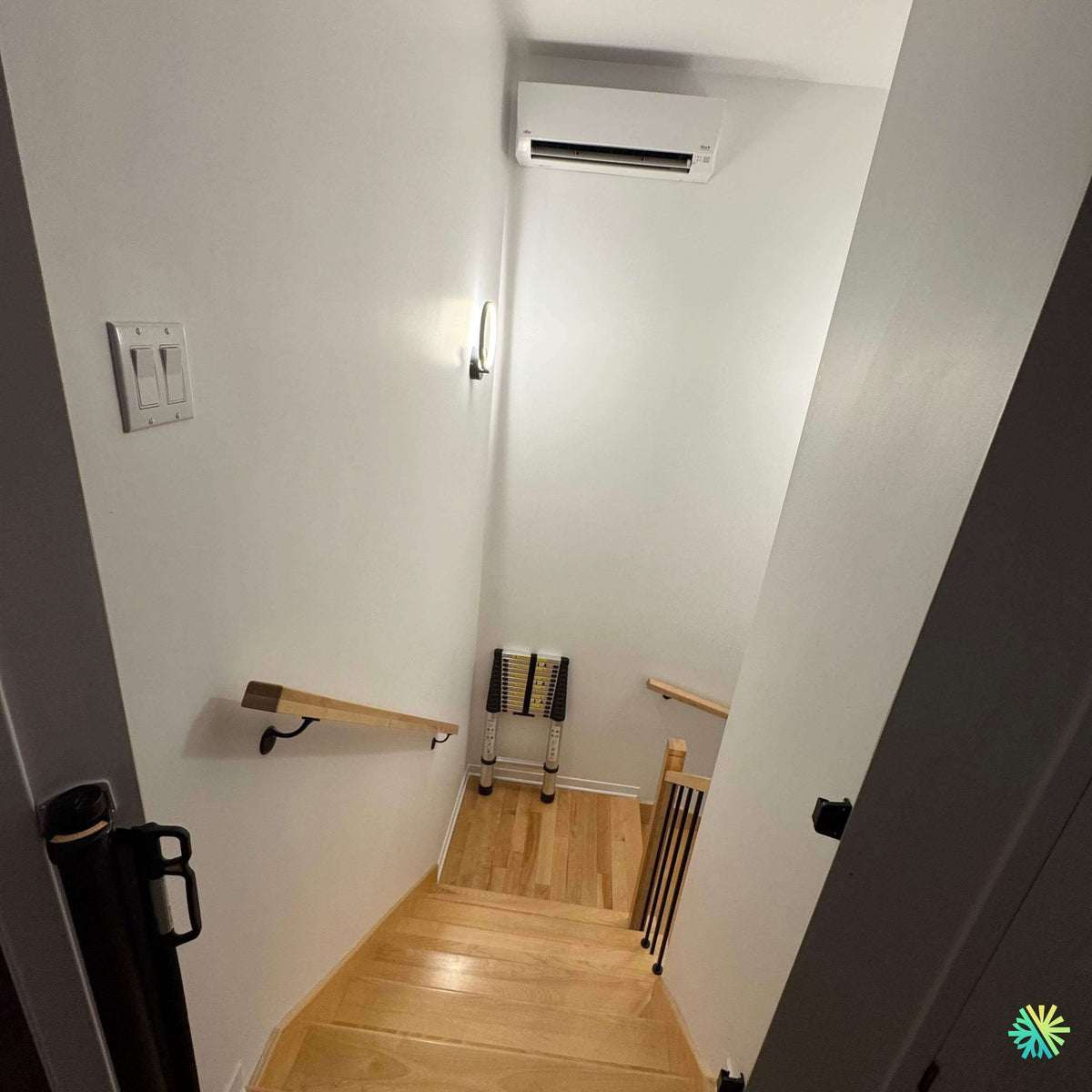
Sharp Eco Inverter wall-mounted heat pump installed at the top of the stairs in Rosemont–La Petite-Patrie. Carefully designed AirGreen HVAC installation, air distribution on two levels, high efficiency, and grant eligibility.
In summer, the outdoor unit rejects the house's heat outside.
Generic illustration of this type of installation, not a survey of this job site. Tap a number.
Mounted level on a wall plate, high enough for the air to reach the whole room, with enough space around it to slide the filters out easily.
The refrigerant lines, the communication cable and the drain go through the wall in a single opening, sealed against water, cold air and insects.
Two insulated copper pipes connect the two units. Outside, a line cover can protect them from sun, knocks and weather.
A shut-off switch near the outdoor unit isolates it safely for service. It must stay accessible at all times.
The compressor and the fan. In heating mode it captures heat from the outdoor air, even in winter, and moves it inside.
On the ground or on the wall, it keeps the unit above accumulated snow. The unit stays clear and defrost water can drain away.
The fan needs to blow freely. Storage, a fence or a wall too close, and efficiency drops while noise goes up.
An interior head placed in a stairwell to heat and cool two levels with a single unit
At AirGreen , we often work in Montreal homes where every square meter counts. This Sharp Eco Inverter wall-mounted heat pump installation in a Rosemont–La Petite-Patrie home is a prime example: we positioned the indoor unit at the top of a stairwell to take advantage of the natural airflow between the upper and lower floors. The result: consistent, four-season comfort , lower bills, and a discreet integration that respects the aesthetics of the space.
The customer context: stable comfort and minimalist aesthetics
The owner wanted:
-
improve thermal stability between floors without multiplying units;
-
reduce operating costs compared to window air conditioners and electric baseboard heaters;
-
maintain a clean visual signature in traffic areas;
-
benefit from a system eligible for subsidies in effect for Greater Montreal.
The Sharp Eco Inverter meets these requirements with a modulating compressor, reliable electronics and improved air quality thanks to Ion treatment (Plasmacluster on the Sharp range), very popular with families sensitive to allergens.
Why the stairwell is a winning location
Installing a wall-mounted headboard at the top of a staircase has concrete advantages:
-
Natural vertical distribution : hot air rises, cool air descends. Placed high up, the head supplies the upper floor in heating mode and causes the cooled air to fall back to the lower level in summer.
-
Optimized airflow : motorized shutters direct the airflow towards the landing, creating a laminar flow along the walls and avoiding dead zones in adjacent rooms.
-
Controlled acoustics : a stairwell provides a sound corridor that keeps decibels away from rest areas; the Sharp nevertheless remains discreet at low speed thanks to the Inverter.
-
Maintenance access : washable filter accessible, sufficient clearance for panel opening and seasonal cleaning.
For this strategy to work, the installation height and blowing angle must be precise. Our technicians secured the unit above the landing , respecting the manufacturer's clearances to ensure unobstructed airflow and easy access to the existing wall lighting.
Technical details of the HVAC installation
Support, template and drillings
-
Tracing with the manufacturer's steel template ; laser verification to maintain flatness on a new wall.
-
Anchoring in the uprights with appropriate screws to limit vibration transmission.
-
Through drilling with a slight gravity slope for condensate drainage (2 to 3°), deburring and installation of a watertight bulkhead fitting .
Refrigeration lines and wiring
-
Refrigerant connections (insulated copper) in diameter prescribed by the nameplate; large radius bending to preserve the volumetric capacity of the refrigerant.
-
Short useful length (≈ 2.5–3.5 m) between the head and the outdoor condenser, limiting pressure loss and improving seasonal efficiency .
-
Communication and power cable sized according to distance and maximum current; protected routing.
Capping and visual integration
-
White cable duct laid with a line, tight fittings, junctions sealed to prevent stray air.
-
In the staircase, the descent bend has been minimized to avoid any inconvenience during passage and maintain a discreet profile.
Condensate management
-
Priority gravity drainage , with insulated pipe to prevent surface condensation in summer.
-
Full load flow test in cold mode, then installation of a non-return valve at the outlet point to prevent the entry of outside air.
Vacuuming, charging and testing
-
Deep vacuum to remove moisture and non-condensables, stabilized and controlled to the micron meter.
-
Opening of valves, control of operating pressures and blowing temperatures .
-
Functional checks: flap response, air flow reading, defrost control in simulated heating mode.
Outside: stability and longevity
The condenser was installed on a concrete slab with raised galvanized aluminum support . This solution:
-
keeps the device away from snow projections and runoff water;
-
reduces vibrations transmitted to the ground;
-
facilitates clearance on the suction and discharge sides.
Peripheral clearances have been respected to ensure air sweeping without recirculation. Lines and cables exit protected to the external trunking, for a clean and durable finish.
Configuration and operating advice
-
Orientation of the shutters : in summer, more horizontal blowing to push fresh air towards the staircase; in winter, angle slightly upwards to promote mixing and limit stratification.
-
Recommended automatic speed **: the inverter algorithm modulates the turbine to maintain the set point with controlled consumption.
-
Dehumidification mode in between seasons**: improves perceived comfort without excessively lowering the temperature.
-
HVAC maintenance : cleaning of filters every 6 to 8 weeks during periods of heavy use; annual AirGreen inspection (pressure, electrical tightening, condition of insulation and condensates).
Results: measurable comfort and savings
After commissioning, measurements show:
-
a reduced temperature difference between upper and lower floors;
-
a short draw time to reach the setpoint during starts;
-
a very low acoustic leveler at the landing (low speed) thanks to the intelligent positioning away from rest areas;
-
smoothed electricity consumption compared to all-or-nothing systems.
Every day, the family enjoys consistent comfort and improved air quality thanks to the ionic treatment specific to the Sharp range.
Grants and Compliance
The wall-mounted heat pump chosen meets the performance criteria generally required by the assistance programs in effect in Quebec. We support our customers in Montreal, Laval, Longueuil, the North Shore and the South Shore in verifying eligibility , preparing files and post-installation procedures (detailed invoices, proof of compliance and AHRI number when required).
What makes the AirGreen difference
-
Custom design : air circulation study and selection of the installation point to serve several areas with a single head.
-
Clean execution : aligned chutes, careful drilling, gravity management of condensates for maximum reliability.
-
Compliance with standards : compliant electrical and refrigeration installation, documented tests and clear explanations to the customer.
-
After-sales service : HVAC maintenance reminders, local availability and stock of common parts to limit delays.
Best practices and pitfalls to avoid in a stairwell
-
Don't undersize : A stairwell acts like a well; the BTU capacity must take into account the volume to be mixed and the adjacent rooms.
-
Avoid blowing directly at an acute angle to avoid creating air bubbles and whistling sounds.
-
Ensure proper clearance around the hopper: guardrails, lights, smoke detectors and switches must remain accessible.
-
Take care with condensate drainage : constant slope, no counter-slope hidden in a riser; otherwise, provide a certified and soundproof lifting pump .
-
Protect lines during future work: screwed capping and clear marking for contractors.
What if the house evolves?
This single-zone configuration can be integrated into a future MultiZone heat pump if the owner wishes to add heads in the bedrooms or basement. The Sharp range offers compatibilities that allow the system to be expanded while maintaining aesthetic consistency and ease of use .
Conclusion
This HVAC installation in Rosemont–La Petite-Patrie demonstrates that strategic positioning at the top of the stairs achieves balanced comfort on two levels with a single wall-mounted heat pump . The Sharp Eco Inverter provides the expected efficiency, while AirGreen execution—from the chute to the vacuum—ensures durability, silence, and savings . For Greater Montreal homeowners who want a clean, efficient, and aid-eligible project, our team puts the rigor of a specialized installer at the service of a more comfortable daily life.
How it goes, from the first call to the end
The main steps of this kind of job at AirGreen. Every house has its quirks: the estimate brings them out.
We look at the room, the outside wall, the line route and where the outdoor unit will go. That is where the capacity gets chosen.
Model, capacity and price, in writing. We also check whether the model qualifies for assistance programs.
Floors and furniture protected, wall plate position marked level, wall opening located.
A single opening, with the slope the drain needs to flow outside.
Set on a stand raised above the snow, with the clearances the manufacturer requires.
Connected, insulated and protected. The opening is then sealed against water, cold air and insects.
A dedicated circuit and an accessible disconnect near the outdoor unit.
Leak test, vacuum, then start-up and a check of heating and cooling.
Remote, modes, filters: we show you the essentials before we leave.
- The on-site estimateWe look at the room, the outside wall, the line route and where the outdoor unit will go. That is where the capacity gets chosen.
- The quoteModel, capacity and price, in writing. We also check whether the model qualifies for assistance programs.
- Getting readyFloors and furniture protected, wall plate position marked level, wall opening located.
- The wall openingA single opening, with the slope the drain needs to flow outside.
- The outdoor unitSet on a stand raised above the snow, with the clearances the manufacturer requires.
- Lines, cable and drainConnected, insulated and protected. The opening is then sealed against water, cold air and insects.
- The electrical workA dedicated circuit and an accessible disconnect near the outdoor unit.
- Tests and start-upLeak test, vacuum, then start-up and a check of heating and cooling.
- The walkthroughRemote, modes, filters: we show you the essentials before we leave.
And at your place?
Two quick checks with real numbers: what heat costs, and what your current heaters add up to in BTU/h.
Conversion: 1 W = 3.412 BTU/h. An indication, not a load calculation: baseboards and furnaces are often stronger than the real need, and they can stay as backup. AirGreen confirms the capacity on site.
What to do, season by season
Three habits per season for this unit. They take a few minutes and prevent many calls.
- Clean the indoor unit's filters.
- Clear leaves and debris left on the outdoor unit by winter.
- Test cooling before the first hot days.
- Clean the filters more often when the unit runs a lot.
- Keep plants away from the outdoor unit.
- Check that no water drips from the indoor unit.
- Rake the leaves around the outdoor unit.
- Test heating before the first cold days.
- Book periodic maintenance before winter.
- Keep snow away from the stand and the front of the unit.
- Let the unit defrost: it is normal.
- Never hit the ice on the fins; call us if the unit stays iced up.
Which type of equipment for your project?
Pick what looks like your need.
Four mistakes we do not make
Flip each card to see what we do instead.
What people ask us about this kind of work
Does a wall-mounted heat pump heat in winter?
Wall-mounted or multi-zone: how do I choose?
Where does the outdoor unit go?
Are there grants?
Do I need a permit?
How cold can it heat?
How much can I save?
How is the LogisVert assistance calculated?
Is it noisy?
The outdoor unit is covered in ice: is that normal?
Does AirGreen hold the required licences?
Is the estimate free?
No question matches. Write to us: we answer.
Useful pages for what comes next
More jobs to see, near you
By town, by equipment or by region: browse more than 4,700 published projects.
Each dot: a town where AirGreen has published projects. The glowing dot: this job.
Tell us about your house. We come and see it for free.
The on-site estimate is free and the quote follows within 24 hours.
Text and photo: a real AirGreen Climatisation & Chauffage job. The diagrams are generic illustrations of the type of installation, not a survey of this job site. Sources of the added figures: airgreen.ca product pages (NEEP / AHRI performance), Hydro-Québec (Heat pumps page, LogisVert, read on 13 October 2026), Régie de l’énergie (rate D as of 1 April 2026).