
Installation of a Sharp ZU1 series wall-mounted heat pump in Nuns' Island
Sharp wall-mounted heat pump (ZU1 series) installed in Nuns' Island: short path, discreet capping, four-season comfort and healthier air. AirGreen, HVAC installation experts in Greater Montreal. ≤275 characters
Take a tour of the installation
Each number is a point we check on site. Switch between summer and winter to watch air and heat move.
In summer, the outdoor unit rejects the house's heat outside.
Generic illustration of this type of installation, not a survey of this job site. Tap a number.
Mounted level on a wall plate, high enough for the air to reach the whole room, with enough space around it to slide the filters out easily.
The refrigerant lines, the communication cable and the drain go through the wall in a single opening, sealed against water, cold air and insects.
Two insulated copper pipes connect the two units. Outside, a line cover can protect them from sun, knocks and weather.
A shut-off switch near the outdoor unit isolates it safely for service. It must stay accessible at all times.
The compressor and the fan. In heating mode it captures heat from the outdoor air, even in winter, and moves it inside.
On the ground or on the wall, it keeps the unit above accumulated snow. The unit stays clear and defrost water can drain away.
The fan needs to blow freely. Storage, a fence or a wall too close, and efficiency drops while noise goes up.
A perfectly integrated inner head for discreet, 4-season comfort
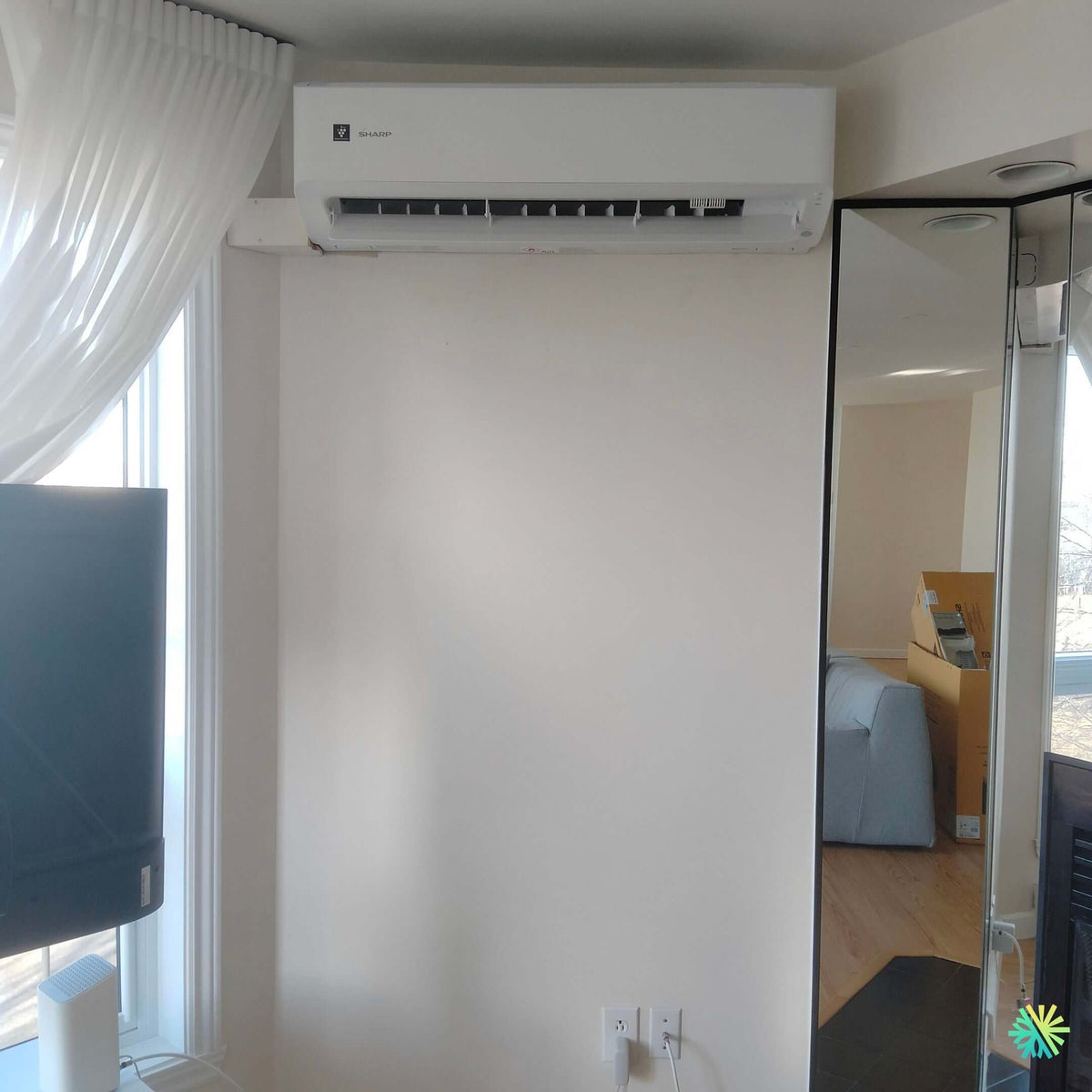
In a bright condo on Nuns' Island (Montreal), our team installed a Sharp wall-mounted heat pump (ZU1 series) . The client's goal was clear: to achieve reliable heating in the spring/fall and precise air conditioning in the summer, without cluttering the space or detracting from the very refined aesthetic of the living room with its large windows. The result: a quiet , efficient unit that is practically invisible in the decor and maintains a stable temperature throughout the year.
Background and choice of equipment
The condo features a largely glazed southwest-facing façade. Solar gains are significant in the afternoon and caused recurring overheating in summer. Conversely, the mid-seasons remained cool. We therefore opted for a wall-mounted heat pump from the Sharp ZU1 range —known for its fine blower control, compressor modulation, and Plasmacluster air treatment (logo visible on the façade), ideal for limiting dust and allergens in an open-concept space.
-
Type : wall-mounted heat pump (mini-split)
-
Brand : Sharp
-
Range : ZU1 (usual capacity 9,000 to 18,000 BTU depending on sizing)
-
Use : summer air conditioning + supplementary/main heating depending on building configuration
-
Target audience : open-concept condos/lofts, main rooms from 300 to 700 sq. ft.
Integration into the decor: precision to the millimeter
The interior headboard is placed at the top of the wall, above a central clearance, between a large window (on the left) and a storage/mirror volume (on the right). We have:
-
ensured the ceiling recess required by the manufacturer for optimal air intake and even diffusion;
-
validated the plumb line and anchoring in the structure in order to eliminate any vibration;
-
aligned the facade with the volumes of the living room to maintain a clear visual line .
A discreet white backsplash serves as reinforcement behind the plate. The capping (gutter) runs laterally to the left —toward the exterior wall—for the shortest possible route . This reduces pressure losses, improves cooling efficiency, and makes maintenance easier.
Refrigeration path, drilling and evacuation of condensates
The passage to the outside was made via a drilling of ± 2 5/8 in with a slight slope (1/4 in per foot), so as to:
-
allow gravity flow of condensates in air conditioning mode, without a pump;
-
exit the refrigeration lines (liquid/gas) and the communication cable into an external chute;
-
ensure sealing with appropriate mastic/air barrier, to prevent any water or air infiltration.
The total length of the connections between the head and the compressor (installed on a technical balcony) has been optimized around a short section (≈ 3 to 6 m) . Less length = less losses = better seasonal efficiency .
Air diffusion and perceived comfort
The area to be treated is an open-plan living space (living room + TV area + bedroom access). We have configured:
-
a vertical/horizontal sweep that pushes the air along the wall , avoiding direct blowing on the sofa and the TV screen;
-
a night instruction with reduced speed to limit any noise perception;
-
programming scenes (day/evening/weekend schedule) in order to anticipate afternoon solar input.
The heat pump thus ensures a uniform temperature , a clear drop in relative humidity on heavy days and stable comfort on cool mornings on the banks of the Saint-Laurent.
Power supply and protections
The indoor head is connected to the outdoor unit via a shielded communication cable. Power supply side:
-
dedicated circuit breaker for the panel;
-
proximity switch to the condenser (external) for maintenance;
-
verification of the circuit size according to the nominal power of the chosen group.
We record this information in the AirGreen installation report (serial numbers, pressure and amperage measurements) — useful for warranty and any future diagnostics.
Air quality: the Plasmacluster advantage
The Sharp head visible in the photo features the Plasmacluster logo. This ionization technology contributes to:
-
reduce odors and suspended particles,
-
purify the air during periods when windows are rarely opened,
-
improve breathing comfort in urban condos.
Combined with regular HVAC maintenance (see below), this is a real plus for indoor health.
Construction site challenges and solutions
-
Limited ceiling space
We adjusted the placement to maintain the required overhead clearance , without encroaching on the curtains or interfering with the rod. -
Large adjacent glazing
Variable solar inputs require a targeted blowing strategy and time programming that pre-cools slightly before peak sunshine. -
Condo aesthetics
The entire capping line was laid in white , connected neatly to the moldings and hidden behind the draperies in order to preserve the minimalist aesthetic .
HVAC maintenance recommended (to maintain efficiency)
A simple but rigorous maintenance plan guarantees performance and longevity:
-
Filters : monthly dusting in summer, bi-monthly the rest of the year; delicate washing in lukewarm water, complete drying before replacing.
-
Battery and turbine : annual professional cleaning to remove biofilm and fine dust responsible for loss of performance and odors.
-
Condensates : check the gravity drain at the start of the hot season.
-
Outdoor unit : 30 to 60 cm clearance around, gentle washing of the fins in early spring and autumn.
AirGreen offers scheduled HVAC maintenance visits in Montreal, Laval, Longueuil, North Shore, South Shore .
Grants and savings
Wall-mounted heat pumps in this category (high efficiency, low temperature operation depending on the model) are generally eligible for local energy transition programs . We systematically validate eligibility upstream (model, seasonal performance, compliant installation). The combined effect of subsidies + inverter modulation results in:
-
lower operating costs compared to electric baseboards,
-
an accelerated return on investment , especially in condos exposed to the sun.
Good installation practices implemented
-
Installation height designed to balance intake/blowing;
-
Shortest possible refrigeration journey ;
-
Careful sealing and air barrier when drilling;
-
Vacuum testing of lines, refrigeration load checked;
-
Fine tuning (scanning, speed, night scene, anti-frost);
-
Instructions for use given to the customer (remote control/app, Auto/Dry/Heat modes).
Why Sharp for a condo on Nuns' Island?
-
Quiet operation and precise blowing — essential in an open space;
-
Air quality thanks to Plasmacluster;
-
Simple design that blends into contemporary glass architecture;
-
Reliability and availability of parts via our AirGreen network.
What the customer gains on a daily basis
-
Immediate comfort on demand (by remote control or via Wi-Fi module when added);
-
Less humidity in summer, so you feel fresher more quickly;
-
An efficient heating supplement in the off-season, reducing dependence on the building's central heating;
-
A controlled energy bill and healthier air .
Conclusion: a clean, efficient installation designed to last
This Sharp wall-mounted heat pump installation (ZU1 series) in Nun's Island illustrates our approach: thermal analysis , aesthetic integration , short connections and precise adjustments . At AirGreen , we combine HVAC engineering and attention to detail to offer high-performance, quiet and durable systems to residents of Greater Montreal . For a glass-fronted condo subject to high solar gain, this is the ideal solution: 4-season comfort , improved air quality and tangible energy savings , with the assurance of responsive local service .
The unit on this job, in figures
The range as published on airgreen.ca: pick a size to see its capacity in deep cold.
| Size | Heating at −8 °C | Heating at −15 °C | Coldest certified point | COP at −15 °C | SEER | HSPF | Indicative LogisVert aid |
|---|---|---|---|---|---|---|---|
| Sharp ZU1 12 000 | 14,500 | 12,000 | −27 °C: 7,200 | 2.11 | 22.0 | 11.0 | $1,740 |
| Sharp ZU1 15 000 | 18,100 | 15,300 | −27 °C: 10,100 | 2.1 | 24.0 | 11.0 | $2,172 |
| Sharp ZU1 18 000 | 22,000 | 18,000 | −27 °C: 11,500 | 2.2 | 24.0 | 11.0 | $2,640 |
| Sharp ZU1 24 000 | 22,400 | 19,000 | −27 °C: 12,300 | 2.2 | 22.0 | 11.0 | $2,688 |
According to NEEP, it delivers 14,500 BTU/h at −8 °C (17 °F), more than at 8 °C (14,000 BTU/h). It heats as hard in moderate cold as in mild weather.
According to NEEP, its certified maximum capacity at −27 °C (−17 °F) is 7,200 BTU/h, 60% of its nominal 12,000 BTU size.
At 8 °C, its certified maximum capacity reaches 17,100 BTU/h, 42% more than its nominal 12,000 BTU size.
According to NEEP, it delivers 18,100 BTU/h at −8 °C (17 °F), more than at 8 °C (18,000 BTU/h). It heats as hard in moderate cold as in mild weather.
According to NEEP, its certified maximum capacity at −27 °C (−17 °F) is 10,100 BTU/h, 67% of its nominal 15,000 BTU size.
At 8 °C, its certified maximum capacity reaches 21,800 BTU/h, 45% more than its nominal 15,000 BTU size.
According to NEEP, it delivers 22,000 BTU/h at −8 °C (17 °F), more than at 8 °C (21,600 BTU/h). It heats as hard in moderate cold as in mild weather.
According to NEEP, its COP at −27 °C is 1.88: the highest of the ZU1 line, which ranges from 1.79 to 1.82 at that temperature.
According to NEEP, its certified maximum capacity at −27 °C (−17 °F) is 11,500 BTU/h, 64% of its nominal 18,000 BTU size.
At −27 °C, its certified minimum capacity is 3,200 BTU/h (5,500 at 8 °C). It slows down instead of cycling on and off.
According to NEEP, its certified heating capacity at −15 °C (5 °F) is 19,000 BTU/h, 79% of its nominal 24,000 BTU size. Its COP there is 2.20.
Data read live from the airgreen.ca page of each size (NEEP / AHRI certified performance). When the title names the installed size, it is highlighted; otherwise the whole range is shown. The aid shown is today’s, using Hydro-Québec’s rule ($120 per 1,000 BTU/h at −8 °C); amounts quoted in the article date from its publication. Only Hydro-Québec confirms the assistance granted.
The big day, step by step
The main steps of this kind of job at AirGreen. Every house has its quirks: the estimate brings them out.
We look at the room, the outside wall, the line route and where the outdoor unit will go. That is where the capacity gets chosen.
Model, capacity and price, in writing. We also check whether the model qualifies for assistance programs.
Floors and furniture protected, wall plate position marked level, wall opening located.
A single opening, with the slope the drain needs to flow outside.
Set on a stand raised above the snow, with the clearances the manufacturer requires.
Connected, insulated and protected. The opening is then sealed against water, cold air and insects.
A dedicated circuit and an accessible disconnect near the outdoor unit.
Leak test, vacuum, then start-up and a check of heating and cooling.
Remote, modes, filters: we show you the essentials before we leave.
- The on-site estimateWe look at the room, the outside wall, the line route and where the outdoor unit will go. That is where the capacity gets chosen.
- The quoteModel, capacity and price, in writing. We also check whether the model qualifies for assistance programs.
- Getting readyFloors and furniture protected, wall plate position marked level, wall opening located.
- The wall openingA single opening, with the slope the drain needs to flow outside.
- The outdoor unitSet on a stand raised above the snow, with the clearances the manufacturer requires.
- Lines, cable and drainConnected, insulated and protected. The opening is then sealed against water, cold air and insects.
- The electrical workA dedicated circuit and an accessible disconnect near the outdoor unit.
- Tests and start-upLeak test, vacuum, then start-up and a check of heating and cooling.
- The walkthroughRemote, modes, filters: we show you the essentials before we leave.
What would it look like at your place?
Two quick checks with real numbers: what heat costs, and what your current heaters add up to in BTU/h.
Baseboards and electric furnaces turn 1 kWh of electricity into 1 kWh of heat. A heat pump delivers more: that is its COP. At Hydro-Québec’s rate D (11.142¢/kWh above 40 kWh a day, since 1 April 2026):
Hydro-Québec: a heat pump can be up to three times more efficient than baseboards for heating in the colder months.
Estimate per kWh of heat, at the chosen temperature, using the certified COP from the product page. Taxes, access charge and backup heat not included.
Conversion: 1 W = 3.412 BTU/h. An indication, not a load calculation: baseboards and furnaces are often stronger than the real need, and they can stay as backup. AirGreen confirms the capacity on site.
Four mistakes we do not make
Flip each card to see what we do instead.
Your own project, step by step
What to do, season by season
Three habits per season for this unit. They take a few minutes and prevent many calls.
- Clean the indoor unit's filters.
- Clear leaves and debris left on the outdoor unit by winter.
- Test cooling before the first hot days.
- Clean the filters more often when the unit runs a lot.
- Keep plants away from the outdoor unit.
- Check that no water drips from the indoor unit.
- Rake the leaves around the outdoor unit.
- Test heating before the first cold days.
- Book periodic maintenance before winter.
- Keep snow away from the stand and the front of the unit.
- Let the unit defrost: it is normal.
- Never hit the ice on the fins; call us if the unit stays iced up.
Is your home ready?
Check what applies at your place. A "no" is not a refusal: it is what we sort out during the estimate.
Four statements: true or false?
It all comes down to details you have just seen.
1. In heating mode, the outdoor unit can produce water.
During defrost cycles. That water must drain away without forming ice.
2. You pick the capacity with a simple square-footage rule.
Windows, insulation, orientation and how the room is used all count. Capacity is chosen on site.
3. A multi-zone connects several indoor heads to a single condenser.
One head per room, all on the same condenser. Each room keeps its own temperature.
4. The disconnect can sit behind the patio furniture.
It must stay accessible: it is what shuts the unit off for service.
0 / 4 right answers
What people ask us about this kind of work
Does a wall-mounted heat pump heat in winter?
Wall-mounted or multi-zone: how do I choose?
Where does the outdoor unit go?
Are there grants?
Do I need a permit?
How cold can it heat?
How much can I save?
How is the LogisVert assistance calculated?
Is it noisy?
The outdoor unit is covered in ice: is that normal?
Does AirGreen hold the required licences?
Is the estimate free?
No question matches. Write to us: we answer.
More jobs to see, near you
By town, by equipment or by region: browse more than 4,700 published projects.
Each dot: a town where AirGreen has published projects. The glowing dot: this job.
Every house has its constraints. We see them before we install.
The on-site estimate is free and the quote follows within 24 hours.
Text and photo: a real AirGreen Climatisation & Chauffage job. The diagrams are generic illustrations of the type of installation, not a survey of this job site. Sources of the added figures: airgreen.ca product pages (NEEP / AHRI performance), Hydro-Québec (Heat pumps page, LogisVert, read on 13 October 2026), Régie de l’énergie (rate D as of 1 April 2026).