
Installation of a Sharp ZU1 series wall-mounted heat pump in Mercier–Hochelaga-Maisonneuve
Sharp ZU1 series wall-mounted heat pump installed in Mercier–Hochelaga-Maisonneuve: roof support, careful connections, winter performance and optimal comfort. AirGreen covers Montreal, Laval, Longueuil, North Shore and South Shore.
- City
- Region
- Equipment
- Brand
- Challenges
- Published
The job on one screen
The unit’s data sheet
The range as published on airgreen.ca: pick a size to see its capacity in deep cold.
| Size | Heating at −8 °C | Heating at −15 °C | Coldest certified point | COP at −15 °C | SEER | HSPF | Indicative LogisVert aid |
|---|---|---|---|---|---|---|---|
| Sharp ZU1 12 000 | 14,500 | 12,000 | −27 °C: 7,200 | 2.11 | 22.0 | 11.0 | $1,740 |
| Sharp ZU1 15 000 | 18,100 | 15,300 | −27 °C: 10,100 | 2.1 | 24.0 | 11.0 | $2,172 |
| Sharp ZU1 18 000 | 22,000 | 18,000 | −27 °C: 11,500 | 2.2 | 24.0 | 11.0 | $2,640 |
| Sharp ZU1 24 000 | 22,400 | 19,000 | −27 °C: 12,300 | 2.2 | 22.0 | 11.0 | $2,688 |
According to NEEP, it delivers 14,500 BTU/h at −8 °C (17 °F), more than at 8 °C (14,000 BTU/h). It heats as hard in moderate cold as in mild weather.
According to NEEP, its certified maximum capacity at −27 °C (−17 °F) is 7,200 BTU/h, 60% of its nominal 12,000 BTU size.
At 8 °C, its certified maximum capacity reaches 17,100 BTU/h, 42% more than its nominal 12,000 BTU size.
According to NEEP, it delivers 18,100 BTU/h at −8 °C (17 °F), more than at 8 °C (18,000 BTU/h). It heats as hard in moderate cold as in mild weather.
According to NEEP, its certified maximum capacity at −27 °C (−17 °F) is 10,100 BTU/h, 67% of its nominal 15,000 BTU size.
At 8 °C, its certified maximum capacity reaches 21,800 BTU/h, 45% more than its nominal 15,000 BTU size.
According to NEEP, it delivers 22,000 BTU/h at −8 °C (17 °F), more than at 8 °C (21,600 BTU/h). It heats as hard in moderate cold as in mild weather.
According to NEEP, its COP at −27 °C is 1.88: the highest of the ZU1 line, which ranges from 1.79 to 1.82 at that temperature.
According to NEEP, its certified maximum capacity at −27 °C (−17 °F) is 11,500 BTU/h, 64% of its nominal 18,000 BTU size.
At −27 °C, its certified minimum capacity is 3,200 BTU/h (5,500 at 8 °C). It slows down instead of cycling on and off.
According to NEEP, its certified heating capacity at −15 °C (5 °F) is 19,000 BTU/h, 79% of its nominal 24,000 BTU size. Its COP there is 2.20.
Data read live from the airgreen.ca page of each size (NEEP / AHRI certified performance). When the title names the installed size, it is highlighted; otherwise the whole range is shown. The aid shown is today’s, using Hydro-Québec’s rule ($120 per 1,000 BTU/h at −8 °C); amounts quoted in the article date from its publication. Only Hydro-Québec confirms the assistance granted.
The article, chapter by chapter
A winter upgrade designed for comfort and efficiency on Montreal flat roofs
Project context and performance objectives
At AirGreen , we often work on Montreal plexes with flat roofs where floor space is limited and heating reliability is paramount. In this project in Mercier–Hochelaga-Maisonneuve , our client wanted a discreet, energy-efficient system capable of providing stable heating even in the coldest weather while maintaining gentle air conditioning in the summer. We recommended the installation of a Sharp wall-mounted heat pump – ZU1 series (R-32) , a consistent choice for the climate of Montreal, Laval, Longueuil, North Shore and South Shore .
Why the Sharp ZU1 Series Wall-Mounted Heat Pump
Sharp's ZU1 range is designed to offer high heating efficiency at negative temperatures and fine modulation of the inverter compressor. Its R-32 refrigerant helps reduce the environmental footprint compared to older generations. The strong points we highlight in this type of urban housing:
-
Continuous comfort : gradual, seamless temperature rise.
-
Silence : very quiet outdoor unit and indoor head, appreciated in Montreal's narrow alleys and backyards.
-
Efficiency : advantageous seasonal coefficients in heating and air conditioning, useful for controlling energy bills.
-
Installation flexibility : small footprint, ideal for flat roofs with technical access.
Configuration chosen for a Montreal flat roof
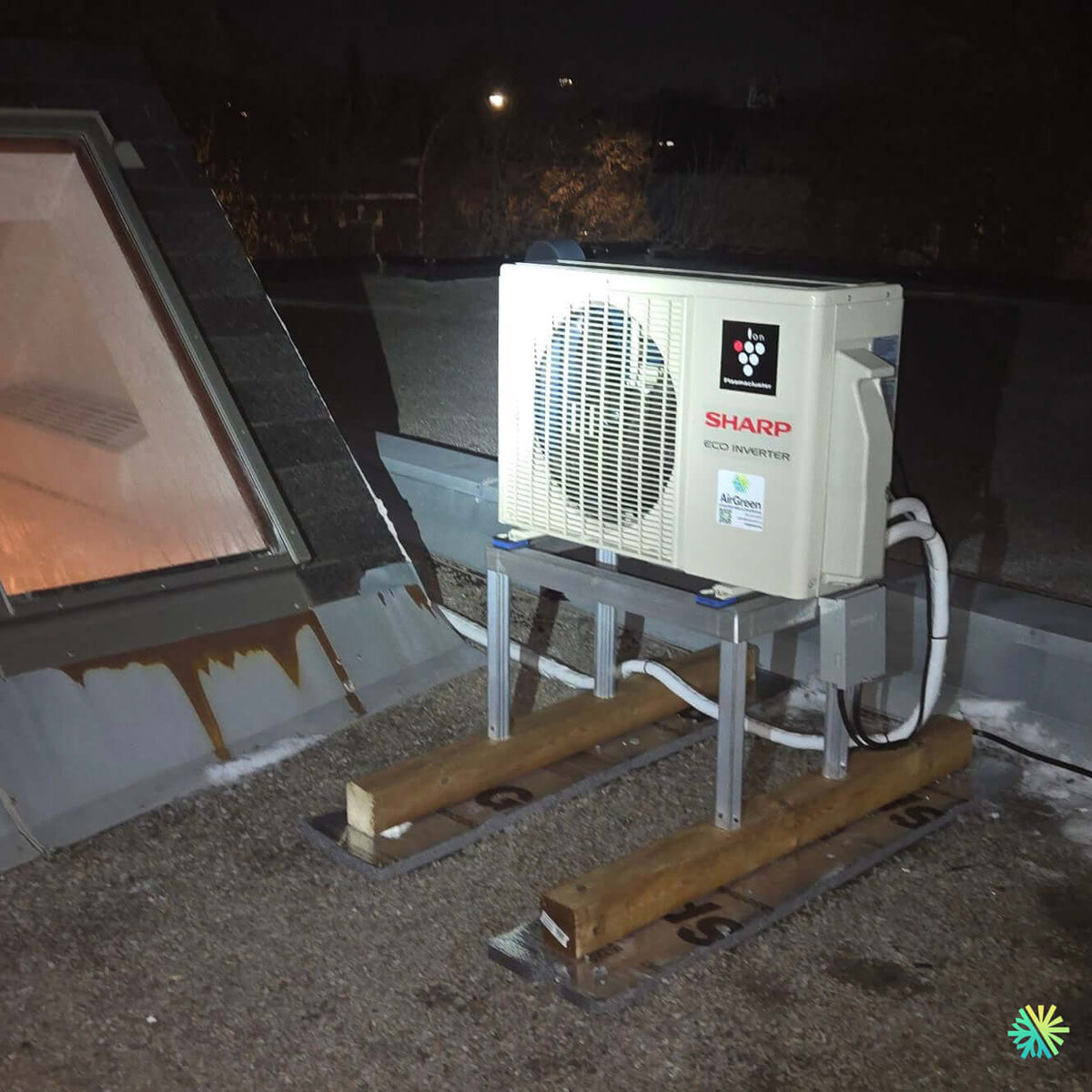
To preserve the watertightness of the roof and guarantee the longevity of the equipment, we opted for installation on a roof support :
-
Aluminum chassis on anti-vibration pads : the load is distributed over protected soles to protect the membrane and dampen vibrations.
-
Generous rise (≈ 40 cm): it keeps the air intake free of any accumulation of snow, an essential condition for defrosting cycles.
-
Approved outdoor disconnect switch : ease of maintenance and electrical safety, in accordance with the Code.
-
Refrigerant and power supply connections routed neatly to the interior via the shortest technical passage , with white UV capping to protect the insulation.
Route of connections and management of condensates
The chosen route limits pressure losses and facilitates maintenance:
-
Line length of approximately 7 meters between the outdoor unit and the indoor head.
-
Slope respected for optimal oil return to the compressor.
-
Condensate from the indoor unit : discreet and compliant drainage; on the roof, the water from defrosting is directed to flow without stagnating near the membrane.
Interior integration: discreet and efficient
The wall-mounted fan is positioned to circulate air evenly throughout the living area, away from obstacles and heat sources. The heating mode uses the ZU1 series' wide inverter range : the machine finely modulates its power and maintains a stable temperature without uncomfortable variations. In summer , the control algorithm reduces ambient humidity, a key element of comfort in typical homes in Montreal, Laval and Longueuil .
Results measured on site
Upon commissioning:
-
Fast stabilization time thanks to careful balancing of refrigerant flow and an adapted charge to the lines.
-
Low exterior noise level - a real advantage for neighbors in dense areas (alleys, interior courtyards).
-
Uniform comfort in the rooms served, without cold zones.
Specific features of a roofing project at MHM
Working on a flat roof in an urban district requires rigorous preparation:
-
Membrane protection : use of non-slip soles and pads to distribute loads and prevent punching.
-
Safe routing of cables and lines: stainless steel clamps, short paths, bending radii respected.
-
Clearance around the fan: 360° clearance for efficient defrost cycles in winter.
-
Access management : coordination with the co-ownership and intervention window limiting nuisances.
What the ZU1 series changes for the customer
-
Energy savings : favorable modulation and EER/SEER/HSPF, relevant for the North Shore and the South Shore where heating is carried out for a long time.
-
Air quality : increased filtration and gentle mixing to prevent drafts.
-
Easy maintenance : clear access to the outdoor unit on the support, disconnect switch within reach, accessible service connections.
Eligibility for assistance and procedures
In Greater Montreal, several provincial and municipal programs encourage the adoption of high-efficiency heat pumps . The Sharp ZU1 series (R-32) meets current energy-efficient equipment criteria when sized and installed by an RBQ contractor. We always validate, on a case-by-case basis, eligibility for current subsidies for Montreal, Laval, Longueuil, North Shore and South Shore , and we support our clients in preparing files (proof of purchase, technical specifications, installation photos).
Best practices that we systematically apply
-
Sizing based on the actual thermal envelope (orientation, infiltration, insulation), not just the surface area.
-
Frost anticipation : raised and lateral clearance to keep the battery performing well in cold conditions.
-
Vacuum Check : Deep vacuum and extended leak test to ensure a clean and dry circuit.
-
Structure-borne noise management : anti-vibration pads and torque tightening to preserve the structure.
-
Connection routing designed for serviceability : clear access to connections, clear identification.
Instructions for use for optimal comfort
-
Auto/Winter mode : let the inverter work; avoid extreme setpoint back and forths.
-
Filters : Monthly dusting during peak season maintains performance.
-
Clearance : In winter, ensure the perimeter around the outdoor unit is free of snow and ice.
-
Programming : smart time slots limit consumption peaks.
What we do differently at AirGreen
Our specialized HVAC teams understand the challenges of Montreal's flat roofs : access, neighborhood, membranes, and coordination with the condominium. We pay particular attention to:
-
Preservation of the building envelope .
-
The aesthetics of the courses (harmonized color capping, straight lines).
-
Durability (UV-resistant materials, stainless steel fasteners).
-
Documentation provided to the customer: step photos, vacuum values, serial numbers — useful for maintenance and warranties .
Frequently Asked Questions — and Our Answers
-
Vibrations on the roof : neutralized by the pads and the frame; tightening controlled by torque.
-
Defrost noise : Fine fan settings and adequate clearance reduce occasional sounds.
-
Defrost water : drain directed to avoid persistent puddles near the membrane upstands.
-
Service access in winter : sufficient height and clear path; disconnector within reach.
What if your home has multiple rooms?
The ZU1 series can be integrated into a Sharp Multi-Zone system when several rooms require individual control. We then study the cumulative lengths, the distribution of the heads and the refrigeration balancing to maintain the desired seasonal efficiencies , including for apartments on the North or South Shore where the plans differ from central plexes.
Construction site report
The customer receives stable heating comfort and efficient air conditioning without taking up floor space. The Sharp ZU1 series outdoor unit installed on a roof support operates with a contained noise level , and its integration complies with the best HVAC installation practices in Montreal. The system is ready for simplified HVAC maintenance and smooth operation for the seasons to come.
Are you considering a heat pump on a flat roof?
We perform an on-site diagnosis in Greater Montreal (Montreal, Laval, Longueuil, North Shore , South Shore ) and offer a Sharp , Gree , Fujitsu or Midea solution based on your budget, habits and expenses. Our promise: a clean, durable and efficient HVAC installation - with administrative support to take advantage of available assistance.
The job tools
Two quick checks with real numbers: what heat costs, and what your current heaters add up to in BTU/h.
Baseboards and electric furnaces turn 1 kWh of electricity into 1 kWh of heat. A heat pump delivers more: that is its COP. At Hydro-Québec’s rate D (11.142¢/kWh above 40 kWh a day, since 1 April 2026):
Hydro-Québec: a heat pump can be up to three times more efficient than baseboards for heating in the colder months.
Estimate per kWh of heat, at the chosen temperature, using the certified COP from the product page. Taxes, access charge and backup heat not included.
Conversion: 1 W = 3.412 BTU/h. An indication, not a load calculation: baseboards and furnaces are often stronger than the real need, and they can stay as backup. AirGreen confirms the capacity on site.
How the job unfolds
The main steps of this kind of job at AirGreen. Every house has its quirks: the estimate brings them out.
We look at the room, the outside wall, the line route and where the outdoor unit will go. That is where the capacity gets chosen.
Model, capacity and price, in writing. We also check whether the model qualifies for assistance programs.
Floors and furniture protected, wall plate position marked level, wall opening located.
A single opening, with the slope the drain needs to flow outside.
Set on a stand raised above the snow, with the clearances the manufacturer requires.
Connected, insulated and protected. The opening is then sealed against water, cold air and insects.
A dedicated circuit and an accessible disconnect near the outdoor unit.
Leak test, vacuum, then start-up and a check of heating and cooling.
Remote, modes, filters: we show you the essentials before we leave.
- The on-site estimateWe look at the room, the outside wall, the line route and where the outdoor unit will go. That is where the capacity gets chosen.
- The quoteModel, capacity and price, in writing. We also check whether the model qualifies for assistance programs.
- Getting readyFloors and furniture protected, wall plate position marked level, wall opening located.
- The wall openingA single opening, with the slope the drain needs to flow outside.
- The outdoor unitSet on a stand raised above the snow, with the clearances the manufacturer requires.
- Lines, cable and drainConnected, insulated and protected. The opening is then sealed against water, cold air and insects.
- The electrical workA dedicated circuit and an accessible disconnect near the outdoor unit.
- Tests and start-upLeak test, vacuum, then start-up and a check of heating and cooling.
- The walkthroughRemote, modes, filters: we show you the essentials before we leave.
What we check on a job like this one
Each number is a point we check on site. Switch between summer and winter to watch air and heat move.
In summer, the outdoor unit rejects the house's heat outside.
Generic illustration of this type of installation, not a survey of this job site. Tap a number.
Mounted level on a wall plate, high enough for the air to reach the whole room, with enough space around it to slide the filters out easily.
The refrigerant lines, the communication cable and the drain go through the wall in a single opening, sealed against water, cold air and insects.
Two insulated copper pipes connect the two units. Outside, a line cover can protect them from sun, knocks and weather.
A shut-off switch near the outdoor unit isolates it safely for service. It must stay accessible at all times.
The compressor and the fan. In heating mode it captures heat from the outdoor air, even in winter, and moves it inside.
On the ground or on the wall, it keeps the unit above accumulated snow. The unit stays clear and defrost water can drain away.
The fan needs to blow freely. Storage, a fence or a wall too close, and efficiency drops while noise goes up.
Is your home ready?
Check what applies at your place. A "no" is not a refusal: it is what we sort out during the estimate.
Good habits, once the unit is in place
Six simple habits that keep the unit going. Your list stays on this device.
What to do, season by season
Three habits per season for this unit. They take a few minutes and prevent many calls.
- Clean the indoor unit's filters.
- Clear leaves and debris left on the outdoor unit by winter.
- Test cooling before the first hot days.
- Clean the filters more often when the unit runs a lot.
- Keep plants away from the outdoor unit.
- Check that no water drips from the indoor unit.
- Rake the leaves around the outdoor unit.
- Test heating before the first cold days.
- Book periodic maintenance before winter.
- Keep snow away from the stand and the front of the unit.
- Let the unit defrost: it is normal.
- Never hit the ice on the fins; call us if the unit stays iced up.
The right pages, at the right time
Four statements: true or false?
It all comes down to details you have just seen.
1. In heating mode, the outdoor unit can produce water.
During defrost cycles. That water must drain away without forming ice.
2. You pick the capacity with a simple square-footage rule.
Windows, insulation, orientation and how the room is used all count. Capacity is chosen on site.
3. A multi-zone connects several indoor heads to a single condenser.
One head per room, all on the same condenser. Each room keeps its own temperature.
4. The disconnect can sit behind the patio furniture.
It must stay accessible: it is what shuts the unit off for service.
0 / 4 right answers
What people ask us about this kind of work
Does a wall-mounted heat pump heat in winter?
Wall-mounted or multi-zone: how do I choose?
Where does the outdoor unit go?
Are there grants?
Do I need a permit?
How cold can it heat?
How much can I save?
How is the LogisVert assistance calculated?
Is it noisy?
The outdoor unit is covered in ice: is that normal?
Does AirGreen hold the required licences?
Is the estimate free?
No question matches. Write to us: we answer.
More jobs to see, near you
By town, by equipment or by region: browse more than 4,700 published projects.
Each dot: a town where AirGreen has published projects. The glowing dot: this job.
An on-site estimate, the right capacity, the right equipment.
The on-site estimate is free and the quote follows within 24 hours.
Text and photo: a real AirGreen Climatisation & Chauffage job. The diagrams are generic illustrations of the type of installation, not a survey of this job site. Sources of the added figures: airgreen.ca product pages (NEEP / AHRI performance), Hydro-Québec (Heat pumps page, LogisVert, read on 13 October 2026), Régie de l’énergie (rate D as of 1 April 2026).