
Installation of a Sharp wall-mounted heat pump in Anjou
Installation of a Sharp wall-mounted heat pump in Anjou: AirGreen provides a complete HVAC service in Montreal and the surrounding area, combining comfort, performance and energy savings.
- City
- Region
- Equipment
- Brand
- Challenges
- Published
The job on one screen
The article, chapter by chapter
Modern comfort in a residential space with dark walls
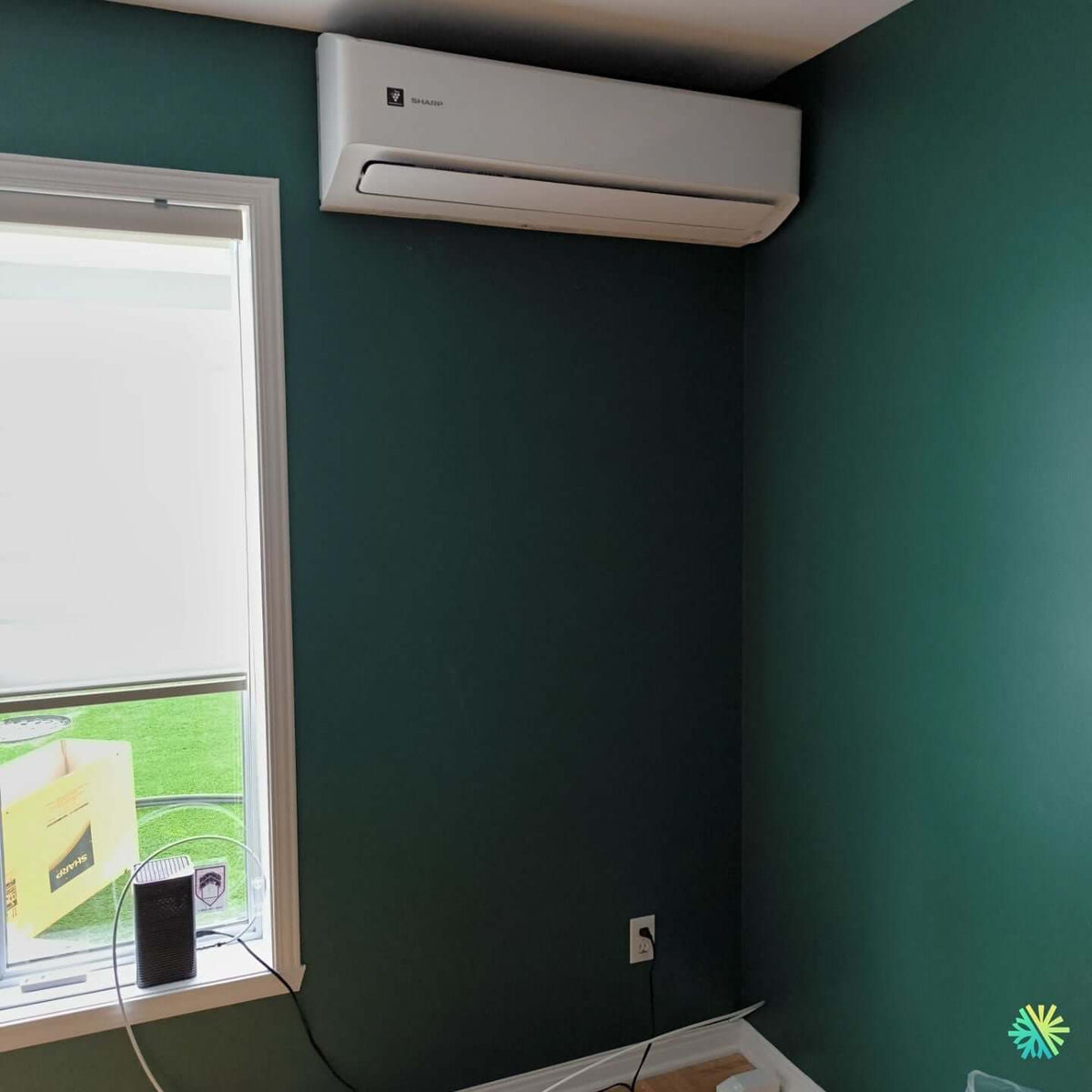
At AirGreen , we recently installed a Sharp wall-mounted heat pump in a residence in the Anjou district of Montreal . This project perfectly illustrates how a well-chosen and well-installed HVAC system can transform a room by ensuring thermal comfort, energy efficiency, and harmonious integration into the interior design.
A solution tailored to customer needs
Our client wanted a discreet yet efficient solution to regulate the temperature of a room exposed to afternoon sun. After analyzing the space and the heating and cooling needs, we recommended installing a Sharp residential wall-mounted heat pump , renowned for its reliability and performance in Quebec's cold climates.
Technical features of the installation
-
Machine type: wall-mounted heat pump (mini-split)
-
Brand: Sharp
-
Estimated capacity: between 9,000 and 12,000 BTUs, suitable for an average-sized room
-
Condensate evacuation method: gravity, optimized thanks to a discreet passage along the exterior wall
-
Ductwork route: side wall exit to the outside, minimizing length and ensuring maximum efficiency
-
Power supply: connection to an already available outlet, with minor adjustments to meet safety standards
Challenge encountered: optimizing integration
The main challenge of this installation was to harmoniously integrate the wall-mounted head into a deep green painted wall. The choice of location, just under the ceiling and close to a window, allowed for maximum air circulation while preserving the aesthetics of the room. The Sharp unit, with its sleek design, blends perfectly into the decor while ensuring optimal air diffusion.
Customer Benefits
-
Year-round comfort: efficient heating down to -25°C and effective air conditioning during summer heat waves.
-
Energy savings: Sharp's inverter technology reduces power consumption by modulating power according to actual needs.
-
Grant eligibility: Thanks to its energy efficiency, this type of heat pump is generally eligible for government programs such as LogisVert, which are particularly beneficial for residents of Montreal, Laval, Longueuil, the North Shore and the South Shore.
-
Improved air quality: Built-in filters help clean indoor air, a plus for health and well-being.
The AirGreen installation process
-
Preliminary assessment: analysis of the surface area and exposure of the room to correctly size the heat pump.
-
Location selection: strategic selection to maximize air diffusion and limit duct length.
-
Drilling and connections: discreet drilling of the exterior wall, installation of insulated refrigerant piping and electrical connection.
-
Commissioning and testing: pressure checks, unit calibration and full explanations given to the customer on the optimal use of their new equipment.
Testimony and satisfaction
The owner quickly noticed the system's effectiveness: immediate freshness in air conditioning mode and consistent comfort throughout the room. He particularly appreciated the speed of the installation, completed in half a day, and the professionalism of our technicians.
Why choose AirGreen for your HVAC installation?
-
Local expertise throughout Greater Montreal (Montreal, Laval, Longueuil, North Shore, South Shore).
-
Wide selection of trusted brands including Sharp, Fujitsu, Gree, Midea and many more.
-
Turnkey service: advice, installation, maintenance and support for subsidies.
-
Commitment to discreet, durable and aesthetic installations.
Conclusion
This installation of a Sharp wall-mounted heat pump in Anjou is a perfect example of our approach: personalized support, meticulous installation, and a result that combines efficiency, comfort, and aesthetics. At AirGreen, we put our HVAC expertise at the service of each client to transform their living space, while maximizing energy savings and daily well-being.
The job tools
Two quick checks with real numbers: what heat costs, and what your current heaters add up to in BTU/h.
Conversion: 1 W = 3.412 BTU/h. An indication, not a load calculation: baseboards and furnaces are often stronger than the real need, and they can stay as backup. AirGreen confirms the capacity on site.
How the job unfolds
The main steps of this kind of job at AirGreen. Every house has its quirks: the estimate brings them out.
We look at the room, the outside wall, the line route and where the outdoor unit will go. That is where the capacity gets chosen.
Model, capacity and price, in writing. We also check whether the model qualifies for assistance programs.
Floors and furniture protected, wall plate position marked level, wall opening located.
A single opening, with the slope the drain needs to flow outside.
Set on a stand raised above the snow, with the clearances the manufacturer requires.
Connected, insulated and protected. The opening is then sealed against water, cold air and insects.
A dedicated circuit and an accessible disconnect near the outdoor unit.
Leak test, vacuum, then start-up and a check of heating and cooling.
Remote, modes, filters: we show you the essentials before we leave.
- The on-site estimateWe look at the room, the outside wall, the line route and where the outdoor unit will go. That is where the capacity gets chosen.
- The quoteModel, capacity and price, in writing. We also check whether the model qualifies for assistance programs.
- Getting readyFloors and furniture protected, wall plate position marked level, wall opening located.
- The wall openingA single opening, with the slope the drain needs to flow outside.
- The outdoor unitSet on a stand raised above the snow, with the clearances the manufacturer requires.
- Lines, cable and drainConnected, insulated and protected. The opening is then sealed against water, cold air and insects.
- The electrical workA dedicated circuit and an accessible disconnect near the outdoor unit.
- Tests and start-upLeak test, vacuum, then start-up and a check of heating and cooling.
- The walkthroughRemote, modes, filters: we show you the essentials before we leave.
What we check on a job like this one
Each number is a point we check on site. Switch between summer and winter to watch air and heat move.
In summer, the outdoor unit rejects the house's heat outside.
Generic illustration of this type of installation, not a survey of this job site. Tap a number.
Mounted level on a wall plate, high enough for the air to reach the whole room, with enough space around it to slide the filters out easily.
The refrigerant lines, the communication cable and the drain go through the wall in a single opening, sealed against water, cold air and insects.
Two insulated copper pipes connect the two units. Outside, a line cover can protect them from sun, knocks and weather.
A shut-off switch near the outdoor unit isolates it safely for service. It must stay accessible at all times.
The compressor and the fan. In heating mode it captures heat from the outdoor air, even in winter, and moves it inside.
On the ground or on the wall, it keeps the unit above accumulated snow. The unit stays clear and defrost water can drain away.
The fan needs to blow freely. Storage, a fence or a wall too close, and efficiency drops while noise goes up.
Is your home ready?
Check what applies at your place. A "no" is not a refusal: it is what we sort out during the estimate.
Good habits, once the unit is in place
Six simple habits that keep the unit going. Your list stays on this device.
What to do, season by season
Three habits per season for this unit. They take a few minutes and prevent many calls.
- Clean the indoor unit's filters.
- Clear leaves and debris left on the outdoor unit by winter.
- Test cooling before the first hot days.
- Clean the filters more often when the unit runs a lot.
- Keep plants away from the outdoor unit.
- Check that no water drips from the indoor unit.
- Rake the leaves around the outdoor unit.
- Test heating before the first cold days.
- Book periodic maintenance before winter.
- Keep snow away from the stand and the front of the unit.
- Let the unit defrost: it is normal.
- Never hit the ice on the fins; call us if the unit stays iced up.
The right pages, at the right time
Four statements: true or false?
It all comes down to details you have just seen.
1. In heating mode, the outdoor unit can produce water.
During defrost cycles. That water must drain away without forming ice.
2. You pick the capacity with a simple square-footage rule.
Windows, insulation, orientation and how the room is used all count. Capacity is chosen on site.
3. A multi-zone connects several indoor heads to a single condenser.
One head per room, all on the same condenser. Each room keeps its own temperature.
4. The disconnect can sit behind the patio furniture.
It must stay accessible: it is what shuts the unit off for service.
0 / 4 right answers
What people ask us about this kind of work
Does a wall-mounted heat pump heat in winter?
Wall-mounted or multi-zone: how do I choose?
Where does the outdoor unit go?
Are there grants?
Do I need a permit?
How cold can it heat?
How much can I save?
How is the LogisVert assistance calculated?
Is it noisy?
The outdoor unit is covered in ice: is that normal?
Does AirGreen hold the required licences?
Is the estimate free?
No question matches. Write to us: we answer.
More jobs to see, near you
By town, by equipment or by region: browse more than 4,700 published projects.
Each dot: a town where AirGreen has published projects. The glowing dot: this job.
An on-site estimate, the right capacity, the right equipment.
The on-site estimate is free and the quote follows within 24 hours.
Text and photo: a real AirGreen Climatisation & Chauffage job. The diagrams are generic illustrations of the type of installation, not a survey of this job site. Sources of the added figures: airgreen.ca product pages (NEEP / AHRI performance), Hydro-Québec (Heat pumps page, LogisVert, read on 13 October 2026), Régie de l’énergie (rate D as of 1 April 2026).