
Installation of a Sharp wall-mounted heat pump in Rosemont–La Petite-Patrie (Montreal)
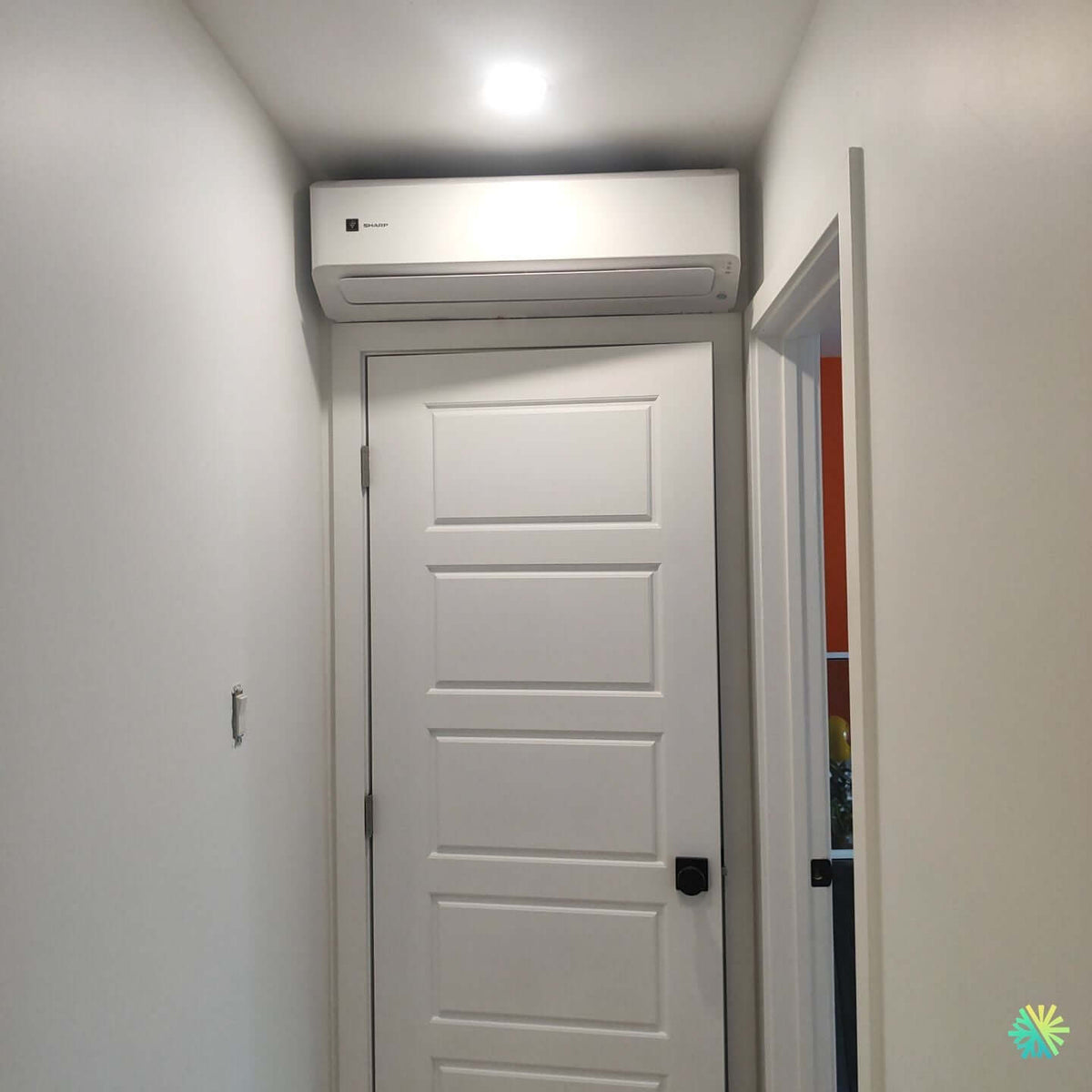
AirGreen installs a Sharp wall-mounted heat pump in Rosemont–La Petite-Patrie: head above a door, optimal diffusion in the corridor, short connections and clean finishes. Interventions in Montreal, Laval, Longueuil, North Shore, South Shore .
In summer, the outdoor unit rejects the house's heat outside.
Generic illustration of this type of installation, not a survey of this job site. Tap a number.
Mounted level on a wall plate, high enough for the air to reach the whole room, with enough space around it to slide the filters out easily.
The refrigerant lines, the communication cable and the drain go through the wall in a single opening, sealed against water, cold air and insects.
Two insulated copper pipes connect the two units. Outside, a line cover can protect them from sun, knocks and weather.
A shut-off switch near the outdoor unit isolates it safely for service. It must stay accessible at all times.
The compressor and the fan. In heating mode it captures heat from the outdoor air, even in winter, and moves it inside.
On the ground or on the wall, it keeps the unit above accumulated snow. The unit stays clear and defrost water can drain away.
The fan needs to blow freely. Storage, a fence or a wall too close, and efficiency drops while noise goes up.
An interior header above a door to distribute air throughout the corridor — the AirGreen trick to optimize comfort and circulation
Background and objectives
In Rosemont–La Petite-Patrie , a couple had just renovated one floor of a plex and wanted a discreet, quiet HVAC system capable of air conditioning the living area while providing additional heat in the spring and fall. We recommended a Sharp wall-mounted heat pump , a recent generation with an inverter , whose interior head would be placed high above a door in the central corridor. This strategic position allows:
-
to water several rooms thanks to the air flow which runs along the corridor and penetrates the adjacent rooms;
-
to free up the walls of the living room/bedrooms for furnishings;
-
to improve the silence felt in the rest rooms.
The installed equipment
-
Brand: Sharp (Inverter technology and Plasmacluster filtration for air quality).
-
Type: wall-mounted heat pump (mini-split); outdoor condenser + high indoor head.
-
Refrigerant: recent generation (meets current efficiency requirements).
-
Control: remote control with eco modes and stable temperature maintenance.
Inverter modulation continuously adapts power: fewer on/off cycles, better efficiency and consistent comfort .
HVAC Installation Details (Interior)
Implantation of the inner head
-
Position above a door in a corridor : excellent for sweeping the corridor and supplying adjacent rooms when the doors are ajar.
-
Ceiling clearances are maintained to prevent hot/cold air recirculation at vault level; the unit is laser-calibrated to fit the lines of the wall corner.
-
Noise management : wall support on reinforcement, anti-vibration strips between plate and structure, torque tightening.
Route of the links
-
Single hole behind the appliance, above the lintel; vapor barrier and watertight seal to prevent any infiltration.
-
Short refrigeration connections and continuous insulation up to the wall passage; curvature radii preserved to maintain the charge and limit pressure losses.
-
Communication and power wiring grouped and protected, labeled for future HVAC maintenance .
Condensate management
-
Gravity drainage with controlled slope (≥ 1%), discreet connection to the outside; the absence of a lifting pump reduces maintenance and the risk of additional noise.
Air diffusion and comfort
-
Initial orientation of the shutters programmed to push the air along the ceiling, Coandă effect , then gently descend into the corridor.
-
Fine adjustment of the flow to avoid direct air flow on the passage under the door.
-
“Night” scene favoring a stable setting and a slow fan to minimize noise at night.
HVAC installation details (exterior, summary)
-
Condenser on brackets with clear height for snow and defrosting, electrical disconnection within easy reach, short connections from the interior drilling.
-
Commissioning checks: high vacuum, vacuum resistance, superheat/subcooling control, defrost test.
Construction site challenges and AirGreen solutions
1) Narrow corridor and large full-height door
Challenge: maintain free circulation without impacting the aircraft and preserve the minimalist aesthetic.
Solution: compact drilling template, re-doing the joint above the molding, laying with a line for perfect alignment with the top shelf of the door.
2) Risk of air recirculation in the ceiling
Challenge: prevent the pulsed air from immediately falling back onto the return, especially at low clearance.
Solution: orientation of the shutters in laminar flow along the ceiling, medium fan setting in daytime mode, low at night; optimization during commissioning with measurement of ΔT at different points in the corridor.
3) Wall passage on recent structure
Challenge: do not weaken the door lintel or the continuous vapor barriers.
Solution: lateral drilling off the load-bearing axis , watertight cable glands, vapor barrier reconstituted after drawing the lines, painted elastomer seal.
Results for the client
-
Multi-room comfort : the head to the corridor tempers living room and bedrooms with a single unit.
-
Silence : anti-vibration isolation and soft adjustments; the device becomes almost inaudible outside of peaks.
-
Aesthetics : the installation remains invisible from the rooms, the door remains functional, no interior chute falls.
-
Simplified maintenance : filters accessible without a large stepladder; exterior with direct access for seasonal maintenance.
Why choose Sharp for a wall-mounted heat pump ?
-
Precise inverter : better seasonal efficiency and less thermal surges.
-
Plasmacluster Filtration : improving indoor air quality .
-
Local support and parts available, a guarantee of reliability and rapid response in Greater Montreal.
Good HVAC Maintenance Practices
-
Filters : clean every 4 to 8 weeks depending on use (gentle suction + rinsing).
-
Shutters : periodic dusting to maintain uniform diffusion .
-
Space under the unit : leave the passage area clear to avoid shocks and ensure the intended blowing angle.
-
Annual visit : electrical check, sealing, pressure/temperature readings, defrost cycle, exchanger cleaning.
Grants and Eligibility
Depending on the power , performance and operating range , efficiency programs may be available in Greater Montreal . We support our clients in Montreal , Laval , Longueuil , North Shore and South Shore to confirm eligibility and prepare applications.
Planning tips before your project
-
Interior location : A central corridor is ideal for a single heat pump serving multiple rooms.
-
Clearances : Maintain minimum distances to the ceiling and sides for maintenance and diffusion.
-
Refrigeration length : favor a short route for better performance and a controlled refrigerant charge.
-
Documentation : request commissioning records and service labeling (intervention number, maintenance instructions).
AirGreen, your HVAC partner in Montreal
Our signature: discreet routes , impeccable finishes , compliance with standards , and a service that follows your system over time. We operate throughout Montreal , Laval , Longueuil , on the North Shore and the South Shore .
Need stable comfort and a virtually invisible installation like in Rosemont–La Petite-Patrie? Let's talk about your hallway, your rooms, and your goals; we'll design an installation tailored to your daily life.
How it goes, from the first call to the end
The main steps of this kind of job at AirGreen. Every house has its quirks: the estimate brings them out.
We look at the room, the outside wall, the line route and where the outdoor unit will go. That is where the capacity gets chosen.
Model, capacity and price, in writing. We also check whether the model qualifies for assistance programs.
Floors and furniture protected, wall plate position marked level, wall opening located.
A single opening, with the slope the drain needs to flow outside.
Set on a stand raised above the snow, with the clearances the manufacturer requires.
Connected, insulated and protected. The opening is then sealed against water, cold air and insects.
A dedicated circuit and an accessible disconnect near the outdoor unit.
Leak test, vacuum, then start-up and a check of heating and cooling.
Remote, modes, filters: we show you the essentials before we leave.
- The on-site estimateWe look at the room, the outside wall, the line route and where the outdoor unit will go. That is where the capacity gets chosen.
- The quoteModel, capacity and price, in writing. We also check whether the model qualifies for assistance programs.
- Getting readyFloors and furniture protected, wall plate position marked level, wall opening located.
- The wall openingA single opening, with the slope the drain needs to flow outside.
- The outdoor unitSet on a stand raised above the snow, with the clearances the manufacturer requires.
- Lines, cable and drainConnected, insulated and protected. The opening is then sealed against water, cold air and insects.
- The electrical workA dedicated circuit and an accessible disconnect near the outdoor unit.
- Tests and start-upLeak test, vacuum, then start-up and a check of heating and cooling.
- The walkthroughRemote, modes, filters: we show you the essentials before we leave.
And at your place?
Two quick checks with real numbers: what heat costs, and what your current heaters add up to in BTU/h.
Conversion: 1 W = 3.412 BTU/h. An indication, not a load calculation: baseboards and furnaces are often stronger than the real need, and they can stay as backup. AirGreen confirms the capacity on site.
What to do, season by season
Three habits per season for this unit. They take a few minutes and prevent many calls.
- Clean the indoor unit's filters.
- Clear leaves and debris left on the outdoor unit by winter.
- Test cooling before the first hot days.
- Clean the filters more often when the unit runs a lot.
- Keep plants away from the outdoor unit.
- Check that no water drips from the indoor unit.
- Rake the leaves around the outdoor unit.
- Test heating before the first cold days.
- Book periodic maintenance before winter.
- Keep snow away from the stand and the front of the unit.
- Let the unit defrost: it is normal.
- Never hit the ice on the fins; call us if the unit stays iced up.
Which type of equipment for your project?
Pick what looks like your need.
Four mistakes we do not make
Flip each card to see what we do instead.
What people ask us about this kind of work
Does a wall-mounted heat pump heat in winter?
Wall-mounted or multi-zone: how do I choose?
Where does the outdoor unit go?
Are there grants?
Do I need a permit?
How cold can it heat?
How much can I save?
How is the LogisVert assistance calculated?
Is it noisy?
The outdoor unit is covered in ice: is that normal?
Does AirGreen hold the required licences?
Is the estimate free?
No question matches. Write to us: we answer.
Useful pages for what comes next
More jobs to see, near you
By town, by equipment or by region: browse more than 4,700 published projects.
Each dot: a town where AirGreen has published projects. The glowing dot: this job.
Tell us about your house. We come and see it for free.
The on-site estimate is free and the quote follows within 24 hours.
Text and photo: a real AirGreen Climatisation & Chauffage job. The diagrams are generic illustrations of the type of installation, not a survey of this job site. Sources of the added figures: airgreen.ca product pages (NEEP / AHRI performance), Hydro-Québec (Heat pumps page, LogisVert, read on 13 October 2026), Régie de l’énergie (rate D as of 1 April 2026).