
Installation of a Sharp ZU1 wall-mounted heat pump in Brossard
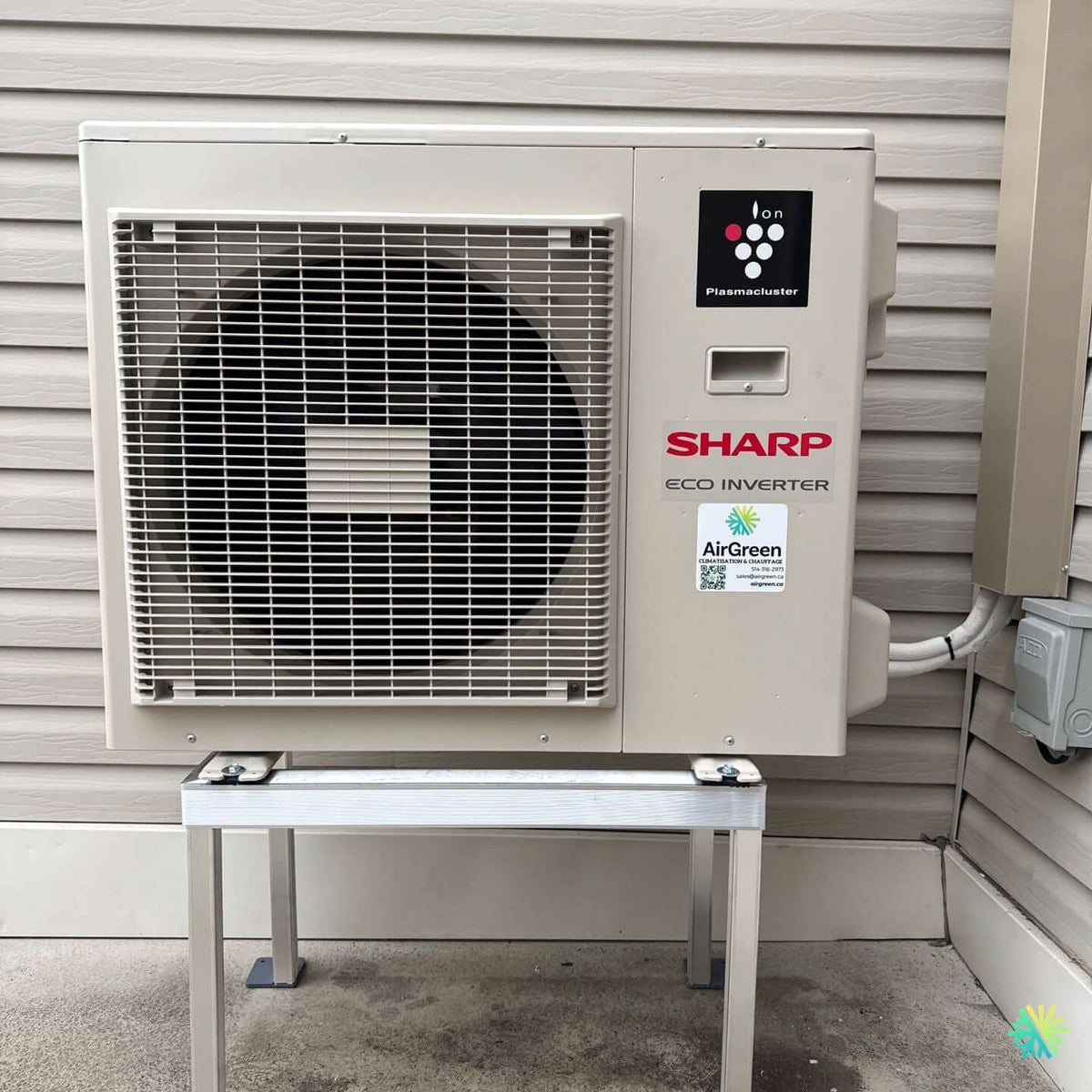
In Brossard, AirGreen installs a Sharp ZU1 (R-32) wall-mounted heat pump with a high-quality finish: raised support, matching capping, and an outdoor disconnect switch. Four-season comfort and savings for the South Shore and all of Greater Montreal.
- City
- Region
- Equipment
- Brand
- Challenges
- Published
The job on one screen
The unit’s data sheet
The range as published on airgreen.ca: pick a size to see its capacity in deep cold.
| Size | Heating at −8 °C | Heating at −15 °C | Coldest certified point | COP at −15 °C | SEER | HSPF | Indicative LogisVert aid |
|---|---|---|---|---|---|---|---|
| Sharp ZU1 12 000 | 14,500 | 12,000 | −27 °C: 7,200 | 2.11 | 22.0 | 11.0 | $1,740 |
| Sharp ZU1 15 000 | 18,100 | 15,300 | −27 °C: 10,100 | 2.1 | 24.0 | 11.0 | $2,172 |
| Sharp ZU1 18 000 | 22,000 | 18,000 | −27 °C: 11,500 | 2.2 | 24.0 | 11.0 | $2,640 |
| Sharp ZU1 24 000 | 22,400 | 19,000 | −27 °C: 12,300 | 2.2 | 22.0 | 11.0 | $2,688 |
According to NEEP, it delivers 14,500 BTU/h at −8 °C (17 °F), more than at 8 °C (14,000 BTU/h). It heats as hard in moderate cold as in mild weather.
According to NEEP, its certified maximum capacity at −27 °C (−17 °F) is 7,200 BTU/h, 60% of its nominal 12,000 BTU size.
At 8 °C, its certified maximum capacity reaches 17,100 BTU/h, 42% more than its nominal 12,000 BTU size.
According to NEEP, it delivers 18,100 BTU/h at −8 °C (17 °F), more than at 8 °C (18,000 BTU/h). It heats as hard in moderate cold as in mild weather.
According to NEEP, its certified maximum capacity at −27 °C (−17 °F) is 10,100 BTU/h, 67% of its nominal 15,000 BTU size.
At 8 °C, its certified maximum capacity reaches 21,800 BTU/h, 45% more than its nominal 15,000 BTU size.
According to NEEP, it delivers 22,000 BTU/h at −8 °C (17 °F), more than at 8 °C (21,600 BTU/h). It heats as hard in moderate cold as in mild weather.
According to NEEP, its COP at −27 °C is 1.88: the highest of the ZU1 line, which ranges from 1.79 to 1.82 at that temperature.
According to NEEP, its certified maximum capacity at −27 °C (−17 °F) is 11,500 BTU/h, 64% of its nominal 18,000 BTU size.
At −27 °C, its certified minimum capacity is 3,200 BTU/h (5,500 at 8 °C). It slows down instead of cycling on and off.
According to NEEP, its certified heating capacity at −15 °C (5 °F) is 19,000 BTU/h, 79% of its nominal 24,000 BTU size. Its COP there is 2.20.
Data read live from the airgreen.ca page of each size (NEEP / AHRI certified performance). When the title names the installed size, it is highlighted; otherwise the whole range is shown. The aid shown is today’s, using Hydro-Québec’s rule ($120 per 1,000 BTU/h at −8 °C); amounts quoted in the article date from its publication. Only Hydro-Québec confirms the assistance granted.
The article, chapter by chapter
A thoughtful HVAC upgrade for four-season comfort on the South Shore
At AirGreen , we design each HVAC installation as an engineering project applied to everyday life. In Brossard , our team installed a Sharp ZU1 (R-32) Eco Inverter wall-mounted heat pump with Plasmacluster Ion module. The goal is clear: to provide stable comfort , measurable energy savings , and discreet integration into the typical residential architecture of the South Shore .
Context of the residence and choice of location
The house has vinyl siding and a concrete slab side clearance. We positioned the condenser on a raised aluminum support (galvanized feet and anchored plates), in order to:
-
Maintain clearance above snow and meltwater;
-
Promote rear and lateral ventilation of the exchanger;
-
Limit vibration transmission to the structure.
The refrigeration path is short (approximately 2.5 to 4 m between units), protected by beige capping that matches the cladding and is perfectly weatherproof . Nearby, an external electrical disconnect ensures circuit isolation for maintenance, in accordance with code requirements and municipal inspection expectations.
Why the Sharp ZU1 for Brossard?
Sharp ZU1 belongs to the new generation R-32 , known for its reduced charge and increased performance at low temperatures. The key advantages for a Brossard residence are:
-
Eco Inverter : fine modulation of the compressor to stabilize the temperature without overconsumption;
-
Plasmacluster Ion : improvement of indoor air quality by neutralizing particles and odors;
-
Quiet operation : a real benefit in residential neighborhoods;
-
Compact format : easy installation without encroaching on passage areas or side strips of land.
AirGreen approach: precision, cleanliness, compliance
We operate using a proven methodology:
-
Technical analysis : verification of the circuit breaker rating, the permissible lengths of refrigerant lines , the piercing point, and the clearances (suction/blowing).
-
Through drilling with sleeve and expanded foam to ensure sealing and avoid thermal bridges.
-
Installation of the support : leveling, anchoring to the concrete, silentbloc supports under the unit for anti-vibration.
-
Connection routing : high-density insulated copper, anti-abrasion reinforcements at contact points, controlled bends .
-
Brazing under nitrogen (if necessary) and vacuuming until a suitable residual humidity level is reached.
-
Leak tests and commissioning : pressure checks, blowing temperatures, absorbed intensity, and calibration of comfort parameters.
-
Finish : sealing with UV polyurethane mastic , aligned capping , sheathed UV-resistant wiring, circuit marking on the electrical panel.
Salient installation details
-
Raised stand : Reduces snow accumulation and facilitates natural drainage. It also protects against wind-borne debris.
-
Continuous beige capping : aesthetics harmonised with the vinyl covering , ensuring a clean and easy-to-inspect installation.
-
Disconnector mounted at service height, waterproof cover for quick access during maintenance.
-
Short lines : minimized pressure losses, better seasonal efficiency and smoother starts in heating mode.
-
Gravity condensate drainage on the interior side (planned with an adequate slope), avoiding the use of a pump in this case.
Sizing and recommended use
For an open living room or a floor of approximately 450 to 900 sq ft , a Sharp ZU1 with 12,000 to 18,000 BTU is often suitable, depending on the insulation and orientation. At AirGreen, we confirm the sizing by taking measurements, simplified load calculations and feedback on comparable houses in Brossard, Longueuil and La Prairie .
Cold climate performance
The inverter compressor associated with R-32 helps maintain heating capacity during cold periods. The settings we apply (optimized defrosting, blower clearances) ensure good frost management . In the event of a storm , we recommend:
-
A clearance of 30 to 45 cm around the unit;
-
Careful manual de-icing if stalactites form above;
-
Periodic checking of the support to maintain a perfectly horizontal plane.
Air Quality: The Plasmacluster Advantage
In newer homes on the South Shore, the envelope is often more airtight : the Sharp ZU1 combines thermal regulation and Plasmacluster ionization to limit dust and allergens. In practice, our customers notice cooler airflow in the summer and less dry air in the off-season thanks to Inverter modulation.
Aesthetic and sound integration
The condenser is aligned under the vinyl siding line, with a setback respecting the windows and air intakes. Silent blocks and torque control on the screws reduce structural noise . Inside, the wall head is placed high on a load-bearing wall , free of path facing the living area, to avoid drafts and allow efficient sweeping .
Good practices and pitfalls to avoid
-
Avoid narrow corridors for the outdoor exchanger: risk of recirculation of hot air in summer, reduced efficiency.
-
Respect the bending radii of the copper: any excessive bending generates a loss of capacity and mechanical stress.
-
Drilling in the right place : a hole that is too low complicates the slope of the condensates and requires a pump, whereas gravity flow is often sufficient.
-
Games around capping : a sloppy finish lets water in; we seal the edges and check the adhesion to the vinyl.
Recommended preventive maintenance
Annual HVAC maintenance ensures long-term performance:
-
Cleaning and disinfection of the filters and exchangers of the interior head;
-
Pressure control , solder inspection , current measurement and probe verification ;
-
Gentle washing of the condenser, possible straightening of fins;
-
Disconnect switch test and UV wiring examination;
-
In winter: regular snow removal around the unit and maintenance of blowing clearance .
Results obtained
The owner benefits from precise cooling in the summer and efficient heating support in the fall and spring, reducing the demand on the main system. The first few weeks have confirmed:
-
Temperature stability without over-variations;
-
A significant reduction in consumption compared to an old R-410A air conditioner;
-
Low exterior noise level , appreciated by the neighborhood.
Grants and administrative support
High-efficiency R-32 heat pumps may be eligible for assistance under current programs in Quebec. Our team assists customers in Montreal, Laval, Longueuil, the North Shore, and the South Shore with preparing detailed invoices, technical specifications, installation certificates, and necessary photos.
Deadlines and logistics
For an installation like the one in Brossard, our typical sequence covers:
-
Technical visit and electrical validation;
-
Ordering and preparation in the workshop (assembly kits, pre-cut pipe lengths);
-
One-day installation with testing;
-
Delivery of the user guide and winter instructions .
Why AirGreen for your project in Greater Montreal?
We operate weekly in Brossard, Saint-Lambert, Longueuil , as well as Montreal , Laval , North Shore and South Shore . Our in-house team carries out the work, without general subcontracting, with installation guarantee and centralized after-sales service . We pay attention to the readability of the quotes : capacity in BTU , lengths included, options (condensate pump, snow guard , retention tray on flat roofs, wall brackets if required), to eliminate surprises on the day.
Conclusion
This Sharp ZU1 wall-mounted heat pump installed in Brossard illustrates a rigorous approach: correct sizing , meticulous installation , clean finish and usage advice for four-season comfort. For a similar project in Montreal , Laval or Longueuil , our team offers complete support , from model selection to annual maintenance monitoring , to guarantee durability and savings over the life of the system.
The job tools
Two quick checks with real numbers: what heat costs, and what your current heaters add up to in BTU/h.
Baseboards and electric furnaces turn 1 kWh of electricity into 1 kWh of heat. A heat pump delivers more: that is its COP. At Hydro-Québec’s rate D (11.142¢/kWh above 40 kWh a day, since 1 April 2026):
Hydro-Québec: a heat pump can be up to three times more efficient than baseboards for heating in the colder months.
Estimate per kWh of heat, at the chosen temperature, using the certified COP from the product page. Taxes, access charge and backup heat not included.
Conversion: 1 W = 3.412 BTU/h. An indication, not a load calculation: baseboards and furnaces are often stronger than the real need, and they can stay as backup. AirGreen confirms the capacity on site.
How the job unfolds
The main steps of this kind of job at AirGreen. Every house has its quirks: the estimate brings them out.
We look at the room, the outside wall, the line route and where the outdoor unit will go. That is where the capacity gets chosen.
Model, capacity and price, in writing. We also check whether the model qualifies for assistance programs.
Floors and furniture protected, wall plate position marked level, wall opening located.
A single opening, with the slope the drain needs to flow outside.
Set on a stand raised above the snow, with the clearances the manufacturer requires.
Connected, insulated and protected. The opening is then sealed against water, cold air and insects.
A dedicated circuit and an accessible disconnect near the outdoor unit.
Leak test, vacuum, then start-up and a check of heating and cooling.
Remote, modes, filters: we show you the essentials before we leave.
- The on-site estimateWe look at the room, the outside wall, the line route and where the outdoor unit will go. That is where the capacity gets chosen.
- The quoteModel, capacity and price, in writing. We also check whether the model qualifies for assistance programs.
- Getting readyFloors and furniture protected, wall plate position marked level, wall opening located.
- The wall openingA single opening, with the slope the drain needs to flow outside.
- The outdoor unitSet on a stand raised above the snow, with the clearances the manufacturer requires.
- Lines, cable and drainConnected, insulated and protected. The opening is then sealed against water, cold air and insects.
- The electrical workA dedicated circuit and an accessible disconnect near the outdoor unit.
- Tests and start-upLeak test, vacuum, then start-up and a check of heating and cooling.
- The walkthroughRemote, modes, filters: we show you the essentials before we leave.
What we check on a job like this one
Each number is a point we check on site. Switch between summer and winter to watch air and heat move.
In summer, the outdoor unit rejects the house's heat outside.
Generic illustration of this type of installation, not a survey of this job site. Tap a number.
Mounted level on a wall plate, high enough for the air to reach the whole room, with enough space around it to slide the filters out easily.
The refrigerant lines, the communication cable and the drain go through the wall in a single opening, sealed against water, cold air and insects.
Two insulated copper pipes connect the two units. Outside, a line cover can protect them from sun, knocks and weather.
A shut-off switch near the outdoor unit isolates it safely for service. It must stay accessible at all times.
The compressor and the fan. In heating mode it captures heat from the outdoor air, even in winter, and moves it inside.
On the ground or on the wall, it keeps the unit above accumulated snow. The unit stays clear and defrost water can drain away.
The fan needs to blow freely. Storage, a fence or a wall too close, and efficiency drops while noise goes up.
Is your home ready?
Check what applies at your place. A "no" is not a refusal: it is what we sort out during the estimate.
Good habits, once the unit is in place
Six simple habits that keep the unit going. Your list stays on this device.
What to do, season by season
Three habits per season for this unit. They take a few minutes and prevent many calls.
- Clean the indoor unit's filters.
- Clear leaves and debris left on the outdoor unit by winter.
- Test cooling before the first hot days.
- Clean the filters more often when the unit runs a lot.
- Keep plants away from the outdoor unit.
- Check that no water drips from the indoor unit.
- Rake the leaves around the outdoor unit.
- Test heating before the first cold days.
- Book periodic maintenance before winter.
- Keep snow away from the stand and the front of the unit.
- Let the unit defrost: it is normal.
- Never hit the ice on the fins; call us if the unit stays iced up.
The right pages, at the right time
Four statements: true or false?
It all comes down to details you have just seen.
1. In heating mode, the outdoor unit can produce water.
During defrost cycles. That water must drain away without forming ice.
2. You pick the capacity with a simple square-footage rule.
Windows, insulation, orientation and how the room is used all count. Capacity is chosen on site.
3. A multi-zone connects several indoor heads to a single condenser.
One head per room, all on the same condenser. Each room keeps its own temperature.
4. The disconnect can sit behind the patio furniture.
It must stay accessible: it is what shuts the unit off for service.
0 / 4 right answers
What people ask us about this kind of work
Does a wall-mounted heat pump heat in winter?
Wall-mounted or multi-zone: how do I choose?
Where does the outdoor unit go?
Are there grants?
Do I need a permit?
How cold can it heat?
How much can I save?
How is the LogisVert assistance calculated?
Is it noisy?
The outdoor unit is covered in ice: is that normal?
Does AirGreen hold the required licences?
Is the estimate free?
No question matches. Write to us: we answer.
More jobs to see, near you
By town, by equipment or by region: browse more than 4,700 published projects.
Each dot: a town where AirGreen has published projects. The glowing dot: this job.
An on-site estimate, the right capacity, the right equipment.
The on-site estimate is free and the quote follows within 24 hours.
Text and photo: a real AirGreen Climatisation & Chauffage job. The diagrams are generic illustrations of the type of installation, not a survey of this job site. Sources of the added figures: airgreen.ca product pages (NEEP / AHRI performance), Hydro-Québec (Heat pumps page, LogisVert, read on 13 October 2026), Régie de l’énergie (rate D as of 1 April 2026).