
Installation of a Sharp ZU1 wall-mounted heat pump in Laval (Sainte-Rose)
AirGreen installed a Sharp ZU1 wall-mounted heat pump in Sainte-Rose, Laval. An exemplary winter HVAC installation offering performance, comfort, and energy savings for homes in Greater Montreal.
Take a tour of the installation
Each number is a point we check on site. Switch between summer and winter to watch air and heat move.
In summer, the outdoor unit rejects the house's heat outside.
Generic illustration of this type of installation, not a survey of this job site. Tap a number.
Mounted level on a wall plate, high enough for the air to reach the whole room, with enough space around it to slide the filters out easily.
The refrigerant lines, the communication cable and the drain go through the wall in a single opening, sealed against water, cold air and insects.
Two insulated copper pipes connect the two units. Outside, a line cover can protect them from sun, knocks and weather.
A shut-off switch near the outdoor unit isolates it safely for service. It must stay accessible at all times.
The compressor and the fan. In heating mode it captures heat from the outdoor air, even in winter, and moves it inside.
On the ground or on the wall, it keeps the unit above accumulated snow. The unit stays clear and defrost water can drain away.
The fan needs to blow freely. Storage, a fence or a wall too close, and efficiency drops while noise goes up.
An exemplary winter installation of energy efficiency by AirGreen
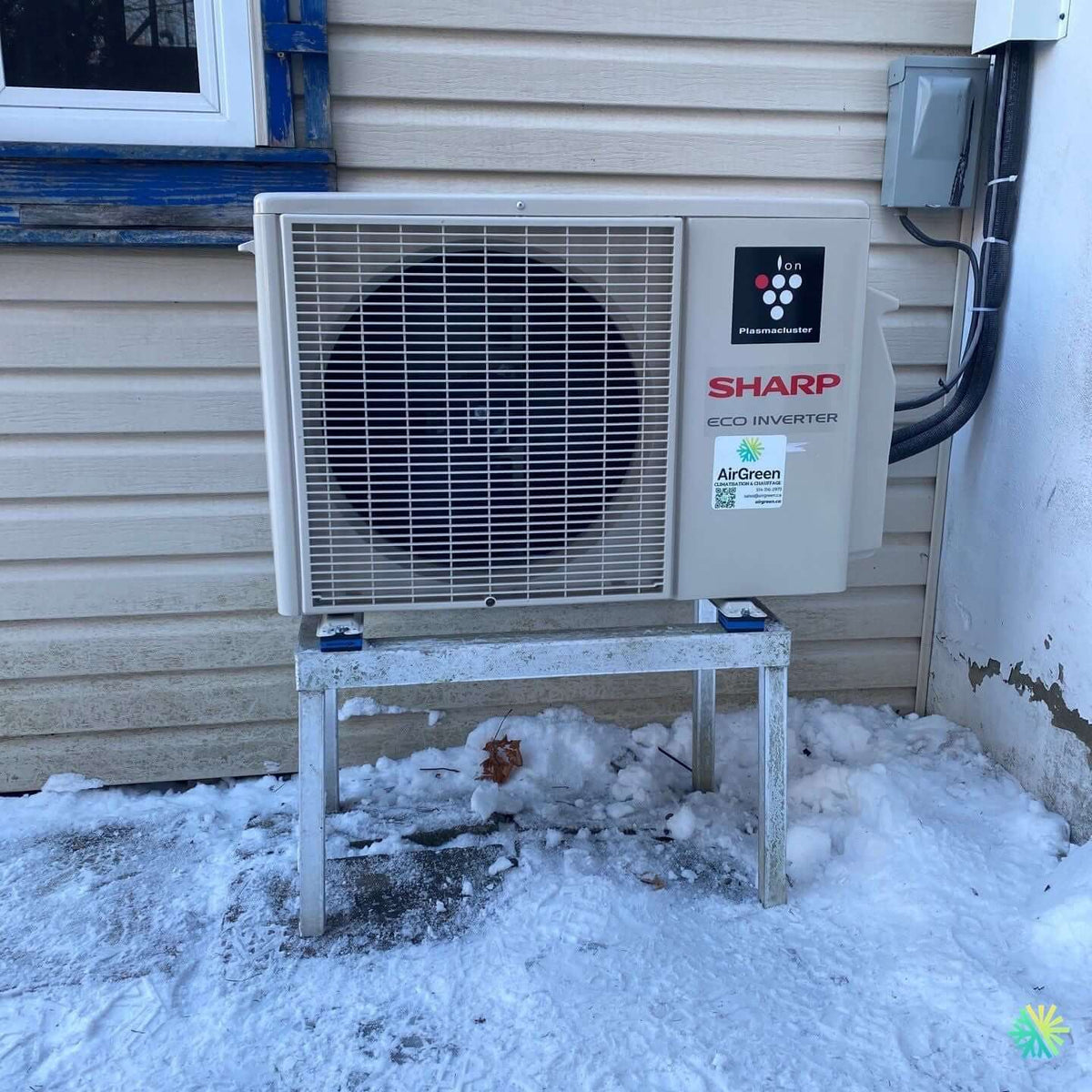
At AirGreen , we know that installing a wall-mounted heat pump isn't just about putting a unit on a wall: it's about energy performance, sustainable comfort, and long-term reliability. With this in mind, our team recently installed a Sharp ZU1 Eco Inverter in Sainte-Rose, Laval , in the heart of a typical residence in the area. Despite the presence of snow and sub-zero temperatures, the project was carried out with precision and without compromising on quality.
A typical residential context of Laval
The client, owner of a single-story single-family home , was looking for a high-performance solution to reduce heating costs while enjoying optimal comfort year-round. The old unit, aging and energy-intensive, was no longer able to ensure stable performance in extreme cold. Our recommendation: the Sharp ZU1 , a highly efficient wall-mounted heat pump designed for the Quebec climate.
The Sharp ZU1: a strategic choice for Quebec winters
The Sharp ZU1 Eco Inverter is one of the most popular models in our residential range. Equipped with Plasmacluster Ion technology, it improves indoor air quality while offering exceptional energy efficiency.
Main technical characteristics:
-
Capacity ranging from 12,000 to 24,000 BTU , depending on the needs of the residence.
-
Stable operation down to −25°C , ideal for North Shore winters.
-
Eco Inverter technology to automatically adjust compressor power according to actual temperature.
-
R-32 refrigerant, more ecological and efficient.
-
Minimal noise level, ensuring remarkable acoustic comfort.
The ZU1 series is also eligible for certain energy subsidies from the Quebec government, a significant advantage for homeowners keen to invest in a sustainable and economical solution.
The challenges of installing in winter conditions
Installing a heat pump in the middle of winter requires careful planning. In Sainte-Rose, our team had to deal with snow on the ground and sub-zero temperatures , as well as limited lateral access to the facade where the compressor was to be installed.
Solutions implemented:
-
Raised metal support : to avoid direct contact with snow and ensure optimal air circulation around the condenser.
-
Wiring and piping protected by rigid white capping , perfectly integrated into the beige vinyl facade of the house.
-
Gravity drainage provided to prevent ice formation under the unit.
-
Direct electrical connection via a nearby waterproof box, ensuring safety and compliance with standards.
Every detail has been designed to ensure the reliability and durability of the installation, even in the most demanding climatic conditions.
A clean and durable finish
We place particular importance on the aesthetics and cleanliness of our facilities. The Sharp ZU1 was installed at an ideal height to facilitate maintenance and allow for adequate airflow. The refrigeration line routing was carefully concealed, preserving the visual harmony of the façade.
The entire system was then tested under real-life conditions: refrigerant gas pressure measurement, condensate flow verification, compressor calibration and thermal efficiency validation. This confirmed excellent energy performance , even at -10°C at the time of commissioning.
The result: comfort, economy and peace of mind
Thanks to this installation, the customer now benefits from:
-
Constant and economical heating all winter long.
-
Rapid and even cooling during the summer.
-
Improved air quality thanks to Plasmacluster technology.
-
Simplified maintenance , the unit being easily accessible for cleaning the filters and annual checks.
The installation also helped reduce the overall energy consumption of the home , an aspect particularly appreciated by Laval residents seeking to limit their environmental footprint.
Why entrust your project to AirGreen?
Every AirGreen installation is carried out according to the highest quality standards in the HVAC industry. Our certified technicians combine technical expertise , field experience and attention to detail , whether for a Sharp wall-mounted heat pump , a multi-zone system , or a central heat pump .
We operate throughout Greater Montreal , including Laval, Longueuil, the North Shore and the South Shore , with the same commitment: to offer each client a high-performance, durable system that is perfectly suited to their home.
Maintenance and follow-up after installation
The efficiency of a Sharp ZU1 heat pump also depends on regular maintenance. At AirGreen, we offer an annual maintenance program that covers:
-
Complete cleaning of filters and coils.
-
Checking the refrigerant level.
-
Checking electrical connections and drainage.
-
Calibrating the Inverter compressor.
These preventive maintenances ensure increased longevity and maintain the unit's optimal energy efficiency, even after several harsh winters.
An installation that reflects our know-how
This project in Sainte-Rose (Laval) perfectly illustrates our expertise in implementing high-performance and sustainable HVAC solutions. The Sharp ZU1 Eco Inverter embodies the ideal combination of energy efficiency , advanced technology and compact design - a perfect match for today's Quebec homes.
AirGreen — Your trusted partner in wall-mounted heat pumps and HVAC systems in Montreal, Laval, Longueuil, on the North Shore and the South Shore.
The unit on this job, in figures
The range as published on airgreen.ca: pick a size to see its capacity in deep cold.
| Size | Heating at −8 °C | Heating at −15 °C | Coldest certified point | COP at −15 °C | SEER | HSPF | Indicative LogisVert aid |
|---|---|---|---|---|---|---|---|
| Sharp ZU1 12 000 | 14,500 | 12,000 | −27 °C: 7,200 | 2.11 | 22.0 | 11.0 | $1,740 |
| Sharp ZU1 15 000 | 18,100 | 15,300 | −27 °C: 10,100 | 2.1 | 24.0 | 11.0 | $2,172 |
| Sharp ZU1 18 000 | 22,000 | 18,000 | −27 °C: 11,500 | 2.2 | 24.0 | 11.0 | $2,640 |
| Sharp ZU1 24 000 | 22,400 | 19,000 | −27 °C: 12,300 | 2.2 | 22.0 | 11.0 | $2,688 |
According to NEEP, it delivers 14,500 BTU/h at −8 °C (17 °F), more than at 8 °C (14,000 BTU/h). It heats as hard in moderate cold as in mild weather.
According to NEEP, its certified maximum capacity at −27 °C (−17 °F) is 7,200 BTU/h, 60% of its nominal 12,000 BTU size.
At 8 °C, its certified maximum capacity reaches 17,100 BTU/h, 42% more than its nominal 12,000 BTU size.
According to NEEP, it delivers 18,100 BTU/h at −8 °C (17 °F), more than at 8 °C (18,000 BTU/h). It heats as hard in moderate cold as in mild weather.
According to NEEP, its certified maximum capacity at −27 °C (−17 °F) is 10,100 BTU/h, 67% of its nominal 15,000 BTU size.
At 8 °C, its certified maximum capacity reaches 21,800 BTU/h, 45% more than its nominal 15,000 BTU size.
According to NEEP, it delivers 22,000 BTU/h at −8 °C (17 °F), more than at 8 °C (21,600 BTU/h). It heats as hard in moderate cold as in mild weather.
According to NEEP, its COP at −27 °C is 1.88: the highest of the ZU1 line, which ranges from 1.79 to 1.82 at that temperature.
According to NEEP, its certified maximum capacity at −27 °C (−17 °F) is 11,500 BTU/h, 64% of its nominal 18,000 BTU size.
At −27 °C, its certified minimum capacity is 3,200 BTU/h (5,500 at 8 °C). It slows down instead of cycling on and off.
According to NEEP, its certified heating capacity at −15 °C (5 °F) is 19,000 BTU/h, 79% of its nominal 24,000 BTU size. Its COP there is 2.20.
Data read live from the airgreen.ca page of each size (NEEP / AHRI certified performance). When the title names the installed size, it is highlighted; otherwise the whole range is shown. The aid shown is today’s, using Hydro-Québec’s rule ($120 per 1,000 BTU/h at −8 °C); amounts quoted in the article date from its publication. Only Hydro-Québec confirms the assistance granted.
The big day, step by step
The main steps of this kind of job at AirGreen. Every house has its quirks: the estimate brings them out.
We look at the room, the outside wall, the line route and where the outdoor unit will go. That is where the capacity gets chosen.
Model, capacity and price, in writing. We also check whether the model qualifies for assistance programs.
Floors and furniture protected, wall plate position marked level, wall opening located.
A single opening, with the slope the drain needs to flow outside.
Set on a stand raised above the snow, with the clearances the manufacturer requires.
Connected, insulated and protected. The opening is then sealed against water, cold air and insects.
A dedicated circuit and an accessible disconnect near the outdoor unit.
Leak test, vacuum, then start-up and a check of heating and cooling.
Remote, modes, filters: we show you the essentials before we leave.
- The on-site estimateWe look at the room, the outside wall, the line route and where the outdoor unit will go. That is where the capacity gets chosen.
- The quoteModel, capacity and price, in writing. We also check whether the model qualifies for assistance programs.
- Getting readyFloors and furniture protected, wall plate position marked level, wall opening located.
- The wall openingA single opening, with the slope the drain needs to flow outside.
- The outdoor unitSet on a stand raised above the snow, with the clearances the manufacturer requires.
- Lines, cable and drainConnected, insulated and protected. The opening is then sealed against water, cold air and insects.
- The electrical workA dedicated circuit and an accessible disconnect near the outdoor unit.
- Tests and start-upLeak test, vacuum, then start-up and a check of heating and cooling.
- The walkthroughRemote, modes, filters: we show you the essentials before we leave.
What would it look like at your place?
Two quick checks with real numbers: what heat costs, and what your current heaters add up to in BTU/h.
Baseboards and electric furnaces turn 1 kWh of electricity into 1 kWh of heat. A heat pump delivers more: that is its COP. At Hydro-Québec’s rate D (11.142¢/kWh above 40 kWh a day, since 1 April 2026):
Hydro-Québec: a heat pump can be up to three times more efficient than baseboards for heating in the colder months.
Estimate per kWh of heat, at the chosen temperature, using the certified COP from the product page. Taxes, access charge and backup heat not included.
Conversion: 1 W = 3.412 BTU/h. An indication, not a load calculation: baseboards and furnaces are often stronger than the real need, and they can stay as backup. AirGreen confirms the capacity on site.
Four mistakes we do not make
Flip each card to see what we do instead.
Your own project, step by step
What to do, season by season
Three habits per season for this unit. They take a few minutes and prevent many calls.
- Clean the indoor unit's filters.
- Clear leaves and debris left on the outdoor unit by winter.
- Test cooling before the first hot days.
- Clean the filters more often when the unit runs a lot.
- Keep plants away from the outdoor unit.
- Check that no water drips from the indoor unit.
- Rake the leaves around the outdoor unit.
- Test heating before the first cold days.
- Book periodic maintenance before winter.
- Keep snow away from the stand and the front of the unit.
- Let the unit defrost: it is normal.
- Never hit the ice on the fins; call us if the unit stays iced up.
Is your home ready?
Check what applies at your place. A "no" is not a refusal: it is what we sort out during the estimate.
Four statements: true or false?
It all comes down to details you have just seen.
1. In heating mode, the outdoor unit can produce water.
During defrost cycles. That water must drain away without forming ice.
2. You pick the capacity with a simple square-footage rule.
Windows, insulation, orientation and how the room is used all count. Capacity is chosen on site.
3. A multi-zone connects several indoor heads to a single condenser.
One head per room, all on the same condenser. Each room keeps its own temperature.
4. The disconnect can sit behind the patio furniture.
It must stay accessible: it is what shuts the unit off for service.
0 / 4 right answers
What people ask us about this kind of work
Does a wall-mounted heat pump heat in winter?
Wall-mounted or multi-zone: how do I choose?
Where does the outdoor unit go?
Are there grants?
Do I need a permit?
How cold can it heat?
How much can I save?
How is the LogisVert assistance calculated?
Is it noisy?
The outdoor unit is covered in ice: is that normal?
Does AirGreen hold the required licences?
Is the estimate free?
No question matches. Write to us: we answer.
More jobs to see, near you
By town, by equipment or by region: browse more than 4,700 published projects.
Each dot: a town where AirGreen has published projects. The glowing dot: this job.
Every house has its constraints. We see them before we install.
The on-site estimate is free and the quote follows within 24 hours.
Text and photo: a real AirGreen Climatisation & Chauffage job. The diagrams are generic illustrations of the type of installation, not a survey of this job site. Sources of the added figures: airgreen.ca product pages (NEEP / AHRI performance), Hydro-Québec (Heat pumps page, LogisVert, read on 13 October 2026), Régie de l’énergie (rate D as of 1 April 2026).