
Installation of a Sharp ZU1 wall-mounted heat pump in Villeray–Saint-Michel–Parc-Extension
AirGreen installs a Sharp ZU1 wall-mounted heat pump in Villeray: positioning above the window, gravity drain, short path and optimized commissioning for 4-season HVAC comfort.
In summer, the outdoor unit rejects the house's heat outside.
Generic illustration of this type of installation, not a survey of this job site. Tap a number.
Mounted level on a wall plate, high enough for the air to reach the whole room, with enough space around it to slide the filters out easily.
The refrigerant lines, the communication cable and the drain go through the wall in a single opening, sealed against water, cold air and insects.
Two insulated copper pipes connect the two units. Outside, a line cover can protect them from sun, knocks and weather.
A shut-off switch near the outdoor unit isolates it safely for service. It must stay accessible at all times.
The compressor and the fan. In heating mode it captures heat from the outdoor air, even in winter, and moves it inside.
On the ground or on the wall, it keeps the unit above accumulated snow. The unit stays clear and defrost water can drain away.
The fan needs to blow freely. Storage, a fence or a wall too close, and efficiency drops while noise goes up.
Quiet and discreet 4-season comfort in a Montreal plex bedroom
At AirGreen , we offer complete HVAC solutions adapted to the realities of Montreal housing. In this project located in Villeray–Saint-Michel–Parc-Extension , we are installing a wall-mounted heat pump from the Sharp ZU1 (R-32) range, designed to provide reliable heating in cold weather and precise air conditioning in the summer, with exemplary interior integration above a casement window.
The context: a living room transformed by a well-positioned wall headboard
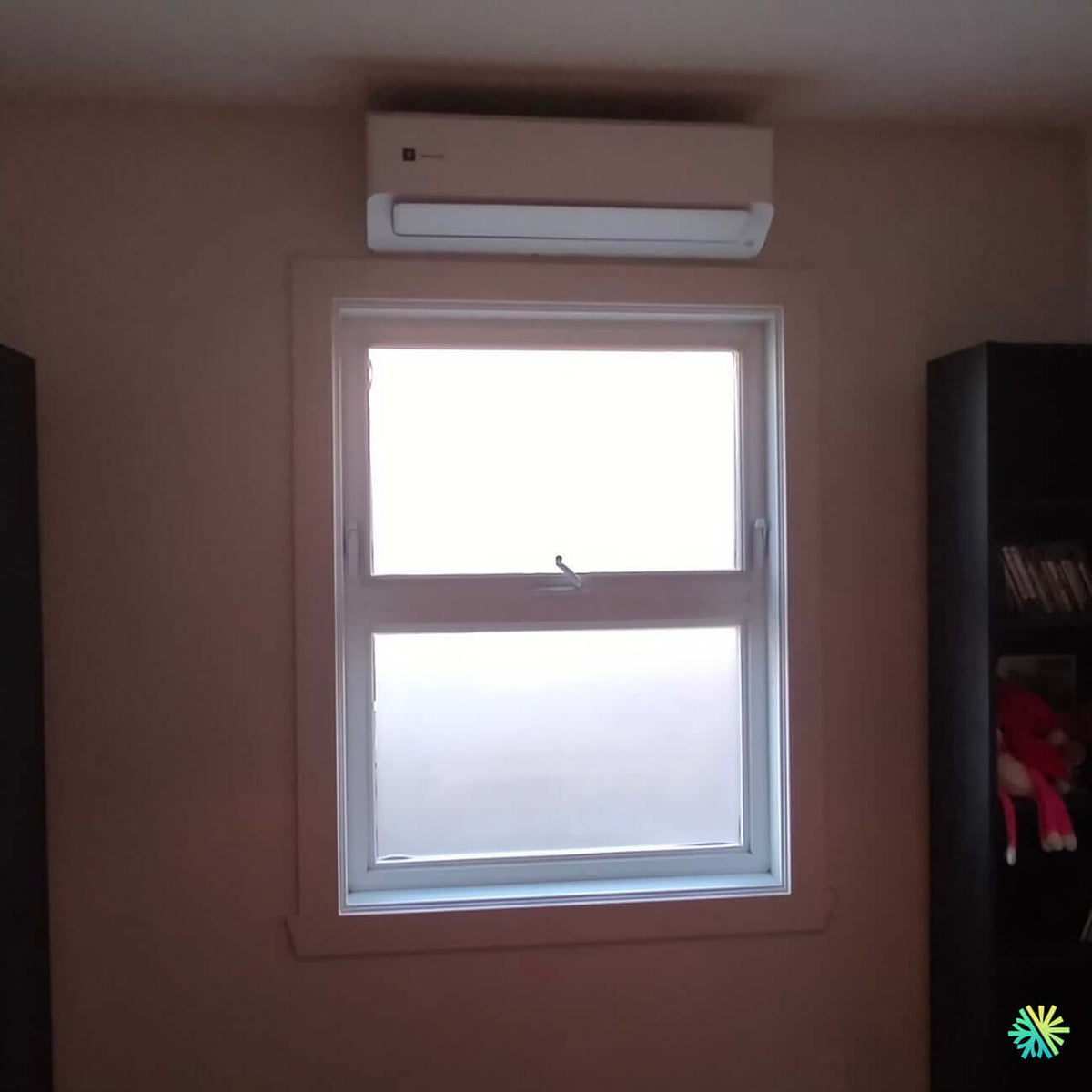
The home is a typical plex, with moderately sized rooms, wood-paneled windows, and standard ceilings. The client's goal: to improve the thermal comfort of a bedroom/office exposed to temperature fluctuations, without taking up floor space or altering the aesthetics. The chosen location— high on the wall, centered above the window —maximizes air diffusion, avoids areas of direct draft on the occupants, and completely frees up the side walls for furniture.
Why the Sharp ZU1 (R-32) range?
-
Seasonal efficiency : the ZU1 series uses R-32 refrigerant, which has better efficiency potential than R-410A, for reduced consumption at partial load, therefore lower bills all year round.
-
Cold weather performance : The optimized defrost algorithm and inverter compressor maintain useful power when the mercury drops, a major asset for Montreal and its greater region.
-
Quiet and precise : the wide turbine and the multi-position motorized shutter ensure gentle blowing; the fine ventilation levels allow adjustment to the nearest degree, ideal for a bedroom.
-
Easy maintenance : smooth front, accessible filters, clear diagnostics — all elements that simplify our HVAC maintenance visits and extend the life of the unit.
The steps of a careful HVAC installation
1) Preparation and tracing
Our technicians validate the wall structure, locate the studs, mark the wall bracket base, and ensure the required clearance around the head. The position above the window provides advantageous air stratification : conditioned air descends naturally, while warm winter air is redistributed throughout the room.
2) Clean drilling and passage of connections
We make a single drilling with a slight slope for gravity evacuation of condensate. The refrigerant connections and the communication cable are sheathed and insulated, then routed to the outside with a short route to limit pressure losses and maintain efficiency. The drain line is laid with a regular slope; the absence of a condensate pump reduces noise and the risk of breakdown.
3) Connections and vacuuming
Externally, the connections are brazed/welded with inert gas and tested with nitrogen. We then perform a deep vacuum to ensure tightness and evacuate residual moisture, which is essential for the longevity of the inverter compressor. The refrigerant charge is adjusted according to the actual length of the lines.
4) Finishes and aesthetic integration
Inside, the Sharp head features a matte white shroud that blends in with the wall. The flush-mounted ceiling position limits shadows and enhances the horizontal line above the window. The remote control is mounted at an ergonomic height; the customer receives express training on heating , cooling , dehumidification and automatic modes.
What the customer gains on a daily basis
-
Controlled comfort : a stable temperature, without overheating or overcooling, thanks to continuous modulation.
-
Energy savings : the heat pump covers a large part of heating needs at a lower cost/kWh compared to electric baseboard heaters.
-
Night silence : low /night mode minimizes noise in the room.
-
Air quality : washable filters, exchanger drying function after cooling to limit odors and mold.
-
Aesthetics preserved : no footprint, clearance of side walls for bookcases and storage.
Key technical points of this pose
-
Installation height : under ceiling, aligned with the window frame for optimal diffusion.
-
Gravity drain : increased reliability, no pump noise.
-
Short route to the outside: better performance and simplified maintenance.
-
Vibration management : resilient strips on the plate, calibrated tightening torque.
-
Programming : adjustment of temperature levels, configuration of vertical sweep to avoid direct flows on the sleeping/working area.
Grants and Eligibility
Many high-efficiency R-32 models, such as the Sharp ZU1 range, align with energy efficiency program requirements when certified (e.g., Energy Star criteria, sustained low-temperature performance). In Montreal, Laval, Longueuil, as well as on the North and South Shores , our team assists our clients in pre-verifying eligibility, preparing documents, and submitting proof of installation.
HVAC Maintenance: AirGreen Best Practices
A well-installed system deserves rigorous HVAC maintenance :
-
Biannual cleaning of filters (more frequent with animals or dust).
-
Annual inspection : circuit pressure, condition of insulation, drain flow, electrical tightening, parameter updates.
-
Good summer practice : activate the exchanger's drying function after long cooling sequences to avoid trapped moisture.
-
Winterization : clearing the outdoor unit, checking the support and water drainage to prevent ice.
Pitfalls to avoid in Montreal plexes
-
Too low a position that blows directly onto the bed or desk.
-
Drain with insufficient slope causing droplets and odors.
-
Oversized or overly long connections that penalize capacity and efficiency.
-
Poorly insulated opening : thermal bridges and parasitic noise.
With AirGreen, these risks are addressed at the source by an installation design adapted to the room and the facade.
Feedback: stability, precision, sobriety
Upon restart, the room reaches the target temperature smoothly. The Sharp wall-mounted heat pump modulates discreetly; the damper directs the flow above the occupied zone and reduces gradients between ceiling and floor. The user benefits from intuitive control (modes, timers, fine-tuned settings), and the unit remains visually discreet—a feature appreciated in sleek decors.
Why AirGreen for your installation in Montreal, Laval, Longueuil and surrounding areas?
-
Field expertise in plexes, condos and houses in Greater Montreal.
-
Selection of recent equipment (R-32/R-454B) compliant with current standards.
-
Controlled execution : single drilling, priority gravity drain, optimized lengths, methodical vacuum tests.
-
Complete service : summary load study, positioning advice, grant management, maintenance and troubleshooting .
-
Respect for the premises : clean finishes, careful aesthetics, protection of surfaces.
Tips for extending performance
-
Maintain a stable setpoint rather than frequent variations.
-
Use dehumidification mode in mid-season for comfort without overcooling.
-
Keep a radius of at least 1 m free in front of the head for good air circulation.
-
Schedule annual maintenance before peak season (summer or winter) to anticipate peak demand.
Conclusion
This HVAC installation in Villeray–Saint-Michel–Parc-Extension illustrates our way of working: a precisely integrated Sharp ZU1 wall-mounted heat pump , respectful of interior aesthetics and calibrated for the Montreal climate. The result: quiet, four-season comfort , a better controlled energy bill and an immediately more pleasant room to live in. For Montreal, Laval, Longueuil, the North Shore and the South Shore , AirGreen remains your trusted partner for sustainable, efficient and impeccably executed projects.
How it goes, from the first call to the end
The main steps of this kind of job at AirGreen. Every house has its quirks: the estimate brings them out.
We look at the room, the outside wall, the line route and where the outdoor unit will go. That is where the capacity gets chosen.
Model, capacity and price, in writing. We also check whether the model qualifies for assistance programs.
Floors and furniture protected, wall plate position marked level, wall opening located.
A single opening, with the slope the drain needs to flow outside.
Set on a stand raised above the snow, with the clearances the manufacturer requires.
Connected, insulated and protected. The opening is then sealed against water, cold air and insects.
A dedicated circuit and an accessible disconnect near the outdoor unit.
Leak test, vacuum, then start-up and a check of heating and cooling.
Remote, modes, filters: we show you the essentials before we leave.
- The on-site estimateWe look at the room, the outside wall, the line route and where the outdoor unit will go. That is where the capacity gets chosen.
- The quoteModel, capacity and price, in writing. We also check whether the model qualifies for assistance programs.
- Getting readyFloors and furniture protected, wall plate position marked level, wall opening located.
- The wall openingA single opening, with the slope the drain needs to flow outside.
- The outdoor unitSet on a stand raised above the snow, with the clearances the manufacturer requires.
- Lines, cable and drainConnected, insulated and protected. The opening is then sealed against water, cold air and insects.
- The electrical workA dedicated circuit and an accessible disconnect near the outdoor unit.
- Tests and start-upLeak test, vacuum, then start-up and a check of heating and cooling.
- The walkthroughRemote, modes, filters: we show you the essentials before we leave.
What the unit delivers when it is cold
The range as published on airgreen.ca: pick a size to see its capacity in deep cold.
| Size | Heating at −8 °C | Heating at −15 °C | Coldest certified point | COP at −15 °C | SEER | HSPF | Indicative LogisVert aid |
|---|---|---|---|---|---|---|---|
| Sharp ZU1 12 000 | 14,500 | 12,000 | −27 °C: 7,200 | 2.11 | 22.0 | 11.0 | $1,740 |
| Sharp ZU1 15 000 | 18,100 | 15,300 | −27 °C: 10,100 | 2.1 | 24.0 | 11.0 | $2,172 |
| Sharp ZU1 18 000 | 22,000 | 18,000 | −27 °C: 11,500 | 2.2 | 24.0 | 11.0 | $2,640 |
| Sharp ZU1 24 000 | 22,400 | 19,000 | −27 °C: 12,300 | 2.2 | 22.0 | 11.0 | $2,688 |
According to NEEP, it delivers 14,500 BTU/h at −8 °C (17 °F), more than at 8 °C (14,000 BTU/h). It heats as hard in moderate cold as in mild weather.
According to NEEP, its certified maximum capacity at −27 °C (−17 °F) is 7,200 BTU/h, 60% of its nominal 12,000 BTU size.
At 8 °C, its certified maximum capacity reaches 17,100 BTU/h, 42% more than its nominal 12,000 BTU size.
According to NEEP, it delivers 18,100 BTU/h at −8 °C (17 °F), more than at 8 °C (18,000 BTU/h). It heats as hard in moderate cold as in mild weather.
According to NEEP, its certified maximum capacity at −27 °C (−17 °F) is 10,100 BTU/h, 67% of its nominal 15,000 BTU size.
At 8 °C, its certified maximum capacity reaches 21,800 BTU/h, 45% more than its nominal 15,000 BTU size.
According to NEEP, it delivers 22,000 BTU/h at −8 °C (17 °F), more than at 8 °C (21,600 BTU/h). It heats as hard in moderate cold as in mild weather.
According to NEEP, its COP at −27 °C is 1.88: the highest of the ZU1 line, which ranges from 1.79 to 1.82 at that temperature.
According to NEEP, its certified maximum capacity at −27 °C (−17 °F) is 11,500 BTU/h, 64% of its nominal 18,000 BTU size.
At −27 °C, its certified minimum capacity is 3,200 BTU/h (5,500 at 8 °C). It slows down instead of cycling on and off.
According to NEEP, its certified heating capacity at −15 °C (5 °F) is 19,000 BTU/h, 79% of its nominal 24,000 BTU size. Its COP there is 2.20.
Data read live from the airgreen.ca page of each size (NEEP / AHRI certified performance). When the title names the installed size, it is highlighted; otherwise the whole range is shown. The aid shown is today’s, using Hydro-Québec’s rule ($120 per 1,000 BTU/h at −8 °C); amounts quoted in the article date from its publication. Only Hydro-Québec confirms the assistance granted.
And at your place?
Two quick checks with real numbers: what heat costs, and what your current heaters add up to in BTU/h.
Baseboards and electric furnaces turn 1 kWh of electricity into 1 kWh of heat. A heat pump delivers more: that is its COP. At Hydro-Québec’s rate D (11.142¢/kWh above 40 kWh a day, since 1 April 2026):
Hydro-Québec: a heat pump can be up to three times more efficient than baseboards for heating in the colder months.
Estimate per kWh of heat, at the chosen temperature, using the certified COP from the product page. Taxes, access charge and backup heat not included.
Conversion: 1 W = 3.412 BTU/h. An indication, not a load calculation: baseboards and furnaces are often stronger than the real need, and they can stay as backup. AirGreen confirms the capacity on site.
What to do, season by season
Three habits per season for this unit. They take a few minutes and prevent many calls.
- Clean the indoor unit's filters.
- Clear leaves and debris left on the outdoor unit by winter.
- Test cooling before the first hot days.
- Clean the filters more often when the unit runs a lot.
- Keep plants away from the outdoor unit.
- Check that no water drips from the indoor unit.
- Rake the leaves around the outdoor unit.
- Test heating before the first cold days.
- Book periodic maintenance before winter.
- Keep snow away from the stand and the front of the unit.
- Let the unit defrost: it is normal.
- Never hit the ice on the fins; call us if the unit stays iced up.
Which type of equipment for your project?
Pick what looks like your need.
Four mistakes we do not make
Flip each card to see what we do instead.
What people ask us about this kind of work
Does a wall-mounted heat pump heat in winter?
Wall-mounted or multi-zone: how do I choose?
Where does the outdoor unit go?
Are there grants?
Do I need a permit?
How cold can it heat?
How much can I save?
How is the LogisVert assistance calculated?
Is it noisy?
The outdoor unit is covered in ice: is that normal?
Does AirGreen hold the required licences?
Is the estimate free?
No question matches. Write to us: we answer.
Useful pages for what comes next
More jobs to see, near you
By town, by equipment or by region: browse more than 4,700 published projects.
Each dot: a town where AirGreen has published projects. The glowing dot: this job.
Tell us about your house. We come and see it for free.
The on-site estimate is free and the quote follows within 24 hours.
Text and photo: a real AirGreen Climatisation & Chauffage job. The diagrams are generic illustrations of the type of installation, not a survey of this job site. Sources of the added figures: airgreen.ca product pages (NEEP / AHRI performance), Hydro-Québec (Heat pumps page, LogisVert, read on 13 October 2026), Régie de l’énergie (rate D as of 1 April 2026).