
Installation of a 3-head GREE Free Match R32 heat pump in Châteauguay, on Montreal’s South Shore
In Châteauguay, AirGreen installs a 3-head GREE Free Match R32 heat pump in the middle of winter, with an integrated line-set cover, multi-zone connections, 208/230 V power supply, and thorough commissioning.
Take a tour of the installation
Each number is a point we check on site. Switch between summer and winter to watch air and heat move.
In summer, the outdoor unit rejects the house's heat outside.
Generic illustration of this type of installation, not a survey of this job site. Tap a number.
Mounted level on a wall plate, high enough for the air to reach the whole room, with enough space around it to slide the filters out easily.
The refrigerant lines, the communication cable and the drain go through the wall in a single opening, sealed against water, cold air and insects.
Two insulated copper pipes connect the two units. Outside, a line cover can protect them from sun, knocks and weather.
A shut-off switch near the outdoor unit isolates it safely for service. It must stay accessible at all times.
The compressor and the fan. In heating mode it captures heat from the outdoor air, even in winter, and moves it inside.
On the ground or on the wall, it keeps the unit above accumulated snow. The unit stays clear and defrost water can drain away.
The fan needs to blow freely. Storage, a fence or a wall too close, and efficiency drops while noise goes up.
A winter job where line routing, electrical work, and service access had to be coordinated in the same location
This installation carried out at Châteauguay perfectly illustrates what distinguishes a 3-head heat pump of a simple single-zone wall-mounted system. Outside, only one GREE unit is visible. Yet behind this unit are three circuits intended to supply different areas of the residence, a dedicated electrical supply, several refrigerant lines, communication connections between the equipment, and condensate drainage to be provided for each indoor unit.
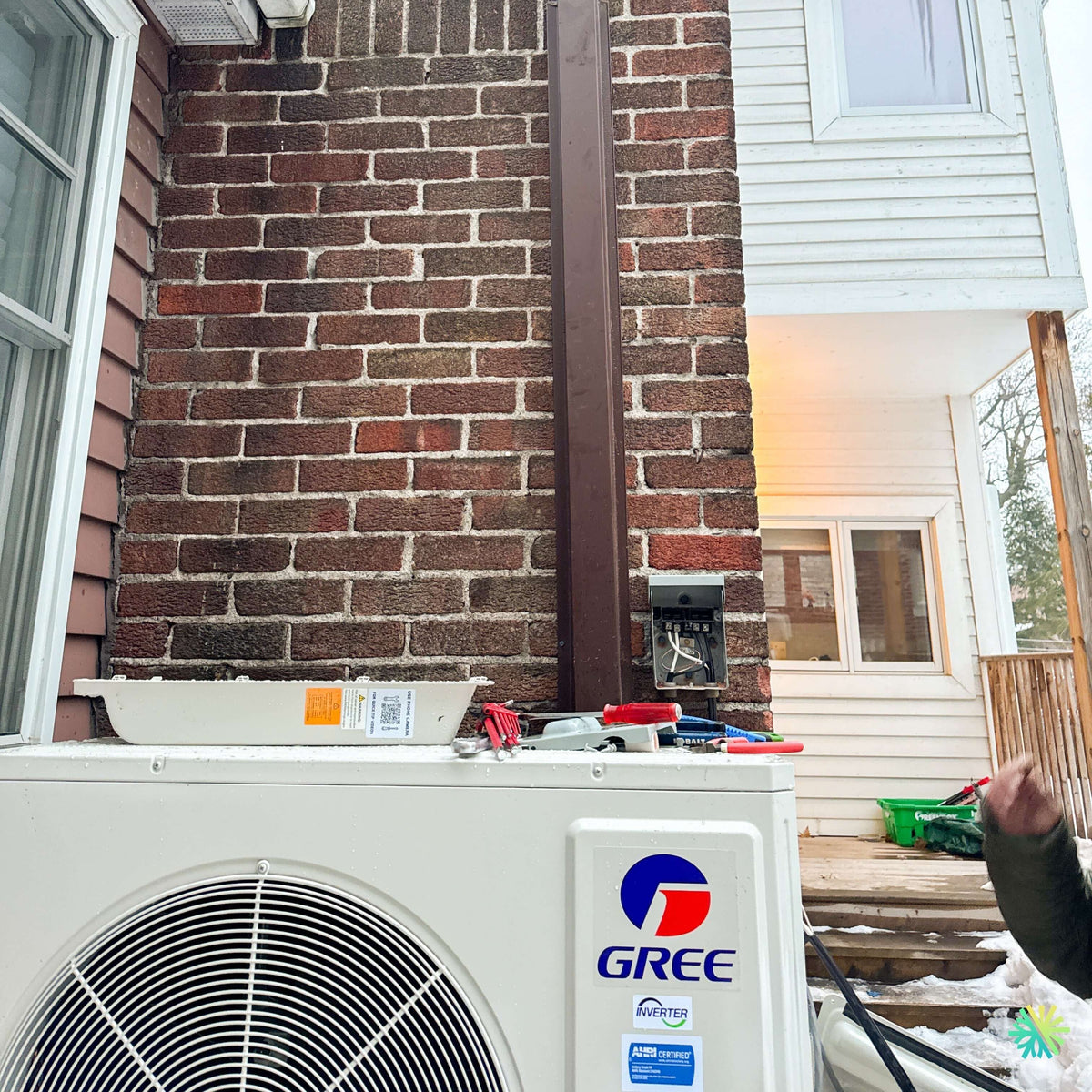
The photo taken during our work shows the outdoor unit GREE Free Match R32 installed near a brick wall, in a relatively narrow area between two parts of the building. The snow on the ground confirms the winter conditions encountered during the work. Just behind the unit, we can see an outdoor electrical disconnect switch open during the work, while a brown line-set cover runs vertically along the masonry.
Several tools are still placed on the outdoor unit: this is clearly a photo taken during the installation and not after the project has been completely finished. This detail is interesting because it shows a step that homeowners rarely observe: the stage when the mechanical, refrigeration, and electrical components are brought together before the final checks and commissioning.
At AirGreen, we believe that an installation of this kind must remain organized even when much of its work will ultimately be concealed. A multizone system can perform very well on paper and nevertheless deliver disappointing results if the lines are routed poorly, if the outdoor unit is difficult to service, or if the combination of the three indoor units has not been properly sized.
Why choose three heads instead of a single wall-mounted heat pump?
A home does not always constitute a single thermal zone. An upstairs bedroom does not respond the same way as a living room on the ground floor. A room with many windows can accumulate a great deal of heat in the afternoon, while a differently oriented room remains cooler. Closed doors also limit the natural movement of air from one room to another.
A GREE 3-head heat pump allows three spaces to be treated directly using a single outdoor unit. Each indoor unit has its own temperature and airflow controls, allowing comfort to be adapted to how each zone is used.
For a Châteauguay homeowner, this solution can offer several concrete advantages:
- fewer outdoor units around the property;
- more precise control of several rooms;
- heating and cooling from the same equipment;
- power modulation according to demand;
- the ability to adapt the types and capacities of the indoor units to the different zones;
- an outdoor installation generally more compact than three independent systems.
GREE documentation also describes the Free Match R32 as a multizone system that can be paired with several types of indoor units. The manufacturer mentions up to seven indoor options, as well as self-diagnostics, intelligent defrosting, automatic voltage adaptation, and G10 inverter technology.
An exterior passage that required careful planning
The jobsite photo shows several interesting constraints. The unit is immediately adjacent to a brick wall and a section of exterior siding. Steps and a deck are also behind the unit.
In this type of situation, we must avoid two extremes: installing the heat pump too far from the building, unnecessarily lengthening the lines and encroaching on the traffic area, or placing it excessively close to a wall to the point of hindering ventilation or technical access.
The location must allow for:
- proper air intake and discharge;
- opening the service panels;
- access to the valves and electrical connections;
- cleaning the outdoor heat exchanger;
- water drainage during defrosting;
- snow removal around the unit;
- the possible replacement of a component without having to dismantle part of the building.
The exact clearances must never be improvised. They are validated according to the installation manual for the outdoor model actually used and the site configuration.
The vertical line-hide cover: an aesthetic detail that also protects the installation
One feature stands out particularly in the photo: the wide brown line-hide cover installed vertically on the brick. Its color choice integrates much better with this façade than a standard white conduit.
Behind this type of finish typically run the insulated refrigerant lines, communication cables, and, depending on the configuration, certain drainage components.
We use line-hide covers for several reasons. In particular, they protect the insulation from UV rays and mechanical damage, keep the lines grouped together, and give the exterior run a much cleaner appearance.
On a three-head heat pump, this aspect is particularly important. Three zones can quickly create a substantial bundle of lines. Without planning, the façade can end up with several independent runs that cross each other or follow inconsistent paths.
Our goal, by contrast, is to create a logical route from the outdoor unit to the points where the circuits need to split.
An electrical installation prepared for the exact outdoor unit
The disconnect visible on the brick wall is an essential part of the installation. It allows the outdoor unit to be electrically isolated during service work.
The GREE Free Match R32 technical data sheet indicates a 208/230 V power supply for all listed outdoor units. For models that can accommodate three indoor units, the minimum circuit ampacity ranges from 19.5 A to 30 A, while the maximum overcurrent protection ranges from 25 A to 45 A depending on the outdoor unit’s capacity.
This variation explains why we never choose a circuit breaker simply based on the term “three-head heat pump.”
Electrical sizing is based on:
- the exact outdoor unit model;
- the MCA value indicated by the manufacturer;
- the MOCP value;
- the conductor size;
- the electrical panel’s available capacity;
- the requirements applicable to the installation.
In the photo, the disconnect is open because the work is still in progress. After the connection and checks are complete, it must of course be closed and protected from the elements.
Sizing, R32, and commissioning: what really determines the performance of a GREE Free Match system
Efficiency of up to 21 SEER2
The technical documentation provided for this range states up to 21 SEER2, 12.5 EER2 and 10 HSPF2. It also indicates an operating range from -30°C to 48°C in cooling mode and -30°C to 24°C in heating mode.
These ratings make the system particularly well suited to our climate, where the same heat pump may be called upon during a hot, humid day in July and then need to contribute to heating during a cold period in January.
The SEER2 is used to assess seasonal cooling efficiency. The HSPF2 focuses on seasonal heating efficiency. This data makes it easier to compare units, but it is not sufficient on its own to predict a home’s annual energy consumption.
Actual results also depend on:
- insulation;
- the building’s airtightness;
- the number and type of windows;
- solar orientation;
- the required temperatures;
- the arrangement of the three indoor units;
- the length of the lines;
- how frequently each zone is used.
Operation down to -30 °C: an important nuance
The advertised heating range goes down to -30 °C.
However, this information must be interpreted correctly. The minimum operating temperature does not mean that the heat pump will automatically retain its full rated capacity at -30 °C.
The lower the outdoor temperature drops, the more the home's heating needs generally increase. At the same time, the heat pump's available capacity may vary. This is precisely why we assess the building's heating load instead of selecting a unit solely based on the “-30 °C” figure printed in a brochure.
For an installation in Châteauguay, as with our projects in Montreal, Laval, Longueuil, on the North Shore or the South Shore, the right unit is the one whose performance matches the building's actual needs.
How many BTUs are needed for a three-head GREE heat pump?
The photo does not make it possible to read the complete model number of the installed outdoor unit with certainty. We therefore prefer not to invent a capacity.
The GREE technical specifications nevertheless make it possible to determine the options available in this range. The 18,000 BTU/h unit accepts only two indoor units. The 24,000 BTU/h model can accommodate two to three. The 30,000 and 36,000 BTU/h versions accept up to four, while the 42,000 BTU/h model can accommodate up to five.
A configuration actually consisting of three heads therefore uses, in this range, an outdoor unit of 24,000 BTU/h or more, depending on the home's needs and the approved combinations.
The rated heating capacities shown in the table are, respectively:
- 24,000 BTU/h for the GWHD(24)ND6MO;
- 30,000 BTU/h for the GWHD(30)ND6MO;
- 36,000 BTU/h for the GWHD(36)ND6MO;
- 44,300 BTU/h for the GWHD(42)ND6MO.
However, rated capacity is only one of the parameters to verify.
Why simply adding the BTUs of the three heads can lead to an error
Suppose a home receives three heads with different capacities. It might be tempting to add up all the BTUs listed on their specifications and automatically select an outdoor unit corresponding to that total.
A multi-zone system is not sized that simply.
We must consider the combination approved by GREE, the permissible connection ratio, the heating loads of each room, and the likelihood that all zones will operate simultaneously at maximum capacity.
This verification is one of the most important differences between a serious quote and a selection made solely based on the home's total area.
R32 and the precision required for connections
The Free Match range presented uses R32 refrigerant. The manufacturer also indicates that an A2L leak detection sensor is included.
On site, work involving refrigerant notably requires:
- clean connections;
- a properly made flare;
- proper torque tightening;
- a leak-tightness check;
- evacuation;
- a measurement of the lengths;
- an additional charge when the manufacturer's conditions require it.
An installation may look impeccable on the outside while having an extremely slow leak at a connection. That is why the quality of the refrigeration work remains one of the most important steps in any HVAC project.
Line lengths: great flexibility, but not permission to take unnecessary detours
Depending on the model, the technical data sheet authorizes a total piping length ranging from 40 to 100 meters. Outdoor systems capable of powering three heads have total limits of 60 m, 80 m, or 100 m, depending on capacity.
The table also specifies:
- liquid line: 1/4 po;
- gas line: 3/8 po;
- maximale height difference: 15 to 25 m depending on the system;
- refrigerant addition: 20 g/m beyond the applicable pre-charged length.
This flexibility is particularly useful for a three-head heat pump, since the indoor units may be located on different levels or different façades.
This does not mean that the entire available length must be used. We always look for a rational route: fewer detours, protected lines, preserved service access, and a cohesive exterior finish.
Winter work requires different planning
The visible snow on the steps and around the worksite adds another tangible element to this Châteauguay installation.
Installing a heat pump in winter is entirely feasible, but site conditions must be taken into consideration. In particular, a safe work area must be maintained, open components must be protected from moisture, and the mounting surfaces must be stable enough.
Once the system is in service, snow also remains something to monitor.
We recommend that the owner:
- to keep the air intakes clear;
- not to pile shoveled snow against the heat pump;
- to monitor ice buildup under the unit;
- never to completely cover a unit operating in heating mode;
- not to use aggressive metal tools against the coil.
An outdoor heat pump needs air, even at -20 °C.
Intelligent defrosting plays an essential role in winter
When the unit heats the house, the outdoor coil becomes cold. Moisture in the air can settle on and freeze onto its fins.
The intelligent defrost mentioned by GREE allows the system to manage this phenomenon automatically.
During a defrost cycle, it is normal to temporarily see steam or water around the outdoor unit. A homeowner unfamiliar with this operation might mistakenly think that a problem has just appeared.
We therefore take the time to explain the equipment’s normal operation during commissioning.
Check each head separately before leaving the job site
The fact that the outdoor unit is operating does not yet mean that the complete installation is finished.
On a three-head system, we must check each zone.
Our inspection sequence includes, among other things:
- verification of the refrigerant connections;
- leak tests;
- evacuation;
- validation of line lengths;
- checking the R32 charge when required;
- startup of the three indoor units;
- verification of their communication with the outdoor unit;
- testing of the condensate drains;
- verification of heating and cooling;
- control of the remote controls and settings.
We must also ensure that each circuit corresponds to the correct head. On a multisplit system, a wiring reversal can cause inconsistent behavior and complicate troubleshooting.
One feature to understand: the three heads share the same mode
Each indoor unit can normally have its own setpoint, but a conventional residential multisplit system shares the same general operating mode.
In other words, you can set one room to 21°C and another to 23°C when both are in heating mode. However, you should not expect to heat one bedroom while another head in the same group is simultaneously providing cooling.
This feature is important during transitional periods, when some rooms receive a great deal of sunlight while others remain cold.
Sound level and location selection
The specifications indicate outdoor sound pressure levels ranging from 58 to 63 dB(A) for 24,000 to 42,000 BTU/h systems capable of accommodating three heads.
However, the manufacturer’s figure does not tell the whole story.
Acoustic comfort also depends on:
- the distance from windows;
- the presence of walls that reflect noise;
- the quality of the support;
- vibrations transmitted through the lines;
- any contact between a pipe and the structure;
- the operating speed of the compressor.
In Montréal’s dense residential sector and surrounding areas, outdoor unit placement therefore deserves just as much attention as the choice of equipment.
ENERGY STAR, AHRI, and rebates: the exact combination matters
The product line sheet lists distinct AHRI references for ductless, ducted, and mixed configurations, and identifies the units in the ENERGY STAR table. It also mentions eligibility for local rebates.
For a homeowner, the essential point is this: simply saying “I’m installing a GREE Free Match” is not enough to automatically know the amount of financial assistance.
The following must be confirmed:
- the exact outdoor unit model;
- the three indoor models;
- their approved combination;
- the applicable AHRI number;
- the current program criteria;
- the property type;
- the required documents.
We therefore verify eligibility based on the configuration actually installed rather than solely on the series name.
A warranty worth registering at the time of installation
The documentation indicates a 10-year standard warranty as well as an additional two-year extension with Wolseley when the registration and proof-of-installation requirements are met.
It is important to keep the installation documents, including:
- the invoice;
- the model numbers;
- the serial numbers;
- the commissioning date;
- the applicable AHRI documents;
- the registration confirmation;
- the proof required for a potential rebate claim.
This administrative aspect may seem less important on the day a new heat pump starts operating. Several years later, it can make all the difference when filing a claim.
What this Châteauguay installation particularly shows
The job-site photo highlights several elements that are rarely visible in final images: the disconnect switch still open, the connection tools, the vertical path of the line-set cover, and the presence of snow around the residence.
It mainly shows that a multi-zone heat pump installation is a coordination job.
Three heads mean three zones to calculate, several routes to organize, and a single outdoor unit that must meet all these demands. The electrical supply must match the exact model. The lines must be measured. The connections must be tested. The drainage must be validated. The outdoor unit must remain accessible and have sufficient clearance.
This sequence of decisions is what turns a new appliance into a reliable HVAC system.
At AirGreen, we apply this approach to our heat pumps in Châteauguay and on the South Shore, but also in Montréal, Laval, Longueuil, and the North ShoreWe are not simply looking for a place to put the outdoor unit: we plan the entire system so that its location, three zones, and technical components work together.
The big day, step by step
The main steps of this kind of job at AirGreen. Every house has its quirks: the estimate brings them out.
We look at the room, the outside wall, the line route and where the outdoor unit will go. That is where the capacity gets chosen.
Model, capacity and price, in writing. We also check whether the model qualifies for assistance programs.
Floors and furniture protected, wall plate position marked level, wall opening located.
A single opening, with the slope the drain needs to flow outside.
Set on a stand raised above the snow, with the clearances the manufacturer requires.
Connected, insulated and protected. The opening is then sealed against water, cold air and insects.
A dedicated circuit and an accessible disconnect near the outdoor unit.
Leak test, vacuum, then start-up and a check of heating and cooling.
Remote, modes, filters: we show you the essentials before we leave.
- The on-site estimateWe look at the room, the outside wall, the line route and where the outdoor unit will go. That is where the capacity gets chosen.
- The quoteModel, capacity and price, in writing. We also check whether the model qualifies for assistance programs.
- Getting readyFloors and furniture protected, wall plate position marked level, wall opening located.
- The wall openingA single opening, with the slope the drain needs to flow outside.
- The outdoor unitSet on a stand raised above the snow, with the clearances the manufacturer requires.
- Lines, cable and drainConnected, insulated and protected. The opening is then sealed against water, cold air and insects.
- The electrical workA dedicated circuit and an accessible disconnect near the outdoor unit.
- Tests and start-upLeak test, vacuum, then start-up and a check of heating and cooling.
- The walkthroughRemote, modes, filters: we show you the essentials before we leave.
What would it look like at your place?
Two quick checks with real numbers: what heat costs, and what your current heaters add up to in BTU/h.
Conversion: 1 W = 3.412 BTU/h. An indication, not a load calculation: baseboards and furnaces are often stronger than the real need, and they can stay as backup. AirGreen confirms the capacity on site.
Four mistakes we do not make
Flip each card to see what we do instead.
Your own project, step by step
What to do, season by season
Three habits per season for this unit. They take a few minutes and prevent many calls.
- Clean the indoor unit's filters.
- Clear leaves and debris left on the outdoor unit by winter.
- Test cooling before the first hot days.
- Clean the filters more often when the unit runs a lot.
- Keep plants away from the outdoor unit.
- Check that no water drips from the indoor unit.
- Rake the leaves around the outdoor unit.
- Test heating before the first cold days.
- Book periodic maintenance before winter.
- Keep snow away from the stand and the front of the unit.
- Let the unit defrost: it is normal.
- Never hit the ice on the fins; call us if the unit stays iced up.
Is your home ready?
Check what applies at your place. A "no" is not a refusal: it is what we sort out during the estimate.
Four statements: true or false?
It all comes down to details you have just seen.
1. In heating mode, the outdoor unit can produce water.
During defrost cycles. That water must drain away without forming ice.
2. You pick the capacity with a simple square-footage rule.
Windows, insulation, orientation and how the room is used all count. Capacity is chosen on site.
3. A multi-zone connects several indoor heads to a single condenser.
One head per room, all on the same condenser. Each room keeps its own temperature.
4. The disconnect can sit behind the patio furniture.
It must stay accessible: it is what shuts the unit off for service.
0 / 4 right answers
What people ask us about this kind of work
Does a wall-mounted heat pump heat in winter?
Wall-mounted or multi-zone: how do I choose?
Where does the outdoor unit go?
Are there grants?
Do I need a permit?
How cold can it heat?
How much can I save?
How is the LogisVert assistance calculated?
Is it noisy?
The outdoor unit is covered in ice: is that normal?
Does AirGreen hold the required licences?
Is the estimate free?
No question matches. Write to us: we answer.
More jobs to see, near you
By town, by equipment or by region: browse more than 4,700 published projects.
Each dot: a town where AirGreen has published projects. The glowing dot: this job.
Every house has its constraints. We see them before we install.
The on-site estimate is free and the quote follows within 24 hours.
Text and photo: a real AirGreen Climatisation & Chauffage job. The diagrams are generic illustrations of the type of installation, not a survey of this job site. Sources of the added figures: airgreen.ca product pages (NEEP / AHRI performance), Hydro-Québec (Heat pumps page, LogisVert, read on 13 October 2026), Régie de l’énergie (rate D as of 1 April 2026).