
Installation of a Tosot wall-mounted heat pump in Rosemont–La Petite-Patrie
In Rosemont–La Petite-Patrie, AirGreen installs a Tosot R-32 wall-mounted heat pump : wall brackets, anti-vibration pads, UV capping, and rigorous commissioning. HVAC installation experts in Montreal, Laval, Longueuil, North Shore, and South Shore.
In summer, the outdoor unit rejects the house's heat outside.
Generic illustration of this type of installation, not a survey of this job site. Tap a number.
Mounted level on a wall plate, high enough for the air to reach the whole room, with enough space around it to slide the filters out easily.
The refrigerant lines, the communication cable and the drain go through the wall in a single opening, sealed against water, cold air and insects.
Two insulated copper pipes connect the two units. Outside, a line cover can protect them from sun, knocks and weather.
A shut-off switch near the outdoor unit isolates it safely for service. It must stay accessible at all times.
The compressor and the fan. In heating mode it captures heat from the outdoor air, even in winter, and moves it inside.
On the ground or on the wall, it keeps the unit above accumulated snow. The unit stays clear and defrost water can drain away.
The fan needs to blow freely. Storage, a fence or a wall too close, and efficiency drops while noise goes up.
Outdoor unit on wall brackets: compactness, silence and performance for a Montreal duplex
Background and objectives
In a typical brick duplex in Rosemont–La Petite-Patrie , the owner wants to stabilize the temperature of the main rooms without cluttering the courtyard or the front facade. We recommend a recentTosot wall-mounted heat pump with R-32 refrigerant (mono-zone), a relevant choice for Montreal homes wanting to combine energy efficiency , silence and discretion . The mission: to ensure four-season comfort with a durable and easy-to-maintain HVAC system.
Why a Tosot R-32 for this project in Montreal?
-
High seasonal heating and cooling efficiency , with a lower fluid charge than R-410A.
-
Cold weather operation adapted to the climate of Greater Montreal, useful for Laval , Longueuil , the North Shore and the South Shore .
-
Careful acoustics : electronically variable fan and compressor limiting noise in the adjoining backyard.
-
Easy HVAC maintenance : clear access to components, washable filters on the inside, treated coils.
Installation: compact and protected outdoor unit
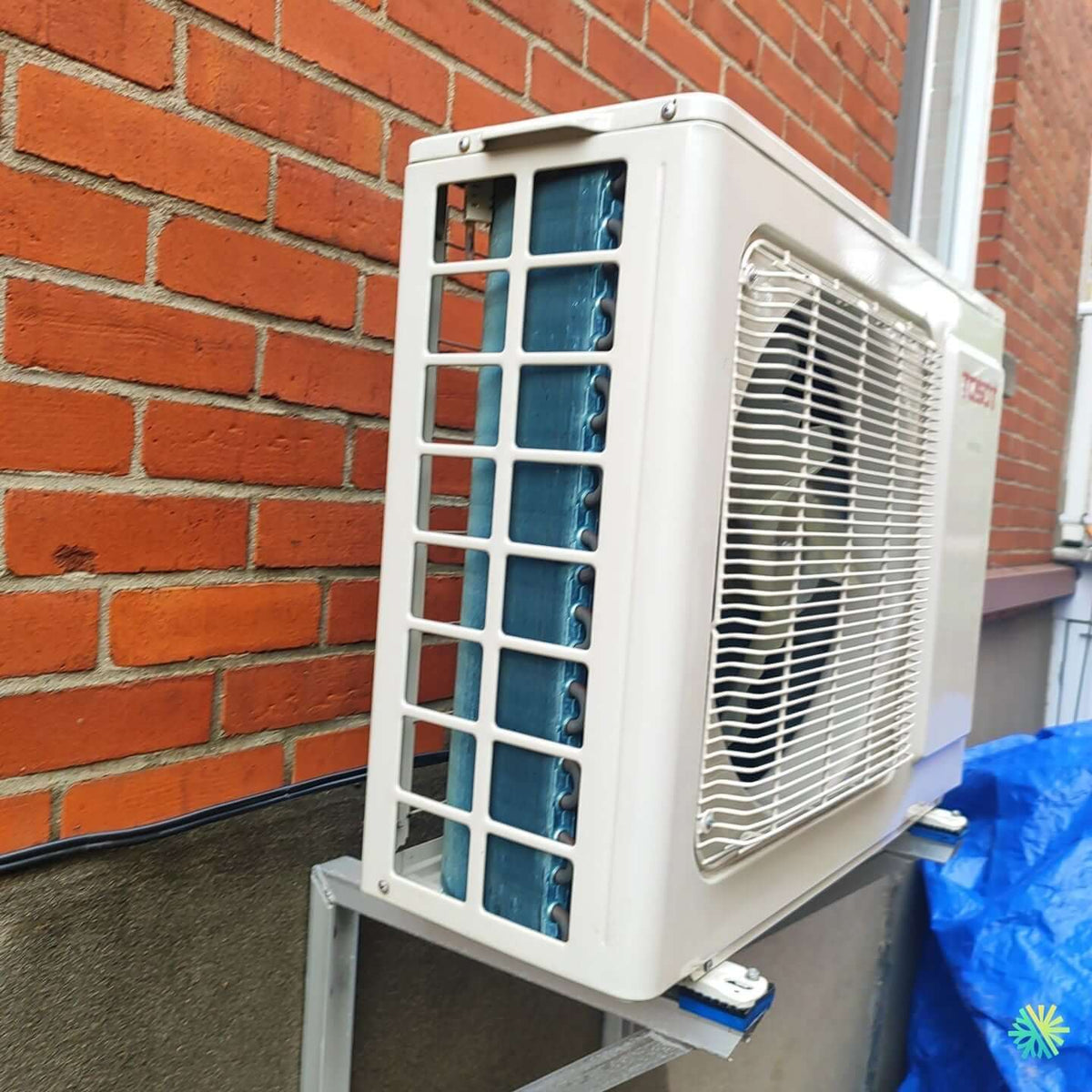
The outdoor unit is installed on galvanized wall brackets , anchored in the solid brick with suitable sealing. We insert blue anti-vibration pads between the base of the condenser and the brackets to cut off the transmission of vibrations to the masonry and reduce sound reverberation. The installation height frees up circulation on the ground, keeps the unit away from snow accumulations and facilitates winter snow removal.
Rear and side clearances are respected to ensure air intake and free discharge, essential for the compressor's longevity. The front grille protects the blue-coated exchanger (anti-corrosion treatment) useful against humidity and urban sea spray.
Refrigerated journey and crossings
-
Optimized length (short path from the inner head) to limit pressure losses.
-
Single wall crossing with sheath , interior/exterior sealant and vapor barrier to prevent any air or water infiltration.
-
Continuously insulated connections , UV-stable exterior capping coordinated with the brick; expansion cove on the unit side to absorb thermal micro-movements.
-
Gravity condensate drainage on the interior side: controlled slope, pipe insulation to prevent surface condensation.
Power supply and compliance
-
Dedicated 240V circuit from the house panel, rating as per the rating plate.
-
Proximity switch (disconnect) installed within reach of the technician, in accordance with RBQ/CSA requirements.
-
Grounding verified and sheathed wiring intended for outdoor use.
-
Regulatory tests : nitrogen pressure, vacuum < 500 microns, valve opening, superheat and subcooling checks upon commissioning.
Inside: targeted comfort, respected aesthetics
The wall head is placed high up to take advantage of the Coanda effect : the air jet runs along the ceiling then back down, which homogenizes the temperature without drafts on the occupants. The shutters are adjusted to avoid direct blowing onto the seating areas. The connections follow the technical column for discreet integration.
Sizing and results
After recording the volumes, exposures and occupancy habits, we retain a capacity adapted to a main area of 25–35 m² .
In summer : the set point of 23–24 °C is reached quickly, with defrosting of the exchanger in cooling mode during high humidex.
In winter : comfortable maintenance around 20–21 °C with long and stable cycles; free discharge to the wall prevents recirculation of cold air, which protects the compressor and efficiency.
What we are putting in place for sustainability
-
Oversized brackets and mechanical anchors suitable for brick, tightening torque verified.
-
Anti-vibration pads and level bearing to limit bearing wear and noise transmission.
-
Anti-corrosion coating of the exchanger respected (no aggressive washing), low pressure cleaning.
-
Water management : roof slope, clearance under the unit, no runoff towards the masonry.
HVAC Maintenance: Recommended Schedule
-
Internal filters : wash every 4 to 8 weeks .
-
Annual AirGreen inspection : gentle washing of coils, leak check, measurement of blowing intensities and temperatures, tightening of electrical connections.
-
Winter : Clear snow from under the wall unit and keep clearances clear for airflow.
-
Exterior : Light rinsing of the condenser in spring to remove dust and pollen without damaging the blue treatment.
AirGreen Tips for Brick Homes and Plexiglas
-
Anti-vibration devices are mandatory on masonry: they significantly reduce structural noise perceived inside.
-
Minimum installation height of 45–60 cm from the ground: protection against snow and dirt, and better ventilation.
-
Short refrigerated route : beyond the basic length, an additional charge may be required and the efficiency decreases; we optimize the route.
-
Quality capping : protects the insulation from UV rays and guarantees aesthetics, an important point in dense areas of Montreal .
-
Accessible disconnect : essential for maintenance and technician safety.
Grants and Eligibility
Recent, ENERGY STAR-certified R-32 wall-mounted heat pumps may be eligible for certain assistance depending on their efficiency and heating capacity maintenance. We verify eligibility at the time of the quote for our customers in Montreal, Laval, Longueuil, the North Shore and the South Shore .
Timeline of a typical AirGreen project
-
Technical visit and validation of the installation point (clearances, noise, access).
-
Protection of work areas, tracing and clean drilling .
-
Installation of brackets , leveling, installation of unit and pads .
-
Passage of connections (continuous insulation), sheath , mastication and capping.
-
Electrical connections , disconnect installation.
-
Pressure tests , vacuum drawing , commissioning with recorded readings.
-
Customer training (modes, ventilation, maintenance) and submission of the report.
What the customer remembers
-
A clean and quiet construction site, with no land use or disturbance to neighbors.
-
A compact, maintainable and compliant HVAC installation .
-
Year-round comfort with a modern R-32 wall-mounted heat pump from Tosot , installed by AirGreen .
Are you considering a wall-mounted heat pump for a plex or brick house in Montreal ? Our teams respond quickly in Laval , Longueuil , on the North Shore and the South Shore with tailor-made, efficient and sustainable solutions.
How it goes, from the first call to the end
The main steps of this kind of job at AirGreen. Every house has its quirks: the estimate brings them out.
We look at the room, the outside wall, the line route and where the outdoor unit will go. That is where the capacity gets chosen.
Model, capacity and price, in writing. We also check whether the model qualifies for assistance programs.
Floors and furniture protected, wall plate position marked level, wall opening located.
A single opening, with the slope the drain needs to flow outside.
Set on a stand raised above the snow, with the clearances the manufacturer requires.
Connected, insulated and protected. The opening is then sealed against water, cold air and insects.
A dedicated circuit and an accessible disconnect near the outdoor unit.
Leak test, vacuum, then start-up and a check of heating and cooling.
Remote, modes, filters: we show you the essentials before we leave.
- The on-site estimateWe look at the room, the outside wall, the line route and where the outdoor unit will go. That is where the capacity gets chosen.
- The quoteModel, capacity and price, in writing. We also check whether the model qualifies for assistance programs.
- Getting readyFloors and furniture protected, wall plate position marked level, wall opening located.
- The wall openingA single opening, with the slope the drain needs to flow outside.
- The outdoor unitSet on a stand raised above the snow, with the clearances the manufacturer requires.
- Lines, cable and drainConnected, insulated and protected. The opening is then sealed against water, cold air and insects.
- The electrical workA dedicated circuit and an accessible disconnect near the outdoor unit.
- Tests and start-upLeak test, vacuum, then start-up and a check of heating and cooling.
- The walkthroughRemote, modes, filters: we show you the essentials before we leave.
And at your place?
Two quick checks with real numbers: what heat costs, and what your current heaters add up to in BTU/h.
Conversion: 1 W = 3.412 BTU/h. An indication, not a load calculation: baseboards and furnaces are often stronger than the real need, and they can stay as backup. AirGreen confirms the capacity on site.
What to do, season by season
Three habits per season for this unit. They take a few minutes and prevent many calls.
- Clean the indoor unit's filters.
- Clear leaves and debris left on the outdoor unit by winter.
- Test cooling before the first hot days.
- Clean the filters more often when the unit runs a lot.
- Keep plants away from the outdoor unit.
- Check that no water drips from the indoor unit.
- Rake the leaves around the outdoor unit.
- Test heating before the first cold days.
- Book periodic maintenance before winter.
- Keep snow away from the stand and the front of the unit.
- Let the unit defrost: it is normal.
- Never hit the ice on the fins; call us if the unit stays iced up.
Which type of equipment for your project?
Pick what looks like your need.
Four mistakes we do not make
Flip each card to see what we do instead.
What people ask us about this kind of work
Does a wall-mounted heat pump heat in winter?
Wall-mounted or multi-zone: how do I choose?
Where does the outdoor unit go?
Are there grants?
Do I need a permit?
How cold can it heat?
How much can I save?
How is the LogisVert assistance calculated?
Is it noisy?
The outdoor unit is covered in ice: is that normal?
Does AirGreen hold the required licences?
Is the estimate free?
No question matches. Write to us: we answer.
Useful pages for what comes next
More jobs to see, near you
By town, by equipment or by region: browse more than 4,700 published projects.
Each dot: a town where AirGreen has published projects. The glowing dot: this job.
Tell us about your house. We come and see it for free.
The on-site estimate is free and the quote follows within 24 hours.
Text and photo: a real AirGreen Climatisation & Chauffage job. The diagrams are generic illustrations of the type of installation, not a survey of this job site. Sources of the added figures: airgreen.ca product pages (NEEP / AHRI performance), Hydro-Québec (Heat pumps page, LogisVert, read on 13 October 2026), Régie de l’énergie (rate D as of 1 April 2026).