
Installation of a Fujitsu Aquila XLTH AIRSTAGE Triple-Zone Heat Pump in Sorel-Tracy: A Raised Wall-Mounted Installation Designed for Quebec’s Climate
In Sorel-Tracy, AirGreen installs a Fujitsu Aquila XLTH triple-zone heat pump on wall brackets: three comfort zones, a single outdoor unit, and a design adapted to snow and Quebec’s climate.
- City
- Region
- Equipment
- Brand
- Challenges
- Published
The job on one screen
The article, chapter by chapter
In Sorel-Tracy, three comfort zones connected to a single Fujitsu outdoor unit
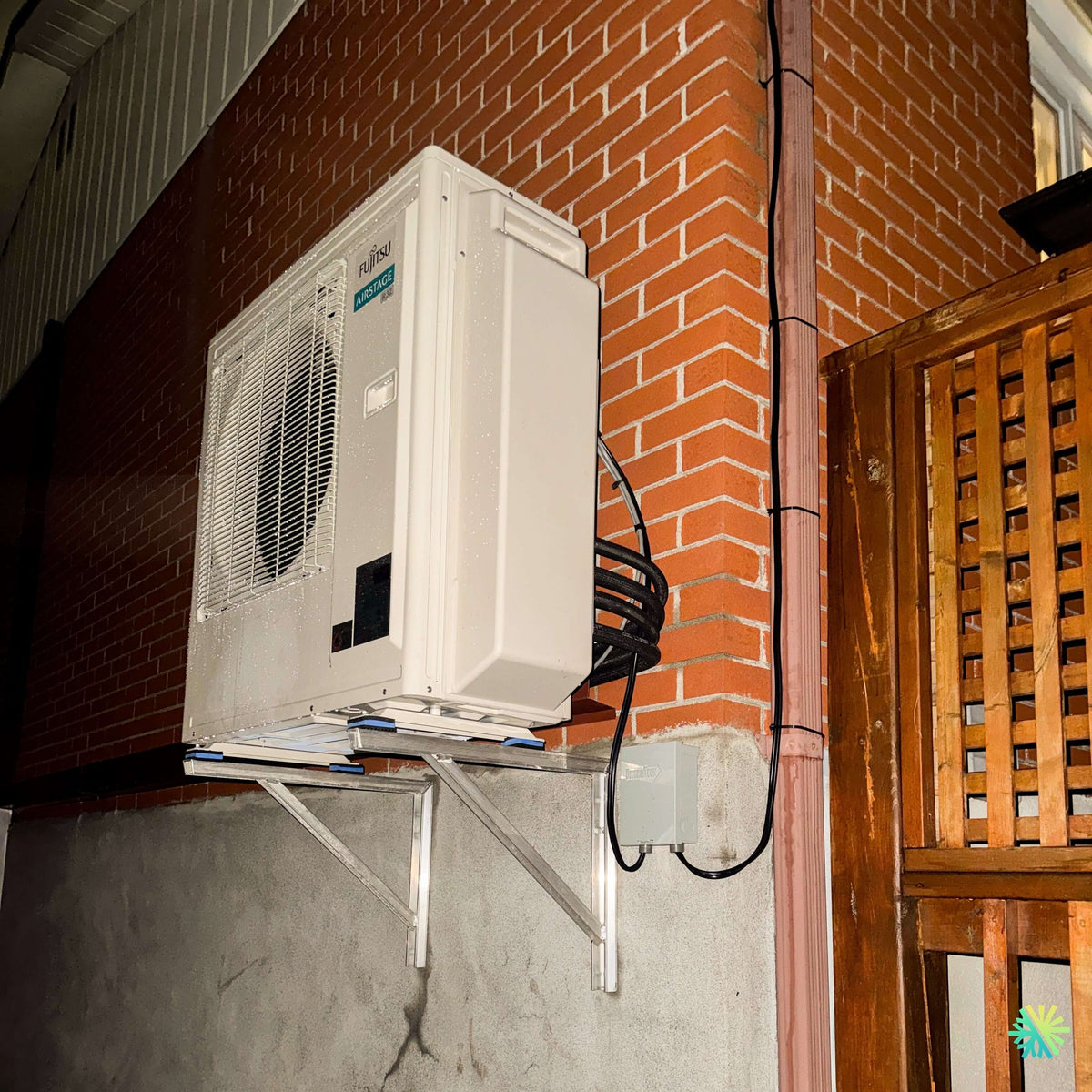
This installation of a Fujitsu Aquila XLTH triple-zone heat pump in Sorel-Tracy perfectly illustrates why the quality of a multi-zone project depends as much on the installation design as on the equipment itself. At this brick residence, the available outdoor space was relatively narrow, immediately beside a wooden deck and a foundation wall. Rather than obstructing the passage with a ground-mounted base, we opted for a wall-mounted installation on sturdy metal brackets, keeping the outdoor unit well above ground level.
This choice serves several purposes at once: providing greater protection for the heat pump against snow accumulation, maintaining convenient access beneath the unit, keeping the ground area clear, and creating a compact installation despite the three refrigerant circuits required for a triple-zone system.
The project photo also shows a characteristic detail of multi-zone installations: several sets of lines leave the outdoor unit and run to the different parts of the residence. Their layout must be planned precisely. When a single heat pump powers three indoor units, we are no longer dealing with a simple connection between two appliances; we are creating a true miniature HVAC network, adapted to three distinct areas of the building.
Why a Fujitsu triple-zone heat pump was particularly well suited to this property
A triple-zone system addresses a common problem in homes in Sorel-Tracy and elsewhere in Quebec: different rooms almost never require the same amount of heating or cooling at the same time.
An open-plan ground floor can receive more sunlight, while a bedroom on another floor stays cooler. A room used only a few hours a day should not necessarily operate with the same settings as the main living room.
With a Fujitsu AIRSTAGE Aquila multi-zone system, several indoor units can be connected to a single outdoor unit. Fujitsu states that its H series systems can be combined with different types of evaporators, including wall-mounted units, Slim Duct units, compact cassettes, and certain Mid Static Duct units. The range includes outdoor units that can serve two to five indoor units, depending on the capacity and model selected.
For the homeowner, this means a much less bulky outdoor installation than three separate single-zone systems.
For us, as HVAC installers, this nevertheless means an additional essential step: properly designing all three zones before beginning the installation.
Triple-zone does not mean three identical indoor units
This is an important distinction.
When a house has three zones, each one may require a different capacity. A small bedroom does not have the same heat loss as a large living room with several windows. Likewise, a top-floor space may have a much higher cooling load on a hot summer day.
Fujitsu’s combination tables illustrate various options using indoor units with different capacities. For the 24,000 BTU/h outdoor unit that can accommodate up to three indoor units, for example, Fujitsu presents several capacity combinations rather than one standardized configuration. The 36,000 and 45,000 BTU/h models offer even more possibilities.
However, we cannot determine the exact BTU ratings of each of the three zones installed in Sorel-Tracy from this photo alone. That is a detail it would be incorrect to make up.
What matters for understanding the project is that a multi-zone system is never sized simply by adding up the capacities listed on the indoor units.
An indoor capacity above 100% does not create additional outdoor capacity
Fujitsu documentation allows certain combinations in which the total rated capacity of the indoor units exceeds the outdoor unit’s rated capacity. However, the manufacturer clearly states that exceeding 100% in combination does not increase the system’s output capacity. Fujitsu also recommends using its Design Simulator software to select the appropriate equipment for AIRSTAGE H series systems.
This distinction is crucial in a triple-zone installation.
Suppose a contractor selects the three indoor units solely according to their individual maximum capacity. On paper, the total may seem impressive. However, when several zones simultaneously require their full output, it is always the outdoor unit that determines the actual amount of heating or cooling available.
At AirGreen, we therefore consider the house as a whole: solar exposure, room volume, insulation, windows, number of floors, and the actual use of each area.
What the photo reveals about our installation in Sorel-Tracy
This installation includes several elements that deserve particular attention.
The Fujitsu AIRSTAGE outdoor unit is installed against a brick wall, above the foundation, on two triangular metal brackets. Pads are visible between the unit and the support rails, helping limit the direct transmission of vibrations to the structure.
To the right of the unit is also the outdoor electrical disconnect, installed near the heat pump to allow a safe shutdown during maintenance or technical work.
At the back and side of the unit, we can see the various connections associated with the multizone system. Several insulated lines are arranged before entering the building. On a three-zone installation, this area must remain clean and organized: the lines must be protected while respecting bending radii and maintaining reasonable access for servicing.
A heat pump installed high up: a detail that takes on its full importance in Sorel-Tracy
Why we did not install this Fujitsu directly on the ground
An outdoor unit capable of heating during the winter must operate while the ground around the house may be covered in snow.
Installing the heat pump at ground level would have created several constraints for this project. Significant snow accumulation could have gradually reduced the clearances around the unit. Defrost cycles also produce water that can freeze beneath the unit.
The wall-mounted installation we selected places the Fujitsu Aquila XLTH heat pump well above these conditions.
On this property, this choice offers another advantage as well: it keeps the passage area at the base of the wall completely clear.
Wall brackets must be part of the design, not added afterward
A multizone heat pump is generally larger than a small single-zone outdoor unit. It must therefore be properly supported.
Before installing such a structure, we examine in particular:
- the composition of the wall and foundation;
- the desired height of the unit;
- the weight of the outdoor unit;
- the proximity of openings and the gallery;
- the clearances required for airflow;
- future accessibility for HVAC maintenance;
- the path of snow coming from the roof or nearby surfaces.
The photo also shows that the unit was not pushed into the corner of the gallery. We leave space around the unit so it can breathe and remain accessible.
A roof must never become a source of ice directly above the unit.
A roof overhang above a heat pump can be beneficial because it limits some direct precipitation. However, it requires careful observation.
We always avoid positioning the outdoor unit directly beneath a major drop zone for snow, ice, or water from the roof. A winter heat pump must remain clear, especially around the heat exchanger and air intake.
Simply placing a unit “under the roof” is therefore not enough. Its entire environment must be analyzed.
Aquila XLTH and cold-weather heating
For a homeowner in Sorel-Tracy, winter heating performance is generally one of the most important criteria.
The Fujitsu documentation provided for the Aquila H Series family indicates that the cold-climate versions can operate in heating mode down to -26 °C. Fujitsu also presents multi-zone units with inverter compressors and notes that the CTEB versions are designed to maintain heating operation down to this outdoor temperature.
This information explains why the outdoor unit's placement is so important.
A heat pump may have excellent low-temperature operating characteristics, but it must still be able to move enough air around its heat exchanger. Poor installation can limit the benefits of a very well-designed machine.
Three comfort thermostats, but only one general mode
The ability to control the different indoor units independently is one of the main advantages of Fujitsu multi-zone systems.
Each zone can have its own setpoint temperature. For example, it is possible to keep a bedroom slightly cooler and a living area warmer.
However, one important rule must be explained during installation: the zones cannot simultaneously request opposite modes.
Fujitsu specifies that multi-zone systems provide heating and cooling, but not simultaneously. In other words, if the system is operating overall in heating mode, another zone cannot demand cooling at the same time.
This limitation is generally not problematic in Sorel-Tracy’s climate, since the needs of the different rooms will usually move in the same direction during the coldest or hottest periods.
Inverter modulation is particularly relevant for a multi-zone system
A home’s heating demand is constantly changing.
Once one zone reaches its temperature, it can reduce its demand while the other two continue operating. An hour later, the situation may be reversed.
The inverter compressor in a Fujitsu multi-zone system is well suited to this type of use because it adjusts its operation rather than operating solely through a succession of complete starts and stops.
Fujitsu also states that its multi-zone units include various electronic protections for the circuits, fan motor, and compressor, as well as a finned heat exchanger designed to provide better corrosion resistance.
For an outdoor unit exposed year after year to Quebec’s weather conditions, these features have very practical importance.
R32 refrigerant and the evolution of HVAC installations
The Fujitsu Aquila XLTH family used for this type of project is part of the new generation of HVAC systems. In a modern installation, the refrigerant and the procedures associated with it must be taken into account from the earliest stages of site preparation.
A multi-zone installation also adds a challenge: several circuits are connected to the same outdoor unit.
Every refrigerant connection must be executed correctly. We must inspect the fittings, perform the necessary pressure-testing and evacuation procedures, and verify the integrity of the network before commissioning.
A small leak in a triple-zone installation is not merely a local problem in one room: it can affect the operation of the entire system.
The lines visible behind the unit tell an important part of the project’s story
In the photo from Sorel-Tracy, we can see several lines forming curves behind the heat pump before reaching the building.
This arrangement is not accidental.
A refrigerant line should not be bent sharply just to save a few centimeters. We must respect its geometry, organize the different lines, and avoid unnecessary mechanical stress on the fittings.
With three zones, the space available behind the unit quickly becomes limited. The way we organize each branch also facilitates future work when a technician needs to identify a zone or perform a diagnosis.
A clean installation must also remain serviceable
Aesthetics matter, especially on a side façade visible from a porch. But an extremely tight installation, where no component is accessible, can become problematic a few years later.
We therefore seek a balance between:
a compact finish, proper clearance, protection from outdoor conditions, and service accessibility.
This Sorel-Tracy project illustrates this balance well. The heat pump does not take over the yard, while remaining accessible from the front, underneath, and on the connection side.
Rebates: why the exact combination must be verified rather than simply the brand
Homeowners looking for a Fujitsu heat pump in Sorel-Tracy regularly ask us whether their system may qualify for financial assistance.
The answer should never be based solely on the Fujitsu logo or on the fact that a heat pump operates in low temperatures.
Eligibility for a rebate generally depends on the exact combination of indoor and outdoor models, the applicable certification, the capacity, and the program rules in effect when the project is completed.
The documentation provided here presents the Fujitsu Aquila technical combinations, but it does not give us enough information to determine with certainty a specific rebate amount for this Sorel-Tracy installation. We therefore prefer to verify the model number and eligible reference before communicating an amount to the homeowner.
This is also a good practice for anyone comparing quotes: ask the contractor which exact combination of models justifies the advertised rebate.
Mistakes we aim to avoid with a triple-zone heat pump
A multizone installation can be extremely comfortable when properly designed. However, several mistakes can compromise the results:
- choosing capacities solely according to a rough square-footage rule;
- installing three identical indoor units without analyzing the rooms’ actual needs;
- placing the outdoor unit too close to the ground;
- intentionally piling snow in front of or behind the heat pump;
- compress the pipes into a space that is too confined;
- neglect drainage from the indoor units;
- forget that all three zones must share the same heating or cooling mode;
- select a combination permitted by the manufacturer without checking whether it is actually suitable for the building's loads.
The Fujitsu document itself emphasizes this final point: the combination tables indicate what can be connected, but they do not, on their own, constitute a capacity calculation for the home.
Our AirGreen approach to multi-zone installations in Sorel-Tracy and Greater Montreal
At AirGreen, we approach a triple-zone heat pump installation as a complete heating and cooling project.
Before installation, we determine where the indoor units can distribute air effectively. We examine the piping route, condensate drainage, the outdoor unit's position and the electrical supply.
During the work, we pay just as much attention to the elements the customer sees as to those that will remain hidden: connections, support, pipe insulation, drainage and commissioning.
After installation, all three zones must be tested to confirm communication with the outdoor unit and operation in the various available modes.
This method applies to our projects in Sorel-Tracy, as well as to our Fujitsu heat pump installations in Montreal, Laval, Longueuil, the North Shore and the South Shore.
What this Fujitsu Aquila XLTH installation demonstrates particularly well
The main benefit of this installation is not simply the Fujitsu brand or the fact that it is a triple-zone system.
This is how the machine was integrated into a property where every inch of outdoor space matters.
A single outdoor unit serves three areas of the home. It is installed high enough to clear the ground. The wall bracket keeps the passage near the deck clear. The electrical disconnect remains accessible. The various refrigerant circuits are grouped close to the building.
The result is a compact, winter-ready HVAC installation tailored to the reality of a home in Sorel-Tracy.
For a homeowner considering a multi-zone heat pump, this is precisely what to look for: not only a good machine, but an installation designed around the house in which that machine will operate for many years.
The job tools
Two quick checks with real numbers: what heat costs, and what your current heaters add up to in BTU/h.
Conversion: 1 W = 3.412 BTU/h. An indication, not a load calculation: baseboards and furnaces are often stronger than the real need, and they can stay as backup. AirGreen confirms the capacity on site.
How the job unfolds
The main steps of this kind of job at AirGreen. Every house has its quirks: the estimate brings them out.
We look at the room, the outside wall, the line route and where the outdoor unit will go. That is where the capacity gets chosen.
Model, capacity and price, in writing. We also check whether the model qualifies for assistance programs.
Floors and furniture protected, wall plate position marked level, wall opening located.
A single opening, with the slope the drain needs to flow outside.
Set on a stand raised above the snow, with the clearances the manufacturer requires.
Connected, insulated and protected. The opening is then sealed against water, cold air and insects.
A dedicated circuit and an accessible disconnect near the outdoor unit.
Leak test, vacuum, then start-up and a check of heating and cooling.
Remote, modes, filters: we show you the essentials before we leave.
- The on-site estimateWe look at the room, the outside wall, the line route and where the outdoor unit will go. That is where the capacity gets chosen.
- The quoteModel, capacity and price, in writing. We also check whether the model qualifies for assistance programs.
- Getting readyFloors and furniture protected, wall plate position marked level, wall opening located.
- The wall openingA single opening, with the slope the drain needs to flow outside.
- The outdoor unitSet on a stand raised above the snow, with the clearances the manufacturer requires.
- Lines, cable and drainConnected, insulated and protected. The opening is then sealed against water, cold air and insects.
- The electrical workA dedicated circuit and an accessible disconnect near the outdoor unit.
- Tests and start-upLeak test, vacuum, then start-up and a check of heating and cooling.
- The walkthroughRemote, modes, filters: we show you the essentials before we leave.
What we check on a job like this one
Each number is a point we check on site. Switch between summer and winter to watch air and heat move.
In summer, the outdoor unit rejects the house's heat outside.
Generic illustration of this type of installation, not a survey of this job site. Tap a number.
Mounted level on a wall plate, high enough for the air to reach the whole room, with enough space around it to slide the filters out easily.
The refrigerant lines, the communication cable and the drain go through the wall in a single opening, sealed against water, cold air and insects.
Two insulated copper pipes connect the two units. Outside, a line cover can protect them from sun, knocks and weather.
A shut-off switch near the outdoor unit isolates it safely for service. It must stay accessible at all times.
The compressor and the fan. In heating mode it captures heat from the outdoor air, even in winter, and moves it inside.
On the ground or on the wall, it keeps the unit above accumulated snow. The unit stays clear and defrost water can drain away.
The fan needs to blow freely. Storage, a fence or a wall too close, and efficiency drops while noise goes up.
Is your home ready?
Check what applies at your place. A "no" is not a refusal: it is what we sort out during the estimate.
Good habits, once the unit is in place
Six simple habits that keep the unit going. Your list stays on this device.
What to do, season by season
Three habits per season for this unit. They take a few minutes and prevent many calls.
- Clean the indoor unit's filters.
- Clear leaves and debris left on the outdoor unit by winter.
- Test cooling before the first hot days.
- Clean the filters more often when the unit runs a lot.
- Keep plants away from the outdoor unit.
- Check that no water drips from the indoor unit.
- Rake the leaves around the outdoor unit.
- Test heating before the first cold days.
- Book periodic maintenance before winter.
- Keep snow away from the stand and the front of the unit.
- Let the unit defrost: it is normal.
- Never hit the ice on the fins; call us if the unit stays iced up.
The right pages, at the right time
Four statements: true or false?
It all comes down to details you have just seen.
1. In heating mode, the outdoor unit can produce water.
During defrost cycles. That water must drain away without forming ice.
2. You pick the capacity with a simple square-footage rule.
Windows, insulation, orientation and how the room is used all count. Capacity is chosen on site.
3. A multi-zone connects several indoor heads to a single condenser.
One head per room, all on the same condenser. Each room keeps its own temperature.
4. The disconnect can sit behind the patio furniture.
It must stay accessible: it is what shuts the unit off for service.
0 / 4 right answers
What people ask us about this kind of work
Does a wall-mounted heat pump heat in winter?
Wall-mounted or multi-zone: how do I choose?
Where does the outdoor unit go?
Are there grants?
Do I need a permit?
How cold can it heat?
How much can I save?
How is the LogisVert assistance calculated?
Is it noisy?
The outdoor unit is covered in ice: is that normal?
Does AirGreen hold the required licences?
Is the estimate free?
No question matches. Write to us: we answer.
More jobs to see, near you
By town, by equipment or by region: browse more than 4,700 published projects.
Each dot: a town where AirGreen has published projects. The glowing dot: this job.
An on-site estimate, the right capacity, the right equipment.
The on-site estimate is free and the quote follows within 24 hours.
Text and photo: a real AirGreen Climatisation & Chauffage job. The diagrams are generic illustrations of the type of installation, not a survey of this job site. Sources of the added figures: airgreen.ca product pages (NEEP / AHRI performance), Hydro-Québec (Heat pumps page, LogisVert, read on 13 October 2026), Régie de l’énergie (rate D as of 1 April 2026).