
Installation of a FUJITSU CENTAURI R32 3-ton (36,000 BTU) central heat pump in Brossard
HVAC installation in Brossard of a FUJITSU 36,000 BTU central heat pump. Uniform comfort, optimized ducts, and a LogisVert subsidy. Discover our expertise on the South Shore, Montreal, Laval, and Longueuil.
- City
- Region
- Equipment
- Brand
- Challenges
- Published
The job on one screen
The article, chapter by chapter
An HVAC Installation Designed for Real and Lasting Comfort on the South Shore
In Brossard, on Montreal's South Shore, we recently completed a full HVAC installation of a FUJITSU CENTAURI R32 3 ton (36,000 BTU) central heat pump in a typical 1990s single-family home. This type of property often presents specific challenges: existing ducts to optimize, thermal balance between floors, and increased comfort requirements in both winter and summer.
At AirGreen, we approach every project with a simple logic: a high-performance machine must be accompanied by impeccable installation, otherwise the final result will never live up to expectations. This project in Brossard is an excellent example.
A FUJITSU Central Heat Pump Adapted to Quebec's Climate Realities
Key Technical Characteristics of the Installed System
The installed FUJITSU CENTAURI R32 3 ton (36,000 BTU) has specifications particularly suited to the conditions of the greater Montreal, Laval, Longueuil, and South Shore regions:
- Cooling Capacity: 36,000 BTU
- Heating capacity down to -21 °C
- R-32 Refrigerant (new generation)
- ENERGY STAR® certified (Cold Climate)
- SEER2: 17.63 | HSPF2: 9.81 | EER2: 11.06
- Outdoor Sound Level: 56 dB(A)
- Voltage: 220V
- Piping: 3/8 - 5/8
- LogisVert Grant: up to $3,288
This type of central system allows for uniform air distribution throughout the house, unlike wall-mounted systems that operate by zones.
Specific Challenges Encountered During Installation in Brossard
1. Outdoor Support and Stability
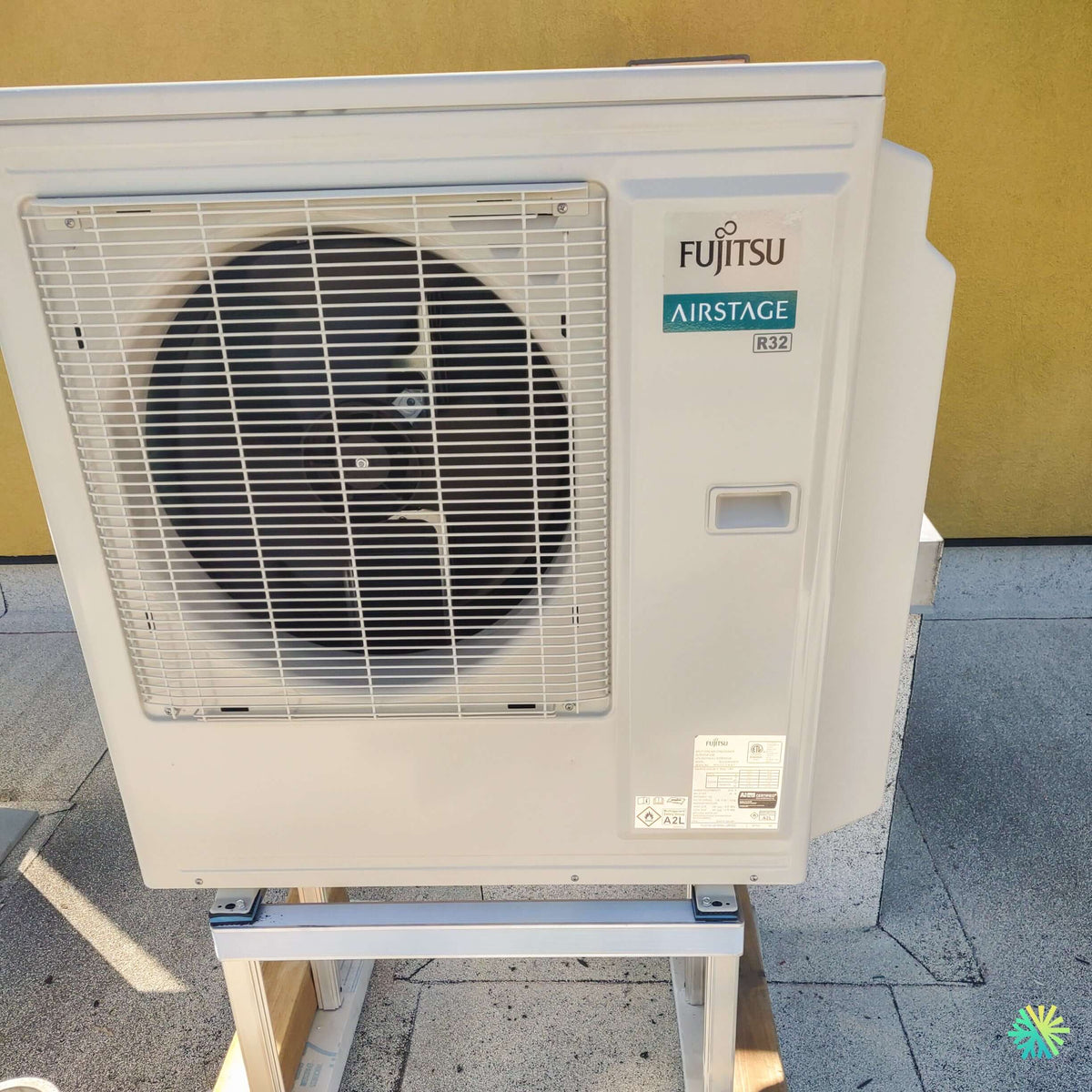
As seen in the image, the outdoor unit was installed on a robust elevated support. This choice is never solely aesthetic:
- Protection against snow accumulation
- Vibration reduction
- Improved compressor longevity
- Easier access for HVAC maintenance
2. Strategic Unit Positioning
The outdoor location was chosen considering several essential factors:
- Optimal distance between indoor and outdoor units
- Reduced noise perceived by occupants
- Compliance with regulatory clearances
- Protection against prevailing winds
3. Optimization of Existing Ducts
In this house, existing ducts were present but had common deficiencies:
- Uneven distribution between ground floor and upper floor
- Insufficient air returns
- Some registers poorly adjusted
Our intervention included:
- Complete rebalancing of airflows
- Precise adjustment of registers
- Verification of pressure drops
Result: a consistent temperature in all rooms, which was the client's main objective.
Why a 3-Ton Central Heat Pump Is Ideal for This Type of Home
Sizing is a critical step. A 3-ton (36,000 BTU) central heat pump is generally suitable for:
- Medium to large sized homes
- Multi-story residences
- Open-plan spaces combined with closed rooms
What we absolutely avoid:
- Oversizing → short cycling, discomfort, poorly controlled humidity
- Undersizing → lack of power during cold periods
At AirGreen, we analyze:
- Building insulation
- Fenestration
- Wind exposure
- Duct configuration
The Key Role of R-32 Refrigerant in New HVAC Installations
The installed system uses R-32 refrigerant, which is becoming the industry standard.
Specifically for the client:
- Improved energy efficiency
- More modern technology
- Compatibility with new Fujitsu platforms
- Reduced environmental impact
This is not a technical detail: it indicates that the machine is designed for current and future standards.
Essential Steps of Our HVAC Installation in Brossard
Preparation and Verification
Before installation:
- Complete duct inspection
- Electrical validation (MCA / MOP)
- Piping route planning
- Condensate drainage analysis
Mechanical Installation
- Securing the outdoor unit on reinforced support
- Installing the indoor unit in the mechanical space
- Refrigerant connection (with complete vacuum evacuation)
- Line insulation
Commissioning
- Pressure test
- Micron test (stable vacuum)
- Airflow calibration
- Adjustment of operating parameters
Final Result: Comfort, Silence, and Thermal Stability
After commissioning, the client immediately noticed:
- Uniform temperature throughout the house
- Significant noise reduction
- Fast system responsiveness
- Better humidity management in summer
This type of installation literally transforms daily comfort.
Common Mistakes We Avoided on This Project
In the HVAC market, several mistakes are still too common:
Poor outdoor unit placement
→ Snow problems, noise, difficult maintenance
Duct neglect
→ Uneven comfort despite a good machine
Quick installation without calibration
→ System performant on paper, ineffective in reality
Absence of micron test
→ Risk of leaks and premature failure
At AirGreen, these steps are non-negotiable.
Available Grants and Profitability
For this project in Brossard, the client is eligible for:
- LogisVert Grant: up to $3,288
This significantly reduces the actual installation cost.
In addition:
- Reduced energy consumption
- Less reliance on electric heating
- Property value enhancement
Why Choose AirGreen for HVAC Installation in Brossard
We operate weekly in Montreal, Laval, Longueuil, North Shore, and South Shore, with an approach based on precision.
What makes us different:
- Free on-site estimate
- Transparent pricing
- Complete and optimized installation
- Experienced refrigeration technicians
- Payment only at the end
We don't just sell a machine — we deliver a complete system that actually works.
Who is this installation for?
The FUJITSU CENTAURI 3-ton central heat pump is ideal for:
- Homeowners with existing ducts
- Families seeking uniform comfort
- Multi-story homes
- Serious HVAC renovation projects
Conclusion: A Successful HVAC Installation in Brossard
This project perfectly illustrates an often underestimated reality: the performance of a central heat pump depends as much on the installation as on the machine itself.
In Brossard, this installation now offers:
- Stable comfort
- Optimized energy efficiency
- Peace of mind for years to come
At AirGreen, every detail matters — and that's precisely what makes the difference between a standard installation and a meticulously executed one.
The job tools
Two quick checks with real numbers: what heat costs, and what your current heaters add up to in BTU/h.
Conversion: 1 W = 3.412 BTU/h. An indication, not a load calculation: baseboards and furnaces are often stronger than the real need, and they can stay as backup. AirGreen confirms the capacity on site.
How the job unfolds
The main steps of this kind of job at AirGreen. Every house has its quirks: the estimate brings them out.
We look at the ducts, the current indoor module, the electrical panel and the planned spot for the outdoor unit.
The equipment combination, capacity and price, in writing. We check whether the combination qualifies for assistance programs.
Access protected, old unit disconnected and removed when it is being replaced.
Electric furnace or air handler, with its coil, connected to the supply and return ducts.
On a level base, raised above the snow, with free space all around.
Insulated, they enter through a sealed opening and run to the indoor coil.
Dedicated circuits, accessible disconnect, a thermostat that works with the heat pump and the backup heat.
Leak test, vacuum, start-up, airflow check and a test of both modes.
Filter, thermostat, backup heat in extreme cold: what to know before winter.
- The on-site estimateWe look at the ducts, the current indoor module, the electrical panel and the planned spot for the outdoor unit.
- The quoteThe equipment combination, capacity and price, in writing. We check whether the combination qualifies for assistance programs.
- Getting readyAccess protected, old unit disconnected and removed when it is being replaced.
- The indoor moduleElectric furnace or air handler, with its coil, connected to the supply and return ducts.
- The outdoor unitOn a level base, raised above the snow, with free space all around.
- The refrigerant linesInsulated, they enter through a sealed opening and run to the indoor coil.
- Electrical and thermostatDedicated circuits, accessible disconnect, a thermostat that works with the heat pump and the backup heat.
- Tests and start-upLeak test, vacuum, start-up, airflow check and a test of both modes.
- The walkthroughFilter, thermostat, backup heat in extreme cold: what to know before winter.
What we check on a job like this one
Each number is a point we check on site. Switch between summer and winter to watch air and heat move.
In summer, the outdoor unit rejects the house's heat outside.
Generic illustration of this type of installation, not a survey of this job site. Tap a number.
It captures or rejects heat outside. It sits on a level base, above the snow, with free space all around.
The insulated refrigerant lines enter the house through a sealed opening and run to the indoor coil.
A shut-off switch near the outdoor unit isolates it safely for service.
Sitting on the indoor module, it moves heat between the house air and the refrigerant.
Electric furnace or air handler: its fan pushes air through the ducts. The electric backup takes over in extreme cold.
Supply ducts bring air to the rooms; returns bring it back to the unit. Their condition matters as much as the unit's.
It protects the coil and the fan. A dirty filter cuts airflow, so it gets checked regularly.
It runs the heat pump and the backup heat. It must be compatible with the installed system.
Is your home ready?
Check what applies at your place. A "no" is not a refusal: it is what we sort out during the estimate.
Good habits, once the unit is in place
Six simple habits that keep the unit going. Your list stays on this device.
What to do, season by season
Three habits per season for this unit. They take a few minutes and prevent many calls.
- Check the indoor module's filter.
- Clear winter debris from the outdoor unit.
- Test cooling before the heat arrives.
- Check the filter more often in peak season.
- Keep registers and returns clear.
- Watch condensate drainage near the coil.
- Change or clean the filter.
- Test heating and backup heat before the cold.
- Book periodic maintenance.
- Clear snow around the outdoor unit.
- Store nothing in front of the indoor module.
- Note any unusual noise or smell and call us.
The right pages, at the right time
Four statements: true or false?
It all comes down to details you have just seen.
1. A central heat pump uses the house's ducts.
It connects to the existing ducts to heat and cool everywhere.
2. In extreme cold, electric backup heat can take over.
The indoor module (furnace or air handler) works with the heat pump and takes over in extreme cold.
3. The filter only gets changed when the unit breaks down.
A dirty filter cuts airflow. It gets checked regularly.
4. You can reuse the old unit's size without checking.
The house may have changed: insulation, windows, added rooms. Capacity is confirmed on site.
0 / 4 right answers
What people ask us about this kind of work
Can I keep my current ducts?
What happens in extreme cold?
Furnace, air handler, ducted: what is the difference?
Are there grants?
Do I need a permit?
How much can I save?
How is the LogisVert assistance calculated?
Will my current thermostat work?
Central or wall units: which one?
Does AirGreen hold the required licences?
Is the estimate free?
No question matches. Write to us: we answer.
More jobs to see, near you
By town, by equipment or by region: browse more than 4,700 published projects.
Each dot: a town where AirGreen has published projects. The glowing dot: this job.
An on-site estimate, the right capacity, the right equipment.
The on-site estimate is free and the quote follows within 24 hours.
Text and photo: a real AirGreen Climatisation & Chauffage job. The diagrams are generic illustrations of the type of installation, not a survey of this job site. Sources of the added figures: airgreen.ca product pages (NEEP / AHRI performance), Hydro-Québec (Heat pumps page, LogisVert, read on 13 October 2026), Régie de l’énergie (rate D as of 1 April 2026).