
Installation of a FUJITSU CENTAURI R32 3 Ton (36,000 BTU) Central Heat Pump in Laval – Performance, Precision, and Lasting Comfort
Project in Laval: installation of a FUJITSU CENTAURI R32 36,000 BTU central heat pump. Duct optimization, uniform comfort, Quebec winter performance, and LogisVert subsidy. AirGreen expertise in HVAC installation.
Take a tour of the installation
Each number is a point we check on site. Switch between summer and winter to watch air and heat move.
In summer, the outdoor unit rejects the house's heat outside.
Generic illustration of this type of installation, not a survey of this job site. Tap a number.
It captures or rejects heat outside. It sits on a level base, above the snow, with free space all around.
The insulated refrigerant lines enter the house through a sealed opening and run to the indoor coil.
A shut-off switch near the outdoor unit isolates it safely for service.
Sitting on the indoor module, it moves heat between the house air and the refrigerant.
Electric furnace or air handler: its fan pushes air through the ducts. The electric backup takes over in extreme cold.
Supply ducts bring air to the rooms; returns bring it back to the unit. Their condition matters as much as the unit's.
It protects the coil and the fan. A dirty filter cuts airflow, so it gets checked regularly.
It runs the heat pump and the backup heat. It must be compatible with the installed system.
An HVAC installation in Laval where every detail makes a difference
At AirGreen, some installations stand out not for their apparent complexity, but for the level of precision required to achieve a truly optimal result. This installation of a FUJITSU CENTAURI R32 3-ton (36,000 BTU) central heat pump completed in Laval is an excellent example. Behind a high-performing machine lies rigorous work on ducts, settings, outdoor placement, and commissioning.
The client, owner of a cottage with existing ducts, was looking to correct significant temperature differences between the ground floor and the upper floor, while upgrading their heating and air conditioning system. The objective was clear: to achieve uniform comfort throughout the house, summer and winter, with a reliable solution adapted to Quebec's climate.
Why the FUJITSU CENTAURI R32 3-ton is essential for this type of project
A capacity adapted to medium to large-sized homes
The 36,000 BTU (3-ton) central heat pump is ideal for many properties in Laval, Montreal, Longueuil, North Shore, and South Shore, provided it is correctly sized. In this specific case, we validated:
- The total habitable volume
- The overall insulation of the building
- Wind exposure
- The configuration of existing ducts
This preliminary work helps avoid common errors such as oversizing or undersizing.
Key technical specifications of the installed system
- Outdoor model: AOUH36KUAS1
- Indoor model: AMUH36KUAS
- Capacity: 36,000 BTU
- Refrigerant: R-32
- Certification: ENERGY STAR® (Cold Climate)
- Heating capacity down to: -21°C
- SEER2: 17.6 (approximation according to provided technical sheet)
- HSPF2: high heating efficiency
- Outdoor sound level: 56 dB(A)
- Voltage: 220V
This model is particularly appreciated for its stable performance in winter conditions, which is essential in the region.
Challenges encountered during this installation in Laval
1. Imbalance in the existing duct network
The main problem was not the old machine, but the air distribution network:
- Lack of return air upstairs
- Poorly distributed airflow
- Certain rooms under-supplied
AirGreen Solution
We performed:
- A complete duct inspection
- Rebalancing of registers
- Airflow optimization
Result: homogeneous distribution in all areas of the house.
2. Strategic placement of the outdoor unit
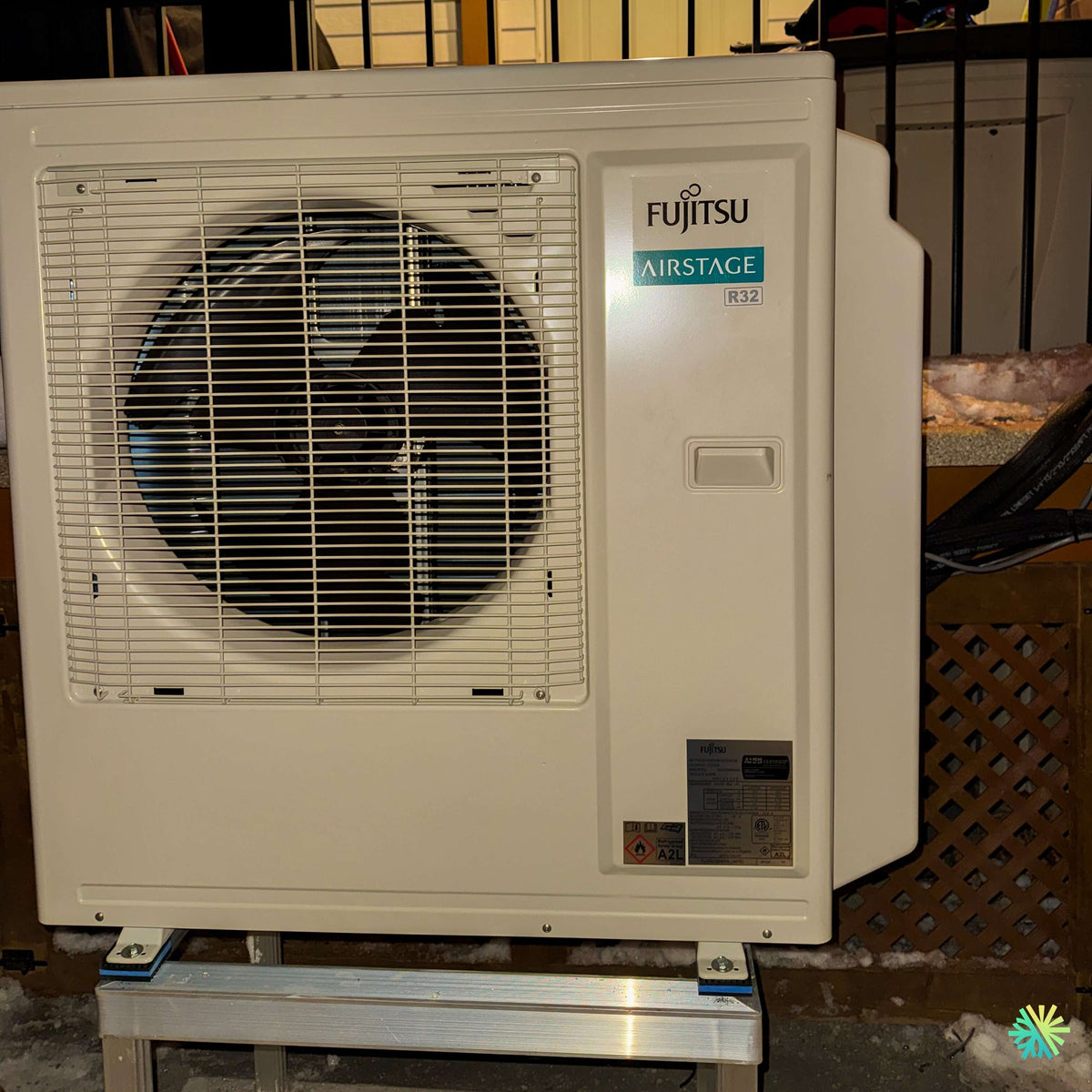
As seen in the installation, the FUJITSU outdoor unit was installed:
- On a raised aluminum stand
- With sufficient clearance for snow
- Taking into account vibrations and drainage
Why this is essential in Quebec
A poorly positioned outdoor unit can:
- Accumulate snow and ice
- Reduce performance
- Increase premature wear
Our approach ensures maximum durability season after season.
3. Condensate management and drainage
Often overlooked, condensate management is crucial in a central system.
We have:
- Checked the drain slope
- Installed an adequate trap
- Ensured safe drainage
This avoids:
- Odors
- Backups
- Water damage
Key steps in the HVAC installation performed by AirGreen
Initial inspection and technical validation
Before any installation:
- Duct analysis
- Electrical verification (MCA/MOP)
- Sizing confirmation
Indoor unit installation
- Integration into the existing duct system
- Adjustment of fittings
- Acoustic insulation
Outdoor unit installation
- Robust support
- Precise alignment and leveling
- Vibration management
Commissioning and adjustments
- Airflow calibration
- Adjustment of ventilation parameters
- Complete system verification
At AirGreen, commissioning is never improvised: it's a critical step to ensure performance.
Concrete results for the client in Laval
After installation, improvements were immediate:
- Uniform temperature between floors
- Significant reduction in on/off cycles
- Increased comfort in bedrooms
- Quiet operation
The client no longer needs to constantly adjust their thermostat. The system maintains a stable temperature automatically.
Subsidy available for this heat pump
This model is eligible for the subsidy:
- LogisVert Program: up to $3,288
A significant advantage for homeowners in Laval, Montreal, and on the South Shore/North Shore, considerably reducing the total project cost.
Common mistakes to avoid with a central heat pump
Neglecting the ducts
Even the best machine will not compensate for a poorly designed network.
Ignoring return air
A lack of return air creates:
- Thermal imbalance
- Noise
- Poor circulation
Inadequate outdoor installation
A poorly placed unit leads to:
- Winter problems
- Loss of performance
- More frequent maintenance
Shoddy settings
A poorly calibrated system will never reach its full potential.
Why choose AirGreen for your HVAC installation in Laval
We don't just install a machine. We optimize a complete system:
- Free on-site estimate
- In-depth duct analysis
- Professional installation
- Precise and tested settings
- Payment only upon satisfaction
We operate daily in Montreal, Laval, Longueuil, the North Shore, and the South Shore, with an approach focused on quality and transparency.
Who is the FUJITSU CENTAURI R32 3-ton for?
This system is ideal for:
- Homes with existing ducts
- Owners seeking uniform comfort
- Medium to large-sized residences
- Clients wanting a durable and high-performing solution
Conclusion: an installation that reflects AirGreen's expertise
This installation in Laval perfectly illustrates our approach: every detail matters. A well-chosen, well-installed, and well-adjusted FUJITSU CENTAURI R32 central heat pump truly transforms a home's comfort.
A high-performing HVAC system relies not only on the brand but on the complete execution of the project.
The big day, step by step
The main steps of this kind of job at AirGreen. Every house has its quirks: the estimate brings them out.
We look at the ducts, the current indoor module, the electrical panel and the planned spot for the outdoor unit.
The equipment combination, capacity and price, in writing. We check whether the combination qualifies for assistance programs.
Access protected, old unit disconnected and removed when it is being replaced.
Electric furnace or air handler, with its coil, connected to the supply and return ducts.
On a level base, raised above the snow, with free space all around.
Insulated, they enter through a sealed opening and run to the indoor coil.
Dedicated circuits, accessible disconnect, a thermostat that works with the heat pump and the backup heat.
Leak test, vacuum, start-up, airflow check and a test of both modes.
Filter, thermostat, backup heat in extreme cold: what to know before winter.
- The on-site estimateWe look at the ducts, the current indoor module, the electrical panel and the planned spot for the outdoor unit.
- The quoteThe equipment combination, capacity and price, in writing. We check whether the combination qualifies for assistance programs.
- Getting readyAccess protected, old unit disconnected and removed when it is being replaced.
- The indoor moduleElectric furnace or air handler, with its coil, connected to the supply and return ducts.
- The outdoor unitOn a level base, raised above the snow, with free space all around.
- The refrigerant linesInsulated, they enter through a sealed opening and run to the indoor coil.
- Electrical and thermostatDedicated circuits, accessible disconnect, a thermostat that works with the heat pump and the backup heat.
- Tests and start-upLeak test, vacuum, start-up, airflow check and a test of both modes.
- The walkthroughFilter, thermostat, backup heat in extreme cold: what to know before winter.
What would it look like at your place?
Two quick checks with real numbers: what heat costs, and what your current heaters add up to in BTU/h.
Conversion: 1 W = 3.412 BTU/h. An indication, not a load calculation: baseboards and furnaces are often stronger than the real need, and they can stay as backup. AirGreen confirms the capacity on site.
Four mistakes we do not make
Flip each card to see what we do instead.
Your own project, step by step
What to do, season by season
Three habits per season for this unit. They take a few minutes and prevent many calls.
- Check the indoor module's filter.
- Clear winter debris from the outdoor unit.
- Test cooling before the heat arrives.
- Check the filter more often in peak season.
- Keep registers and returns clear.
- Watch condensate drainage near the coil.
- Change or clean the filter.
- Test heating and backup heat before the cold.
- Book periodic maintenance.
- Clear snow around the outdoor unit.
- Store nothing in front of the indoor module.
- Note any unusual noise or smell and call us.
Is your home ready?
Check what applies at your place. A "no" is not a refusal: it is what we sort out during the estimate.
Four statements: true or false?
It all comes down to details you have just seen.
1. A central heat pump uses the house's ducts.
It connects to the existing ducts to heat and cool everywhere.
2. In extreme cold, electric backup heat can take over.
The indoor module (furnace or air handler) works with the heat pump and takes over in extreme cold.
3. The filter only gets changed when the unit breaks down.
A dirty filter cuts airflow. It gets checked regularly.
4. You can reuse the old unit's size without checking.
The house may have changed: insulation, windows, added rooms. Capacity is confirmed on site.
0 / 4 right answers
What people ask us about this kind of work
Can I keep my current ducts?
What happens in extreme cold?
Furnace, air handler, ducted: what is the difference?
Are there grants?
Do I need a permit?
How much can I save?
How is the LogisVert assistance calculated?
Will my current thermostat work?
Central or wall units: which one?
Does AirGreen hold the required licences?
Is the estimate free?
No question matches. Write to us: we answer.
More jobs to see, near you
By town, by equipment or by region: browse more than 4,700 published projects.
Each dot: a town where AirGreen has published projects. The glowing dot: this job.
Every house has its constraints. We see them before we install.
The on-site estimate is free and the quote follows within 24 hours.
Text and photo: a real AirGreen Climatisation & Chauffage job. The diagrams are generic illustrations of the type of installation, not a survey of this job site. Sources of the added figures: airgreen.ca product pages (NEEP / AHRI performance), Hydro-Québec (Heat pumps page, LogisVert, read on 13 October 2026), Régie de l’énergie (rate D as of 1 April 2026).