
Installation of a GREE Inverter R32 Central Heat Pump in Mercier–Hochelaga-Maisonneuve, Montreal: a compact, clean, and urban home-friendly AirGreen achievement
AirGreen installs a GREE Inverter R32 central heat pump in Mercier–Hochelaga-Maisonneuve: wall mount, clean finish, and central HVAC comfort in Montreal.
- City
- Region
- Equipment
- Brand
- Challenges
- Published
The job on one screen
The article, chapter by chapter
A GREE Central Heat Pump Precisely Installed in a Typical Mercier–Hochelaga-Maisonneuve Residential Setting
In a neighborhood like Mercier–Hochelaga-Maisonneuve, HVAC installations require a very practical approach: outdoor space is often limited, side walls are close to passageways, foundations do not always allow for ideal ground-level installation, and homeowners are looking for a reliable solution that improves indoor comfort without detracting from the home's appearance. It is precisely in this context that AirGreen carried out this GREE central heat pump installation in Montreal, with particular attention paid to stability, clean connections, and equipment durability.
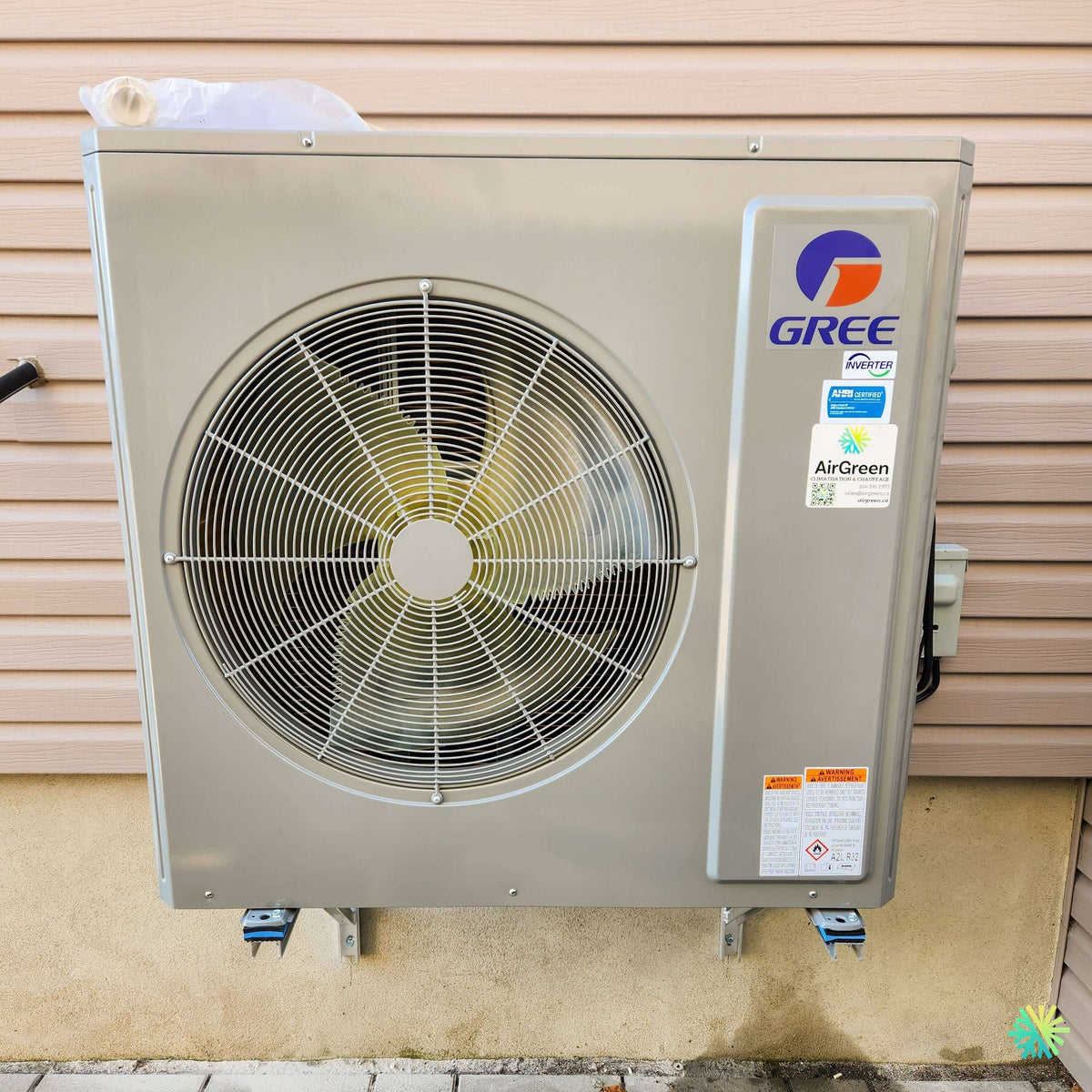
The photo clearly shows the GREE Inverter outdoor unit, installed on wall mounts fixed to the foundation. The choice of this configuration is not only aesthetic. It meets several important requirements for a central heat pump in an urban environment: ground clearance, protection against snow accumulation, reduction of humidity-related risks, easy access for HVAC maintenance, and clean integration against the house's exterior cladding.
The unit also bears the visible indications specific to the GREE range: Inverter technology, AHRI certification, use of R32 refrigerant, and AirGreen identification affixed directly to the appliance. These elements are important for homeowners comparing heat pump, central air conditioner, or old HVAC system replacement options in Greater Montreal.
Why a GREE Central Heat Pump for this Montreal Home
The central heat pump is a highly sought-after solution for homeowners who want to improve the comfort of the entire home from a ducted system. Unlike a wall-mounted air conditioner or a wall-mounted heat pump that targets a main zone, the central system allows for more uniform air distribution in multiple rooms, depending on the configuration of the existing network.
In this project in Mercier–Hochelaga-Maisonneuve, the client wanted a solution that met three priorities: better comfort in summer, an effective contribution to heating for a good part of the year, and an outdoor installation that remains clean, solid, and accessible. The choice of GREE proved to be a relevant option thanks to Inverter technology, which allows the compressor to modulate its operation rather than working only in on-off mode.
This modulation offers several concrete advantages:
- more stable indoor temperature;
- reduction of sudden comfort variations;
- generally quieter operation;
- better controlled energy consumption;
- reduced wear when the system is properly sized;
- better adaptation to the actual needs of the house.
For a property located in Montreal, where cooling periods can be intense and intermediate seasons require flexible heating, this type of equipment represents a balanced solution.
A Wall Installation that Protects the Outdoor Unit
The positioning of the outdoor unit on wall mounts is one of the most important aspects of this project. In Mercier–Hochelaga-Maisonneuve, as in several areas of Montreal, the available space around the house can be limited. Installing the unit directly on the ground could have exposed the appliance to runoff water, snow, leaves, debris, and accidental impacts.
By fixing the unit on a suitable wall structure, our technicians achieved several immediate benefits:
Protection against snow and humidity
An outdoor unit installed too low can find itself surrounded by compacted snow or ice during winter. This can hinder air circulation, increase operating effort, and make maintenance more difficult. The wall mount raises the appliance to a safer height and helps maintain useful clearance around the base.
Mechanical stability
The visible supports under the appliance are securely anchored to the foundation. This detail is essential, as a GREE central heat pump has considerable weight and must remain perfectly stable despite normal operating vibrations, freeze-thaw cycles, and external conditions specific to the Quebec climate.
Better access for service
Access to the outdoor unit is simpler when the appliance is not buried at ground level. For inspections, cleanings, electrical checks, or future interventions, this configuration facilitates the work of technicians and reduces constraints for the client.
Special Attention Paid to Connections and Finish
A good HVAC installation is not limited to the machine's performance. It is also evident in the quality of the connections, the protection of the lines, the positioning of electrical components, and the overall cleanliness of the site. In this installation, we note a discreet lateral connection as well as an electrical box placed accessibly, without cluttering the unit's facade.
This type of detail matters greatly. Poorly protected lines, exposed wiring, or an improvised passage can cause medium-term problems: premature wear, water infiltration, maintenance difficulties, a neglected appearance, or more costly interventions. At AirGreen, we pay particular attention to the finish, because a clean installation today becomes an easier-to-maintain installation tomorrow.
In neighborhoods like Mercier–Hochelaga-Maisonneuve, where houses are often close together and outdoor passageways are narrower, technical discretion is a real advantage. The client gets a high-performance system without transforming the exterior of the house into a cluttered technical zone.
The Role of R32 Refrigerant in New Installations
The visible label on the unit indicates the use of R32 refrigerant. This detail deserves attention, as several new HVAC equipment now use newer refrigerants than those of previous generations. R32 is valued in many modern systems for its thermal properties and its use in high-efficiency equipment.
For the owner, the important thing to understand is that this type of refrigerant must always be handled by qualified professionals. The installation, connection, pressurization, leak tests, and commissioning of a central heat pump require precise technical knowledge. It is never a simple mechanical connection.
At AirGreen, our teams comply with the required procedures to ensure a safe and compliant installation. This rigor is essential to protect the system, maintain its performance, and avoid problems related to improper commissioning.
A Solution Designed for Whole-Home Comfort
The main reason for opting for a central heat pump remains overall comfort. When properly integrated into the duct network, it allows air to be diffused into multiple areas of the house. For homeowners who wish to avoid adding several indoor wall units, this is often the most harmonious solution.
In this project, the GREE outdoor unit supports a central system that contributes to the daily comfort of the occupants. The goal was not only to cool the house during Montreal heatwaves, but also to improve temperature management during transitional periods, when traditional heating is not always needed at full capacity.
Homeowners in Montreal, Laval, Longueuil, the North Shore, and the South Shore often ask us the same question: is a central heat pump worth it if the house already has a ducted system? In many cases, the answer is yes, provided the equipment is properly sized, the network is compatible, and the installation is performed correctly.
Sizing: A Step That Influences Overall Performance
Choosing a heat pump should never be limited to brand or price. Sizing is a decisive step. An undersized unit could run for a long time without achieving the desired comfort. An oversized unit could lead to short cycling, reduced dehumidification, increased wear, and less stable comfort.
For this installation in Mercier–Hochelaga-Maisonneuve, our technicians considered several factors before validating the configuration:
- the serviced area;
- house insulation;
- window type;
- solar orientation;
- duct network capacity;
- possible location of the outdoor unit;
- cooling needs;
- supplementary or transitional heating needs;
- noise and visual constraints;
- future access for HVAC maintenance.
This preparatory work avoids costly mistakes. A well-chosen central heat pump can provide excellent performance for several years, but only if it truly matches the house.
Specific Challenges of an HVAC Installation in Mercier–Hochelaga-Maisonneuve
This sector of Montreal often presents very varied installation conditions. Some houses have older foundations, vinyl or brick exterior cladding, narrow passages, compact backyards, or constraints related to neighbors. A successful installation therefore depends as much on field experience as on equipment quality.
Managing Available Space Without Compromising Ventilation
The outdoor unit of a GREE central heat pump must have sufficient clearance to properly exhaust and draw in air. Even if the appliance is robust, it cannot operate at its full potential if air circulation is obstructed by a wall, fence, stored objects, or vegetation that is too close.
In this project, the clear frontal positioning allows the fan to work efficiently. This is a point to monitor after installation: avoid accumulating objects in front of the unit, blocking the sides, or placing storage materials too close to the appliance.
Preserving the Exterior Appearance of the House
A technical installation can be efficient without being visually intrusive. The GREE unit is installed cleanly against the side facade, with an orderly arrangement. The presence of the AirGreen sticker also clearly identifies the installer, which facilitates service follow-ups and reminds the client that they benefit from an installation carried out by a specialized team.
Anticipating Winter Conditions
Even if much of the discussion around heat pumps focuses on air conditioning, the climate of Montreal requires thinking about winter from the moment of installation. Snow, ice, runoff, freeze-thaw, and cold winds influence the durability of the system. A well-positioned unit better withstands these constraints and remains more accessible for checks.
Mistakes to Avoid with a Central Heat Pump
After several installations carried out in Montreal, Laval, Longueuil, on the North Shore, and on the South Shore, we regularly see the same mistakes when owners compare quotes or choose an installer.
Installing the unit too close to the ground
This is a common mistake, especially when the goal is to reduce costs or save time. A unit that is too low can be exposed to snow accumulation, fallen leaves, standing water, and debris. The wall mount used here is a professional solution adapted to the context.
Neglecting vibrations
An outdoor unit must be installed on appropriate supports with elements to limit vibration transmission. A neglected installation can create audible noises indoors or disturb occupants. The right choice of support and the quality of fixation make a real difference.
Forgetting regular maintenance
Even a new heat pump requires maintenance. The outdoor coils must remain clean, the indoor system filters must be checked, and performance must be monitored. Good HVAC maintenance helps extend the system's lifespan and maintain its energy efficiency.
Choosing solely based on price
A low price can hide shortcuts: less robust supports, less protected lines, poor location, absence of complete checks, or limited after-sales service. An HVAC installation must be evaluated as a whole, not just on the initial cost.
Subsidies, Energy Efficiency, and Documents to Keep
Depending on the exact model installed, its certifications, capacity, and current criteria, some central heat pumps may be eligible for financial assistance programs related to energy efficiency. Owners generally need to keep the invoice, model information, serial numbers, and required documents to complete their application.
In this project, the AHRI certification visible on the unit is an important element to consider in the technical analysis of equipment. At AirGreen, we help our clients better understand the necessary documents and the steps to plan, while reminding them that eligibility always depends on the exact model and the rules applicable at the time of the application.
Why AirGreen is a Solid Choice for a GREE Central Heat Pump
AirGreen regularly works on central heat pump, wall-mounted air conditioner, multi-zone systems, and HVAC equipment replacement projects in Greater Montreal. Our strength comes from our field experience: we know the homes in Montreal, the constraints of dense residential neighborhoods, homeowners' expectations, and the technical details that make a difference after installation.
For this installation in Mercier–Hochelaga-Maisonneuve, our team delivered a clean, stable installation adapted to the building's conditions. The visible result is simple, but it is based on several important decisions: choice of location, robust wall support, adequate clearance, discreet connection, service accessibility, and respect for site specificities.
A GREE central heat pump can transform a home's comfort, but the quality of the installation remains crucial. A good appliance poorly installed will never perform at its best. Conversely, a well-selected and rigorously installed system can offer reliable comfort, better efficiency, and lasting peace of mind.
For homeowners in Mercier–Hochelaga-Maisonneuve, Rosemont, Anjou, Saint-Léonard, Laval, Longueuil, the North Shore, or the South Shore, this installation clearly illustrates our approach: analyze the house, recommend the right solution, carry out a clean installation, and support the client after the work.
The job tools
Two quick checks with real numbers: what heat costs, and what your current heaters add up to in BTU/h.
Conversion: 1 W = 3.412 BTU/h. An indication, not a load calculation: baseboards and furnaces are often stronger than the real need, and they can stay as backup. AirGreen confirms the capacity on site.
How the job unfolds
The main steps of this kind of job at AirGreen. Every house has its quirks: the estimate brings them out.
We look at the ducts, the current indoor module, the electrical panel and the planned spot for the outdoor unit.
The equipment combination, capacity and price, in writing. We check whether the combination qualifies for assistance programs.
Access protected, old unit disconnected and removed when it is being replaced.
Electric furnace or air handler, with its coil, connected to the supply and return ducts.
On a level base, raised above the snow, with free space all around.
Insulated, they enter through a sealed opening and run to the indoor coil.
Dedicated circuits, accessible disconnect, a thermostat that works with the heat pump and the backup heat.
Leak test, vacuum, start-up, airflow check and a test of both modes.
Filter, thermostat, backup heat in extreme cold: what to know before winter.
- The on-site estimateWe look at the ducts, the current indoor module, the electrical panel and the planned spot for the outdoor unit.
- The quoteThe equipment combination, capacity and price, in writing. We check whether the combination qualifies for assistance programs.
- Getting readyAccess protected, old unit disconnected and removed when it is being replaced.
- The indoor moduleElectric furnace or air handler, with its coil, connected to the supply and return ducts.
- The outdoor unitOn a level base, raised above the snow, with free space all around.
- The refrigerant linesInsulated, they enter through a sealed opening and run to the indoor coil.
- Electrical and thermostatDedicated circuits, accessible disconnect, a thermostat that works with the heat pump and the backup heat.
- Tests and start-upLeak test, vacuum, start-up, airflow check and a test of both modes.
- The walkthroughFilter, thermostat, backup heat in extreme cold: what to know before winter.
What we check on a job like this one
Each number is a point we check on site. Switch between summer and winter to watch air and heat move.
In summer, the outdoor unit rejects the house's heat outside.
Generic illustration of this type of installation, not a survey of this job site. Tap a number.
It captures or rejects heat outside. It sits on a level base, above the snow, with free space all around.
The insulated refrigerant lines enter the house through a sealed opening and run to the indoor coil.
A shut-off switch near the outdoor unit isolates it safely for service.
Sitting on the indoor module, it moves heat between the house air and the refrigerant.
Electric furnace or air handler: its fan pushes air through the ducts. The electric backup takes over in extreme cold.
Supply ducts bring air to the rooms; returns bring it back to the unit. Their condition matters as much as the unit's.
It protects the coil and the fan. A dirty filter cuts airflow, so it gets checked regularly.
It runs the heat pump and the backup heat. It must be compatible with the installed system.
Is your home ready?
Check what applies at your place. A "no" is not a refusal: it is what we sort out during the estimate.
Good habits, once the unit is in place
Six simple habits that keep the unit going. Your list stays on this device.
What to do, season by season
Three habits per season for this unit. They take a few minutes and prevent many calls.
- Check the indoor module's filter.
- Clear winter debris from the outdoor unit.
- Test cooling before the heat arrives.
- Check the filter more often in peak season.
- Keep registers and returns clear.
- Watch condensate drainage near the coil.
- Change or clean the filter.
- Test heating and backup heat before the cold.
- Book periodic maintenance.
- Clear snow around the outdoor unit.
- Store nothing in front of the indoor module.
- Note any unusual noise or smell and call us.
The right pages, at the right time
Four statements: true or false?
It all comes down to details you have just seen.
1. A central heat pump uses the house's ducts.
It connects to the existing ducts to heat and cool everywhere.
2. In extreme cold, electric backup heat can take over.
The indoor module (furnace or air handler) works with the heat pump and takes over in extreme cold.
3. The filter only gets changed when the unit breaks down.
A dirty filter cuts airflow. It gets checked regularly.
4. You can reuse the old unit's size without checking.
The house may have changed: insulation, windows, added rooms. Capacity is confirmed on site.
0 / 4 right answers
What people ask us about this kind of work
Can I keep my current ducts?
What happens in extreme cold?
Furnace, air handler, ducted: what is the difference?
Are there grants?
Do I need a permit?
How much can I save?
How is the LogisVert assistance calculated?
Will my current thermostat work?
Central or wall units: which one?
Does AirGreen hold the required licences?
Is the estimate free?
No question matches. Write to us: we answer.
More jobs to see, near you
By town, by equipment or by region: browse more than 4,700 published projects.
Each dot: a town where AirGreen has published projects. The glowing dot: this job.
An on-site estimate, the right capacity, the right equipment.
The on-site estimate is free and the quote follows within 24 hours.
Text and photo: a real AirGreen Climatisation & Chauffage job. The diagrams are generic illustrations of the type of installation, not a survey of this job site. Sources of the added figures: airgreen.ca product pages (NEEP / AHRI performance), Hydro-Québec (Heat pumps page, LogisVert, read on 13 October 2026), Régie de l’énergie (rate D as of 1 April 2026).