
Installation of a Gree central heat pump on a flat roof in Rosemont–La Petite-Patrie
Successful HVAC installation: Gree central heat pump installed on a flat roof in Rosemont–La Petite-Patrie. AirGreen, experts in heat pumps and wall-mounted air conditioners in Montreal and the surrounding area.
Take a tour of the installation
Each number is a point we check on site. Switch between summer and winter to watch air and heat move.
In summer, the outdoor unit rejects the house's heat outside.
Generic illustration of this type of installation, not a survey of this job site. Tap a number.
It captures or rejects heat outside. It sits on a level base, above the snow, with free space all around.
The insulated refrigerant lines enter the house through a sealed opening and run to the indoor coil.
A shut-off switch near the outdoor unit isolates it safely for service.
Sitting on the indoor module, it moves heat between the house air and the refrigerant.
Electric furnace or air handler: its fan pushes air through the ducts. The electric backup takes over in extreme cold.
Supply ducts bring air to the rooms; returns bring it back to the unit. Their condition matters as much as the unit's.
It protects the coil and the fan. A dirty filter cuts airflow, so it gets checked regularly.
It runs the heat pump and the backup heat. It must be compatible with the installed system.
An HVAC installation adapted to urban constraints
At AirGreen , we often encounter unique challenges when installing a central heat pump in Montreal's densely populated neighborhoods. This concrete example, carried out in Rosemont–La Petite-Patrie , perfectly illustrates how we adapt our methods to offer optimal comfort to our clients, while respecting the architectural constraints of urban buildings.
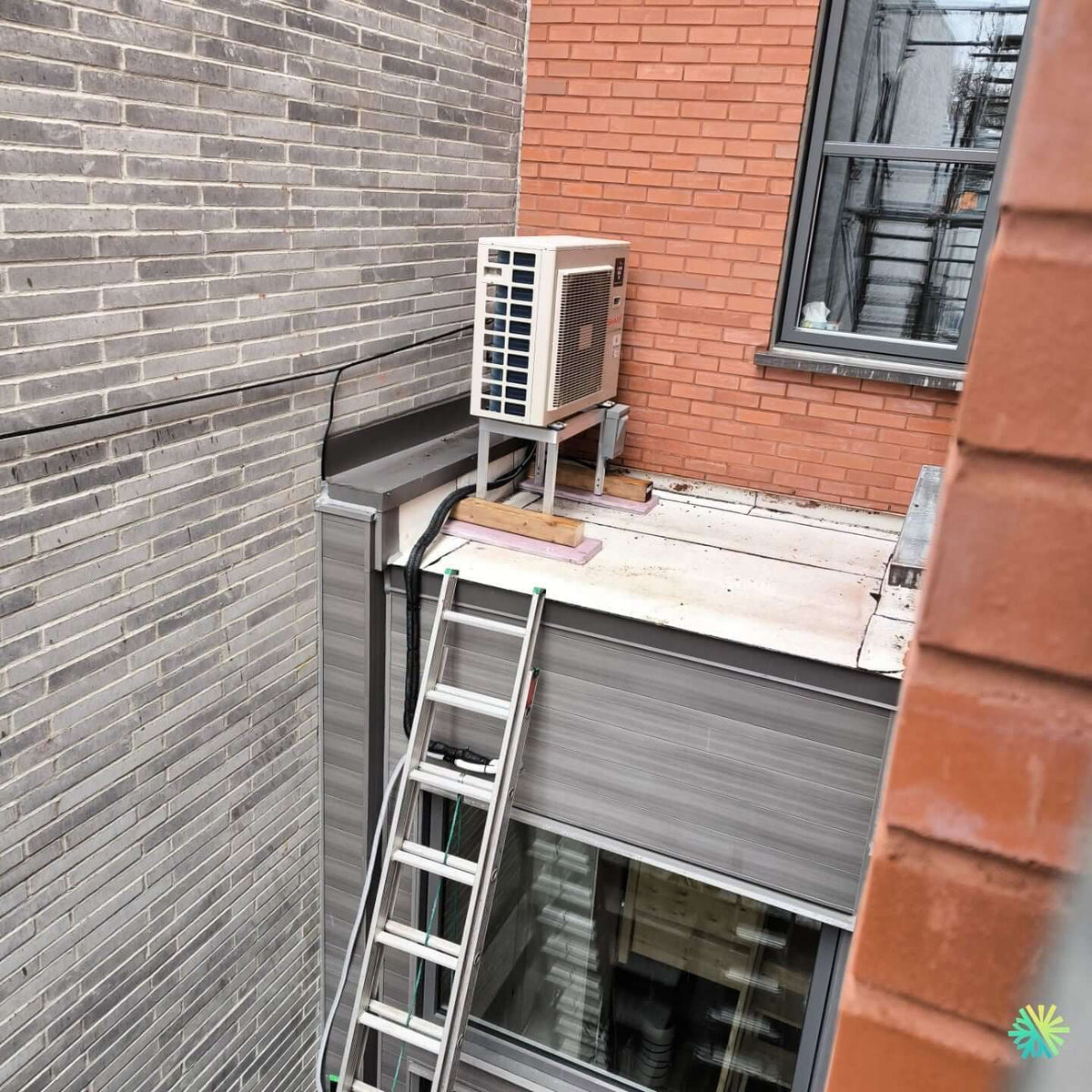
In this project, our team installed a Gree outdoor condenser on a flat roof , accessible only by ladder. This configuration, typical of Montreal buildings, requires careful logistics and particular attention to safety.
The characteristics of the installed heat pump
The machine chosen by our client is a Gree Flexx R32 central heat pump , designed to operate efficiently in the Quebec climate. With a capacity ranging from 2 to 5 tons depending on needs, this type of system allows for heating and cooling an entire residence through a centralized duct network.
Key Benefits:
-
Compatibility with Montreal climate : stable performance down to −25°C.
-
R-32 refrigerant : more environmentally friendly and efficient than R-410A.
-
Energy saving : significant reduction in electricity consumption compared to traditional systems.
-
Grant eligibility : programs such as LogisVert and Maisons Plus Vertes provide financial support for this type of installation.
Technical details of the installation
Our intervention consisted of:
-
Install the condenser on a raised base to ensure good air circulation and protect the unit from stagnant water.
-
Route the refrigerant and electrical pipes along the brick wall through a discreet and secure route.
-
Fix the lines with a gray capping that blends harmoniously with the facade.
-
Provide gravity drainage of condensates, made possible by the natural slope of the flat roof.
-
Reinforce the platform with treated wooden plates and insulation to protect the roof covering and absorb vibrations from the device.
Challenges encountered and solutions provided
Restricted access
As the installation site is only accessible by a ladder leaning against the rear facade , we have taken additional safety measures: harness, ladder stabilization, and teamwork for handling the condenser.
Aesthetic integration
Visible ducts on the facade are often a concern for homeowners. Here, the capping was chosen in a shade that matches the gray masonry, ensuring a result that is both functional and discreet.
Results obtained
Once commissioned, the Gree central heat pump immediately provided consistent comfort throughout the residence. The client now benefits from:
-
a stable indoor temperature in all seasons,
-
reduced electricity bills ,
-
of a future-ready system with an environmentally friendly refrigerant that meets new environmental standards.
Why choose AirGreen in Montreal, Laval, Longueuil, North Shore and South Shore?
Our expertise lies in our ability to adapt each HVAC installation to the architectural realities of Greater Montreal: urban plexes, modern condos, suburban homes, or commercial buildings. Each project represents a unique challenge that we tackle with the same rigor and attention to detail.
At AirGreen, we don't just install machines: we design sustainable comfort solutions, designed for Quebec's harsh winters and humid summers.
The big day, step by step
The main steps of this kind of job at AirGreen. Every house has its quirks: the estimate brings them out.
We look at the ducts, the current indoor module, the electrical panel and the planned spot for the outdoor unit.
The equipment combination, capacity and price, in writing. We check whether the combination qualifies for assistance programs.
Access protected, old unit disconnected and removed when it is being replaced.
Electric furnace or air handler, with its coil, connected to the supply and return ducts.
On a level base, raised above the snow, with free space all around.
Insulated, they enter through a sealed opening and run to the indoor coil.
Dedicated circuits, accessible disconnect, a thermostat that works with the heat pump and the backup heat.
Leak test, vacuum, start-up, airflow check and a test of both modes.
Filter, thermostat, backup heat in extreme cold: what to know before winter.
- The on-site estimateWe look at the ducts, the current indoor module, the electrical panel and the planned spot for the outdoor unit.
- The quoteThe equipment combination, capacity and price, in writing. We check whether the combination qualifies for assistance programs.
- Getting readyAccess protected, old unit disconnected and removed when it is being replaced.
- The indoor moduleElectric furnace or air handler, with its coil, connected to the supply and return ducts.
- The outdoor unitOn a level base, raised above the snow, with free space all around.
- The refrigerant linesInsulated, they enter through a sealed opening and run to the indoor coil.
- Electrical and thermostatDedicated circuits, accessible disconnect, a thermostat that works with the heat pump and the backup heat.
- Tests and start-upLeak test, vacuum, start-up, airflow check and a test of both modes.
- The walkthroughFilter, thermostat, backup heat in extreme cold: what to know before winter.
What would it look like at your place?
Two quick checks with real numbers: what heat costs, and what your current heaters add up to in BTU/h.
Conversion: 1 W = 3.412 BTU/h. An indication, not a load calculation: baseboards and furnaces are often stronger than the real need, and they can stay as backup. AirGreen confirms the capacity on site.
Four mistakes we do not make
Flip each card to see what we do instead.
Your own project, step by step
What to do, season by season
Three habits per season for this unit. They take a few minutes and prevent many calls.
- Check the indoor module's filter.
- Clear winter debris from the outdoor unit.
- Test cooling before the heat arrives.
- Check the filter more often in peak season.
- Keep registers and returns clear.
- Watch condensate drainage near the coil.
- Change or clean the filter.
- Test heating and backup heat before the cold.
- Book periodic maintenance.
- Clear snow around the outdoor unit.
- Store nothing in front of the indoor module.
- Note any unusual noise or smell and call us.
Is your home ready?
Check what applies at your place. A "no" is not a refusal: it is what we sort out during the estimate.
Four statements: true or false?
It all comes down to details you have just seen.
1. A central heat pump uses the house's ducts.
It connects to the existing ducts to heat and cool everywhere.
2. In extreme cold, electric backup heat can take over.
The indoor module (furnace or air handler) works with the heat pump and takes over in extreme cold.
3. The filter only gets changed when the unit breaks down.
A dirty filter cuts airflow. It gets checked regularly.
4. You can reuse the old unit's size without checking.
The house may have changed: insulation, windows, added rooms. Capacity is confirmed on site.
0 / 4 right answers
What people ask us about this kind of work
Can I keep my current ducts?
What happens in extreme cold?
Furnace, air handler, ducted: what is the difference?
Are there grants?
Do I need a permit?
How much can I save?
How is the LogisVert assistance calculated?
Will my current thermostat work?
Central or wall units: which one?
Does AirGreen hold the required licences?
Is the estimate free?
No question matches. Write to us: we answer.
More jobs to see, near you
By town, by equipment or by region: browse more than 4,700 published projects.
Each dot: a town where AirGreen has published projects. The glowing dot: this job.
Every house has its constraints. We see them before we install.
The on-site estimate is free and the quote follows within 24 hours.
Text and photo: a real AirGreen Climatisation & Chauffage job. The diagrams are generic illustrations of the type of installation, not a survey of this job site. Sources of the added figures: airgreen.ca product pages (NEEP / AHRI performance), Hydro-Québec (Heat pumps page, LogisVert, read on 13 October 2026), Régie de l’énergie (rate D as of 1 April 2026).