
Installation of a Hitachi airCore 700 central heat pump in Dorval, in Montreal’s West Island
See how we integrated a Hitachi airCore 700 central heat pump in Dorval, with a wired wall controller, air handler, and precise settings for a multilevel home.
Take a tour of the installation
Each number is a point we check on site. Switch between summer and winter to watch air and heat move.
In summer, the outdoor unit rejects the house's heat outside.
Generic illustration of this type of installation, not a survey of this job site. Tap a number.
It captures or rejects heat outside. It sits on a level base, above the snow, with free space all around.
The insulated refrigerant lines enter the house through a sealed opening and run to the indoor coil.
A shut-off switch near the outdoor unit isolates it safely for service.
Sitting on the indoor module, it moves heat between the house air and the refrigerant.
Electric furnace or air handler: its fan pushes air through the ducts. The electric backup takes over in extreme cold.
Supply ducts bring air to the rooms; returns bring it back to the unit. Their condition matters as much as the unit's.
It protects the coil and the fan. A dirty filter cuts airflow, so it gets checked regularly.
It runs the heat pump and the backup heat. It must be compatible with the installed system.
A central installation where comfort can be adjusted precisely, right down to the stairwell
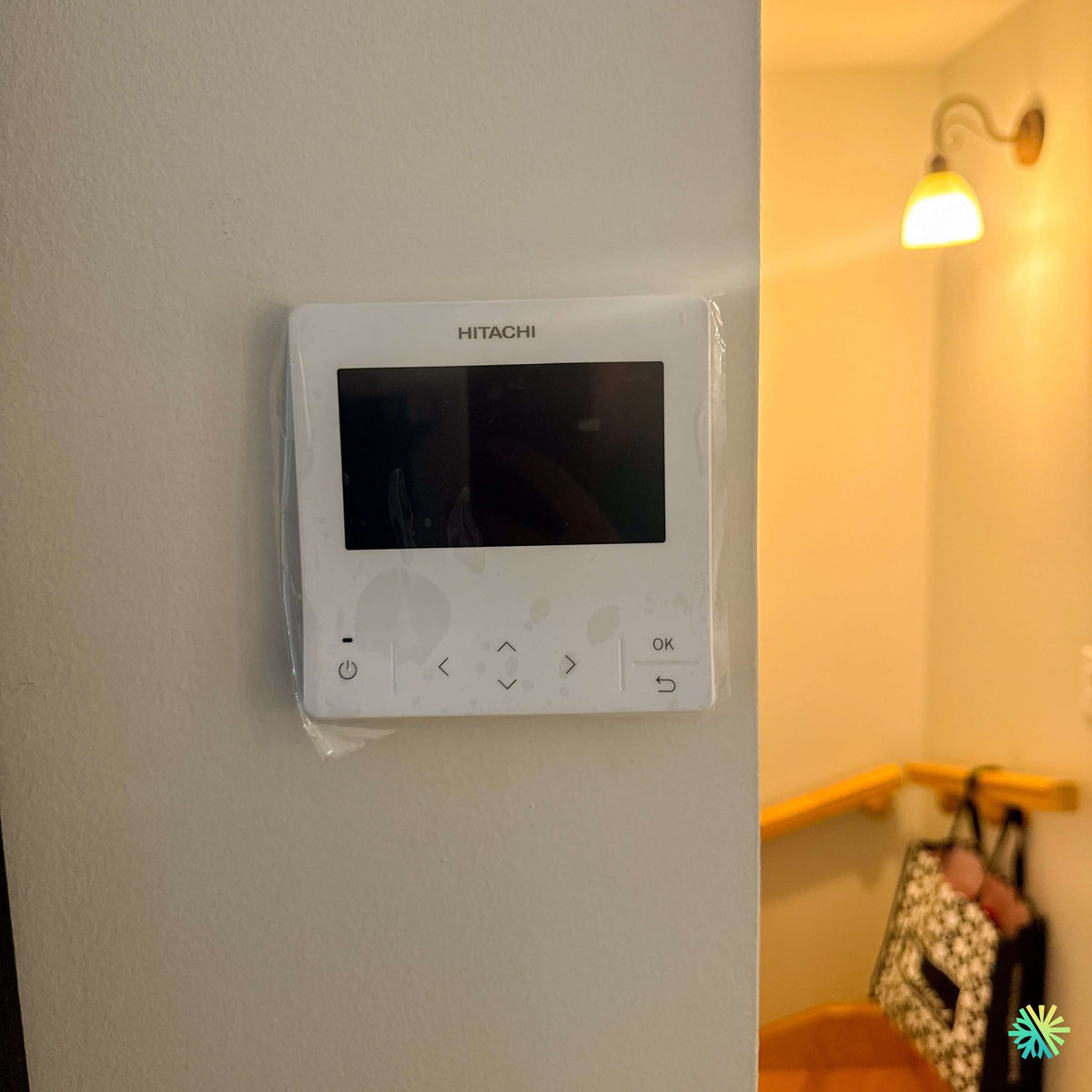
In the photo of this installation in Dorval, the most visible element is the Hitachi wall controller, neatly installed on a clear wall near the staircase. Behind this discreet interface is a complete HVAC system: a Hitachi airCore 700 central heat pump, an indoor air handler, a duct network, refrigerant connections, a power supply and a configuration adapted to a multilevel home.
In a multilevel home, comfort quality depends on more than just the heat pump's nominal capacity. The natural movement of warm air toward the upper floor, temperature variations near a staircase, ductwork resistance and the controller's location can all affect how heating and cooling are perceived.
Our job, therefore, is to make the entire system operate as one cohesive unit. Choosing the equipment is important, but so are its sizing, integration with the ductwork and commissioning.
Why a central airCore 700 heat pump was the right fit for this Dorval project
The Hitachi airCore 700 line is designed for residential and light commercial applications. It can be paired with various types of indoor units, including ducted units, cassettes, wall-mounted units and central air handlers.
For a central residential installation like this one, the air handler distributes heating and cooling to several rooms through a duct network. This solution is particularly suitable for homeowners who want to:
- maintain a clean interior appearance;
- heat and cool several rooms simultaneously;
- use the existing ductwork when its condition and sizing allow;
- replace or supplement an older central system;
- reduce the use of electric resistance, oil or gas heating;
- achieve better temperature control on the different floors.
The airCore 700 line covers several capacities. According to the manufacturer's documentation, Hitachi air handlers are available in nominal capacities of 18,000, 24,000, 30,000, 36,000 and 48,000 BTU/h. The exact choice should be based on a heat-load analysis and not simply on the size of the home.
A residence in Dorval exposed to winds from the lake, with large windows or older insulation, may require a different capacity than a similarly sized home that has recently received building-envelope upgrades.
A central technology designed for Quebec's climate
The airCore 700 family uses the refrigerant R32, whose stated global warming potential is 675. This refrigerant allows manufacturers to improve system efficiency while reducing their climate impact compared with certain older refrigerants.
Because R32 is classified as A2L, its handling requires appropriate work methods, tools, and procedures. The Hitachi air handler notably includes a factory-installed refrigerant detection sensor, an important feature for system compliance and safety.
Hitachi documentation also indicates that the air handler uses a five-speed ECM blower motor. This motor facilitates airflow adjustment and can reduce blower consumption by approximately 10%, while providing better compatibility with different duct configurations.
The indoor unit cabinet is approximately 20.5 inches wide, making it easier to install in certain narrow mechanical rooms, finished basements, or spaces where access to the system is limited. The design also includes relatively smooth side surfaces, simplifying integration and maintenance.
For central combinations with an air handler, the brochure lists ratings of up to approximately 18 SEER2, with EER2 varying according to the capacity and exact combination. The official ratings applicable to an installation must always be verified using the complete model numbers and the corresponding AHRI certificate.
Standard or HeatForce: a distinction to verify before preparing a quote
The airCore 700 lineup includes standard outdoor units as well as HeatForce configurations designed to provide greater low-temperature heating capacity.
According to the manufacturer's data, certain HeatForce combinations can maintain:
- approximately 100% of their heating capacity at -15 °C;
- more than 70% of their capacity at -25 °C;
- heating operation down to approximately -25 °C, depending on the model and conditions.
These values are particularly relevant in Dorval, where winter temperatures, wind, and defrost cycles can place significant demands on a heat pump.
It remains essential not to automatically attribute HeatForce performance to all airCore 700 units. The photo of the wall-mounted control alone cannot confirm the installed capacity, the outdoor unit model number, or the exact certification of the combination. This information must be verified on the nameplates and in the selection documents.
The Hitachi airPoint Room 700 control visible in the photo
The control installed in this home is a Hitachi wall-mounted control from the airPoint Room 700 family, corresponding to the CIW03-H wired controller shown in the airCore 700 documentation.
Its installation is particularly neat:
- no wires are visible;
- the casing is installed straight and at an easily accessible height;
- the screen is positioned on a clear surface;
- the navigation buttons remain easy to use;
- the protective film was still in place when the photo was taken, indicating that the installation had recently been completed.
The control allows the occupant to manage the system's essential settings without having to access the indoor unit. It becomes the daily point of contact with the entire HVAC system.
Why its location matters
In a multistory home, a stairwell can become a natural corridor for warm air. If the temperature sensor is placed in an area affected by a draft, supply vent, sunlight, or a heat source, the system may receive a reading that does not accurately represent the main rooms.
The controller must therefore be installed in an area that is:
- representative of the home's average temperature;
- away from the direct airflow of a register;
- not exposed to sunlight;
- a reasonable distance from light fixtures and other heat sources;
- accessible for adjustments and maintenance;
- compatible with the control wiring route.
Being near a staircase is not necessarily a problem, but it underscores the importance of properly balancing the ductwork. During commissioning, we must verify that the lower level does not become excessively cool while the upper level remains too warm, or that the thermostat does not shut off the system before the more distant rooms reach the requested temperature.
The technical steps behind this central installation
Heating and cooling load assessment
Before recommending a capacity, we analyze several factors:
- the floor area of each level;
- the number and type of windows;
- insulation in the walls, roof, and basement;
- the home's orientation;
- air infiltration;
- ceiling height;
- wind exposure;
- heat gains from the sun and occupants;
- the capacity of the existing ductwork.
Choosing a heat pump solely based on square footage can result in a system that is too large or too small.
An oversized system may short-cycle, control humidity less effectively, and cause temperature fluctuations. An undersized system may run continuously without reaching the setpoint on the coldest days or during periods of intense heat.
Duct system inspection
A high-performance heat pump cannot compensate for a highly restrictive duct system.
We specifically check:
- size of the supply and return ducts;
- number of registers;
- condition of the seals;
- air leakage;
- system cleanliness;
- filter size;
- static pressure;
- access to the unit for filter replacement;
- distribution between the ground floor and the upper floor.
The Hitachi unit’s five-speed ECM motor offers some flexibility, but the fan speed should not be increased simply to mask an undersized duct. Excessive airflow can increase noise, reduce comfort, and decrease heat transfer.
Installation of refrigeration components
Refrigerant piping must be sized according to Hitachi requirements. The routing must limit unnecessary bends, protect the pipes from damage, and comply with the permitted lengths.
Depending on the configuration, the airCore 700 range can accommodate considerable refrigerant piping runs, but this technical capability does not mean that a very long run is always preferable. A more direct route generally facilitates:
- evacuation;
- charge control;
- future maintenance;
- the reduction of potential losses;
- the installation’s exterior appearance.
The connections undergo a leak-tightness test, then the circuit is evacuated with a vacuum pump and checked with appropriate instruments before startup.
Condensate drainage
In cooling mode, the indoor unit removes moisture from the air. This water must be discharged through a properly sloped drain or, when gravity is insufficient, by a condensate pump.
An improperly designed drain can cause:
- leaks;
- odors;
- water accumulation in the drain pan;
- damage to the ceiling or floor;
- system shutdown by a safety device;
- biological growth in a damp section.
We check the drainage before considering the installation complete.
Controller connection and programming
The airPoint Room 700 controller is connected to the system by cable. The configuration must correspond to the type of indoor unit, the accessories present, and the desired control mode.
The range can also accommodate various communication accessories. Hitachi notably offers an adapter compatible with five-wire thermostat signals, Wi-Fi, BACnet, or Modbus. Control via the airCloud Go app nevertheless requires a compatible Wi-Fi adapter, specifically the GA-WFG-N according to the documentation.
Therefore, you should not assume that Wi-Fi is included simply because the controller has a digital screen. When preparing a quote, connected features must be listed separately when the required adapter is not included as standard.
Commissioning: the step that determines actual performance
A central installation is not complete when the units are mounted and powered.
Our commissioning includes, among other things, checking:
- electrical voltage;
- conductor sizing and protection devices;
- communications between the outdoor unit, indoor unit, and controller;
- airflow;
- static pressure;
- return and supply air temperatures;
- condensate drainage;
- heating operation;
- cooling operation;
- the defrost sequence;
- auxiliary heating, when present;
- error codes and recorded settings.
In a multilevel home like this one, we also pay attention to air distribution between floors. Adjusting dampers, fan speed, or settings may be necessary to achieve a balanced result.
What a central heat pump changes for occupants
Once properly sized and adjusted, a Hitachi airCore 700 central heat pump can provide more even heating than several independent units distributed throughout the home.
The occupant benefits from centralized control and air distribution to the rooms served by the ducts. The system can also provide cooling and dehumidification during the summer, a valuable advantage in Montreal’s West Island, where hot and humid periods can make upper floors particularly uncomfortable.
The modulating operation of inverter compressor technology allows the unit to adjust its output to demand. Instead of operating only at full capacity and then shutting off, it can maintain a reduced operating level for longer. This promotes a more stable temperature and limits abrupt starts.
Eligibility for rebates for a Hitachi airCore 700
Certain airCore 700 combinations have ENERGY STAR or ENERGY STAR Cold Climate certifications. This may contribute to eligibility for certain financial assistance programs, but the brand and product line name alone are not enough to confirm a grant.
Eligibility must be verified based on:
- the exact outdoor unit model number;
- the exact indoor unit model number;
- the combination’s capacity;
- the AHRI number;
- the official list of applicable programs;
- the purchase and installation date;
- the type of building;
- whether the heating system is replaced or retained.
A 24,000 BTU/h airCore 700 unit may have a different certification from a 36,000 or 48,000 BTU/h combination. A standard configuration may also differ from a HeatForce configuration.
At AirGreen, we therefore avoid promising a price before confirming the complete combination. This verification protects the homeowner from an unpleasant surprise after installation.
The most common mistakes to avoid with a central heat pump
Choosing capacity based on square footage alone
Two 2,000-square-foot homes can have very different needs. The construction year, insulation, windows, and air leakage must be taken into account.
Neglecting existing ductwork
Ductwork designed for an old furnace is not automatically suited to the airflow required by a modern heat pump.
Installing the controller in an unrepresentative area
A thermostat affected by a staircase, an air vent, or a heat source can result in poor temperature control.
Assuming that all accessories are included
Wi-Fi, certain thermostat interfaces, and some communication modules may require additional adapters.
Comparing only the range’s maximum SEER2
A maximum value advertised for a cassette or wall-mounted unit does not necessarily correspond to the performance of a central combination with an air handler.
Omitting the AHRI verification
The AHRI number confirms the performance of the specific combination. It is essential for comparing systems and checking financial assistance programs.
Reducing access for maintenance
The indoor unit, filter, drain, and electrical components must remain accessible. A very compact installation that is impossible to service can become costly in the long term.
An HVAC installation suited to Dorval and Greater Montreal
This Hitachi airCore 700 central heat pump installation in Dorval shows that a successful project involves more than simply setting down an outdoor unit and connecting a thermostat.
The result depends on a series of technical decisions: capacity, static pressure, airflow, controller location, R32 refrigerant safety, drainage, programming, and balancing between floors.
The wall control visible in the photo is the simplest part to use, but also the culmination of all this preparation. Its clean, discreet, and accessible installation reflects the intended goal: to give occupants clear control over a complex central system without complicating their daily lives.
We apply this same rigor to our HVAC installations in Montreal, Laval, Longueuil, the North Shore and the South Shore, whether it’s a central heat pump, a ducted system, or a complete heating and air conditioning replacement.
The big day, step by step
The main steps of this kind of job at AirGreen. Every house has its quirks: the estimate brings them out.
We look at the ducts, the current indoor module, the electrical panel and the planned spot for the outdoor unit.
The equipment combination, capacity and price, in writing. We check whether the combination qualifies for assistance programs.
Access protected, old unit disconnected and removed when it is being replaced.
Electric furnace or air handler, with its coil, connected to the supply and return ducts.
On a level base, raised above the snow, with free space all around.
Insulated, they enter through a sealed opening and run to the indoor coil.
Dedicated circuits, accessible disconnect, a thermostat that works with the heat pump and the backup heat.
Leak test, vacuum, start-up, airflow check and a test of both modes.
Filter, thermostat, backup heat in extreme cold: what to know before winter.
- The on-site estimateWe look at the ducts, the current indoor module, the electrical panel and the planned spot for the outdoor unit.
- The quoteThe equipment combination, capacity and price, in writing. We check whether the combination qualifies for assistance programs.
- Getting readyAccess protected, old unit disconnected and removed when it is being replaced.
- The indoor moduleElectric furnace or air handler, with its coil, connected to the supply and return ducts.
- The outdoor unitOn a level base, raised above the snow, with free space all around.
- The refrigerant linesInsulated, they enter through a sealed opening and run to the indoor coil.
- Electrical and thermostatDedicated circuits, accessible disconnect, a thermostat that works with the heat pump and the backup heat.
- Tests and start-upLeak test, vacuum, start-up, airflow check and a test of both modes.
- The walkthroughFilter, thermostat, backup heat in extreme cold: what to know before winter.
What would it look like at your place?
Two quick checks with real numbers: what heat costs, and what your current heaters add up to in BTU/h.
Conversion: 1 W = 3.412 BTU/h. An indication, not a load calculation: baseboards and furnaces are often stronger than the real need, and they can stay as backup. AirGreen confirms the capacity on site.
Four mistakes we do not make
Flip each card to see what we do instead.
Your own project, step by step
What to do, season by season
Three habits per season for this unit. They take a few minutes and prevent many calls.
- Check the indoor module's filter.
- Clear winter debris from the outdoor unit.
- Test cooling before the heat arrives.
- Check the filter more often in peak season.
- Keep registers and returns clear.
- Watch condensate drainage near the coil.
- Change or clean the filter.
- Test heating and backup heat before the cold.
- Book periodic maintenance.
- Clear snow around the outdoor unit.
- Store nothing in front of the indoor module.
- Note any unusual noise or smell and call us.
Is your home ready?
Check what applies at your place. A "no" is not a refusal: it is what we sort out during the estimate.
Four statements: true or false?
It all comes down to details you have just seen.
1. A central heat pump uses the house's ducts.
It connects to the existing ducts to heat and cool everywhere.
2. In extreme cold, electric backup heat can take over.
The indoor module (furnace or air handler) works with the heat pump and takes over in extreme cold.
3. The filter only gets changed when the unit breaks down.
A dirty filter cuts airflow. It gets checked regularly.
4. You can reuse the old unit's size without checking.
The house may have changed: insulation, windows, added rooms. Capacity is confirmed on site.
0 / 4 right answers
What people ask us about this kind of work
Can I keep my current ducts?
What happens in extreme cold?
Furnace, air handler, ducted: what is the difference?
Are there grants?
Do I need a permit?
How much can I save?
How is the LogisVert assistance calculated?
Will my current thermostat work?
Central or wall units: which one?
Does AirGreen hold the required licences?
Is the estimate free?
No question matches. Write to us: we answer.
More jobs to see, near you
By town, by equipment or by region: browse more than 4,700 published projects.
Each dot: a town where AirGreen has published projects. The glowing dot: this job.
Every house has its constraints. We see them before we install.
The on-site estimate is free and the quote follows within 24 hours.
Text and photo: a real AirGreen Climatisation & Chauffage job. The diagrams are generic illustrations of the type of installation, not a survey of this job site. Sources of the added figures: airgreen.ca product pages (NEEP / AHRI performance), Hydro-Québec (Heat pumps page, LogisVert, read on 13 October 2026), Régie de l’énergie (rate D as of 1 April 2026).