
Installation of a Hitachi airCore 700 36,000 BTU central heat pump in LaSalle, Montreal
In LaSalle, we integrated a Hitachi airCore 700 36,000 BTU central heat pump into a narrow mechanical room, with precise connections to the existing ductwork and simplified access for maintenance.
- City
- Region
- Equipment
- Brand
- Challenges
- Published
The job on one screen
The article, chapter by chapter
A central upgrade designed for an exceptionally narrow mechanical room
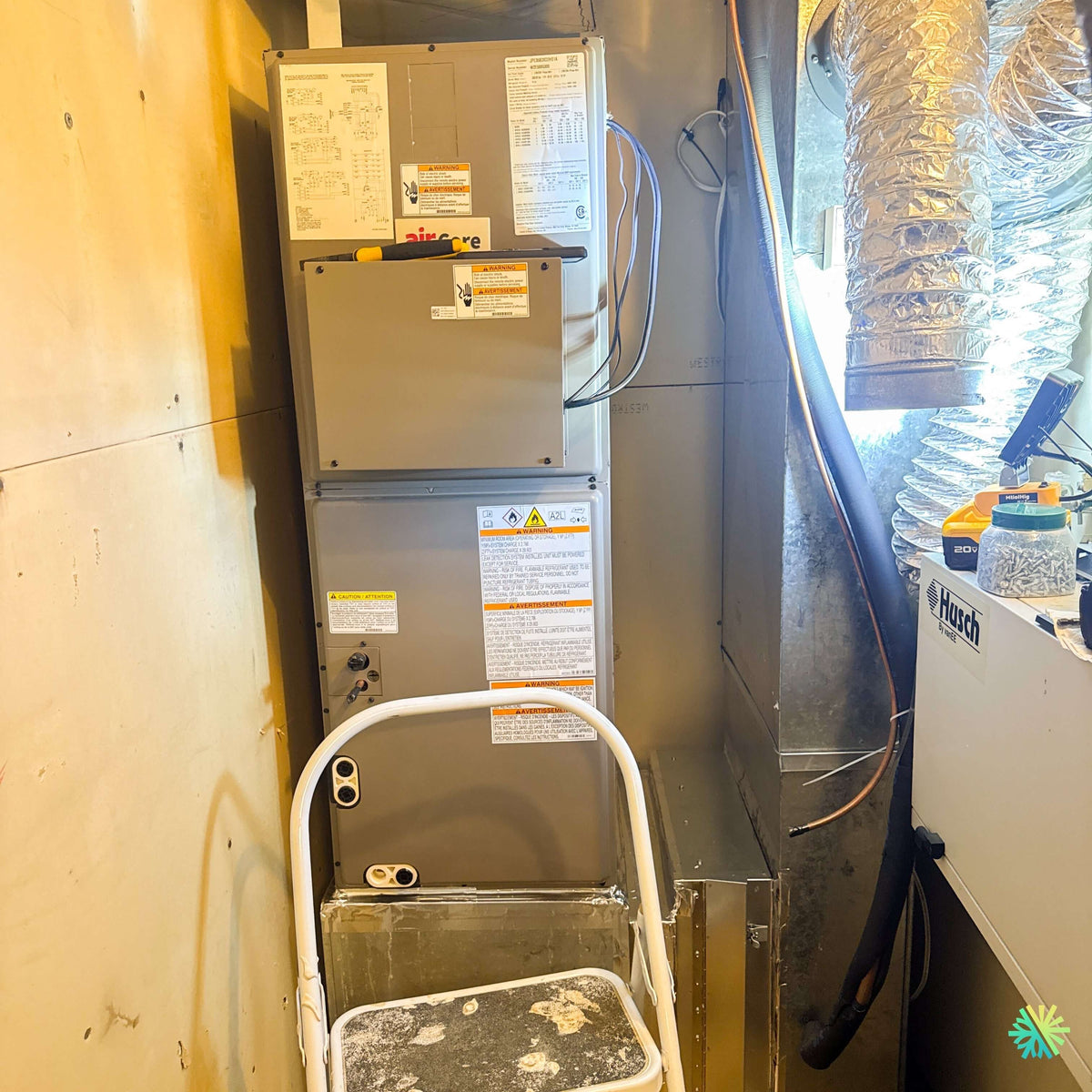
This central heat pump installation in LaSalle perfectly illustrates the difference between simply replacing equipment and truly integrating an HVAC system tailored to the building. The new equipment had to be installed in a very compact mechanical room surrounded by existing ducts, electrical connections, refrigerant lines, and plumbing components, leaving little room to maneuver.
We installed a Hitachi airCore 700 central heat pump, paired with a 36,000 BTU air handling unit, with a nominal capacity of three tons. The model number visible on the equipment nameplate is JPE36B3XD2HS1A.
In the project photo, the indoor unit is installed vertically in an upflow configuration. It rests on the lower connection leading to the existing ventilation network, while the upper air outlet connects to the home's galvanized ducts. This arrangement distributes heating and cooling to the various rooms through the existing ductwork.
Why this installation required precise planning
The mechanical room presented several visible constraints:
- limited side clearance between the equipment and the wall;
- a rigid duct network immediately adjacent to the unit;
- several flexible ducts in the upper part of the room;
- refrigerant lines that had to be routed without obstructing service access;
- a control cabinet and electrical connections that had to be positioned safely;
- front clearance that needed to remain accessible for future maintenance.
In such an environment, a few inches can make a significant difference. A poorly positioned unit can complicate blower motor replacement, access to electrical components, drain cleaning, or coil inspection.
So we worked around the available space rather than imposing a standard configuration. The unit was aligned with the lower plenum, then connected to the upper ductwork to limit unnecessary transitions and pressure losses.
An air handling unit designed for tight installations
One of the practical advantages of the Hitachi airCore 700 indoor unit is its relatively narrow cabinet. According to the manufacturer's documentation, the air handler is designed with a cabinet approximately 20.5 inches wide, smooth side panels, and a rigid construction that facilitates installation in attics, mechanical closets, and confined spaces.
The range includes air handlers from 18,000 to 48,000 BTU. The model installed in LaSalle belongs to the 36,000 BTU class. It is equipped with a five-speed ECM blower motor designed to provide stable airflow while reducing the fan's electricity consumption. The documentation also indicates that an R32 refrigerant detector is factory-installed in the unit.
These features are particularly relevant in a home where the central system must operate for long periods, both during Montreal heat waves and during the cold periods of January and February.
A central system using R32 refrigerant
The Hitachi airCore 700 platform uses R32 refrigerant, classified as A2L. This refrigerant has a lower global warming potential than several refrigerants used in previous generations of heat pumps.
However, using an A2L refrigerant requires an installation that complies with the manufacturer's requirements and applicable standards. This includes, in particular:
- compliance with refrigeration connection methods;
- a rigorous leak test;
- proper evacuation of the circuit;
- compliance with the minimum volume requirements for the spaces served;
- verification of the integrated refrigerant detector;
- compliance of the electrical connections and protective devices.
The A2L labels visible on the front of the unit remind technicians that installation and service procedures must be adapted to this type of refrigerant.
Clean integration with the existing duct network
When replacing or modernizing a central system, the nominal capacity of the new heat pump is only part of the work. The duct network must be able to carry the required airflow without producing excessive noise, excessively high static pressure, or an imbalance between floors.
For this installation in LaSalle, we paid particular attention to the connections between the indoor unit and the existing ducts. The lower plenum was adjusted to the base of the unit, while the upper section was integrated into the main duct.
An improper transition can cause:
- turbulence immediately at the fan outlet;
- a loss of airflow in the farthest ducts;
- whistling at the grilles;
- increased ECM motor consumption;
- a significant temperature difference between the ground floor and the upper floor;
- a reduction in actual heating and cooling capacity.
Our approach is to consider the equipment, return air, distribution ducts, and dampers as a single system. A three-ton central heat pump can deliver its expected performance only if the system allows it to move air properly.
The control cabinet positioned for easier servicing
A gray electrical cabinet is installed on the upper front of the unit. Its position allows the control components to be grouped together while maintaining front access.
This layout is important in such a narrow room. Placing the electrical cabinet on one side would have further reduced the clearance from the wall or ductwork. On the front, the technician can perform an inspection, take electrical readings, and access the connections without having to dismantle nearby components.
We always ensure that installations remain serviceable. A compact appearance on the day of installation should not result in several hours of dismantling during a future service call.
Refrigerant line and insulation management
To the right of the unit, the refrigerant lines run upward along the ductwork. The suction line is protected by black insulation to limit heat gain and condensation.
The line routing must meet several objectives:
- avoid excessively tight bends;
- protect the copper from vibrations;
- prevent rubbing against metal edges;
- maintain sufficient access to the service panels;
- ensure proper slope and support;
- reduce the risk of condensation in the room.
In central installations in Montreal, Laval, Longueuil, the North Shore, and the South Shore, we regularly encounter mechanical rooms where the lines must share space already occupied by ductwork, plumbing, and wiring. The quality of the routing directly affects long-term reliability.
A capacity suited to the building, not just its floor area
The installed indoor unit has a nominal capacity of 36,000 BTU, equivalent to approximately three tons. However, this value should never be selected solely based on a rough rule using floor area.
Sizing a central heat pump must take several factors into account:
- the heated and cooled floor area;
- the number of floors;
- the level of insulation;
- the number and orientation of windows;
- the building’s airtightness;
- the capacity of the ductwork;
- calculated heat losses;
- the presence of auxiliary heating;
- dehumidification needs;
- the region’s design temperature.
An oversized unit may run excessively short cycles in cooling mode, control humidity less effectively, and cause temperature fluctuations. An undersized unit may rely too often on auxiliary heating during cold periods.
At AirGreen, we seek a balance between heating capacity, summer performance, available airflow, and the building’s actual characteristics.
What the Hitachi airCore 700 brings to the comfort of a LaSalle home
The Hitachi airCore 700 heat pump is designed for both homes and certain light commercial spaces. In a home equipped with central ductwork, it can replace several independent units with an integrated solution that distributes air throughout the building.
Cold-weather heating with the HeatForce series
The airCore 700 HeatForce series uses a DC inverter compressor and an optimized heat exchanger design to maintain substantial heating capacity as the outdoor temperature drops.
According to the manufacturer’s data, the HeatForce platform can maintain:
- up to 100% of its heating capacity at -15 °C;
- more than 70% of its heating capacity at -25 °C;
- a heating operating range that can reach as low as -25 °C.
The installation’s exact performance always depends on the match between the outdoor unit, indoor unit, line length, and operating conditions. The AHRI number for the complete combination must be verified before confirming seasonal performance or eligibility for financial assistance.
More consistent comfort between rooms
A properly integrated central heat pump can improve temperature consistency in rooms already served by the ventilation system.
The ECM motor makes it possible to adjust the airflow according to the selected configuration. Better-controlled circulation helps:
- reduce areas that are too hot or too cold;
- improve air mixing between floors;
- maintain a more stable temperature;
- reduce abrupt fan starts;
- limit noise at the grilles;
- support better air filtration.
In two-story homes, temperature differences do not always originate with the heat pump itself. They may be caused by insufficient return airflow on the upper floor, overly restrictive ducts, improperly balanced dampers, or uneven insulation.
Our commissioning therefore includes checks that go beyond simply starting the equipment.
Essential checks during commissioning
A central system must be tested under real-world conditions. We check, among other things:
- the operation of the heat pump in heating and cooling modes;
- the electrical voltages and currents;
- communication between the components;
- the operation of the blower motor;
- the return-air and supply-air temperatures;
- condensate drainage;
- the system's static pressure when necessary;
- the cleanliness of the connections;
- the absence of abnormal vibration;
- the accessibility of the panels;
- the operation of the auxiliary heating, when installed.
These steps make it possible to immediately detect inadequate airflow, an incorrect connection, or a drainage problem before the system is used daily.
Maintenance required after installation
Even a recent system requires regular maintenance. To preserve the performance of the Hitachi airCore 700, we recommend monitoring the following elements.
Air filter
The filter should be inspected regularly. A clogged filter reduces airflow, increases static pressure, and forces the motor to work harder.
The replacement frequency depends on the presence of pets, work being done in the house, the type of filter, and the system's operating time.
Condensate drain
In cooling mode, the indoor unit removes moisture from the air. The drain must remain clear to prevent an overflow in the mechanical room.
Outdoor unit
The area around the outdoor unit must remain free of leaves, compacted snow, and vegetation. In winter, defrost water must be able to drain away without forming an accumulation of ice beneath the unit.
Professional inspection
A periodic inspection helps check the electrical components, coil, blower, operating temperatures, and overall condition of the system.
Mistakes to avoid when replacing a central system
This LaSalle installation highlights several common mistakes to avoid.
Choose the capacity based solely on the old appliance
An old three-ton system does not automatically mean that the new one should have the same capacity. Insulation work, window replacement, or modifications to the ductwork can change the requirements.
Neglecting the return-air system
A high-performance unit cannot deliver its rated airflow if the return-air opening is too small or restrictive.
Blocking access to the panels
Ducts, pipes, cables, and accessories must not prevent the service panels from opening.
Ignoring static pressure
Excessive pressure can reduce actual airflow and accelerate blower wear.
Assuming that a model is automatically eligible for a rebate
Eligibility generally depends on the complete combination of the indoor and outdoor models, the AHRI certificate, the type of building, and the program rules in effect when the application is submitted. The Hitachi airCore 700 product name alone is not sufficient.
An HVAC installation adapted to Montreal homes
LaSalle homes often have mechanical configurations in which every available space is already being used. Basements may contain ductwork installed near foundation walls, low ceilings, limited return-air pathways, and several utilities grouped in the same room.
Our job is to integrate the new heat pump without compromising:
- air circulation;
- access for maintenance;
- electrical safety;
- condensate drainage;
- the quality of the refrigerant connections;
- the existing ventilation system structure.
The same level of rigor applies to our HVAC installations in Montreal, Laval, Longueuil, on the North Shore, and on the South Shore. Each building requires a precise assessment of the space, ductwork, heating and cooling load, and occupants’ comfort habits.
The result of the LaSalle installation
The result is a compact vertical indoor unit, firmly integrated into the existing ductwork, with controls accessible from the front and refrigerant lines routed along the right side of the system.
The 36,000 BTU Hitachi airCore 700 central heat pump can now provide heating and cooling through the home’s ductwork. The installation preserves access to the main panels while making efficient use of the mechanical room’s limited space.
This project demonstrates that a successful central installation depends as much on equipment selection as on the quality of its integration. Sizing, airflow, duct transitions, control placement, and commissioning must be treated as parts of the same whole.
The job tools
Two quick checks with real numbers: what heat costs, and what your current heaters add up to in BTU/h.
Conversion: 1 W = 3.412 BTU/h. An indication, not a load calculation: baseboards and furnaces are often stronger than the real need, and they can stay as backup. AirGreen confirms the capacity on site.
How the job unfolds
The main steps of this kind of job at AirGreen. Every house has its quirks: the estimate brings them out.
We look at the ducts, the current indoor module, the electrical panel and the planned spot for the outdoor unit.
The equipment combination, capacity and price, in writing. We check whether the combination qualifies for assistance programs.
Access protected, old unit disconnected and removed when it is being replaced.
Electric furnace or air handler, with its coil, connected to the supply and return ducts.
On a level base, raised above the snow, with free space all around.
Insulated, they enter through a sealed opening and run to the indoor coil.
Dedicated circuits, accessible disconnect, a thermostat that works with the heat pump and the backup heat.
Leak test, vacuum, start-up, airflow check and a test of both modes.
Filter, thermostat, backup heat in extreme cold: what to know before winter.
- The on-site estimateWe look at the ducts, the current indoor module, the electrical panel and the planned spot for the outdoor unit.
- The quoteThe equipment combination, capacity and price, in writing. We check whether the combination qualifies for assistance programs.
- Getting readyAccess protected, old unit disconnected and removed when it is being replaced.
- The indoor moduleElectric furnace or air handler, with its coil, connected to the supply and return ducts.
- The outdoor unitOn a level base, raised above the snow, with free space all around.
- The refrigerant linesInsulated, they enter through a sealed opening and run to the indoor coil.
- Electrical and thermostatDedicated circuits, accessible disconnect, a thermostat that works with the heat pump and the backup heat.
- Tests and start-upLeak test, vacuum, start-up, airflow check and a test of both modes.
- The walkthroughFilter, thermostat, backup heat in extreme cold: what to know before winter.
What we check on a job like this one
Each number is a point we check on site. Switch between summer and winter to watch air and heat move.
In summer, the outdoor unit rejects the house's heat outside.
Generic illustration of this type of installation, not a survey of this job site. Tap a number.
It captures or rejects heat outside. It sits on a level base, above the snow, with free space all around.
The insulated refrigerant lines enter the house through a sealed opening and run to the indoor coil.
A shut-off switch near the outdoor unit isolates it safely for service.
Sitting on the indoor module, it moves heat between the house air and the refrigerant.
Electric furnace or air handler: its fan pushes air through the ducts. The electric backup takes over in extreme cold.
Supply ducts bring air to the rooms; returns bring it back to the unit. Their condition matters as much as the unit's.
It protects the coil and the fan. A dirty filter cuts airflow, so it gets checked regularly.
It runs the heat pump and the backup heat. It must be compatible with the installed system.
Is your home ready?
Check what applies at your place. A "no" is not a refusal: it is what we sort out during the estimate.
Good habits, once the unit is in place
Six simple habits that keep the unit going. Your list stays on this device.
What to do, season by season
Three habits per season for this unit. They take a few minutes and prevent many calls.
- Check the indoor module's filter.
- Clear winter debris from the outdoor unit.
- Test cooling before the heat arrives.
- Check the filter more often in peak season.
- Keep registers and returns clear.
- Watch condensate drainage near the coil.
- Change or clean the filter.
- Test heating and backup heat before the cold.
- Book periodic maintenance.
- Clear snow around the outdoor unit.
- Store nothing in front of the indoor module.
- Note any unusual noise or smell and call us.
The right pages, at the right time
Four statements: true or false?
It all comes down to details you have just seen.
1. A central heat pump uses the house's ducts.
It connects to the existing ducts to heat and cool everywhere.
2. In extreme cold, electric backup heat can take over.
The indoor module (furnace or air handler) works with the heat pump and takes over in extreme cold.
3. The filter only gets changed when the unit breaks down.
A dirty filter cuts airflow. It gets checked regularly.
4. You can reuse the old unit's size without checking.
The house may have changed: insulation, windows, added rooms. Capacity is confirmed on site.
0 / 4 right answers
What people ask us about this kind of work
Can I keep my current ducts?
What happens in extreme cold?
Furnace, air handler, ducted: what is the difference?
Are there grants?
Do I need a permit?
How much can I save?
How is the LogisVert assistance calculated?
Will my current thermostat work?
Central or wall units: which one?
Does AirGreen hold the required licences?
Is the estimate free?
No question matches. Write to us: we answer.
More jobs to see, near you
By town, by equipment or by region: browse more than 4,700 published projects.
Each dot: a town where AirGreen has published projects. The glowing dot: this job.
An on-site estimate, the right capacity, the right equipment.
The on-site estimate is free and the quote follows within 24 hours.
Text and photo: a real AirGreen Climatisation & Chauffage job. The diagrams are generic illustrations of the type of installation, not a survey of this job site. Sources of the added figures: airgreen.ca product pages (NEEP / AHRI performance), Hydro-Québec (Heat pumps page, LogisVert, read on 13 October 2026), Régie de l’énergie (rate D as of 1 April 2026).