
Installation of a Midea central heat pump in Chomedey (Laval)
AirGreen installed a Midea central heat pump in Chomedey (Laval), an efficient and discreet system perfectly suited to homes in Greater Montreal.
In summer, the outdoor unit rejects the house's heat outside.
Generic illustration of this type of installation, not a survey of this job site. Tap a number.
It captures or rejects heat outside. It sits on a level base, above the snow, with free space all around.
The insulated refrigerant lines enter the house through a sealed opening and run to the indoor coil.
A shut-off switch near the outdoor unit isolates it safely for service.
Sitting on the indoor module, it moves heat between the house air and the refrigerant.
Electric furnace or air handler: its fan pushes air through the ducts. The electric backup takes over in extreme cold.
Supply ducts bring air to the rooms; returns bring it back to the unit. Their condition matters as much as the unit's.
It protects the coil and the fan. A dirty filter cuts airflow, so it gets checked regularly.
It runs the heat pump and the backup heat. It must be compatible with the installed system.
In this single-family home located in Chomedey, Laval , we recently completed the installation of a Midea central heat pump , a system perfectly suited to homes with existing ducted air distribution. This project perfectly illustrates our approach at AirGreen : meticulous, high-performance integration designed for the Quebec climate.
A Midea central heat pump designed for four-season comfort
The installed system is a Midea central heat pump , consistent with the Midea EVOX G3 range (new generation refrigerant), recognized for its reliability, high energy efficiency and ability to maintain stable comfort even during the harsh winters of Greater Montreal.
Unlike wall-mounted systems, a central heat pump heats the entire house via a network of pipes. This allows it to:
-
a uniform temperature in all rooms,
-
discreet heating and air conditioning (no visible wall unit),
-
improved air quality thanks to central filtration.
Installation details observed on the construction site
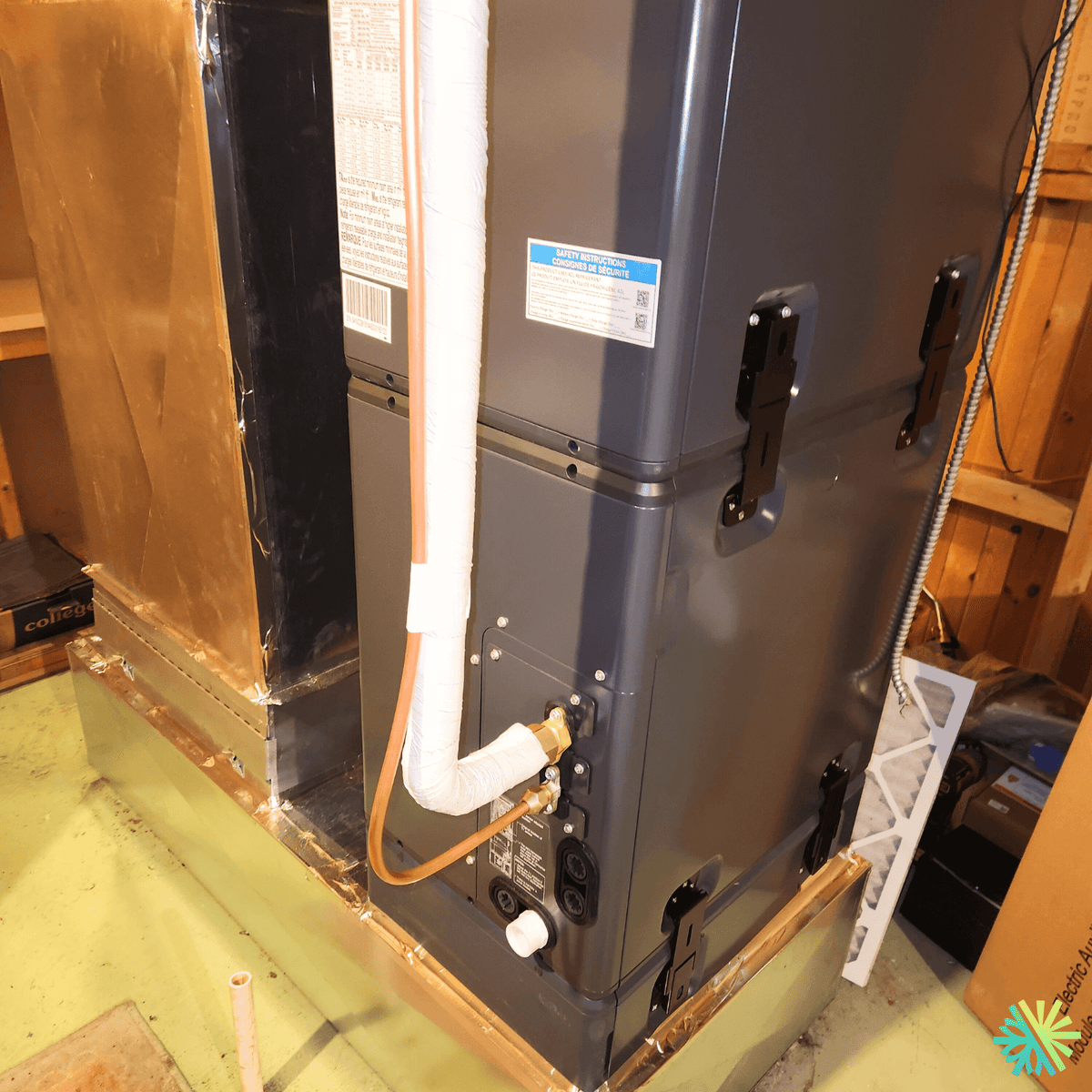
Based on the elements visible in the photo, several key technical points emerge:
-
Central indoor air manager installed on an isolated base, ensuring stability and vibration reduction
-
Direct connection to the existing plenum , with carefully sealed, watertight transitions.
-
Insulated copper refrigeration lines , with continuous insulation to prevent heat loss and condensation
-
Secure condensation drain , essential for reliable long-term operation
-
Basement installation , typical of Laval homes, facilitating access for maintenance and future adjustments
This type of configuration is ideal in residential areas like Chomedey , where many properties already have central ventilation ducts.
Why choose a Midea central heat pump in Laval?
Midea central systems stand out because of:
-
their excellent coefficient of performance (COP) in heating,
-
their compatibility with modern energy standards ,
-
their silent operation ,
-
their adaptation to Quebec winter heating , particularly appreciated during periods of extreme cold.
For Laval families looking to replace an old electric or oil-fired system, the Midea central heat pump represents a sustainable, economical and ecological solution .
The AirGreen approach: rigor, precision and peace of mind
At AirGreen , every central heat pump installation is carried out with meticulous attention to detail:
-
complete analysis of the house and ducts,
-
choosing equipment that is consistent with actual needs,
-
clean and compliant installation
-
commissioning and complete checks.
Our goal is simple: to offer a system that performs well today, is reliable for years to come, and is comfortable in all seasons.
How it goes, from the first call to the end
The main steps of this kind of job at AirGreen. Every house has its quirks: the estimate brings them out.
We look at the ducts, the current indoor module, the electrical panel and the planned spot for the outdoor unit.
The equipment combination, capacity and price, in writing. We check whether the combination qualifies for assistance programs.
Access protected, old unit disconnected and removed when it is being replaced.
Electric furnace or air handler, with its coil, connected to the supply and return ducts.
On a level base, raised above the snow, with free space all around.
Insulated, they enter through a sealed opening and run to the indoor coil.
Dedicated circuits, accessible disconnect, a thermostat that works with the heat pump and the backup heat.
Leak test, vacuum, start-up, airflow check and a test of both modes.
Filter, thermostat, backup heat in extreme cold: what to know before winter.
- The on-site estimateWe look at the ducts, the current indoor module, the electrical panel and the planned spot for the outdoor unit.
- The quoteThe equipment combination, capacity and price, in writing. We check whether the combination qualifies for assistance programs.
- Getting readyAccess protected, old unit disconnected and removed when it is being replaced.
- The indoor moduleElectric furnace or air handler, with its coil, connected to the supply and return ducts.
- The outdoor unitOn a level base, raised above the snow, with free space all around.
- The refrigerant linesInsulated, they enter through a sealed opening and run to the indoor coil.
- Electrical and thermostatDedicated circuits, accessible disconnect, a thermostat that works with the heat pump and the backup heat.
- Tests and start-upLeak test, vacuum, start-up, airflow check and a test of both modes.
- The walkthroughFilter, thermostat, backup heat in extreme cold: what to know before winter.
And at your place?
Two quick checks with real numbers: what heat costs, and what your current heaters add up to in BTU/h.
Conversion: 1 W = 3.412 BTU/h. An indication, not a load calculation: baseboards and furnaces are often stronger than the real need, and they can stay as backup. AirGreen confirms the capacity on site.
What to do, season by season
Three habits per season for this unit. They take a few minutes and prevent many calls.
- Check the indoor module's filter.
- Clear winter debris from the outdoor unit.
- Test cooling before the heat arrives.
- Check the filter more often in peak season.
- Keep registers and returns clear.
- Watch condensate drainage near the coil.
- Change or clean the filter.
- Test heating and backup heat before the cold.
- Book periodic maintenance.
- Clear snow around the outdoor unit.
- Store nothing in front of the indoor module.
- Note any unusual noise or smell and call us.
Which type of equipment for your project?
Pick what looks like your need.
Four mistakes we do not make
Flip each card to see what we do instead.
What people ask us about this kind of work
Can I keep my current ducts?
What happens in extreme cold?
Furnace, air handler, ducted: what is the difference?
Are there grants?
Do I need a permit?
How much can I save?
How is the LogisVert assistance calculated?
Will my current thermostat work?
Central or wall units: which one?
Does AirGreen hold the required licences?
Is the estimate free?
No question matches. Write to us: we answer.
Useful pages for what comes next
More jobs to see, near you
By town, by equipment or by region: browse more than 4,700 published projects.
Each dot: a town where AirGreen has published projects. The glowing dot: this job.
Tell us about your house. We come and see it for free.
The on-site estimate is free and the quote follows within 24 hours.
Text and photo: a real AirGreen Climatisation & Chauffage job. The diagrams are generic illustrations of the type of installation, not a survey of this job site. Sources of the added figures: airgreen.ca product pages (NEEP / AHRI performance), Hydro-Québec (Heat pumps page, LogisVert, read on 13 October 2026), Régie de l’énergie (rate D as of 1 April 2026).