
Installation of a MIDEA EVOX G3 central heat pump in L’Île-Cadieux, in Vaudreuil-Soulanges, Montérégie
In Île-Cadieux, AirGreen installs a MIDEA EVOX G3 central heat pump in a restricted space, on an elevated stand, with inverter technology, R-454B, and heating designed for Quebec’s cold climate.
Take a tour of the installation
Each number is a point we check on site. Switch between summer and winter to watch air and heat move.
In summer, the outdoor unit rejects the house's heat outside.
Generic illustration of this type of installation, not a survey of this job site. Tap a number.
It captures or rejects heat outside. It sits on a level base, above the snow, with free space all around.
The insulated refrigerant lines enter the house through a sealed opening and run to the indoor coil.
A shut-off switch near the outdoor unit isolates it safely for service.
Sitting on the indoor module, it moves heat between the house air and the refrigerant.
Electric furnace or air handler: its fan pushes air through the ducts. The electric backup takes over in extreme cold.
Supply ducts bring air to the rooms; returns bring it back to the unit. Their condition matters as much as the unit's.
It protects the coil and the fan. A dirty filter cuts airflow, so it gets checked regularly.
It runs the heat pump and the backup heat. It must be compatible with the installed system.
In L’Île-Cadieux, the challenge was to integrate the MIDEA EVOX G3 into an already crowded outdoor passage
This MIDEA EVOX G3 central heat pump installation in L’Île-Cadieux perfectly illustrates an aspect of the trade that technical specifications almost never show: in an existing home, we do not install a heat pump in an empty space. We must work around everything already located around the building.
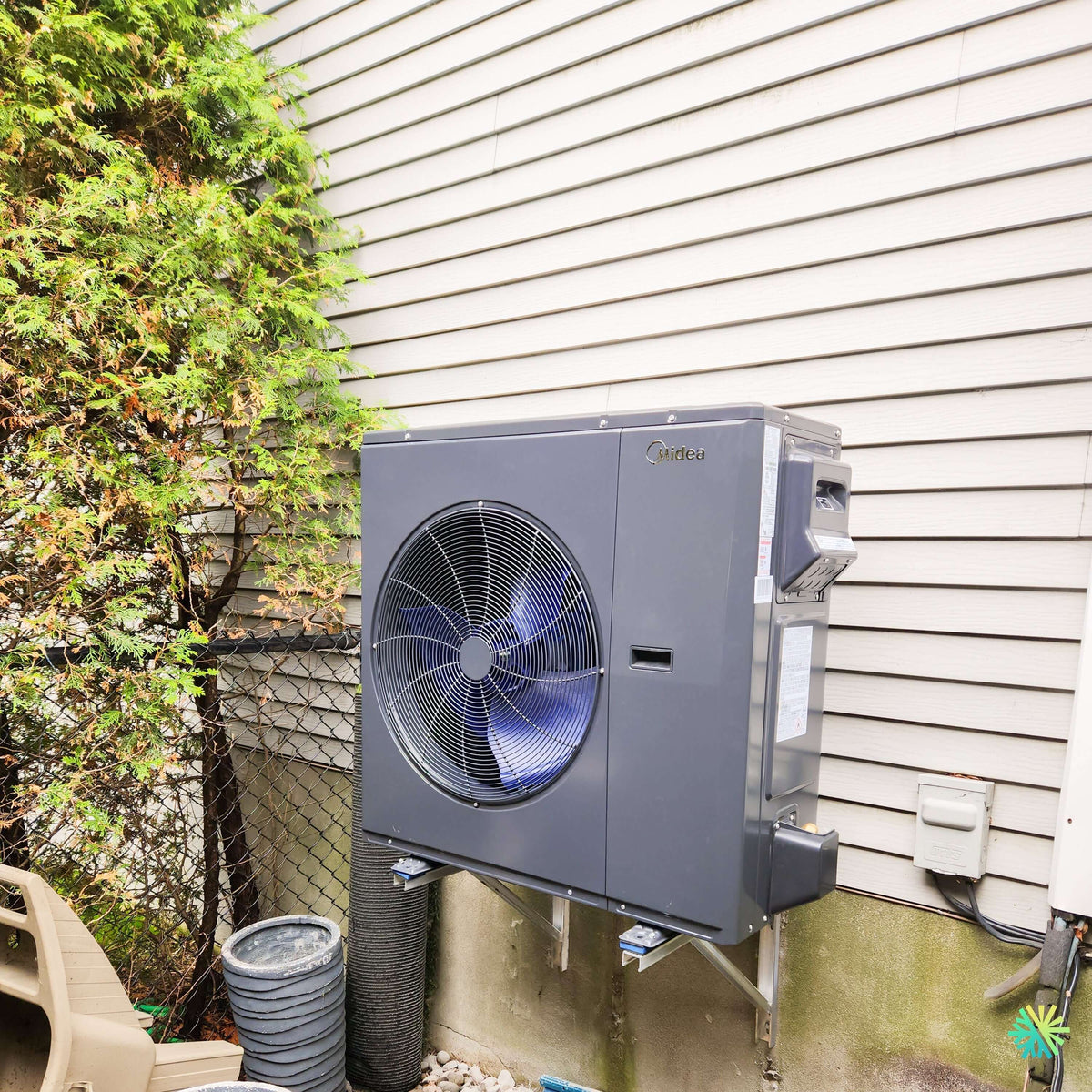
At this residence, the space available along the foundation is relatively tight. A mature conifer hedge occupies the left side, a fence is located behind it, two vertical corrugated conduits are present near the foundation, and the outdoor electrical installation is immediately to the right of the new unit. The facade is covered with vinyl siding, and the lower part of the heat pump is positioned above the foundation.
Our work therefore consisted of positioning the MIDEA EVOX G3 to maintain good clearance in front of its fan, preserve realistic access to the service panels, protect the unit from winter accumulation, and avoid turning this side passage into an impractical area.
The chosen solution is clearly visible in the photo: the heat pump is installed on a raised wall-mounted metal bracket, with two horizontal rails and reinforcing legs anchored to the foundation. The front of the unit remains largely open despite the relatively dense surroundings.
The MIDEA EVOX G3 range is designed as an inverter central system for ducted distribution, which MIDEA presents as a solution for modernizing residential central heating.
Why we did not simply place the heat pump on the ground
In L’Île-Cadieux, as everywhere in Quebec, a heat pump that is expected to make a serious contribution to winter heating must be installed with January and February conditions in mind, not just summer cooling.
During heating, the outdoor coil becomes cold enough to accumulate frost. The unit then periodically performs a defrost cycle. The resulting water must be able to drain beneath the unit.
By installing the MIDEA EVOX G3 higher, we create space that helps manage:
- snow accumulation around the building;
- water from defrost cycles;
- the risk of gradual ice buildup directly beneath the chassis;
- access to the base of the unit for inspection and maintenance;
- the presence of the elements already located at the base of the foundation.
In this particular installation, the corrugated ducts visible beneath and to the left of the unit were also factors to consider when positioning it. Installing the unit directly on the ground would have taken up much more of this useful space.
A very close hedge: a detail that matters throughout the unit’s entire service life
The vegetation visible to the left of the heat pump makes this installation particularly interesting from a practical standpoint.
A hedge provides privacy and can coexist very well with a central heat pump, but it must be maintained. Branches should not gradually move closer to the heat exchanger or enter the areas where the unit draws in and exhausts air.
This is a simple piece of advice we regularly give after our installations: keep the clearances specified by the manufacturer unobstructed, even several years after the work is complete.
A hedge can gain a lot of volume in just a few seasons. Needles, leaves, and small plant debris can also accumulate on the outdoor coil.
In this L’Île-Cadieux project, the front of the condenser is completely clear. The main long-term consideration will be keeping the nearby vegetation trimmed so that the space available today does not close in over time.
Why the large front fan must remain unobstructed
The MIDEA EVOX G3 uses a horizontal discharge architecture. The large fan visible in the photo exhausts air directly forward.
MIDEA explains that this design combines a horizontal fan with a vertical heat exchanger to create more uniform airflow across the heat exchanger.
This directly influences our choice of location.
In particular, we avoid positioning it too close to the fan:
- a solid fence;
- a wall;
- a shed;
- a bin or container;
- a dense hedge;
- another piece of mechanical equipment.
A heat pump can physically fit in a space while still being poorly positioned for operation. For us, an appropriate location must provide both enough room for the unit and sufficient space for the air it moves.
Heating down to -30 °C: why installation height makes even more sense
MIDEA documentation states that the EVOX G3 can operate continuously in heating mode down to -30 °C. In the test data presented for a three-ton system, MIDEA also indicates heating capacity of up to 100% of the rated capacity at around -25 °C, with a COP of up to approximately 1.9 under these conditions.
The manufacturer also describes its M-Powevi compressor technology, which uses an intermediate-temperature vapor supply when conditions become very cold to increase the amount of compressed refrigerant and support heat production.
When an appliance is designed to keep operating at such temperatures, how it is installed outdoors becomes especially important.
It would be contradictory to select a heat pump capable of operating at -25 °C or -30 °C and then place it in a position where snow or ice could quickly compromise its immediate surroundings.
What MIDEA EVOX G3 capacity did we install in L’Île-Cadieux?
The photo clearly identifies the MIDEA EVOX G3 family, but the complete model number on the rating plate is not clear enough to confirm with certainty the capacity of this specific installation.
We therefore prefer not to make up a BTU rating.
The documentation provided by MIDEA covers several EVOX G3 capacities, including 18,000, 24,000, 30,000, 36,000, 48,000 and 54,000 BTU/h, with performance varying according to the exact indoor and outdoor unit combination.
Depending on the configurations, the range reaches up to:
- 19 SEER2;
- 12.5 EER2;
- 10.8 HSPF2;
- 2.14 COP at 5 °F, or approximately -15 °C.
MIDEA specifies this performance range for EVOX G3 systems from 18,000 to 54,000 BTU/h.
A few examples taken directly from the MIDEA datasheet
The 18,000 BTU/h combination is rated at up to 19 SEER2, 12.5 EER2 and 10.1 HSPF2, with 18,600 BTU/h of heating at -15 °C and a COP of 2.12.
The 30,000 BTU/h configuration is rated at 17.2 SEER2 and 10.8 HSPF2, with a heating capacity of 33,200 BTU/h at -15 °C.
The 36,000 BTU/h version, for its part, has 17.7 SEER2 and 10.0 HSPF2, with 32,600 BTU/h at -15 °C and a COP of 2.06.
For a customer, this variation explains why it is not enough to ask for “the price of an EVOX G3.” The exact model must match the building's needs.
Sizing cannot be determined by looking only at the home's floor area
When estimating a central heat pump, the floor area is useful, but it is not enough.
Two homes of the same size can have very different needs depending on:
- the year of construction;
- the quality of the insulation;
- airtightness;
- the number of windows;
- solar orientation;
- the number of floors;
- the basement configuration;
- the airflow available in the ducts;
- the energy improvements made over the years.
The tonnage of the old equipment is not proof that its sizing was ideal either.
With an inverter heat pump, we want to benefit from modulation. Deliberately installing an oversized unit does not automatically improve comfort.
The electrical disconnect visible on the right must remain accessible
The exterior electrical box located to the right of the heat pump is also visible in the photo.
This component must be easily accessible during service. When a technician diagnoses or performs certain work on the condenser, they must be able to properly isolate the electrical power supply.
We therefore avoid positioning the unit in a way that blocks the disconnect switch or makes it difficult to open.
In this side passage on L’Île-Cadieux, every existing element had an impact: vegetation on the left, electrical services on the right, ducts on the ground, and the facade immediately behind the unit.
This is precisely the type of project where a few inches of movement can considerably improve the final installation quality.
Why the MIDEA EVOX G3 is particularly interesting when modernizing an existing central system
The outdoor condenser is only half of the installation
A central heat pump should never be evaluated solely based on the outdoor unit shown in the photos.
Inside, the air handler must circulate the required volume of air through the home’s duct system. An airflow problem can reduce comfort even if the outdoor heat pump is operating perfectly.
This is an important distinction from a wall-mounted heat pump. In a central system, ductwork quality is genuinely part of the equipment’s performance.
Computational Constant Airflow 2.0: an answer to imperfect duct systems
MIDEA uses its Computational Constant Airflow 2.0 technology on the EVOX G3.
According to the documentation, the system can adjust fan output when the duct system’s static pressure changes. The manufacturer specifically illustrates maintaining airflow under conditions ranging from 0.4 to 1.2 in. of external static water column pressure.
The controller also provides up to 60 air volume adjustment levels, allowing the installer to fine-tune the indoor unit’s operation.
This technology is useful during a renovation, but it must not become an excuse to keep inadequate ductwork.
An undersized air return, a highly restrictive transition, or a damaged duct remains a problem that must be corrected.
An indoor unit that can be configured in six ways
The EVOX G3 incorporates a modular design called Block N Lock.
MIDEA presents six installation options, including vertical configurations, horizontal configurations on the left or right, and certain compact low-boy configurations.
This flexibility is highly relevant in existing homes in L’Île-Cadieux, Vaudreuil-Dorion, Montréal, Laval, Longueuil, de la Rive Sud and de la Rive Nord.
We often work in mechanical rooms where:
- the ceiling height is limited;
- the air return comes from a specific side;
- the existing plenum cannot be moved completely;
- a plumbing line limits the available space;
- the basement staircase complicates equipment transport.
A modular unit can then reduce the number of modifications required.
A width designed to replace certain existing furnaces
The EVOX G3 documentation also indicates indoor unit widths ranging approximately from 14.5 to 21.5 inches, sizes close to those of several residential furnaces.
MIDEA also provides, depending on the configuration, the ability to adapt to a 115 V or 208/230 V power supply.
For a replacement, this is worthwhile, but we never qualify a project as a “direct replacement” before inspection.
The plenum, air return, drain, electrical system, auxiliary element, and filtration must all be validated.
Auxiliary heating: up to 25 kW depending on the configuration
The platform allows the integration of a three-stage auxiliary electric heating system, up to 25 kW, depending on the model. MIDEA indicates that its operation can be adapted to temperature changes to better control energy consumption and comfort.
In a Quebec home, adjusting this backup heat is far from secondary.
If the electrical elements come on too early, the homeowner risks losing part of the heat pump’s energy savings. If they are not configured consistently with the building’s actual needs, comfort may also suffer during extreme temperatures.
24 V thermostat or communicating system: several options
The EVOX G3 can operate with different control strategies.
The documentation notably provides for compatibility with:
- communication 485;
- certain conventional 24 V thermostats;
- Sub-1 GHz wireless communication between certain MIDEA components.
MIDEA also states that the equipment can automatically identify certain control modes.
This can simplify certain projects where replacing all the existing thermostat wiring would be complicated.
MERV 13: finer filtration provided that airflow requirements are respected
The platform also allows the use of 1-, 2-, or 4-inch MERV 13 filters. The manufacturer explains that this filtration can capture more dust, pollen, particles, and dander while helping keep the coil cleaner.
However, we emphasize one point: a better filter must not choke the duct system.
The filter surface area, filter thickness, and unit airflow must work together.
Smart control with Midea SmartHome
With the compatible communicating thermostat and the Midea SmartHome app, the EVOX G3 documentation provides for scheduled programming, comfort monitoring, certain consumption information, as well as remote diagnostic and update functions.
These features are particularly interesting with an inverter heat pump, whose operation can be much more gradual than that of an older on-off furnace or central air conditioner.
R-454B: MIDEA’s current generation of refrigerant
MIDEA states that it selected R-454B for this product line. The manufacturer gives this A2L refrigerant a global warming potential of 466.
This information mainly affects the installer’s work.
An R-454B installation must be carried out using the appropriate procedures and tools, particularly for refrigerant connections, leak testing, evacuation, and commissioning.
LogisVert: what to check for an EVOX G3 installed in Quebec in 2026
Hydro-Québec’s current rules state that heat pumps installed since November 26, 2025, must be ENERGY STAR certified to qualify for the LogisVert program.
The currently planned assistance is $50 per 1,000 BTU/h of heating capacity at -8 °C for an ENERGY STAR heat pump, and $120 per 1,000 BTU/h at -8 °C when it is also ENERGY STAR - Cold Climate certified. The applicable amount is determined based on the installation date.
The MIDEA brochure indicates that its range exceeds the ENERGY STAR Most Efficient criteria presented by the manufacturer. However, for a LogisVert application, we must always confirm the exact combination of the indoor and outdoor models in the Hydro-Québec list.
Since the complete model number of the condenser in this L’Île-Cadieux installation is not legible in the photo, we are not publishing an unverified rebate amount.
The three points that this L’Île-Cadieux installation illustrates particularly well
1. The outdoor location must be chosen for winter, not only for summer
The height of the support helps protect the heat pump’s immediate surroundings from snow and ice accumulation resulting from defrost cycles.
2. Vegetation must be considered an evolving element
A hedge does not remain the same distance away year after year. Its maintenance must be planned to preserve the necessary clearances.
3. A narrow passage requires a truly planned installation
Between the fence, vegetation, existing ducts, foundation, and electrical service, the positioning could not be improvised.
An installation that looks simple precisely because the constraints were addressed before commissioning
The final result visible in L’Île-Cadieux is relatively discreet: a dark gray MIDEA EVOX G3 unit, installed on its support in front of light-colored siding.
But behind this apparent simplicity lies all the logic of a proper HVAC installation.
We had to work with a tight space, keep the condenser above ground level, maintain adequate airflow, preserve access to the electrical service, and take mature vegetation located very close to the mechanical area into account.
Indoors, the success of a central heat pump project then depends on sizing, the ductwork, static pressure, airflow, the thermostat, filtration, and the auxiliary heating configuration.
This is the comprehensive approach we apply at AirGreen in L’Île-Cadieux, Vaudreuil-Dorion, Montreal, Laval, Longueuil, on the North Shore and on the South Shore.
A central heat pump should not only work properly on the day we complete the installation. It should also be positioned correctly to keep operating when the hedge has grown back, the snow has accumulated, and the equipment needs its first real maintenance several years later.
The unit on this job, in figures
The range as published on airgreen.ca: pick a size to see its capacity in deep cold.
| Size | Heating at −8 °C | Heating at −15 °C | Coldest certified point | COP at −15 °C | SEER | HSPF | Indicative LogisVert aid |
|---|---|---|---|---|---|---|---|
| Midea EVOX G3 · 1.5 tons | 14,700 | 18,600 | −30 °C: 11,800 | 2.12 | 19.0 | 10.1 | $1,764 |
| Midea EVOX G3 · 2 tons | 20,800 | 20,600 | −30 °C: 12,100 | 2.14 | 18.6 | 10.0 | $2,496 |
| Midea EVOX G3 · 2.5 tons | 24,000 | 33,200 | −30 °C: 17,900 | 1.97 | 17.2 | 10.8 | $2,880 |
| Midea EVOX G3 · 3 tons | 33,000 | 37,400 | −30 °C: 27,600 | 1.9 | 18.0 | 10.0 | $3,960 |
| Midea EVOX G3 · 4 tons | 39,500 | 48,000 | −30 °C: 27,200 | 2.0 | 17.5 | 9.5 | $4,740 |
| Midea EVOX G3 · 5 tons | 45,000 | 54,000 | −30 °C: 37,300 | 1.9 | 17.5 | 9.5 | $5,400 |
Data read live from the airgreen.ca page of each size (NEEP / AHRI certified performance). When the title names the installed size, it is highlighted; otherwise the whole range is shown. The aid shown is today’s, using Hydro-Québec’s rule ($120 per 1,000 BTU/h at −8 °C); amounts quoted in the article date from its publication. Only Hydro-Québec confirms the assistance granted.
The big day, step by step
The main steps of this kind of job at AirGreen. Every house has its quirks: the estimate brings them out.
We look at the ducts, the current indoor module, the electrical panel and the planned spot for the outdoor unit.
The equipment combination, capacity and price, in writing. We check whether the combination qualifies for assistance programs.
Access protected, old unit disconnected and removed when it is being replaced.
Electric furnace or air handler, with its coil, connected to the supply and return ducts.
On a level base, raised above the snow, with free space all around.
Insulated, they enter through a sealed opening and run to the indoor coil.
Dedicated circuits, accessible disconnect, a thermostat that works with the heat pump and the backup heat.
Leak test, vacuum, start-up, airflow check and a test of both modes.
Filter, thermostat, backup heat in extreme cold: what to know before winter.
- The on-site estimateWe look at the ducts, the current indoor module, the electrical panel and the planned spot for the outdoor unit.
- The quoteThe equipment combination, capacity and price, in writing. We check whether the combination qualifies for assistance programs.
- Getting readyAccess protected, old unit disconnected and removed when it is being replaced.
- The indoor moduleElectric furnace or air handler, with its coil, connected to the supply and return ducts.
- The outdoor unitOn a level base, raised above the snow, with free space all around.
- The refrigerant linesInsulated, they enter through a sealed opening and run to the indoor coil.
- Electrical and thermostatDedicated circuits, accessible disconnect, a thermostat that works with the heat pump and the backup heat.
- Tests and start-upLeak test, vacuum, start-up, airflow check and a test of both modes.
- The walkthroughFilter, thermostat, backup heat in extreme cold: what to know before winter.
What would it look like at your place?
Two quick checks with real numbers: what heat costs, and what your current heaters add up to in BTU/h.
Baseboards and electric furnaces turn 1 kWh of electricity into 1 kWh of heat. A heat pump delivers more: that is its COP. At Hydro-Québec’s rate D (11.142¢/kWh above 40 kWh a day, since 1 April 2026):
Hydro-Québec: a heat pump can be up to three times more efficient than baseboards for heating in the colder months.
Estimate per kWh of heat, at the chosen temperature, using the certified COP from the product page. Taxes, access charge and backup heat not included.
Conversion: 1 W = 3.412 BTU/h. An indication, not a load calculation: baseboards and furnaces are often stronger than the real need, and they can stay as backup. AirGreen confirms the capacity on site.
Four mistakes we do not make
Flip each card to see what we do instead.
Your own project, step by step
What to do, season by season
Three habits per season for this unit. They take a few minutes and prevent many calls.
- Check the indoor module's filter.
- Clear winter debris from the outdoor unit.
- Test cooling before the heat arrives.
- Check the filter more often in peak season.
- Keep registers and returns clear.
- Watch condensate drainage near the coil.
- Change or clean the filter.
- Test heating and backup heat before the cold.
- Book periodic maintenance.
- Clear snow around the outdoor unit.
- Store nothing in front of the indoor module.
- Note any unusual noise or smell and call us.
Is your home ready?
Check what applies at your place. A "no" is not a refusal: it is what we sort out during the estimate.
Four statements: true or false?
It all comes down to details you have just seen.
1. A central heat pump uses the house's ducts.
It connects to the existing ducts to heat and cool everywhere.
2. In extreme cold, electric backup heat can take over.
The indoor module (furnace or air handler) works with the heat pump and takes over in extreme cold.
3. The filter only gets changed when the unit breaks down.
A dirty filter cuts airflow. It gets checked regularly.
4. You can reuse the old unit's size without checking.
The house may have changed: insulation, windows, added rooms. Capacity is confirmed on site.
0 / 4 right answers
What people ask us about this kind of work
Can I keep my current ducts?
What happens in extreme cold?
Furnace, air handler, ducted: what is the difference?
Are there grants?
Do I need a permit?
How much can I save?
How is the LogisVert assistance calculated?
Will my current thermostat work?
Central or wall units: which one?
Does AirGreen hold the required licences?
Is the estimate free?
No question matches. Write to us: we answer.
More jobs to see, near you
By town, by equipment or by region: browse more than 4,700 published projects.
Each dot: a town where AirGreen has published projects. The glowing dot: this job.
Every house has its constraints. We see them before we install.
The on-site estimate is free and the quote follows within 24 hours.
Text and photo: a real AirGreen Climatisation & Chauffage job. The diagrams are generic illustrations of the type of installation, not a survey of this job site. Sources of the added figures: airgreen.ca product pages (NEEP / AHRI performance), Hydro-Québec (Heat pumps page, LogisVert, read on 13 October 2026), Régie de l’énergie (rate D as of 1 April 2026).