
Installation of a MIDEA EVOX G3 central heat pump in Verchères on the South Shore
In Verchères, AirGreen installs a MIDEA EVOX G3 central heat pump on wall brackets: an Inverter solution suited to Quebec's cold climate, central ductwork, and HVAC system replacements.
Take a tour of the installation
Each number is a point we check on site. Switch between summer and winter to watch air and heat move.
In summer, the outdoor unit rejects the house's heat outside.
Generic illustration of this type of installation, not a survey of this job site. Tap a number.
It captures or rejects heat outside. It sits on a level base, above the snow, with free space all around.
The insulated refrigerant lines enter the house through a sealed opening and run to the indoor coil.
A shut-off switch near the outdoor unit isolates it safely for service.
Sitting on the indoor module, it moves heat between the house air and the refrigerant.
Electric furnace or air handler: its fan pushes air through the ducts. The electric backup takes over in extreme cold.
Supply ducts bring air to the rooms; returns bring it back to the unit. Their condition matters as much as the unit's.
It protects the coil and the fan. A dirty filter cuts airflow, so it gets checked regularly.
It runs the heat pump and the backup heat. It must be compatible with the installed system.
In Verchères, an EVOX G3 central heat pump installed on wall brackets to better cope with Quebec winters
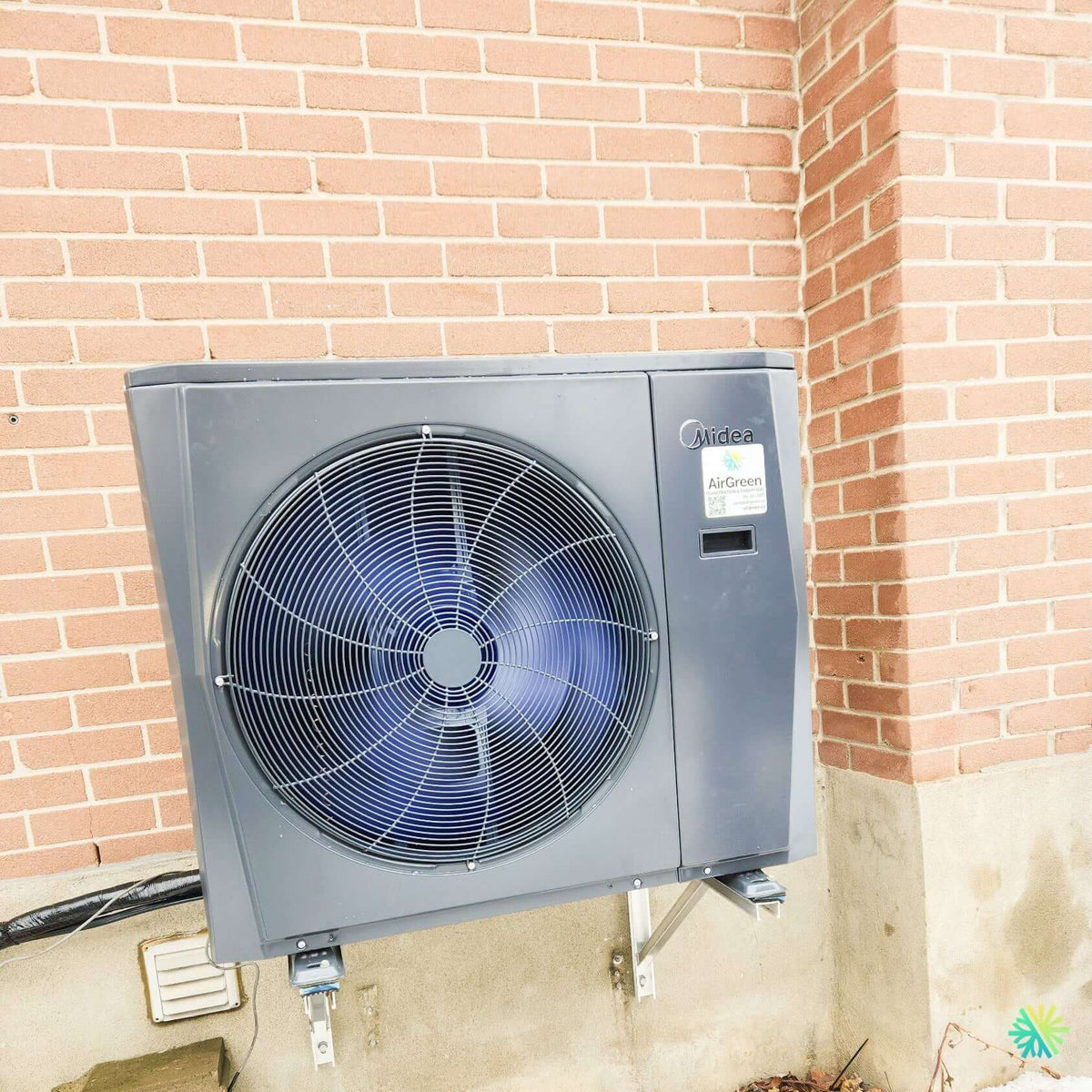
This MIDEA EVOX G3 central heat pump installation in Verchères features a detail that summarizes a large part of our work at AirGreen: the outdoor unit was not simply placed on the ground beside the house. In the project photo, we can see the Midea condenser installed on two metal brackets firmly anchored to the building, above the foundation, in front of a brick wall.
This configuration serves several practical purposes. It lifts the unit off the ground, makes it easier to manage snow around the heat pump, keeps the lower part of the equipment accessible, and leaves the large front grille completely unobstructed for airflow.
The result is particularly consistent with how the MIDEA EVOX G3 operates, an Inverter central heat pump designed to replace or modernize a ducted HVAC system. Midea’s documentation also presents this platform as an upgrade solution for central systems, with an emphasis on low-temperature heating, energy efficiency, and installation flexibility.
In Verchères, as elsewhere on the South Shore, a good installation must be designed with both January and July in mind.
An outdoor unit installed above ground rather than at foundation level
The photo clearly shows what is distinctive about this project: the dark gray outdoor unit is suspended on metal wall brackets, with open space beneath the unit.
This decision may seem secondary when comparing quotes for central heat pumps, but it becomes very tangible after a good accumulation of snow.
A heat pump used for heating must be able to draw in and discharge air properly. Its outdoor heat exchanger must also remain accessible during defrost cycles. A unit installed too low can become surrounded by compacted snow or ice if the area around the condenser is not maintained.
In this installation in Verchères, mounting the unit on supports therefore makes it possible to:
- keep the condenser above the immediate ground level;
- preserve space beneath the unit;
- facilitate access for HVAC maintenance;
- reduce the risk that accumulated snow will quickly block the unit;
- keep an unobstructed air discharge area in front of the fan;
- avoid taking up more floor space around the foundation.
However, we must always consider the wall structure, vibrations, and the manufacturer's installation recommendations before choosing a wall-mounted installation.
The horizontal fan of the EVOX G3 and the importance of keeping clear space in front of the unit
The large round grille visible in the photo is the outdoor fan outlet.
Midea specifically highlights a horizontal discharge design, combined with a vertically arranged heat exchanger. According to the manufacturer, this architecture helps provide more uniform airflow across the heat exchanger and maintain good performance as the outdoor temperature drops.
In the field, this means that we must not only check the space behind and on the sides of the condenser. The space in front of this grille must also remain clear.
An obstacle placed directly in front of a heat pump can promote recirculation of discharged air and compromise operating conditions. Here, the unit faces an open area rather than a nearby wall.
An installation that must also anticipate defrosting
In heating mode, a heat pump draws energy from the outdoor air. When conditions promote frost formation on the heat exchanger, the system periodically runs a defrost cycle.
This phenomenon is normal.
What must be planned correctly is the water produced by this defrosting. In the middle of winter, it can then refreeze beneath or around the unit.
The visible clearance beneath the MIDEA EVOX G3 installed in Verchères provides more space to manage this climate reality than a unit installed almost directly at ground level.
EVOX G3: a central heat pump that operates down to -30 °C
In the Montreal region, winter performance is one of the first criteria we examine for a central heat pump.
Midea advertises continuous operation down to -30 °C for the EVOX G3 Extreme Heat line. The manufacturer also indicates, depending on the configuration and test conditions, up to 100% heating capacity at -25 °C with a COP of approximately 1.9.
The documentation explains that, under extreme cold conditions, the compressor technology uses intermediate-temperature vapor injection to increase the total amount of compressed refrigerant and support heating performance.
For a homeowner in Verchères, Boucherville, Varennes, Beloeil, Saint-Hyacinthe, or elsewhere on the South Shore, this information is much more meaningful than a simple cooling capacity in BTUs.
A Quebec heat pump must be selected based on what it can produce when temperatures actually drop.
Central capacities ranging from 18,000 to 54,000 BTU/h in the EVOX G3 documentation
The EVOX G3 line covers several central system sizes. Midea documentation lists nominal cooling capacities ranging from 18,000 to 54,000 BTU/h, representing several formats suited to different residential loads.
The technical table on page 11 specifically presents the indoor and outdoor unit combinations for the G3 generation:
- 18,000 BTU/h;
- 24,000 BTU/h;
- 30,000 BTU/h;
- 36,000 BTU/h;
- 48,000 BTU/h;
- 54,000 BTU/h.
Published performance reaches up to 19 SEER2, with values of up to 12.5 EER2 and 10.8 HSPF2, depending on the capacity and combination.
The photo of this installation in Verchères does not show the rating plate clearly enough to reliably assign a precise capacity to the photographed unit. We therefore prefer not to invent a tonnage based solely on its visual dimensions.
This is exactly the same level of rigor we apply when preparing a quote: the exact capacity, the indoor/outdoor combination, and the AHRI reference must match the system actually installed.
Central system sizing: more complex than “more BTUs = more comfort”
For a central heat pump, sizing directly influences system performance.
An oversized unit can quickly reach the setpoint without necessarily providing the operating cycle most conducive to temperature uniformity or summer dehumidification. An undersized system, on the other hand, may have to run for very long periods when the loads become significant.
We therefore analyze several factors:
- property size and layout;
- insulation level;
- orientation and amount of glazing;
- air leakage;
- condition of the existing ductwork;
- airflow required for each room;
- available electrical capacity;
- auxiliary heating;
- heat pump performance at low temperatures.
For a central HVAC installation in Verchères, the existing distribution system is particularly important. A high-performance heat pump cannot, by itself, correct a highly restrictive or poorly balanced duct system.
Computational Constant Airflow 2.0: the EVOX G3 also works with the ductwork
One of the interesting features of the EVOX G3 platform is found in the indoor unit.
Midea presents its Computational Constant Airflow 2.0 technology, designed to adjust motor output and fan speed to the conditions of the ductwork and filtration system. The documentation indicates a capacity of up to 1.2 in. of water column static pressure, with up to 60 airflow adjustment levels.
This adaptability is especially useful when replacing a central system while retaining all or part of the existing ductwork.
It obviously does not eliminate the need to check the ductwork. A crushed, undersized, or poorly designed duct remains a mechanical problem. However, a unit capable of better handling static pressure variations offers greater flexibility when modernizing an existing installation.
Why the MIDEA EVOX G3 is particularly interesting for a central system replacement in Verchères
Replacing a furnace or central heat pump can quickly become more complex than simply swapping equipment. You have to account for the mechanical room dimensions, existing ductwork, filtration, wiring, thermostat, electrical supply, and sometimes an auxiliary system.
The EVOX G3 was clearly designed with this type of project in mind.
A modular indoor unit that can be installed in six configurations
Midea uses a modular locking design called Block N Lock.
The brochure shows six possible configurations: upflow, downflow, horizontal right, horizontal left, as well as compact low-boy configurations. This modularity is particularly intended for basements, attics, and spaces where limited height makes installing a conventional unit difficult.
In our daily work in Montreal, Laval, Longueuil, the North Shore, and the South Shore, this feature has very practical value.
Quebec mechanical rooms are rarely uniform. We work in finished basements, narrow mechanical spaces, older properties with existing ductwork, and homes where every inch counts.
A width designed to make furnace replacement easier
Midea also presents the EVOX G3 as a direct replacement for gas furnaces.
The documentation indicates cabinet widths ranging approximately from 14.5 to 21.5 inches, to match the dimensions commonly used for furnaces with similar capacities.
This approach can reduce the amount of modification required at the duct connections when the dimensions are compatible with the existing installation.
However, a replacement remains a customized project. We must check the transitions, plenum, return air, filters, clearances, structure, and auxiliary heating requirements.
Adaptable power supply and auxiliary heating up to 25 kW
The G3 platform also includes a multi-voltage indoor unit capable of recognizing and adapting to an existing power supply of 115 V or 208/230 V, depending on the configuration. Midea presents this feature as a way to facilitate certain modernization projects without automatically requiring complete rewiring of the indoor unit.
Three-stage auxiliary heating kits are also available, with capacities of up to 25 kW. The manufacturer states that these elements can be activated and modulated according to temperature requirements.
In Quebec, this part of the system must always be sized according to the property and checked against the electrical panel's actual capacity.
Adding a major electrical component without analyzing the home's power supply is not good practice.
485 communication, 24 V thermostat, and wireless communication capability
Modernization often becomes complicated when the existing wiring does not match the new system.
Midea provides several options for the EVOX G3. The documentation indicates compatibility with 485 communication mode as well as 24 V controls, including third-party thermostats. The system can automatically identify the control mode being used.
The platform also provides wireless communication between certain components through Sub-1 GHz modules, which may reduce the need to run a new communication cable in some configurations.
This is a particularly interesting feature in already-finished homes where installing a new wire run could require opening walls or ceilings.
MERV 13 filtration and three filter thicknesses
The quality of a central heat pump also depends on how we handle indoor air.
The filtration module presented by Midea is compatible with 1-, 2-, or 4-inch MERV 13 filters. Adequate filtration can capture more dust, pollen, particles, and pet hair or dander while helping keep the indoor coil cleaner.
However, the filter choice must remain compatible with the required airflow. A highly restrictive filter installed without considering static pressure can do exactly the opposite of what we are looking for.
An R-454B central heat pump
The EVOX G3 product line uses R-454B refrigerant, classified as A2L.
Midea indicates a global warming potential, or GWP, of 466 for this refrigerant and states that it has adopted R-454B for its relevant product line.
This transition changes certain installation methods and requirements compared with older generations of equipment using higher-GWP refrigerants.
For us, this means, among other things, that the commissioning tools, procedures, connections, and practices must correspond to the refrigerant and the specific requirements of the installed equipment.
Commissioning is just as important as the equipment
After installing the outdoor condenser like the one we see here in Verchères, the work does not end when the electrical power is connected.
Commissioning a central heat pump must include, among other things, validating the connections, checking the refrigeration circuit, monitoring airflow rates, verifying thermostat operation, confirming the response of the indoor and outdoor units, and testing the various heating and cooling modes.
For a central replacement, we also place great importance on the duct network. Good overall airflow does not automatically guarantee that every room receives the appropriate amount of air.
Balancing and the condition of the duct network therefore remain essential.
LogisVert: never determine a subsidy solely from the name EVOX G3
The performance of the MIDEA EVOX G3 meets the requirements for high-efficiency central systems, and the brochure indicates that the range exceeds the ENERGY STAR Most Efficient criteria targeted by the manufacturer.
For financial assistance in Quebec, however, we need to go further.
The name “EVOX G3” is not enough to determine whether a subsidy is available. The exact indoor and outdoor unit combination, its capacity, AHRI number, and the program criteria applicable at the time of installation must be identified.
We therefore always recommend verifying eligibility before making a decision based solely on an announced subsidy amount.
What this Verchères installation really shows
This photo could be summarized as a Midea outdoor unit installed on two supports.
In reality, it represents a series of decisions that determine the quality of an installation for many years: height above the ground, clearance in front of the fan, support structure, service access, winter conditions, pipe routing, selected capacity, indoor duct network, electrical supply, and auxiliary heating strategy.
This is the approach we apply at AirGreen for every central heat pump project in Montreal, Laval, Longueuil, the North Shore, and the South Shore.
For this MIDEA EVOX G3 installation in Verchères, the wall-mounted setup visible in the photo integrates the unit into the property while keeping it clear of the ground. Combined with Inverter technology, heating capacity down to very low temperatures, advanced airflow management, and indoor unit flexibility, this platform is a particularly attractive solution when an existing central system needs to be modernized.
At AirGreen, we never look only at the box installed outside. We look at the complete HVAC system: heat pump, indoor unit, ductwork, filtration, controls, electrical system, backup heating, and the building's actual constraints.
The unit on this job, in figures
The range as published on airgreen.ca: pick a size to see its capacity in deep cold.
| Size | Heating at −8 °C | Heating at −15 °C | Coldest certified point | COP at −15 °C | SEER | HSPF | Indicative LogisVert aid |
|---|---|---|---|---|---|---|---|
| Midea EVOX G3 · 1.5 tons | 14,700 | 18,600 | −30 °C: 11,800 | 2.12 | 19.0 | 10.1 | $1,764 |
| Midea EVOX G3 · 2 tons | 20,800 | 20,600 | −30 °C: 12,100 | 2.14 | 18.6 | 10.0 | $2,496 |
| Midea EVOX G3 · 2.5 tons | 24,000 | 33,200 | −30 °C: 17,900 | 1.97 | 17.2 | 10.8 | $2,880 |
| Midea EVOX G3 · 3 tons | 33,000 | 37,400 | −30 °C: 27,600 | 1.9 | 18.0 | 10.0 | $3,960 |
| Midea EVOX G3 · 4 tons | 39,500 | 48,000 | −30 °C: 27,200 | 2.0 | 17.5 | 9.5 | $4,740 |
| Midea EVOX G3 · 5 tons | 45,000 | 54,000 | −30 °C: 37,300 | 1.9 | 17.5 | 9.5 | $5,400 |
Data read live from the airgreen.ca page of each size (NEEP / AHRI certified performance). When the title names the installed size, it is highlighted; otherwise the whole range is shown. The aid shown is today’s, using Hydro-Québec’s rule ($120 per 1,000 BTU/h at −8 °C); amounts quoted in the article date from its publication. Only Hydro-Québec confirms the assistance granted.
The big day, step by step
The main steps of this kind of job at AirGreen. Every house has its quirks: the estimate brings them out.
We look at the ducts, the current indoor module, the electrical panel and the planned spot for the outdoor unit.
The equipment combination, capacity and price, in writing. We check whether the combination qualifies for assistance programs.
Access protected, old unit disconnected and removed when it is being replaced.
Electric furnace or air handler, with its coil, connected to the supply and return ducts.
On a level base, raised above the snow, with free space all around.
Insulated, they enter through a sealed opening and run to the indoor coil.
Dedicated circuits, accessible disconnect, a thermostat that works with the heat pump and the backup heat.
Leak test, vacuum, start-up, airflow check and a test of both modes.
Filter, thermostat, backup heat in extreme cold: what to know before winter.
- The on-site estimateWe look at the ducts, the current indoor module, the electrical panel and the planned spot for the outdoor unit.
- The quoteThe equipment combination, capacity and price, in writing. We check whether the combination qualifies for assistance programs.
- Getting readyAccess protected, old unit disconnected and removed when it is being replaced.
- The indoor moduleElectric furnace or air handler, with its coil, connected to the supply and return ducts.
- The outdoor unitOn a level base, raised above the snow, with free space all around.
- The refrigerant linesInsulated, they enter through a sealed opening and run to the indoor coil.
- Electrical and thermostatDedicated circuits, accessible disconnect, a thermostat that works with the heat pump and the backup heat.
- Tests and start-upLeak test, vacuum, start-up, airflow check and a test of both modes.
- The walkthroughFilter, thermostat, backup heat in extreme cold: what to know before winter.
What would it look like at your place?
Two quick checks with real numbers: what heat costs, and what your current heaters add up to in BTU/h.
Baseboards and electric furnaces turn 1 kWh of electricity into 1 kWh of heat. A heat pump delivers more: that is its COP. At Hydro-Québec’s rate D (11.142¢/kWh above 40 kWh a day, since 1 April 2026):
Hydro-Québec: a heat pump can be up to three times more efficient than baseboards for heating in the colder months.
Estimate per kWh of heat, at the chosen temperature, using the certified COP from the product page. Taxes, access charge and backup heat not included.
Conversion: 1 W = 3.412 BTU/h. An indication, not a load calculation: baseboards and furnaces are often stronger than the real need, and they can stay as backup. AirGreen confirms the capacity on site.
Four mistakes we do not make
Flip each card to see what we do instead.
Your own project, step by step
What to do, season by season
Three habits per season for this unit. They take a few minutes and prevent many calls.
- Check the indoor module's filter.
- Clear winter debris from the outdoor unit.
- Test cooling before the heat arrives.
- Check the filter more often in peak season.
- Keep registers and returns clear.
- Watch condensate drainage near the coil.
- Change or clean the filter.
- Test heating and backup heat before the cold.
- Book periodic maintenance.
- Clear snow around the outdoor unit.
- Store nothing in front of the indoor module.
- Note any unusual noise or smell and call us.
Is your home ready?
Check what applies at your place. A "no" is not a refusal: it is what we sort out during the estimate.
Four statements: true or false?
It all comes down to details you have just seen.
1. A central heat pump uses the house's ducts.
It connects to the existing ducts to heat and cool everywhere.
2. In extreme cold, electric backup heat can take over.
The indoor module (furnace or air handler) works with the heat pump and takes over in extreme cold.
3. The filter only gets changed when the unit breaks down.
A dirty filter cuts airflow. It gets checked regularly.
4. You can reuse the old unit's size without checking.
The house may have changed: insulation, windows, added rooms. Capacity is confirmed on site.
0 / 4 right answers
What people ask us about this kind of work
Can I keep my current ducts?
What happens in extreme cold?
Furnace, air handler, ducted: what is the difference?
Are there grants?
Do I need a permit?
How much can I save?
How is the LogisVert assistance calculated?
Will my current thermostat work?
Central or wall units: which one?
Does AirGreen hold the required licences?
Is the estimate free?
No question matches. Write to us: we answer.
More jobs to see, near you
By town, by equipment or by region: browse more than 4,700 published projects.
Each dot: a town where AirGreen has published projects. The glowing dot: this job.
Every house has its constraints. We see them before we install.
The on-site estimate is free and the quote follows within 24 hours.
Text and photo: a real AirGreen Climatisation & Chauffage job. The diagrams are generic illustrations of the type of installation, not a survey of this job site. Sources of the added figures: airgreen.ca product pages (NEEP / AHRI performance), Hydro-Québec (Heat pumps page, LogisVert, read on 13 October 2026), Régie de l’énergie (rate D as of 1 April 2026).