
Installation of a Fujitsu AIRSTAGE Aquila XLTH dual-zone heat pump in the city of Laval
AirGreen installs a Fujitsu Aquila XLTH dual-zone heat pump in Laval, with wall brackets, anti-vibration pads, protected lines, and a configuration adapted to Quebec winters.
In summer, the outdoor unit rejects the house's heat outside.
Generic illustration of this type of installation, not a survey of this job site. Tap a number.
Mounted level on a wall plate, high enough for the air to reach the whole room, with enough space around it to slide the filters out easily.
The refrigerant lines, the communication cable and the drain go through the wall in a single opening, sealed against water, cold air and insects.
Two insulated copper pipes connect the two units. Outside, a line cover can protect them from sun, knocks and weather.
A shut-off switch near the outdoor unit isolates it safely for service. It must stay accessible at all times.
The compressor and the fan. In heating mode it captures heat from the outdoor air, even in winter, and moves it inside.
On the ground or on the wall, it keeps the unit above accumulated snow. The unit stays clear and defrost water can drain away.
The fan needs to blow freely. Storage, a fence or a wall too close, and efficiency drops while noise goes up.
A winter installation carefully integrated into a brick façade
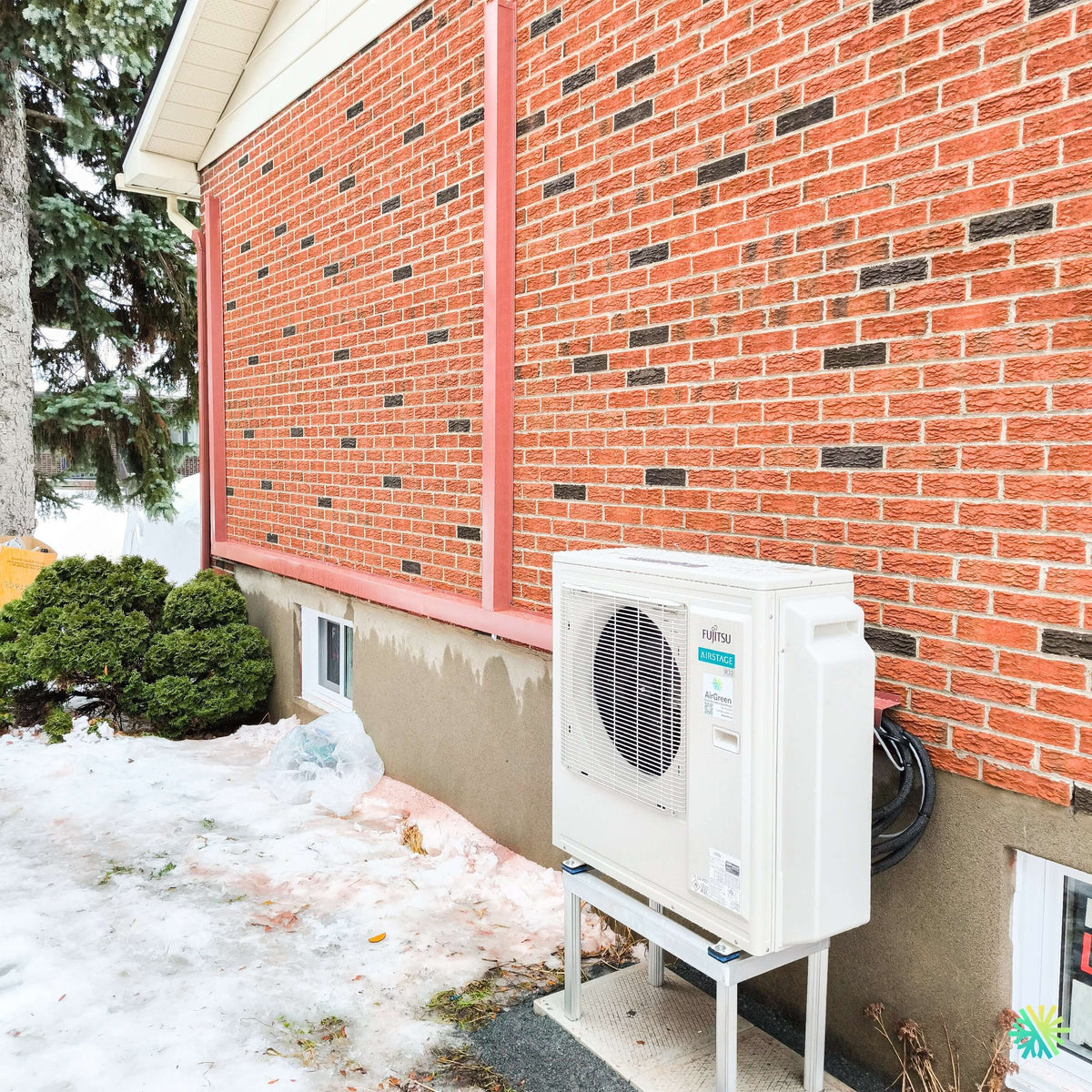
For this installation in the city of Laval, we installed a Fujitsu AIRSTAGE Aquila XLTH dual-zone heat pump at a residence with a brick façade, a concrete foundation, and a relatively open side area. The goal was to provide efficient heating and cooling to two distinct areas of the home while maintaining a single outdoor unit.
The photograph taken after the installation shows a project completed in winter conditions. Snow is present on the ground, a shovel is nearby, and the outdoor unit was installed at a sufficient height to limit the risks associated with snow and ice buildup. This is particularly important for a heat pump in Laval, where temperature fluctuations, freezing conditions, and snowfall can directly affect the operation of a poorly positioned unit.
We mounted the outdoor unit on metal wall brackets anchored into the foundation. Anti-vibration pads were placed between the heat pump chassis and the brackets. This configuration keeps the unit above the ground, frees up the space beneath it, and reduces vibration transmission to the building structure.
The project also presented a significant visual challenge: the refrigerant lines had to rise almost to the roof to connect to the two indoor units. We therefore installed a brown vertical line-hide cover, chosen to complement the dark tones of the brick and the façade’s decorative joints. Rather than leaving several lines, cables, and insulation exposed, we grouped the components into a straight, orderly, and durable exterior finish.
Why a dual-zone heat pump was the right choice for this home
A dual-zone heat pump can power two indoor units from a single outdoor unit. This configuration is particularly well suited when a home has two areas with different needs, for example:
- a ground floor and an upper floor;
- an open-plan area and a primary bedroom;
- the front and rear sections of the house;
- a living area and a finished basement;
- two distant rooms that cannot be served effectively by a single wall-mounted unit.
In a home, cooled or heated air does not always circulate naturally from one room to another. Doors, stairs, hallways, and differences in elevation limit its distribution. Installing a single oversized indoor unit in the hope that it will serve the entire residence often produces uneven results.
Instead, the multi-zone system makes it possible to install an air distribution point in each priority area. Each indoor unit can be controlled independently, with its own setpoint temperature and fan speed.
Fujitsu documentation indicates that H Series AIRSTAGE multi-zone systems can power several types of indoor units, including wall-mounted units, slim duct units, compact cassettes, and certain ducted units. The manufacturer also specifies that each indoor unit can be controlled separately, while reminding users that the system heats or cools all zones in a shared mode.
This means that one zone can be turned off while the other operates, and the requested temperatures can differ. However, one indoor unit cannot heat while another is simultaneously cooling.
An outdoor installation designed for Laval winters
Choosing the height of the outdoor unit is one of the most important aspects of this installation. A heat pump installed too close to the ground can quickly become surrounded by snow or ice.
During heating, the outdoor heat exchanger naturally accumulates frost. The system then initiates a defrost cycle. The water produced flows beneath the unit and must be able to drain freely.
If the unit is too low, several problems may arise:
- ice forming beneath the chassis;
- partial obstruction of the lower openings;
- snow accumulating in front of the heat exchanger;
- reduced airflow;
- more frequent defrost cycles;
- reduced performance;
- risk of damage caused by a shovel or snow blower.
With this installation, wall brackets hold the heat pump at a practical height above the ground. The space underneath remains clear for defrost water drainage and seasonal maintenance.
The chosen position also takes into account the basement window located to the left of the unit. We avoided placing the unit directly in front of this opening to preserve the window’s light, access, and use.
Mounting to the foundation rather than the brick veneer
The façade has a large brick surface, but the unit’s supports are positioned in the foundation area. This decision is important.
Masonry veneer is not automatically designed to support the weight of mechanical equipment and the repeated vibrations of the compressor. Anchors must be installed in an appropriate support, according to the building’s actual structure.
We specifically check:
- the strength of the anchoring material;
- fastener depth;
- alignment of the two supports;
- load capacity;
- leveling the unit;
- the presence of sufficient space behind the unit;
- access to the service panel.
Poor fastening can cause sagging, tilting, or vibrations that can be felt inside the house. It can also damage the exterior finish.
The role of anti-vibration blocks
The blue blocks visible beneath the heat pump’s feet isolate the unit from its metal supports. They help limit the transmission of vibrations produced by the compressor and fan.
This protection is useful in all installations, but it becomes even more important when the unit is mounted directly to the building. Without adequate isolation, a slight vibration outside can become a noticeable hum in a bedroom, living room, or basement.
We also pay close attention to the refrigerant lines. Even when the unit is resting on good supports, lines that are too taut or fastened too rigidly can transmit vibrations to the wall.
The system must therefore be stable without being completely and rigidly “locked” in place. The connections must retain enough flexibility to absorb the compressor’s normal movements and thermal variations.
A vertical line-set cover suited to the façade
One of the most visible elements of this installation is the long brown line-set cover that runs from the heat pump up to the upper level of the house.
In a dual-zone installation, each indoor unit has its own refrigerant circuit. Several lines, communication cables, and insulation components must therefore be routed from the outdoor unit to the two indoor locations.
Without an appropriate finish, these components can create a disorganized appearance. They are also exposed to:
- ultraviolet rays;
- rain;
- snow;
- freezing;
- birds;
- small animals;
- accidental impacts;
- wind-induced movement.
We grouped these components in a straight vertical cover that follows the façade. The brown color creates a controlled contrast with the red brick and matches the building's other dark accents.
The vertical routing also reduces the number of changes in direction. Each additional elbow increases labor time, visual clutter, and the risk of an overly tight bend in the lines.
The lower wall penetration
The photo also shows the entry point into the building, located in the foundation to the right of the unit. We carefully sealed this penetration to limit:
- water infiltration;
- air infiltration;
- insects entering;
- heat loss;
- moisture around the lines;
- insulation movement.
The seal must remain durable despite the contraction and expansion caused by temperature variations. A simple superficial filling may crack after a few seasons.
The electrical power supply visible on the façade
A disconnect box is installed near the outdoor unit. It allows the heat pump's power supply to be isolated during maintenance or repairs.
Its location must be accessible to the technician while being protected against accidental tampering. The outdoor wiring is routed neatly to the unit, and exposed sections are protected.
During an HVAC installation, we do not limit ourselves to checking that the unit starts up. We also verify:
- the supply voltage;
- the electrical panel protection;
- the conductor size;
- the disconnect device;
- terminal tightening;
- grounding;
- the communication wiring between the units.
In a dual-zone system, a mismatch between the communication cable and the refrigerant circuit can cause inconsistent operation. It is therefore essential to identify each circuit from the start of the installation.
The Fujitsu Aquila XLTH: Multi-zone comfort and rigorous technical selection
The capacities and combinations offered by the H series
According to the Fujitsu combination table, the AIRSTAGE H series includes 18,000, 24,000, 36,000, and 45,000 BTU/h outdoor units that can be connected to a maximum of two, three, four, or five indoor units, respectively, depending on the model.
For an 18,000 BTU/h dual-zone outdoor unit, the manufacturer lists the following combinations, among others:
- 7,000 + 7,000 BTU/h;
- 7,000 + 9,000 BTU/h;
- 7,000 + 12,000 BTU/h;
- 7,000 + 15,000 BTU/h;
- 9,000 + 9,000 BTU/h;
- 9,000 + 12,000 BTU/h;
- 9,000 + 15,000 BTU/h;
- 12,000 + 12,000 BTU/h.
These data indicate the approved combinations, but they do not replace a load calculation. Fujitsu also notes that the tables should not be used alone to select capacity and recommends using its Design Simulator software.
The nameplate visible in the photograph is not legible enough to confirm the exact capacity of the installed unit with certainty. We therefore avoid assigning a precise BTU rating based on the outdoor cabinet’s size.
Why an approved combination is not always an ideal combination
A system can technically accept two indoor units whose combined nominal capacity exceeds that of the outdoor unit. This does not mean that the outdoor unit will produce more heating or cooling.
Fujitsu indicates that certain configurations can reach a connection capacity of up to 130%, but specifies that exceeding 100% does not increase the outdoor unit’s output capacity.
When both zones call for maximum capacity at the same time, the system distributes the available output. This reality must be considered during sizing.
We therefore analyze:
- heat loss from each zone;
- actual open area;
- insulation;
- solar orientation;
- ceiling height;
- windows;
- occupancy frequency;
- design temperature;
- low-temperature capacity;
- the likelihood that both zones will operate at full load simultaneously.
A homeowner might assume that a 12,000 BTU/h indoor unit always provides that capacity, regardless of the configuration. In a multi-zone system, the actual capacity also depends on the outdoor unit and the other active zones.
Cold-weather operation
Fujitsu documentation for the Aquila series indicates that CTEB versions intended for cold climates can operate in heating mode down to -26 °C. It also features an inverter-driven compressor and a heat exchanger with fins designed to improve corrosion resistance.
Inverter technology allows the compressor to modulate its speed according to demand. Rather than operating only at full capacity or shutting down completely, the system can adjust its output.
This modulation contributes to:
- maintain a more stable temperature;
- reduce short cycling;
- match consumption to the load;
- reduce temperature fluctuations;
- improve comfort during milder periods.
However, it is essential to distinguish the minimum operating temperature from the available capacity. A heat pump may continue producing heat at very low temperatures, but its capacity and efficiency vary according to outdoor conditions.
Depending on the building, supplemental heating may therefore remain useful during the coldest periods.
The R32 refrigerant
The marking R32 is visible on the façade of the Fujitsu unit. This refrigerant is used in several recent generations of heat pumps.
Its use requires appropriate practices during installation:
- compatible tools;
- precise preparation of the flared connections;
- leak testing;
- pressure testing;
- measured vacuum pulling;
- ensuring the line lengths are within specifications;
- checking the charge;
- proper recovery procedures.
An improperly prepared connection can cause a slow leak that may not appear until several months later. We therefore pay close attention to cutting, flaring, tightening, and testing the lines.
Key steps in this Laval installation
For this project, our work notably included:
- assessing the outdoor location;
- checking the foundation and available clearances;
- positioning the wall brackets;
- anchoring and leveling;
- installing the vibration isolators;
- installing the Fujitsu outdoor unit;
- drilling and sealing the wall penetration;
- routing the two refrigerant circuits;
- installing the vertical line-set cover;
- installing the outdoor electrical disconnect;
- pressure testing;
- pulling a vacuum;
- checking the connections;
- commissioning both zones;
- testing in heating and cooling modes;
- explaining how it works to the owner.
Mistakes to avoid on a brick façade
Securing the unit to unsuitable masonry
The facing brick is not always structurally load-bearing. It is necessary to determine where and how to anchor the supports.
Place the unit too close to the snow
A heat pump installed at ground level can become partially blocked after a storm.
Leave the lines exposed
Insulation deteriorates under UV rays, and the lines become more vulnerable to impacts.
Neglect the appearance of the line route
A poorly aligned cover or one made up of many unnecessary connections detracts from the façade’s appearance.
Install the unit in front of a window
Even a small basement window must remain accessible and functional.
Forget the service clearance
The technical panel, valves, and removal screws must remain accessible.
Poorly seal the passage through the foundation
An improperly sealed opening can let in water, cold air, and insects.
Recommended maintenance after installation
A properly installed heat pump must also be maintained correctly. We recommend that the homeowner:
- clean the indoor units’ filters regularly;
- keep the outdoor unit’s front clear of snow;
- remove leaves and debris from around the unit;
- do not strike the ice with a tool;
- check that the line-set cover remains closed;
- monitor unusual noises;
- schedule professional HVAC maintenance as needed.
The shovel visible near the unit recalls an important precaution: snow removal must be carried out carefully. Clear the area around the heat pump without hitting the heat exchanger, grille, lines, or supports.
A clean installation tailored to the city of Laval
This installation highlights several essential aspects of a successful multi-zone heat pump project:
- a raised outdoor unit;
- supports anchored to a suitable structure;
- vibration isolation;
- continued access to the basement window;
- a vertical line-set cover matching the façade;
- a carefully sealed wall penetration;
- an accessible electrical device;
- two zones powered by a single outdoor unit.
The Fujitsu AIRSTAGE Aquila XLTH system meets a specific need here: providing better comfort control in two areas of the home while limiting the number of outdoor units installed.
At AirGreen, we install dual-zone heat pumps in Laval, as well as in Montreal, Longueuil, the North Shore, and the South Shore. We adapt each project to the building’s structure, outdoor constraints, heating and cooling needs, and the manufacturer’s technical requirements.
How it goes, from the first call to the end
The main steps of this kind of job at AirGreen. Every house has its quirks: the estimate brings them out.
We look at the room, the outside wall, the line route and where the outdoor unit will go. That is where the capacity gets chosen.
Model, capacity and price, in writing. We also check whether the model qualifies for assistance programs.
Floors and furniture protected, wall plate position marked level, wall opening located.
A single opening, with the slope the drain needs to flow outside.
Set on a stand raised above the snow, with the clearances the manufacturer requires.
Connected, insulated and protected. The opening is then sealed against water, cold air and insects.
A dedicated circuit and an accessible disconnect near the outdoor unit.
Leak test, vacuum, then start-up and a check of heating and cooling.
Remote, modes, filters: we show you the essentials before we leave.
- The on-site estimateWe look at the room, the outside wall, the line route and where the outdoor unit will go. That is where the capacity gets chosen.
- The quoteModel, capacity and price, in writing. We also check whether the model qualifies for assistance programs.
- Getting readyFloors and furniture protected, wall plate position marked level, wall opening located.
- The wall openingA single opening, with the slope the drain needs to flow outside.
- The outdoor unitSet on a stand raised above the snow, with the clearances the manufacturer requires.
- Lines, cable and drainConnected, insulated and protected. The opening is then sealed against water, cold air and insects.
- The electrical workA dedicated circuit and an accessible disconnect near the outdoor unit.
- Tests and start-upLeak test, vacuum, then start-up and a check of heating and cooling.
- The walkthroughRemote, modes, filters: we show you the essentials before we leave.
And at your place?
Two quick checks with real numbers: what heat costs, and what your current heaters add up to in BTU/h.
Conversion: 1 W = 3.412 BTU/h. An indication, not a load calculation: baseboards and furnaces are often stronger than the real need, and they can stay as backup. AirGreen confirms the capacity on site.
What to do, season by season
Three habits per season for this unit. They take a few minutes and prevent many calls.
- Clean the indoor unit's filters.
- Clear leaves and debris left on the outdoor unit by winter.
- Test cooling before the first hot days.
- Clean the filters more often when the unit runs a lot.
- Keep plants away from the outdoor unit.
- Check that no water drips from the indoor unit.
- Rake the leaves around the outdoor unit.
- Test heating before the first cold days.
- Book periodic maintenance before winter.
- Keep snow away from the stand and the front of the unit.
- Let the unit defrost: it is normal.
- Never hit the ice on the fins; call us if the unit stays iced up.
Which type of equipment for your project?
Pick what looks like your need.
Four mistakes we do not make
Flip each card to see what we do instead.
What people ask us about this kind of work
Does a wall-mounted heat pump heat in winter?
Wall-mounted or multi-zone: how do I choose?
Where does the outdoor unit go?
Are there grants?
Do I need a permit?
How cold can it heat?
How much can I save?
How is the LogisVert assistance calculated?
Is it noisy?
The outdoor unit is covered in ice: is that normal?
Does AirGreen hold the required licences?
Is the estimate free?
No question matches. Write to us: we answer.
Useful pages for what comes next
More jobs to see, near you
By town, by equipment or by region: browse more than 4,700 published projects.
Each dot: a town where AirGreen has published projects. The glowing dot: this job.
Tell us about your house. We come and see it for free.
The on-site estimate is free and the quote follows within 24 hours.
Text and photo: a real AirGreen Climatisation & Chauffage job. The diagrams are generic illustrations of the type of installation, not a survey of this job site. Sources of the added figures: airgreen.ca product pages (NEEP / AHRI performance), Hydro-Québec (Heat pumps page, LogisVert, read on 13 October 2026), Régie de l’énergie (rate D as of 1 April 2026).