
Installation of a MIDEA 28 dual-zone heat pump in Beloeil, on a residential balcony
Installation of a MIDEA 28 dual-zone heat pump in Beloeil: a single condenser, two comfort zones, and a neat balcony installation by AirGreen's HVAC team.
- City
- Region
- Equipment
- Brand
- Challenges
- Published
The job on one screen
The article, chapter by chapter
A dual-zone installation in Beloeil where every inch of the balcony mattered
At Beloeil, this MIDEA 28 dual-zone heat pump installation perfectly illustrates a type of job where the quality of the work is measured by more than just the equipment’s performance. The available space, the routing of the refrigerant lines, access for maintenance, integration with the façade, and proximity to a large window all had to be considered even before the outdoor unit was permanently secured.
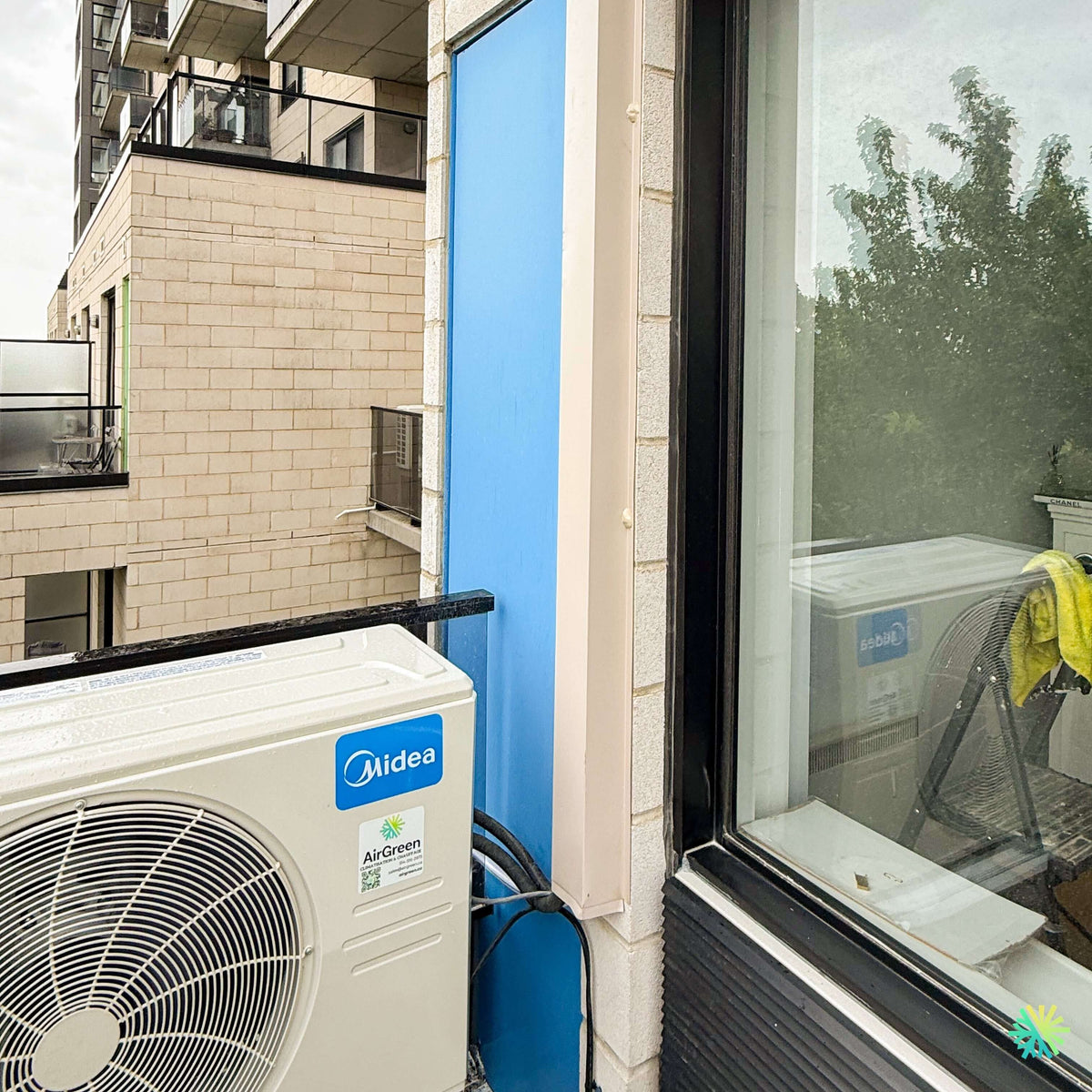
The jobsite photo shows a particularly interesting configuration. The MIDEA condenser is installed on a relatively narrow balcony of a residential building, near a large glazed surface and a guardrail. Between the unit and the window, we have a compact technical passage where the lines can enter the building. A long beige vertical line cover protects and conceals the mechanical installation against the wall, while the connections are grouped behind the outdoor unit rather than left scattered across the balcony.
The result is clean and consistent with the existing architecture. In this type of project, we aim precisely for this balance: installing a high-performance heat pump without turning the balcony into a cluttered mechanical space.
Why a dual-zone heat pump was particularly relevant here
A multi-zone heat pump uses a single outdoor unit to power several indoor units. In a dual-zone installation, two spaces can therefore be heated and cooled from a single outdoor condenser. MIDEA specifies that the indoor units of a multi-zone system can be controlled individually and set according to the desired temperature in each room.
This configuration is particularly interesting when outdoor space is limited, as on this balcony in Beloeil. Instead of installing two independent condensers and taking up a much larger portion of the balcony, we can group the system around a single outdoor unit.
For the homeowner, this also means that the two zones do not have to have exactly the same needs at the same time. A room exposed to sunlight may require more cooling while another needs far less capacity. MIDEA documentation specifically explains that its multi-zone system offers different capacities and several indoor-unit styles to adapt to the size and layout of the rooms.
The indoor units in this installation are not visible in the provided photo, but that is precisely the purpose of the MIDEA 28 dual-zone configuration: to distribute comfort between two zones while maintaining a single mechanical unit outdoors.
The MIDEA 28 and modulation: a detail that changes the system's behavior
One of the important advantages of a modern multi-zone heat pump is its ability to avoid operating only in full-power on-off mode.
MIDEA technical documentation indicates that inverter technology adjusts system capacity by controlling the compressor and fan motors according to changes in temperature. When not all zones require their full capacity, the system can operate at partial load to reduce its energy consumption.
In a home, this becomes particularly relevant with two zones. The needs of a bedroom, living room, office, or open space do not necessarily follow the same schedule. A properly sized system can therefore adjust its operation more precisely than a unit that would have to constantly treat the entire home in the same way.
Performance depends on the exact combination of units
With a multi-zone system, a common mistake should be avoided: considering only the capacity listed on the condenser and assuming that all indoor-unit combinations will deliver exactly the same performance.
In the MIDEA documentation provided, the 27,000 BTU/h Extreme Heat platform, which is part of this multi-zone configuration, is listed with values of up to 23 SEER2, 12.5 EER2, and 10.5 HSPF in the certified combination presented by the manufacturer. The table associates this configuration with the outdoor model MO4HX-H27B-2A.
However, these figures should not be automatically applied to just any dual-zone installation. With a multi-zone heat pump, the exact combination of the condenser and indoor units determines the applicable AHRI rating. That is why, at AirGreen, we place as much importance on equipment matching as we do on choosing the outdoor capacity.
The vertical routing of the lines: one of the most visible details of the installation
In the photo of this installation in Beloeil, one element immediately draws our attention: the large beige vertical line set cover installed between the building's blue siding and the window.
It serves several functions.
The refrigerant lines, communication wiring, and other technical elements must reach the indoor units while remaining protected from the elements and physical damage. Leaving them visible would have created a much less tidy collection of pipes and cables along the facade.
Here, the line set cover instead forms a clean vertical line that blends in with the building's colors. It is an aesthetic detail, but also a durability detail.
On a HVAC installation in Beloeil, particularly in a condo or a building with stacked balconies, this type of finish can make a considerable difference in the installation's final appearance.
SynchroConnect: a particularly useful technology for multi-zone installations
The more connections a system has, the more important it becomes to correctly identify the circuits. MIDEA incorporates its SynchroConnect technology into this family of systems.
According to the manufacturer's documentation, the system can diagnose the correspondence between the wiring and refrigerant lines and synchronize the connections in certain situations where the ports do not initially match.
For an installer, this function obviously does not replace methodical work. Rather, it provides an additional layer of control on a system where multiple refrigeration and electrical circuits converge at the same condenser.
With a dual-zone heat pump, we must always be able to clearly identify which line and circuit correspond to each indoor unit.
This MIDEA 28 installation in Beloeil shows why installation details matter just as much as the machine
Positioning a condenser on a balcony without sacrificing space
The outdoor unit visible in the photo is installed near the perimeter of the balcony rather than in the middle of the usable space. Its fan remains directed toward an open area, which is essential: the air discharged by a condenser must not be trapped directly in front of the unit.
The proximity of the large window also requires careful planning.
We must maintain the clearances specified by the manufacturer, avoid excessive air recirculation, preserve reasonable access to the connections, and account for future HVAC maintenance work. Installing a condenser is therefore not simply a matter of finding a place where its physical dimensions allow it to be set down.
A space that seems sufficient during installation can become problematic when a technician needs to access the valves, remove a panel, or perform diagnostics a few years later.
Noise and vibrations deserve even more attention near a window
In this configuration in Beloeil, the outdoor unit is located immediately next to the home. This makes vibration control particularly important.
On this type of project, we pay particular attention to the installation's stability, mounting points, vibration transmission to the structure, and how the lines enter the building. A rigid line that unnecessarily touches a surface can transmit more vibration than a properly supported installation.
Choosing a variable-capacity heat pump also contributes to acoustic comfort. When a unit does not need to operate at maximum capacity continuously, its operating rate can vary according to the actual load.
Sizing the two zones is not simply a matter of adding numbers
A common mistake with multi-zone heat pumps is to select two indoor units solely according to their rated capacity, then check whether the condenser can accommodate them.
We proceed in the opposite direction: we assess the needs of each space and then verify the combinations permitted by the manufacturer.
MIDEA documentation also includes several tables of indoor-unit combinations. The manufacturer expressly warns that when the total capacity of the indoor units exceeds the condenser's rated capacity, the capacity actually available to each unit may decrease, particularly in heating mode.
This is particularly important in Quebec.
A combination that seems more than sufficient to cool two rooms in July must also be evaluated when it is very cold in Beloeil in January. Sizing must therefore consider low-temperature heating performance, not just the cooling capacity displayed in large characters on a technical data sheet.
The errors we seek to eliminate in a dual-zone installation
For a project like this, our attention focuses in particular on the following points:
- avoid exposed or poorly supported refrigerant lines;
- observe the necessary clearances around the condenser;
- protect outdoor lines with an appropriate finish;
- maintain access to panels and connections for servicing;
- check each combination of indoor units against the manufacturer's data;
- properly plan for condensate drainage;
- limit the transmission of vibrations to the building;
- check the electrical circuit and the protections required for the unit;
- properly perform the evacuation and leak checks before commissioning;
- confirm that each zone responds to the correct control and the correct refrigerant circuit.
These details, often invisible once the work is complete, are what determine whether a heat pump installation will simply work “properly” or will actually deliver the performance, quiet operation, and reliability expected for several years.
A cleaner installation thanks to a single condenser
The photo from Beloeil also shows one of the most concrete arguments in favor of a MIDEA dual-zone heat pump: its outdoor footprint.
Even with two heating and cooling zones, only one condenser is needed. MIDEA also describes the multi-zone principle as a way to reduce outdoor installation space and the number of noise sources by connecting several indoor units to the same outdoor unit.
On a house with a large yard, this benefit is appreciable. On a balcony, it becomes much more significant.
In this project, the condenser, connections, and line-hide cover were grouped into a relatively narrow strip beside the window. The rest of the balcony remains much less cluttered than it would have been if two independent systems had been installed.
Hydro-Québec rebates: eligibility must be verified for the exact combination
Homeowners in Beloeil, Montréal, Laval, Longueuil, the North Shore, and the South Shore regularly ask us whether a multi-zone heat pump can qualify for financial assistance.
In September 2026, Hydro-Québec's LogisVert program provides, when all conditions are met, an incentive of $120 per 1,000 BTU/h at -8 °C for a cold-climate ENERGY STAR certified heat pump, compared with $50 per 1,000 BTU/h for certain eligible ENERGY STAR heat pumps. The final amount depends, among other things, on the capacity recognized by the program and the installation date.
Since June 15, 2026, certain eligible multi-unit residential buildings may also qualify for an enhanced incentive bringing the assistance to $220 per 1,000 BTU/h at -8 °C, provided they meet the program's specific criteria, particularly those related to the building and the installed heat pump.
However, it is essential not to determine an installation's eligibility simply because the condenser bears the MIDEA brand or belongs to a cold-climate product line.
For a dual-zone heat pump, we must verify the complete combination: outdoor model, indoor models, and corresponding performance reference. The amount of financial assistance should therefore not be calculated solely based on the commercial name “MIDEA 28.”
What we take away from this Beloeil installation
This project is a good example of our approach at AirGreen: the equipment and its installation are two parts of the same system.
Choosing a MIDEA 28 dual-zone system makes it possible here to serve two spaces with a single outdoor unit. But the project's visible success also rests on much more concrete decisions: positioning the condenser in a restricted space, maintaining adequate airflow, organizing the connections behind the unit, and using a vertical line-set cover that integrates cleanly with the building.
These are exactly the constraints we regularly encounter in residential installations in Beloeil, Montreal, Laval, Longueuil, on the South Shore and the North Shore. A heat pump should never be chosen solely based on a BTU rating or an advertised price. The location, the two heating and cooling loads, piping distances, available electrical capacity, condensate drainage options, and maintenance requirements all factor into the decision.
For a homeowner considering a dual-zone heat pump, this Beloeil project also demonstrates the value of carrying out an assessment before ordering the equipment. An on-site visit makes it possible to determine where the condenser can actually be installed, how the lines can be routed cleanly, and which capacities are suitable for each of the two zones.
At AirGreen, our goal is for the finished installation to be as technically sound as it is visually clean. On this MIDEA 28 project in Beloeil, the balcony imposed very specific constraints. The visible result shows that a well-planned multi-zone system can fit into a tight space while maintaining a discreet finish, functional access, and the benefits of true independent heating and cooling in two zones.
The job tools
Two quick checks with real numbers: what heat costs, and what your current heaters add up to in BTU/h.
Conversion: 1 W = 3.412 BTU/h. An indication, not a load calculation: baseboards and furnaces are often stronger than the real need, and they can stay as backup. AirGreen confirms the capacity on site.
How the job unfolds
The main steps of this kind of job at AirGreen. Every house has its quirks: the estimate brings them out.
We look at the room, the outside wall, the line route and where the outdoor unit will go. That is where the capacity gets chosen.
Model, capacity and price, in writing. We also check whether the model qualifies for assistance programs.
Floors and furniture protected, wall plate position marked level, wall opening located.
A single opening, with the slope the drain needs to flow outside.
Set on a stand raised above the snow, with the clearances the manufacturer requires.
Connected, insulated and protected. The opening is then sealed against water, cold air and insects.
A dedicated circuit and an accessible disconnect near the outdoor unit.
Leak test, vacuum, then start-up and a check of heating and cooling.
Remote, modes, filters: we show you the essentials before we leave.
- The on-site estimateWe look at the room, the outside wall, the line route and where the outdoor unit will go. That is where the capacity gets chosen.
- The quoteModel, capacity and price, in writing. We also check whether the model qualifies for assistance programs.
- Getting readyFloors and furniture protected, wall plate position marked level, wall opening located.
- The wall openingA single opening, with the slope the drain needs to flow outside.
- The outdoor unitSet on a stand raised above the snow, with the clearances the manufacturer requires.
- Lines, cable and drainConnected, insulated and protected. The opening is then sealed against water, cold air and insects.
- The electrical workA dedicated circuit and an accessible disconnect near the outdoor unit.
- Tests and start-upLeak test, vacuum, then start-up and a check of heating and cooling.
- The walkthroughRemote, modes, filters: we show you the essentials before we leave.
What we check on a job like this one
Each number is a point we check on site. Switch between summer and winter to watch air and heat move.
In summer, the outdoor unit rejects the house's heat outside.
Generic illustration of this type of installation, not a survey of this job site. Tap a number.
Mounted level on a wall plate, high enough for the air to reach the whole room, with enough space around it to slide the filters out easily.
The refrigerant lines, the communication cable and the drain go through the wall in a single opening, sealed against water, cold air and insects.
Two insulated copper pipes connect the two units. Outside, a line cover can protect them from sun, knocks and weather.
A shut-off switch near the outdoor unit isolates it safely for service. It must stay accessible at all times.
The compressor and the fan. In heating mode it captures heat from the outdoor air, even in winter, and moves it inside.
On the ground or on the wall, it keeps the unit above accumulated snow. The unit stays clear and defrost water can drain away.
The fan needs to blow freely. Storage, a fence or a wall too close, and efficiency drops while noise goes up.
Is your home ready?
Check what applies at your place. A "no" is not a refusal: it is what we sort out during the estimate.
Good habits, once the unit is in place
Six simple habits that keep the unit going. Your list stays on this device.
What to do, season by season
Three habits per season for this unit. They take a few minutes and prevent many calls.
- Clean the indoor unit's filters.
- Clear leaves and debris left on the outdoor unit by winter.
- Test cooling before the first hot days.
- Clean the filters more often when the unit runs a lot.
- Keep plants away from the outdoor unit.
- Check that no water drips from the indoor unit.
- Rake the leaves around the outdoor unit.
- Test heating before the first cold days.
- Book periodic maintenance before winter.
- Keep snow away from the stand and the front of the unit.
- Let the unit defrost: it is normal.
- Never hit the ice on the fins; call us if the unit stays iced up.
The right pages, at the right time
Four statements: true or false?
It all comes down to details you have just seen.
1. In heating mode, the outdoor unit can produce water.
During defrost cycles. That water must drain away without forming ice.
2. You pick the capacity with a simple square-footage rule.
Windows, insulation, orientation and how the room is used all count. Capacity is chosen on site.
3. A multi-zone connects several indoor heads to a single condenser.
One head per room, all on the same condenser. Each room keeps its own temperature.
4. The disconnect can sit behind the patio furniture.
It must stay accessible: it is what shuts the unit off for service.
0 / 4 right answers
What people ask us about this kind of work
Does a wall-mounted heat pump heat in winter?
Wall-mounted or multi-zone: how do I choose?
Where does the outdoor unit go?
Are there grants?
Do I need a permit?
How cold can it heat?
How much can I save?
How is the LogisVert assistance calculated?
Is it noisy?
The outdoor unit is covered in ice: is that normal?
Does AirGreen hold the required licences?
Is the estimate free?
No question matches. Write to us: we answer.
More jobs to see, near you
By town, by equipment or by region: browse more than 4,700 published projects.
Each dot: a town where AirGreen has published projects. The glowing dot: this job.
An on-site estimate, the right capacity, the right equipment.
The on-site estimate is free and the quote follows within 24 hours.
Text and photo: a real AirGreen Climatisation & Chauffage job. The diagrams are generic illustrations of the type of installation, not a survey of this job site. Sources of the added figures: airgreen.ca product pages (NEEP / AHRI performance), Hydro-Québec (Heat pumps page, LogisVert, read on 13 October 2026), Régie de l’énergie (rate D as of 1 April 2026).