
Installation of a MIDEA MIDEA 28 dual-zone heat pump in Saint-Paul-de-l’Île-aux-Noix
Installation of a MIDEA MIDEA 28 dual-zone heat pump in Saint-Paul-de-l’Île-aux-Noix: multi-zone configuration, performance, piping route, and AirGreen installation expertise.
In summer, the outdoor unit rejects the house's heat outside.
Generic illustration of this type of installation, not a survey of this job site. Tap a number.
Mounted level on a wall plate, high enough for the air to reach the whole room, with enough space around it to slide the filters out easily.
The refrigerant lines, the communication cable and the drain go through the wall in a single opening, sealed against water, cold air and insects.
Two insulated copper pipes connect the two units. Outside, a line cover can protect them from sun, knocks and weather.
A shut-off switch near the outdoor unit isolates it safely for service. It must stay accessible at all times.
The compressor and the fan. In heating mode it captures heat from the outdoor air, even in winter, and moves it inside.
On the ground or on the wall, it keeps the unit above accumulated snow. The unit stays clear and defrost water can drain away.
The fan needs to blow freely. Storage, a fence or a wall too close, and efficiency drops while noise goes up.
A dual-zone installation designed to cool and heat multiple spaces with a single outdoor unit
In Saint-Paul-de-l’Île-aux-Noix, we completed an installation that clearly illustrates the benefits of a MIDEA MIDEA 28 dual-zone heat pump when a building requires precise control of multiple spaces without multiplying the number of outdoor units.
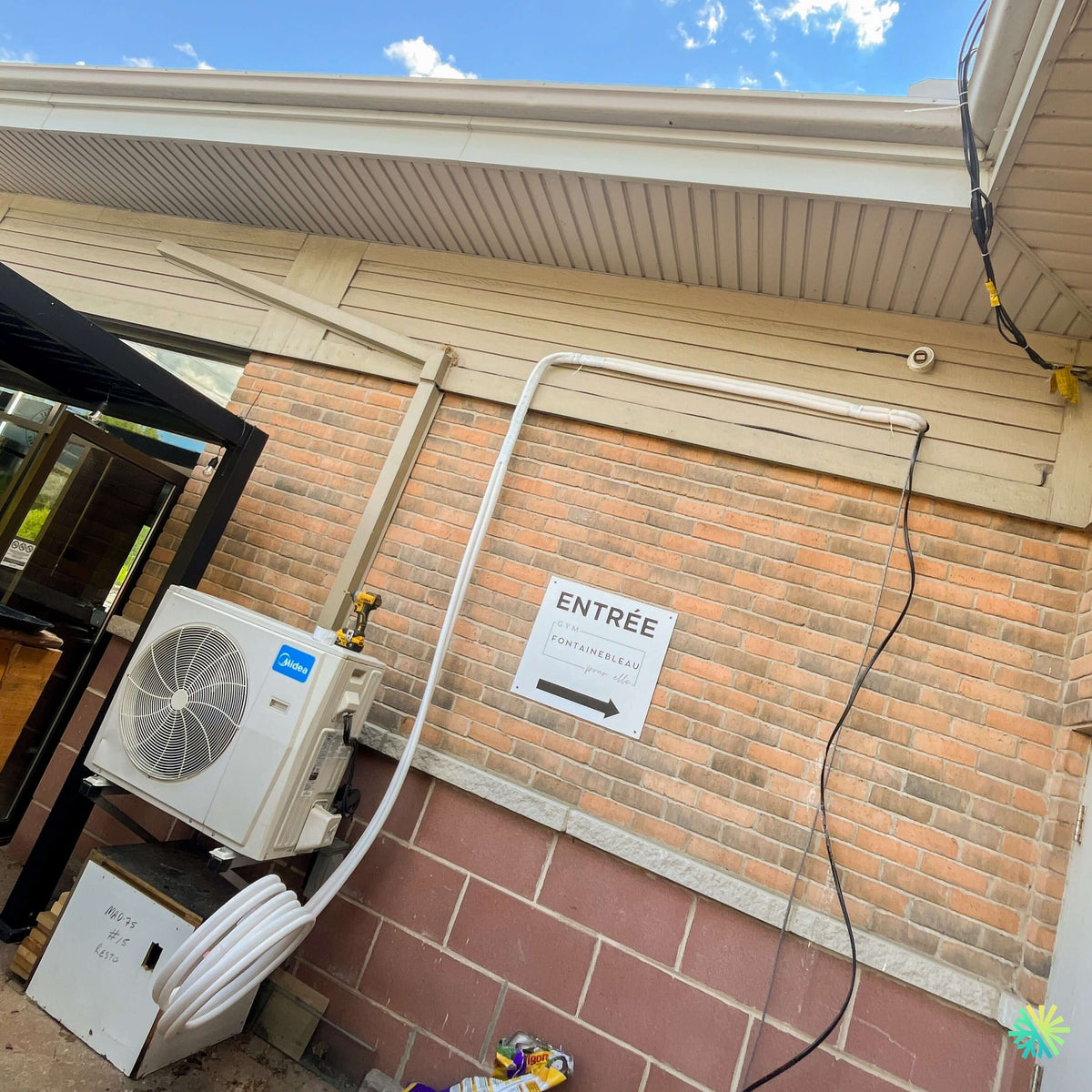
In the project photo, the MIDEA outdoor unit is installed against the building, immediately adjacent to an existing structure. The route of the refrigerant lines is particularly visible: the lines leave the heat pump, run vertically along the brick wall, and then continue horizontally beneath the exterior siding. This configuration allows us to serve the indoor zones while grouping the connections around a single condenser.
The MIDEA multi-zone system is designed precisely for this type of project: a single outdoor unit can be connected to several indoor units, each of which can be controlled individually according to the desired temperature in its space.
For a homeowner in Saint-Paul-de-l’Île-aux-Noix, Montreal, Laval, Longueuil, the South Shore, or the North Shore, this configuration can be particularly appealing when two rooms or areas have different heating and cooling requirements.
Why choose a dual-zone heat pump instead of two independent systems?
A dual-zone heat pump is not simply two wall-mounted air conditioners with a similar appearance. It is a truly integrated system.
In an installation like this, a single outdoor unit supplies several indoor units. This helps reduce the space occupied outdoors and limit the number of compressors around the building. MIDEA documentation specifically highlights this advantage: several indoor units can be connected to a single outdoor unit, reducing installation space and the outdoor noise associated with multiple condensers.
For this project in Saint-Paul-de-l’Île-aux-Noix, this aspect is particularly relevant. The side façade visible in the photo already presents several physical constraints:
- an exterior structure located very close to the equipment;
- a wall combining masonry and cladding;
- relatively low soffits;
- several cables and technical components already present;
- a refrigerant line that must reach the indoor units without unnecessarily cluttering the exterior.
In such a context, installing two independent condensers could have taken up more space and significantly complicated the layout.
The MIDEA 28: a flexible multi-zone platform
The MIDEA multi-zone product line is designed to accommodate several types of indoor units. The technical brochure clearly states that the system is compatible with ducted and ductless configurations.
MIDEA offers, among others, the following types of units:
- wall-mounted units;
- low- or high-static-pressure ducted units;
- consoles;
- one-way cassettes;
- four-way cassettes;
- ceiling/floor units;
- air-handling units.
This diversity is important in HVAC installation, because a building does not necessarily require two identical indoor units. The product line documentation mentions a selection comprising seven types of units and several dozen models, with the option of combining ducted and ductless solutions.
This allows us to adapt the installation to the building’s architectural reality rather than forcing the building to adapt to the equipment.
Two zones, two comfort needs
One of the main advantages of a MIDEA multi-zone heat pump is the ability to adjust the temperature to suit different rooms.
MIDEA documentation explains that each indoor unit can be controlled individually, making it possible to heat or cool only the rooms that need it instead of treating the entire building uniformly.
In practice, this function is useful when the two zones have different heating and cooling loads.
A room exposed to the sun may require substantial cooling while a space on the other side of the building remains comfortable. In winter, a room with several windows may lose more heat than a more protected interior space.
With a properly sized dual-zone installation, we can therefore seek a more precise balance between comfort, energy consumption, and available capacity.
However, it is important to understand an essential characteristic of multi-zone systems: the indoor units share the condenser’s capacity. MIDEA also points out that when the total capacity requested by the indoor units exceeds the outdoor unit’s rated capacity, the capacity actually available to each unit may decrease, a phenomenon that is particularly noticeable in heating mode.
This is precisely why sizing should never be based solely on adding up the figures listed on the indoor units.
What we notice about this installation in Saint-Paul-de-l’Île-aux-Noix
The site photo shows several details that are important from the installer’s perspective.
The MIDEA outdoor unit is positioned near the building
The heat pump is installed against the exterior wall, in an area where it remains accessible for maintenance and future service work.
The location of a condenser must take into account not only aesthetics, but also:
- air circulation;
- the clearances specified by the manufacturer;
- access to the service panel;
- drainage during defrost cycles;
- possible snow accumulation;
- noise transmitted to the structure;
- the route required for the refrigerant lines.
A convenient location today that makes the unit inaccessible in five years is not a good installation.
The routing of the lines is an important part of the work
In this installation, the insulated lines running up along the wall before continuing horizontally beneath the siding are clearly visible.
A dual-zone installation requires more planning than a simple mini-split system. Each indoor unit has its own connection circuit to the outdoor unit, and the layout of these lines directly affects the final result.
The following must be managed simultaneously:
- refrigerant lines;
- insulation;
- communication wiring;
- condensate drainage;
- changes in direction;
- the mechanical protection of the ducts;
- the distances permitted by the manufacturer.
Poor route planning can easily turn a relatively discreet installation into a network of ducts that is difficult to maintain.
Inverter technology suited to multi-zone operation
The MIDEA range uses inverter technology, which allows the operating capacity to be adjusted according to actual demand.
According to the manufacturer’s documentation, the system adjusts its output by controlling the compressor and fan motors. When all rooms do not need to be conditioned simultaneously, the system can operate at partial load rather than continuously at full capacity.
This modulation is particularly beneficial in a two-zone installation.
For example, when only one zone calls for heating, the system does not necessarily need to operate as if both spaces were simultaneously at full load. The desired result is operation better suited to the building’s actual needs.
Performance, capacity, and technical selection of a MIDEA multi-zone system
The MIDEA brochure presents several Extreme Heat multi-zone outdoor units. Depending on the certified combination, the specifications vary considerably.
For example, the documentation provides the following information for non-ducted Extreme Heat configurations:
- Approximately 18,000/19,000 BTU/h depending on the mode for the MO3HX-H18B-2A, with SEER2 25 and AHRI reference 215471457;
- 27,000 BTU/h for the MO4HX-H27B-2A, with SEER2 23 and AHRI reference 215471460;
- 36,000 BTU/h for the MO5HX-H36B-2A, with SEER2 23 and AHRI reference 215471463;
- 47,000/49,000 BTU/h for the MO6HX-H48B-2A, with SEER2 23 and AHRI reference 215471466.
The exact outdoor model number is not legible in the photo of this installation. We therefore avoid arbitrarily assigning one of these AHRI references to this specific project.
This is an important distinction for homeowners shopping for a heat pump in Saint-Paul-de-l’Île-aux-Noix: a commercial designation such as MIDEA 28 is not enough to determine the certified performance of an installation. The outdoor model, indoor models, and certified combination must be verified together.
Why the AHRI number matters so much
When a customer compares two quotes for multi-zone heat pumps, we recommend not looking only at the displayed number of BTUs.
Final performance depends on the certified combination.
Two systems from the same product line may have:
- different capacities;
- a different SEER2;
- different heating performance;
- different indoor unit combinations;
- different AHRI references.
This verification becomes even more important when financial assistance is being considered.
Eligibility for a heat pump rebate in Quebec should never be promised simply because a brand or series appears to be eligible. The exact model and installed combination must be confirmed according to the program criteria in effect at the time of the project.
A common mistake: oversizing the indoor units
With a dual-zone system, it can be tempting to choose a very large indoor unit for each room “just in case.”
This reasoning is often flawed.
The manufacturer explicitly points out that a total indoor load greater than the outdoor unit’s rated capacity results in a reduction in the capacity actually available to each zone.
We therefore analyze the actual needs of the spaces rather than automatically adding up the largest available units.
Proper sizing takes into account, among other factors:
- floor area;
- insulation levels;
- the amount of glazing;
- solar exposure;
- ceiling height;
- the number of occupants;
- internal heat gains;
- the room layout;
- the actual heating needs in very cold weather.
Another mistake is thinking that a multi-zone system works exactly like two single-zone systems
Two indoor units connected to the same condenser share a common refrigeration platform.
This offers many advantages, but it is important to understand this architecture before purchasing.
A homeowner who wants complete independence between two systems, including at the outdoor-unit level, may sometimes be better served by two separate single-zone systems. Conversely, when the goal is to reduce the number of condensers, simplify the outdoor layout, and manage several rooms with a single outdoor heat pump, the dual-zone option is often highly relevant.
At AirGreen, our role is precisely to determine which of these approaches suits the building.
A clean installation is not judged only on the day it is commissioned
On a job like the one in Saint-Paul-de-l’Île-aux-Noix, we also consider what will happen several years later.
A technician will eventually need access to:
- to the service valves;
- to the electrical connections;
- to the fan;
- to the control board;
- to the indoor units;
- to the drains;
- to the refrigerant connections.
The equipment layout and piping route must therefore remain logical for HVAC maintenance and future repairs.
This is one of the differences between an installation that is simply functional and one designed as a lasting system.
What the MIDEA lineup allows when a project evolves
Another interesting aspect of the MIDEA multi-zone platform is its flexibility.
The documentation indicates that certain configurations can combine an air handler with ductless units and that one system can serve spaces that are difficult to heat or cool with the existing ductwork.
The brochure also presents systems that support multiple zones, with different capacities depending on the condenser selected.
This flexibility is particularly useful in properties where needs change: additions, finished basements, offices, rooms above garages, or areas poorly served by a central system.
Our approach at AirGreen for a two-zone installation
Before proposing a MIDEA two-zone heat pump, we first seek to understand how the building is actually used.
We check the two zones, their approximate loads, the possible locations for the indoor units, the outdoor route, the line-set length, the electrical supply, and where the outdoor unit can be installed without creating access or airflow problems.
Next comes the less visible but essential part of the work: preparing the connections, pulling a vacuum, checking the circuit, completing the electrical and communication wiring, installing the drainage, testing, and commissioning.
For the customer, the completed installation often comes down to two indoor units and one condenser. For us, the quality of the result depends mainly on everything between these three devices.
This Saint-Paul-de-l’Île-aux-Noix project in a few points
This project brings together several characteristics representative of a professional multi-zone HVAC installation:
- a MIDEA MIDEA 28 two-zone heat pump;
- a single outdoor unit serving multiple spaces;
- a refrigerant-line route adapted to a façade featuring brick, siding, and soffit;
- an installation designed for an outdoor space already occupied by several elements;
- inverter technology capable of adapting operation to demand;
- an architecture allowing separate control of the different zones.
The MIDEA multi-zone system should therefore not be viewed solely as a way to “connect two heads to one machine.” Its value lies in the combination of sizing, unit selection, zone control, efficiency, and installation quality.
Are you considering a two-zone heat pump in Montreal, Laval, Longueuil, on the South Shore, or the North Shore?
At AirGreen, we install wall-mounted, multi-zone, ducted, and central heat pumps in Greater Montreal.
For a project similar to the one completed in Saint-Paul-de-l’Île-aux-Noix, we can assess the building configuration, determine the appropriate capacities for each zone, and choose the MIDEA combination that matches the customer’s actual needs.
Before comparing prices alone, we recommend comparing the exact condenser model, the proposed indoor units, the AHRI reference, the certified performance, the line-set routing, and the overall installation quality.
A well-chosen heat pump starts with the right equipment. A heat pump that will operate properly for years starts with an installation that respects every detail.
How it goes, from the first call to the end
The main steps of this kind of job at AirGreen. Every house has its quirks: the estimate brings them out.
We look at the room, the outside wall, the line route and where the outdoor unit will go. That is where the capacity gets chosen.
Model, capacity and price, in writing. We also check whether the model qualifies for assistance programs.
Floors and furniture protected, wall plate position marked level, wall opening located.
A single opening, with the slope the drain needs to flow outside.
Set on a stand raised above the snow, with the clearances the manufacturer requires.
Connected, insulated and protected. The opening is then sealed against water, cold air and insects.
A dedicated circuit and an accessible disconnect near the outdoor unit.
Leak test, vacuum, then start-up and a check of heating and cooling.
Remote, modes, filters: we show you the essentials before we leave.
- The on-site estimateWe look at the room, the outside wall, the line route and where the outdoor unit will go. That is where the capacity gets chosen.
- The quoteModel, capacity and price, in writing. We also check whether the model qualifies for assistance programs.
- Getting readyFloors and furniture protected, wall plate position marked level, wall opening located.
- The wall openingA single opening, with the slope the drain needs to flow outside.
- The outdoor unitSet on a stand raised above the snow, with the clearances the manufacturer requires.
- Lines, cable and drainConnected, insulated and protected. The opening is then sealed against water, cold air and insects.
- The electrical workA dedicated circuit and an accessible disconnect near the outdoor unit.
- Tests and start-upLeak test, vacuum, then start-up and a check of heating and cooling.
- The walkthroughRemote, modes, filters: we show you the essentials before we leave.
And at your place?
Two quick checks with real numbers: what heat costs, and what your current heaters add up to in BTU/h.
Conversion: 1 W = 3.412 BTU/h. An indication, not a load calculation: baseboards and furnaces are often stronger than the real need, and they can stay as backup. AirGreen confirms the capacity on site.
What to do, season by season
Three habits per season for this unit. They take a few minutes and prevent many calls.
- Clean the indoor unit's filters.
- Clear leaves and debris left on the outdoor unit by winter.
- Test cooling before the first hot days.
- Clean the filters more often when the unit runs a lot.
- Keep plants away from the outdoor unit.
- Check that no water drips from the indoor unit.
- Rake the leaves around the outdoor unit.
- Test heating before the first cold days.
- Book periodic maintenance before winter.
- Keep snow away from the stand and the front of the unit.
- Let the unit defrost: it is normal.
- Never hit the ice on the fins; call us if the unit stays iced up.
Which type of equipment for your project?
Pick what looks like your need.
Four mistakes we do not make
Flip each card to see what we do instead.
What people ask us about this kind of work
Does a wall-mounted heat pump heat in winter?
Wall-mounted or multi-zone: how do I choose?
Where does the outdoor unit go?
Are there grants?
Do I need a permit?
How cold can it heat?
How much can I save?
How is the LogisVert assistance calculated?
Is it noisy?
The outdoor unit is covered in ice: is that normal?
Does AirGreen hold the required licences?
Is the estimate free?
No question matches. Write to us: we answer.
Useful pages for what comes next
More jobs to see, near you
By town, by equipment or by region: browse more than 4,700 published projects.
Each dot: a town where AirGreen has published projects. The glowing dot: this job.
Tell us about your house. We come and see it for free.
The on-site estimate is free and the quote follows within 24 hours.
Text and photo: a real AirGreen Climatisation & Chauffage job. The diagrams are generic illustrations of the type of installation, not a survey of this job site. Sources of the added figures: airgreen.ca product pages (NEEP / AHRI performance), Hydro-Québec (Heat pumps page, LogisVert, read on 13 October 2026), Régie de l’énergie (rate D as of 1 April 2026).