
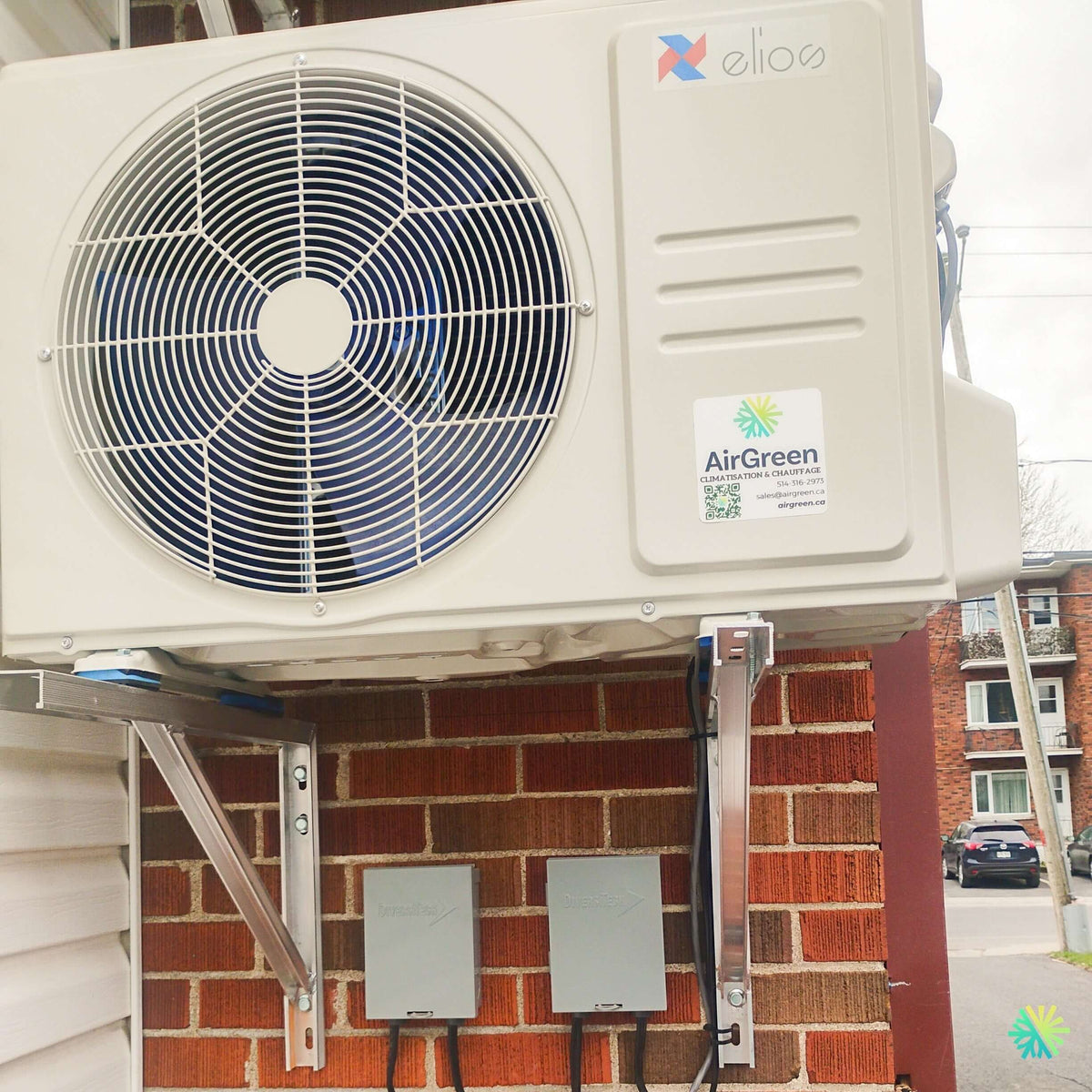
Installation of an ELIOS EMC wall-mounted heat pump in Saint-Cyprien-de-Napierville on an anti-vibration wall bracket
An ELIOS EMC wall-mounted heat pump installed on an elevated support in Saint-Cyprien-de-Napierville, with anti-vibration pads, winter clearance, and a configuration adapted to Quebec’s cold climate.
Take a tour of the installation
Each number is a point we check on site. Switch between summer and winter to watch air and heat move.
In summer, the outdoor unit rejects the house's heat outside.
Generic illustration of this type of installation, not a survey of this job site. Tap a number.
Mounted level on a wall plate, high enough for the air to reach the whole room, with enough space around it to slide the filters out easily.
The refrigerant lines, the communication cable and the drain go through the wall in a single opening, sealed against water, cold air and insects.
Two insulated copper pipes connect the two units. Outside, a line cover can protect them from sun, knocks and weather.
A shut-off switch near the outdoor unit isolates it safely for service. It must stay accessible at all times.
The compressor and the fan. In heating mode it captures heat from the outdoor air, even in winter, and moves it inside.
On the ground or on the wall, it keeps the unit above accumulated snow. The unit stays clear and defrost water can drain away.
The fan needs to blow freely. Storage, a fence or a wall too close, and efficiency drops while noise goes up.
A Compact, Sturdy Outdoor Installation Adapted to Montérégie's Winters
In Saint-Cyprien-de-Napierville, winter temperatures, snow accumulation, and repeated freeze-thaw cycles place real demands on heating equipment installed outdoors. For this project, we installed an ELIOS EMC wall-mounted heat pump, a system designed to provide heating and cooling for a residential space without requiring a duct network.
The site photo shows an installation carried out on an exterior brick wall using a sturdy metal wall bracket. The outdoor unit is thus kept well above the ground, reducing its exposure to snow, runoff, leaves, and debris.
This configuration is particularly relevant in a municipality like Saint-Cyprien-de-Napierville, where the space available around a property may be limited and a ground installation is not always the best solution. Wall mounting also keeps the area around the building clear while making the unit easier to access for inspections and HVAC maintenance.
A Careful Assessment of the Building Before Installing the Equipment
A wall-mounted heat pump should never be positioned solely based on available space. Before drilling into the masonry, we must consider several factors:
- the strength of the wall and the condition of the mortar joints;
- the height required to limit snow accumulation;
- the proximity of windows, entrances, and property lines;
- air circulation in front of and behind the unit;
- the clearance required for maintenance;
- the route of the refrigerant lines;
- the location of the electrical connections;
- the potential transmission of vibrations to the structure.
In this installation, the support rests on two vertical rails anchored to the masonry. Triangular braces support the unit and distribute its load across several attachment points. This structure is preferable to an improvised mounting or an undersized shelf, especially when an outdoor unit must remain stable despite the weight of ice and the vibrations produced during operating cycles.
Visible anti-vibration pads beneath the unit
The blue components placed between the heat pump and its support are anti-vibration pads. Their purpose is to reduce the direct transmission of mechanical vibrations to the supports and the brick wall.
This addition may seem minor, but it plays an important role in acoustic comfort. An outdoor unit with an Inverter compressor generally operates at different speeds. Certain frequencies can create resonance if the unit is mounted directly on a rigid structure without proper mechanical isolation.
We therefore pay particular attention to:
- to uniformly tightening the bolts;
- to aligning the bracket;
- to leveling the unit;
- to the presence of undesirable contact points;
- to the rigidity of the wall;
- to insulating the lines passing through the building envelope.
The goal is not merely to achieve a visually straight installation. It is also necessary to prevent a slight vibration outdoors from becoming a noticeable hum indoors.
Accessible and clearly separated electrical power supply
Two outdoor electrical boxes are visible beneath the unit. This arrangement allows the disconnect and protection components to be grouped in an area accessible to technicians.
For a wall-mounted heat pump installation, the circuit rating must be selected based on the outdoor unit’s nameplate, particularly the minimum circuit ampacity and the maximum permitted protection. Selecting a circuit breaker solely based on the number of BTUs would be incorrect.
In the ELIOS EMC range, the maximum outdoor protection varies according to capacity:
- 9,000 BTU: 15 A;
- 12,000 BTU: 15 A;
- 18,000 BTU: 20 A;
- 24,000 BTU: 25 A;
- 33,000 BTU: 35 A.
All capacities presented in the documentation operate on a 208 to 230 V, single-phase, 60 Hz power supply. However, the precise capacity of the pictured unit cannot be confirmed from the exterior view alone; it must be verified on the nameplate or in the installation records.
ELIOS EMC: a range available from 9,000 to 33,000 BTU
The ELIOS EMC series includes five rated air-conditioning capacities, allowing the system to be adapted to different floor areas and thermal loads:
| Rated capacity | Maximum TRÉS2 | CPSC2 Region V | Rated heating |
|---|---|---|---|
| 9,000 BTU | 26,0 | 10,1 | 12,000 BTU/h |
| 12,000 BTU | 24,0 | 8,0 | 12,000 BTU/h |
| 18,000 BTU | 21,7 | 8,8 | 18,800 BTU/h |
| 24,000 BTU | 22,3 | 9,6 | 26,000 BTU/h |
| 33,000 BTU | 20,0 | 8,6 | 36,000 BTU/h |
These values demonstrate why sizing should not be reduced to a simple square-footage rule. A professional selection must consider insulation, windows, solar exposure, ceiling height, room configuration, and the building’s heat loss.
An oversized heat pump may reach the requested temperature too quickly, shorten its cycle duration, and control humidity less effectively. An undersized unit, on the other hand, may run almost continuously during the coldest periods.
At AirGreen, we therefore assess the required capacity before recommending an ELIOS EMC heat pump in Saint-Cyprien-de-Napierville, Montreal, Laval, Longueuil, on the North Shore, or on the South Shore.
A heat pump designed to operate down to -30 °C
The EMC series is presented as a range of cold-climate wall-mounted heat pumps. According to the technical documentation, its units can operate in heating mode when the outdoor temperature drops to -30 °C.
The Heat+ technology is designed to increase heating output as the outdoor temperature drops. The range can provide up to 100% of its rated capacity at -15 °C, depending on the manufacturer’s test conditions.
This feature is important in Quebec, but it does not mean that an auxiliary heating system is unnecessary in every property. The capacity actually required depends on the building’s heat loss. In some homes, an electric baseboard heater, furnace, or another heat source may still be necessary during peak periods.
The EMC series also includes a heated condensate pan, designed to limit ice accumulation beneath the outdoor unit. During heating, a heat pump must periodically perform a defrost cycle. The water produced must be able to drain without forming a block of ice that would obstruct the underside of the unit.
The clearance created by the wall bracket visible in the photo directly contributes to this winter management. Defrost water has more space to move away from the base of the unit than it would with an installation that is too low.
R454B refrigerant and integrated leak detection
ELIOS EMC heat pumps use R454B refrigerant. This choice requires installation methods, tools, and procedures adapted to this type of fluid.
The brochure also indicates the presence of a refrigerant leak detection sensor. When a leak is detected, the system can stop operating and activate the fan according to its safety logic.
A compliant installation requires, among other things:
- precisely executed refrigerant connections;
- a leak test;
- proper evacuation;
- verification of operating pressures and temperatures;
- careful protection of the lines;
- strict adherence to the maximum permitted lengths.
Piping diameters differ according to capacity. The 9,000 and 12,000 BTU versions use a 1/4 in. liquid line and a 3/8 in. gas line. The 18,000 BTU model uses 1/4 in. and 1/2 in. lines, while the 24,000 and 33,000 BTU capacities require larger lines.
The maximum permitted length varies from 82 feet to 164 feet, depending on the model. These limits should not be interpreted as a recommendation to routinely use long piping. A short, logical, accessible, and properly protected route generally remains preferable.
Inverter modulation for maintaining a more stable temperature
The Inverter Drive technology allows the compressor to adjust its speed rather than operating only in on or off mode. The documentation mentions compressor frequency control in 1% increments for models in the EMC series.
This modulation can help:
- maintain a more consistent indoor temperature;
- limit sudden comfort fluctuations;
- reduce frequent starts;
- adapt consumption to actual demand;
- improve operation at partial load.
However, the result depends just as much on proper sizing and installation as on the technology itself. A high-performance heat pump that is poorly positioned, incorrectly connected, or oversized will not necessarily deliver the expected results.
The details that turn a functional installation into a durable one
Choosing between a wall-mounted support and a ground-level base
A ground-level base may be appropriate when the terrain is stable, well drained, and sufficiently clear. A wall-mounted support becomes advantageous when you want to:
- free up ground space;
- keep the unit above the snow;
- avoid an area where water accumulates;
- work around a narrow or irregular surface;
- make maintenance around the appliance easier.
The support must nevertheless be suitable for the unit’s weight. Depending on capacity, an EMC outdoor unit weighs approximately 73 to 157 pounds, before taking the support and seasonal loads into account.
The wall structure must also be assessed. Weakened masonry, deteriorated joints, or a fastener placed too close to the edge of the bricks can compromise stability. Anchors must be selected based on the actual material behind the exterior finish.
Common mistakes to avoid during a wall-mounted installation
Installing the unit too close to the ground
A unit placed just a few inches above the ground can quickly become surrounded by compacted snow. Air then circulates less effectively, and defrost water can freeze directly beneath the appliance.
Neglecting vibrations
A metal bracket mounted without isolators can transmit noise to the structure. The problem is often more noticeable at night, when ambient sound levels decrease.
Blocking access to the service panel
Fittings, valves, and panels must remain accessible. An installation wedged against a side wall, fence, or balcony can turn a simple service call into complex work.
Using the wrong pipe diameters
Piping dimensions are not interchangeable. They must match the exact model. An error at this stage can affect refrigerant circulation, oil return, and compressor reliability.
Neglecting water drainage
The indoor unit produces condensation in cooling mode, while the outdoor unit produces water during winter defrost cycles. Both phenomena must be accounted for when designing the HVAC installation.
Acoustic comfort and indoor air quality
Depending on the capacity and selected speed, the indoor sound level of EMC units can drop to approximately 20 dB(A) in quiet mode. This is particularly relevant for installations near a bedroom or in a home where background noise must remain low.
The series also offers:
- a variable-speed indoor fan;
- a turbo mode;
- a “Do Not Disturb” mode;
- an active coil-cleaning function;
- a two-stage filtration system;
- an 8°C freeze-protection mode;
- an automatic restart function;
- an optional wall-mounted controller;
- possible compatibility with a 24 V interface.
The first filter is designed to capture dust, pollen, and pet hair, among other particles. The second contains activated carbon. However, these filters do not replace a specialized air purification system or adequate mechanical ventilation.
Regular cleaning remains necessary to maintain airflow. Clogged filters increase fan strain, reduce efficiency, and promote contaminant buildup on the indoor coil.
ENERGY STAR certification for cold climates
The ELIOS EMC series documentation indicates that all five capacities are ENERGY STAR V6.1 certified, including in the cold climate category. This certification is an important consideration when evaluating certain financial assistance programs.
However, it does not automatically guarantee that a rebate application will be approved. Eligibility generally depends on the exact model, the indoor-outdoor combination, the energy reference number, the purchase date, the building, and the rules in effect when the application is submitted.
We recommend having the following items confirmed before signing a contract primarily based on financial assistance:
- the exact indoor and outdoor unit numbers;
- the certification applicable to this combination;
- the capacity recognized by the program;
- the documents required after installation;
- the criteria specific to the building;
- the application submission deadline.
The EMC brochure lists indoor models EWHMA09C2AS1 to EWHMA33C2AS1 and the corresponding outdoor units ESHMA09C2AN1 to ESHMA33C2AN1.
Long-term warranty and maintenance
The manufacturer’s documentation presents a standard limited warranty of 1 year on parts and 5 years on the compressor, with an option for an extended 10-year warranty on parts and the compressor. Optional 10-year labour coverage may also be offered by a third party.
The actual terms should always be verified in the contract, as product registration, deadlines, maintenance and certain exclusions may affect coverage.
To extend the service life of an ELIOS EMC wall-mounted heat pump, we recommend in particular:
- clean the filters regularly;
- keep the outdoor unit free of snow and vegetation;
- never break the ice with a metal tool;
- monitor for new noises;
- check that defrost water drains properly;
- have the unit inspected when performance declines;
- schedule a thorough coil cleaning according to the environment.
AirGreen’s approach to an installation in Saint-Cyprien-de-Napierville
This project illustrates how we work: adapting the heat pump to the building rather than imposing a standard configuration without considering the site.
The wall bracket, vibration isolators, winter clearance and access to electrical components form a coherent whole. Every detail contributes to the unit’s stability, acoustic comfort, service safety and installation durability.
At AirGreen, we install wall-mounted heat pumps, multi-zone systems and central heat pumps in Montreal, Laval, Longueuil, on the North Shore, on the South Shore and in several municipalities in Montérégie, including Saint-Cyprien-de-Napierville.
Our work goes beyond mounting a unit on the wall. We verify the sizing, clearances, structure, piping, drainage, electrical system and operating conditions so the system can genuinely meet the building’s needs throughout Quebec’s seasons.
The big day, step by step
The main steps of this kind of job at AirGreen. Every house has its quirks: the estimate brings them out.
We look at the room, the outside wall, the line route and where the outdoor unit will go. That is where the capacity gets chosen.
Model, capacity and price, in writing. We also check whether the model qualifies for assistance programs.
Floors and furniture protected, wall plate position marked level, wall opening located.
A single opening, with the slope the drain needs to flow outside.
Set on a stand raised above the snow, with the clearances the manufacturer requires.
Connected, insulated and protected. The opening is then sealed against water, cold air and insects.
A dedicated circuit and an accessible disconnect near the outdoor unit.
Leak test, vacuum, then start-up and a check of heating and cooling.
Remote, modes, filters: we show you the essentials before we leave.
- The on-site estimateWe look at the room, the outside wall, the line route and where the outdoor unit will go. That is where the capacity gets chosen.
- The quoteModel, capacity and price, in writing. We also check whether the model qualifies for assistance programs.
- Getting readyFloors and furniture protected, wall plate position marked level, wall opening located.
- The wall openingA single opening, with the slope the drain needs to flow outside.
- The outdoor unitSet on a stand raised above the snow, with the clearances the manufacturer requires.
- Lines, cable and drainConnected, insulated and protected. The opening is then sealed against water, cold air and insects.
- The electrical workA dedicated circuit and an accessible disconnect near the outdoor unit.
- Tests and start-upLeak test, vacuum, then start-up and a check of heating and cooling.
- The walkthroughRemote, modes, filters: we show you the essentials before we leave.
What would it look like at your place?
Two quick checks with real numbers: what heat costs, and what your current heaters add up to in BTU/h.
Conversion: 1 W = 3.412 BTU/h. An indication, not a load calculation: baseboards and furnaces are often stronger than the real need, and they can stay as backup. AirGreen confirms the capacity on site.
Four mistakes we do not make
Flip each card to see what we do instead.
Your own project, step by step
What to do, season by season
Three habits per season for this unit. They take a few minutes and prevent many calls.
- Clean the indoor unit's filters.
- Clear leaves and debris left on the outdoor unit by winter.
- Test cooling before the first hot days.
- Clean the filters more often when the unit runs a lot.
- Keep plants away from the outdoor unit.
- Check that no water drips from the indoor unit.
- Rake the leaves around the outdoor unit.
- Test heating before the first cold days.
- Book periodic maintenance before winter.
- Keep snow away from the stand and the front of the unit.
- Let the unit defrost: it is normal.
- Never hit the ice on the fins; call us if the unit stays iced up.
Is your home ready?
Check what applies at your place. A "no" is not a refusal: it is what we sort out during the estimate.
Four statements: true or false?
It all comes down to details you have just seen.
1. In heating mode, the outdoor unit can produce water.
During defrost cycles. That water must drain away without forming ice.
2. You pick the capacity with a simple square-footage rule.
Windows, insulation, orientation and how the room is used all count. Capacity is chosen on site.
3. A multi-zone connects several indoor heads to a single condenser.
One head per room, all on the same condenser. Each room keeps its own temperature.
4. The disconnect can sit behind the patio furniture.
It must stay accessible: it is what shuts the unit off for service.
0 / 4 right answers
What people ask us about this kind of work
Does a wall-mounted heat pump heat in winter?
Wall-mounted or multi-zone: how do I choose?
Where does the outdoor unit go?
Are there grants?
Do I need a permit?
How cold can it heat?
How much can I save?
How is the LogisVert assistance calculated?
Is it noisy?
The outdoor unit is covered in ice: is that normal?
Does AirGreen hold the required licences?
Is the estimate free?
No question matches. Write to us: we answer.
More jobs to see, near you
By town, by equipment or by region: browse more than 4,700 published projects.
Each dot: a town where AirGreen has published projects. The glowing dot: this job.
Every house has its constraints. We see them before we install.
The on-site estimate is free and the quote follows within 24 hours.
Text and photo: a real AirGreen Climatisation & Chauffage job. The diagrams are generic illustrations of the type of installation, not a survey of this job site. Sources of the added figures: airgreen.ca product pages (NEEP / AHRI performance), Hydro-Québec (Heat pumps page, LogisVert, read on 13 October 2026), Régie de l’énergie (rate D as of 1 April 2026).