
Installation of a ForestAir E24 wall-mounted heat pump in Salaberry-de-Valleyfield
AirGreen installs a ForestAir E24 wall-mounted heat pump in Salaberry-de-Valleyfield with a professional HVAC approach, providing efficient heating, air conditioning, and lasting comfort for Quebec homes.
- City
- Region
- Equipment
- Brand
- Challenges
- Published
The job on one screen
The article, chapter by chapter
A wall-mounted heat pump installation designed for four-season comfort in a Salaberry-de-Valleyfield home
At AirGreen, we install wall-mounted heat pumps every week in several areas of Quebec, including Salaberry-de-Valleyfield, Montreal, Laval, Longueuil, the North Shore, and the South Shore. Every project has its own particularities: the home's layout, available space for the units, electrical constraints, building insulation, and the homeowner's expectations.
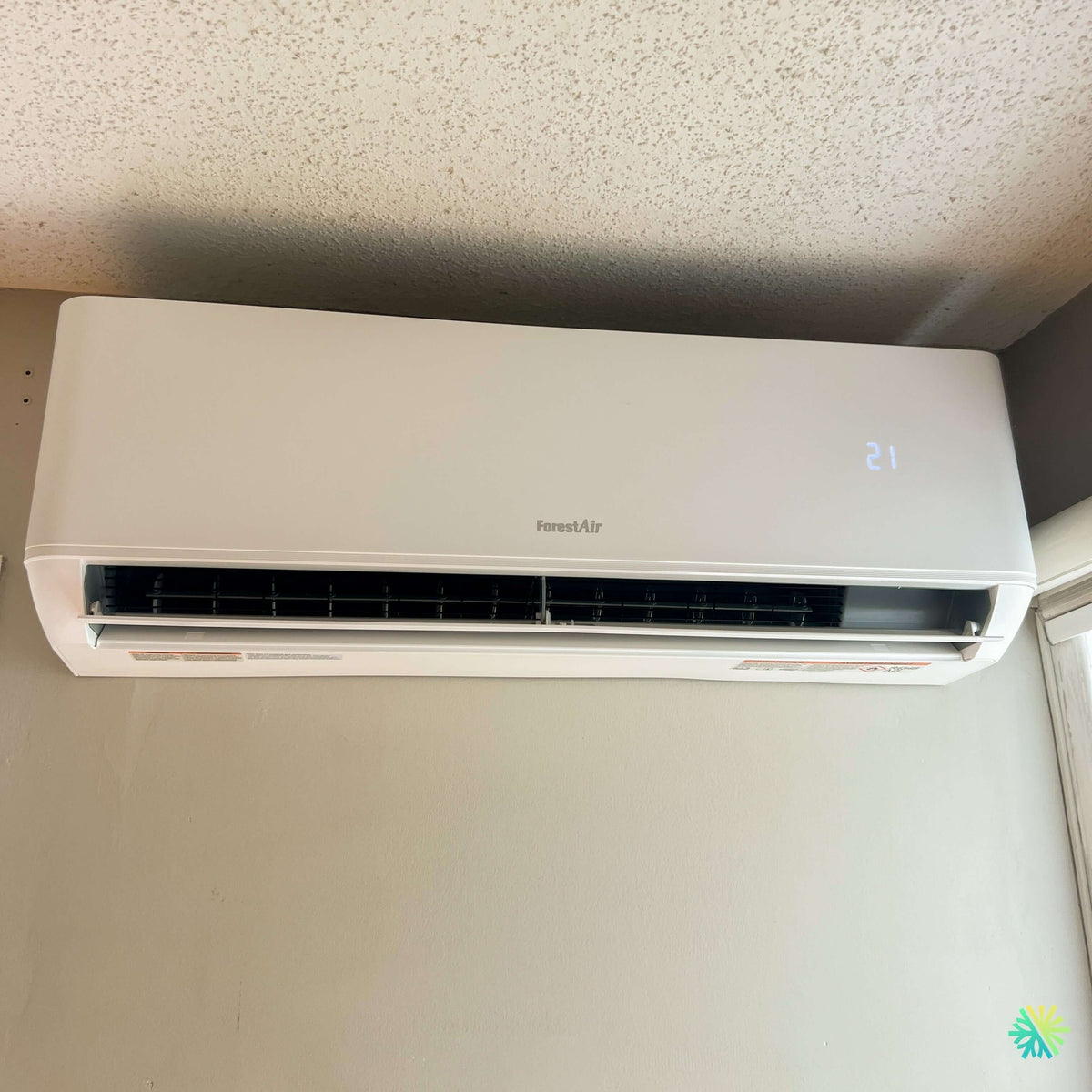
During this installation in Salaberry-de-Valleyfield, our team installed a ForestAir E24 wall-mounted heat pump, a solution suited to homeowners seeking an efficient system to improve indoor comfort during both the hot summer months and the cold days of Quebec winters.
The indoor unit was installed high on an interior wall, near the ceiling, to provide better air distribution throughout the room while maintaining a discreet integration into the residential environment. As can be seen in the installation images, the white unit with its streamlined design blends easily with the walls and ceiling, providing a clean result without compromising the home's aesthetics.
The success of a wall-mounted heat pump installation in Salaberry-de-Valleyfield depends not only on the choice of equipment. Installation quality, unit positioning, compliance with installation standards, and professional commissioning play a major role in long-term performance.
Why choose a ForestAir E24 ductless wall-mounted heat pump for a home in Quebec?
The ForestAir E24 is one of the models designed to meet the needs of Quebec homeowners who want to replace or supplement their existing heating system with a more economical and versatile solution.
This 12,000 BTU ForestAir E24 wall-mounted heat pump uses inverter technology, allowing the compressor to adjust its output according to the home’s actual needs. Unlike a traditional unit that operates only in on or off mode, inverter technology continuously modulates its operation to maintain a more stable temperature.
The main benefits sought by homeowners are:
- Heating and cooling in a single unit
- Reduced electricity consumption through intelligent modulation
- Operation adapted to Quebec’s climatic conditions
- Reduced noise level compared with older air conditioners
- Better room-by-room comfort control
- Possibility of obtaining certain financial incentives depending on the building’s eligibility and the program in effect
The ForestAir E24 R454B model also uses a new-generation refrigerant with a reduced environmental impact compared with older refrigerants. This technological advancement meets the new requirements of the HVAC market, which aim to improve energy efficiency.
The technical details of a professional installation carried out by AirGreen
Installing a wall-mounted heat pump involves more than simply mounting a unit on the wall and connecting a few cables. Several technical steps must be followed to ensure system reliability.
For this installation in Salaberry-de-Valleyfield, our team paid particular attention to the following elements:
Strategic positioning of the indoor unit
The choice of location for the wall-mounted unit directly affects air circulation.
An installation that is too low can reduce the even distribution of warm air. Installing the unit too close to an obstacle can also limit airflow and reduce system efficiency.
In this project, the ForestAir indoor unit was positioned near the ceiling to promote optimal air distribution throughout the room while maintaining a clean visual appearance.
Installation of the outdoor unit
A heat pump’s outdoor unit must be installed in a location that allows for:
- good air circulation;
- easy access for HVAC maintenance;
- effective drainage of defrost water;
- reduced vibrations transmitted to the structure.
In Quebec, this aspect is particularly important during the winter, when the heat pump regularly performs defrost cycles.
Refrigerant connection and leak testing
Our technicians carry out the essential steps before commissioning:
- Installing the refrigerant piping;
- Pressurizing the circuit;
- Checking for leaks;
- Evacuating the system;
- Opening the valves;
- Complete operating tests.
These procedures help protect the compressor and ensure stable performance for many years.
Common mistakes to avoid when installing a wall-mounted heat pump
Many problems encountered in the residential HVAC field stem not from the machine itself, but from improper installation.
Choosing capacity based solely on floor area
A more powerful unit is not always better. An oversized heat pump can cause short cycling, reduce comfort, and lose efficiency.
The calculation must take several factors into account:
- living area;
- ceiling height;
- quality of the insulation;
- orientation of the rooms;
- number of windows;
- winter heat losses.
At AirGreen, we always recommend assessing the building before suggesting a specific model.
Neglecting heat pump maintenance
Even an excellent machine requires regular maintenance.
Professional HVAC maintenance notably allows you to:
- clean the filters and coils;
- check the condition of the drain;
- check the refrigerant pressures;
- check the fan’s operation;
- extend the compressor’s service life.
A well-maintained heat pump generally maintains better energy efficiency and provides more consistent comfort.
Installing the outdoor unit without considering Quebec winters
Salaberry-de-Valleyfield’s winter conditions can be demanding. Ice, snow, and freeze-thaw cycles must be taken into consideration.
A professional installation allows sufficient clearance around the outdoor unit to prevent buildup that could interfere with its operation.
AirGreen’s approach to heat pump installations in Salaberry-de-Valleyfield
Every project completed by AirGreen follows a structured method aimed equally at technical performance and homeowner satisfaction.
Our work begins with an analysis of the actual need:
- Which room needs to be heated or cooled?
- Does the homeowner want to replace an existing air conditioner?
- Will the heat pump be used as the primary or supplementary heating system?
- Is the building eligible for certain financial assistance programs?
This approach avoids recommendations based solely on price or rated capacity.
In many installations completed in Montreal and on the various shores, we encounter similar situations: homes with existing electric heating, limited space for the outdoor unit, condos with electrical constraints, or homeowners who want to improve their comfort without undertaking a major renovation.
A wall-mounted heat pump is often an effective solution because it requires little work while significantly improving everyday comfort.
A solution suited to homeowners in Salaberry-de-Valleyfield and the surrounding areas
Demand for wall-mounted heat pumps in Salaberry-de-Valleyfield continues to grow, particularly because homeowners are looking for solutions capable of handling hotter summers and Quebec winters.
An installation like this ForestAir E24 offers an interesting balance between:
- reasonable investment;
- year-round comfort;
- potential reduction in energy costs;
- ease of use;
- small footprint.
At AirGreen, we install HVAC systems adapted to the realities of Quebec homes. Whether in Montreal, Laval, Longueuil, the North Shore, the South Shore, or Salaberry-de-Valleyfield, our goal remains the same: to provide a clean, safe, and durable installation.
A high-performance heat pump always begins with a precisely completed installation.
The job tools
Two quick checks with real numbers: what heat costs, and what your current heaters add up to in BTU/h.
Conversion: 1 W = 3.412 BTU/h. An indication, not a load calculation: baseboards and furnaces are often stronger than the real need, and they can stay as backup. AirGreen confirms the capacity on site.
How the job unfolds
The main steps of this kind of job at AirGreen. Every house has its quirks: the estimate brings them out.
We look at the room, the outside wall, the line route and where the outdoor unit will go. That is where the capacity gets chosen.
Model, capacity and price, in writing. We also check whether the model qualifies for assistance programs.
Floors and furniture protected, wall plate position marked level, wall opening located.
A single opening, with the slope the drain needs to flow outside.
Set on a stand raised above the snow, with the clearances the manufacturer requires.
Connected, insulated and protected. The opening is then sealed against water, cold air and insects.
A dedicated circuit and an accessible disconnect near the outdoor unit.
Leak test, vacuum, then start-up and a check of heating and cooling.
Remote, modes, filters: we show you the essentials before we leave.
- The on-site estimateWe look at the room, the outside wall, the line route and where the outdoor unit will go. That is where the capacity gets chosen.
- The quoteModel, capacity and price, in writing. We also check whether the model qualifies for assistance programs.
- Getting readyFloors and furniture protected, wall plate position marked level, wall opening located.
- The wall openingA single opening, with the slope the drain needs to flow outside.
- The outdoor unitSet on a stand raised above the snow, with the clearances the manufacturer requires.
- Lines, cable and drainConnected, insulated and protected. The opening is then sealed against water, cold air and insects.
- The electrical workA dedicated circuit and an accessible disconnect near the outdoor unit.
- Tests and start-upLeak test, vacuum, then start-up and a check of heating and cooling.
- The walkthroughRemote, modes, filters: we show you the essentials before we leave.
What we check on a job like this one
Each number is a point we check on site. Switch between summer and winter to watch air and heat move.
In summer, the outdoor unit rejects the house's heat outside.
Generic illustration of this type of installation, not a survey of this job site. Tap a number.
Mounted level on a wall plate, high enough for the air to reach the whole room, with enough space around it to slide the filters out easily.
The refrigerant lines, the communication cable and the drain go through the wall in a single opening, sealed against water, cold air and insects.
Two insulated copper pipes connect the two units. Outside, a line cover can protect them from sun, knocks and weather.
A shut-off switch near the outdoor unit isolates it safely for service. It must stay accessible at all times.
The compressor and the fan. In heating mode it captures heat from the outdoor air, even in winter, and moves it inside.
On the ground or on the wall, it keeps the unit above accumulated snow. The unit stays clear and defrost water can drain away.
The fan needs to blow freely. Storage, a fence or a wall too close, and efficiency drops while noise goes up.
Is your home ready?
Check what applies at your place. A "no" is not a refusal: it is what we sort out during the estimate.
Good habits, once the unit is in place
Six simple habits that keep the unit going. Your list stays on this device.
What to do, season by season
Three habits per season for this unit. They take a few minutes and prevent many calls.
- Clean the indoor unit's filters.
- Clear leaves and debris left on the outdoor unit by winter.
- Test cooling before the first hot days.
- Clean the filters more often when the unit runs a lot.
- Keep plants away from the outdoor unit.
- Check that no water drips from the indoor unit.
- Rake the leaves around the outdoor unit.
- Test heating before the first cold days.
- Book periodic maintenance before winter.
- Keep snow away from the stand and the front of the unit.
- Let the unit defrost: it is normal.
- Never hit the ice on the fins; call us if the unit stays iced up.
The right pages, at the right time
Four statements: true or false?
It all comes down to details you have just seen.
1. In heating mode, the outdoor unit can produce water.
During defrost cycles. That water must drain away without forming ice.
2. You pick the capacity with a simple square-footage rule.
Windows, insulation, orientation and how the room is used all count. Capacity is chosen on site.
3. A multi-zone connects several indoor heads to a single condenser.
One head per room, all on the same condenser. Each room keeps its own temperature.
4. The disconnect can sit behind the patio furniture.
It must stay accessible: it is what shuts the unit off for service.
0 / 4 right answers
What people ask us about this kind of work
Does a wall-mounted heat pump heat in winter?
Wall-mounted or multi-zone: how do I choose?
Where does the outdoor unit go?
Are there grants?
Do I need a permit?
How cold can it heat?
How much can I save?
How is the LogisVert assistance calculated?
Is it noisy?
The outdoor unit is covered in ice: is that normal?
Does AirGreen hold the required licences?
Is the estimate free?
No question matches. Write to us: we answer.
More jobs to see, near you
By town, by equipment or by region: browse more than 4,700 published projects.
Each dot: a town where AirGreen has published projects. The glowing dot: this job.
An on-site estimate, the right capacity, the right equipment.
The on-site estimate is free and the quote follows within 24 hours.
Text and photo: a real AirGreen Climatisation & Chauffage job. The diagrams are generic illustrations of the type of installation, not a survey of this job site. Sources of the added figures: airgreen.ca product pages (NEEP / AHRI performance), Hydro-Québec (Heat pumps page, LogisVert, read on 13 October 2026), Régie de l’énergie (rate D as of 1 April 2026).