
Installation of a Fujitsu AIRSTAGE Altair 700 wall-mounted heat pump in Saint-Cyprien-de-Napierville
AirGreen installation of a Fujitsu AIRSTAGE Altair 700 wall-mounted heat pump using R-32 in Saint-Cyprien-de-Napierville: elevated outdoor mounting, technical details, performance, and HVAC advice.
- City
- Region
- Equipment
- Brand
- Challenges
- Published
The job on one screen
The article, chapter by chapter
A wall-mounted installation designed to keep the outdoor unit clear, stable, and accessible year-round
At Saint-Cyprien-de-Napierville, we completed an installation that clearly illustrates why a wall-mounted heat pump should not be viewed as simply an appliance attached to the outside of a house. The choice of location, the height of the outdoor unit, refrigerant piping management, the stability of the brackets, and future maintenance access all contribute to the final result.
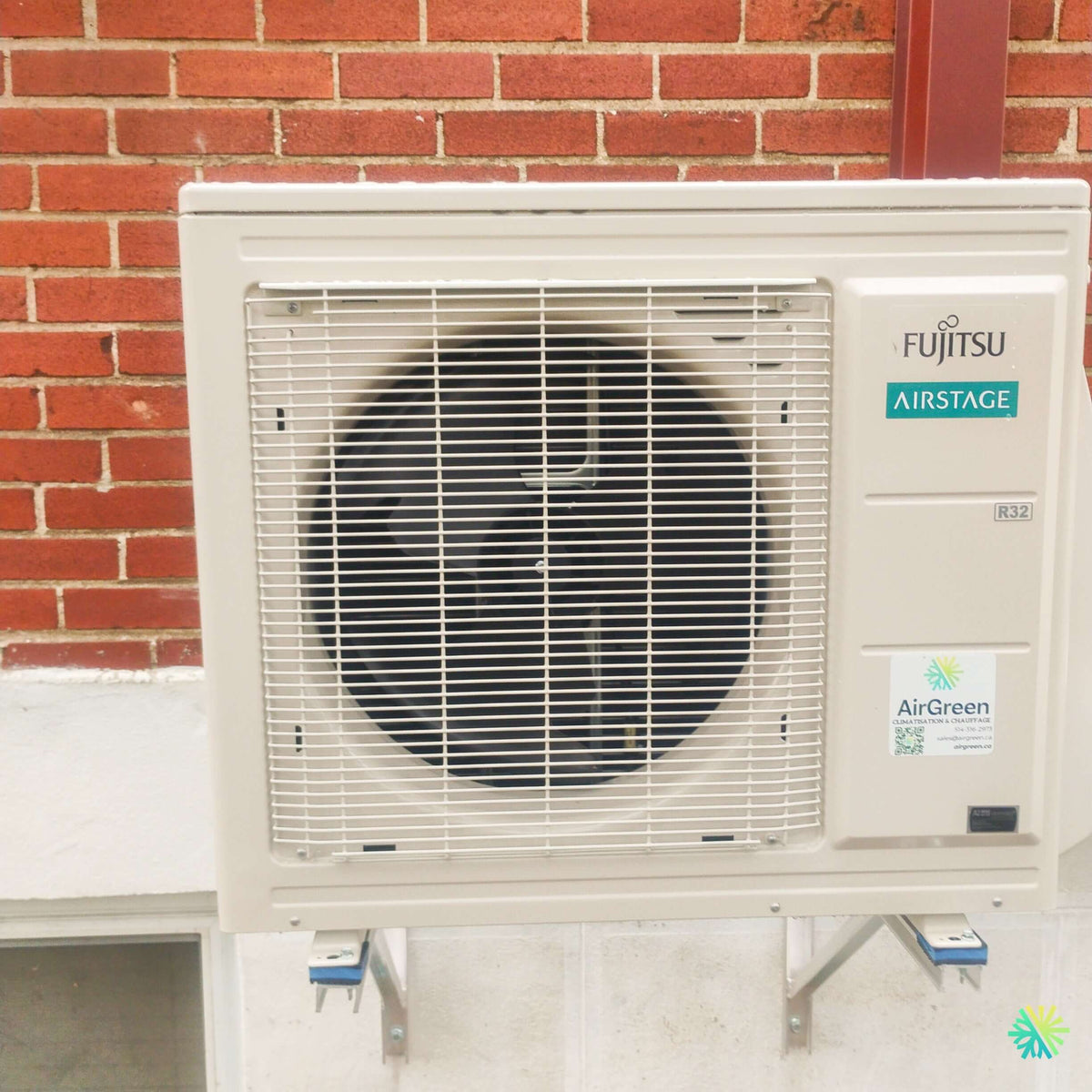
For this project, the choice was a Fujitsu AIRSTAGE Altair 700 wall-mounted heat pump, a single-zone series operating with R-32 refrigerant. The installation photo clearly shows a Fujitsu AIRSTAGE outdoor unit mounted on wall brackets, above ground level, in front of a section of wall composed of a foundation and brick masonry.
This configuration is particularly relevant in Quebec. A unit placed directly on the ground may be more exposed to snow accumulation, water from thawing, splashes of dirt, and obstacles around the outdoor heat exchanger. Here, we created clearance beneath the unit while maintaining a structured and accessible installation.
What we can clearly observe about this installation in Saint-Cyprien-de-Napierville
Several visible details in the photo are worth highlighting.
The outdoor unit is:
- installed high on wall-mounted metal brackets;
- positioned in front of a solid surface, with brick on the upper portion and a foundation in the lower portion;
- raised off the ground to facilitate airflow and limit exposure to buildup at the base of the building;
- installed in a way that keeps the front of the unit and its fan fully accessible;
- clearly identified as a Fujitsu AIRSTAGE with R-32;
- mounted with visible support and insulation components between the unit and the supports.
For our teams, these details matter just as much as the choice of brand. A heat pump may have excellent technical specifications, but its long-term performance also depends greatly on the quality of its HVAC installation.
Why was the outdoor unit mounted on the wall?
In a region such as Saint-Cyprien-de-Napierville, clearance from the ground is an important planning consideration.
We must consider in particular:
- snow that may accumulate around the house;
- drainage during defrost cycles;
- seasonal ground movement;
- access for any potential HVAC maintenance or repair;
- air circulation around the heat exchanger;
- the risk that a unit installed too low will be obstructed by vegetation, leaves, or snow.
The wall bracket also prevents the heat pump from resting directly on the ground. However, the right solution depends on each building. At some installations in Montreal, Laval, Longueuil, on the North Shore or the South Shore, a ground pad may be preferable. In other situations, such as the one shown here, wall brackets provide a clean and efficient configuration.
Fujitsu AIRSTAGE Altair 700: an R-32 single-zone heat pump
The Fujitsu documentation provided for the Altair 700 series covers two capacities: the 09KMAS1 9,000 BTU/h and 12KMAS1 12,000 BTU/h models. The series is designed as a single-zone wall-mounted system and uses R-32 refrigerant.
It is important to point out that the exterior photo alone does not reliably confirm whether the unit installed in Saint-Cyprien-de-Napierville is the 09KMAS1 or the 12KMAS1. We therefore prefer not to make up a capacity that cannot be read on the nameplate shown in the photo.
The technical documentation nevertheless allows us to clearly present the characteristics of the product line.
Fujitsu Altair 700 – 9,000 BTU version
For the system 09KMAS1, Fujitsu specifically states:
- rated cooling capacity: 9,000 BTU/h;
- cooling capacity modulation: 3,100 to 12,100 BTU/h;
- rated heating capacity: 12,000 BTU/h;
- heating capacity modulation: 2,800 to 14,500 BTU/h;
- TRÈS2 rating: 30,0;
- CPSC2 Region V: 9,9;
- heating operation down to -15 °C;
- cooling operation from -10°C to 50°C;
- indoor sound level as low as 19 dB(A) in quiet mode;
- outdoor sound level rated at 44 dB(A) in cooling mode and 47 dB(A) in heating mode.
Fujitsu Altair 700 – 12,000 BTU version
For the system 12KMAS1, the specification sheet states:
- rated cooling capacity: 12,000 BTU/h;
- cooling capacity range: 3,100 to 13,800 BTU/h;
- nominal heating capacity: 14,000 BTU/h;
- heating range: 2,800 to 15,000 BTU/h;
- TRÈS2 rating: 27,5;
- CPSC2 Region V: 8,5;
- heating operation down to -15 °C;
- cooling possible from -10 °C to 50 °C;
- minimum indoor sound level of 19 dB(A);
- outdoor sound level rated at 48 dB(A) in cooling and 50 dB(A) in heating.
These data show why it is not enough to look only at the nominal capacity of a wall-mounted heat pump. Minimum capacity, maximum capacity, modulation range, and performance in cold weather have a direct impact on comfort in the home.
Inverter technology that adjusts capacity instead of operating only in on-off mode
The Fujitsu AIRSTAGE Altair 700 series uses an Inverter compressor.
In practice, this means that the system can adjust its output according to actual demand instead of constantly operating at full capacity and then shutting off.
For a homeowner, this principle can help:
- maintain a more stable temperature;
- reduce significant temperature fluctuations;
- reduce repeated starts and stops;
- improve acoustic comfort;
- fine-tune energy consumption to the room’s actual load.
Modulation is particularly evident in Fujitsu’s data. A 12,000 BTU/h Altair 700, for example, can go as low as 3,100 BTU/h in cooling and 2,800 BTU/h in heating, while still being able to exceed its nominal capacity when conditions require it.
Fujitsu also indicates that the outdoor unit can provide up to 33% more heat than the stated nominal capacity, depending on operating conditions.
A quiet heat pump: a particularly important detail when installing a unit near the wall of the house
The positioning of an outdoor unit near a façade must always take noise into account.
For this installation in Saint-Cyprien-de-Napierville, the unit is mounted directly to the building. We must therefore consider two possible sources of noise: airborne noise produced by the fan and compressor, as well as vibrations that could be transmitted to the structure.
The Altair 700 range offers a low-noise outdoor operating mode, while the indoor unit can reach as low as 19 dB(A), depending on the selected speed.
This feature becomes particularly valuable when the indoor unit is located in a bedroom, office, living room, or another space where quiet operation is an important criterion.
An outdoor mounting system that must be treated as a mechanical component, not merely an aesthetic one
One detail we monitor closely during an installation is how the unit’s weight is transferred to the building.
The technical data sheet indicates a weight of approximately 32 kg, or 71 lb, for the outdoor unit of the Altair 700 series. Appropriate mounting for the available structure is therefore required.
In the photo, we can see two separate metal brackets with support points beneath the unit. The heat pump is not simply resting against the wall.
This is important because inadequate mounting can eventually cause:
- vibrations;
- noise transmitted to the structure;
- tilting of the unit;
- abnormal stress on the refrigerant connections;
- premature deterioration of the bracket.
A proper Fujitsu heat pump installation therefore begins well before the electrical connection or startup.
The technical details that make the difference between an ordinary installation and a durable HVAC installation
The Altair 700 series offers some installation flexibility, but this flexibility does not mean the piping can be improvised.
1/4 in and 3/8 in refrigerant lines
For the two Altair 700 systems documented by Fujitsu, the piping dimensions are:
- liquid: 1/4 in;
- gas: 3/8 in.
The technical data sheet specifies a minimum length of 3 m, or 10 ft, and a maximum length of 20 m, or 66 ft. The maximum stated height difference is 14.9 m, or 49 ft. The factory refrigerant charge covers a piping length of up to 14.9 m, or 49 ft, according to the documentation.
This data is essential during planning.
Installing a wall-mounted heat pump is not about taking the visually shortest route. We need to find a path that respects the manufacturer’s limits while protecting the lines, facilitating condensate drainage, and avoiding unnecessary work on the structure.
Electrical power supply: 208 to 230 V with a 15 A circuit breaker
The Altair 700 series operates on a power supply of:
208 to 230 V / 60 Hz / single-phase, with a 15 A circuit breaker specified in the technical data sheet.
For the 9,000 BTU model, Fujitsu indicates a maximum current of:
- 6.4 A in cooling mode;
- 9.4 A in heating mode.
For the 12,000 BTU model:
- 6.9 A maximum in cooling mode;
- 9.4 A maximum in heating mode.
This type of information must be verified before installation, not when the team is already on site with the appliance.
We always verify compatibility between the selected system, the existing electrical installation, and the requirements specified by the manufacturer.
R-32: A Major Change in the New Generation of Wall-Mounted Heat Pumps
The heat pump visible in the photo clearly bears the marking R32, as does Fujitsu’s documentation.
According to Fujitsu, R-32 has a global warming potential of 675, compared with 2,088 for R-410A, representing an announced 68% reduction in GWP.
The switch to R-32 also affects installation procedures. For our technicians, a new generation of refrigerant means that handling methods, tools, connections, circuit evacuation, and commissioning must be carried out according to the requirements applicable to the system concerned.
The fact that a technician has worked with R-410A for several years does not mean that all practices should automatically be replicated on a new R-32 appliance.
Integrated Wi-Fi and remote control
The Fujitsu AIRSTAGE Altair 700 series also includes integrated Wi-Fi connectivity, with monitoring and control through the AIRSTAGE mobile app.
For many homeowners, it is not just a gimmick.
Remote control can be useful for:
- change the temperature before returning home;
- check the system’s operation without being in front of the remote control;
- adjust the air conditioning while away;
- better manage a room used only during certain periods;
- avoid unnecessarily leaving the setpoint very high or very low.
The platform also supports various interfaces and control options. Fujitsu specifically mentions connectivity with BACnet and Modbus, opening the door to more advanced integrations in certain projects.
A compact indoor unit with ProCore coils
Fujitsu’s documentation also presents the ProCore coils, made of highly corrosion-resistant copper.
The indoor unit in this series measures approximately:
- 834 mm wide;
- 270 mm high;
- 222 mm deep.
Its weight is approximately 10 kg, or 22 lb.
These relatively compact dimensions make it easier to integrate the unit into several types of rooms. However, this does not mean that the unit can be installed just anywhere.
We must always consider ceiling clearance, air projection, the position of furniture, doors, stairs, and the natural flow between spaces.
A poor indoor location can negate some of the benefits of an excellent heat pump
One of the mistakes we still see in the HVAC industry is choosing the indoor unit’s location solely based on where it is easiest to drill through the wall.
The simplest route for the installer is not necessarily the best option for the homeowner.
Before installing a wall-mounted unit, we consider, among other things:
- the main direction of the airflow;
- the length and shape of the room;
- furniture placement;
- areas that tend to overheat;
- air circulation toward adjacent rooms;
- the position of the outdoor unit;
- drainage;
- the route of the lines;
This consideration is particularly important for a single-zone system such as the Fujitsu Altair 700.
Sizing matters: 9,000 BTU or 12,000 BTU should not be chosen based solely on floor area
Another common mistake is selecting a heat pump based on a simplified rule such as “a certain number of square feet equals a certain number of BTUs.”
Floor area obviously plays a role, but it is only one factor.
We must also consider:
- the level of insulation;
- the number and quality of the windows;
- sun exposure;
- the number of floors;
- ceiling height;
- heat loss;
- the layout of the rooms;
- the number of exterior walls;
- the level of heating we want to assign to the heat pump.
An oversized unit is not automatically better. Thanks to Inverter technology, newer heat pumps can modulate their capacity, but it is still important to choose a capacity that matches the building’s actual heating load.
Operation down to -15 °C: understanding exactly what the Fujitsu specifications state
The Altair 700 series documentation indicates a heating range down to -15 °C.
This information deserves to be presented clearly.
It means that this series is designed to continue operating in heating mode at this outdoor temperature. It does not automatically mean that every home will be heated exclusively by the heat pump down to -15 °C under all circumstances.
The capacity required by the building depends on heat loss. The lower the outdoor temperature falls, the greater the home's heating needs become.
That is why we always evaluate the heat pump in the context of the building and the existing heating system.
ENERGY STAR and subsidies: verify the exact system rather than announcing an amount without validation
The Fujitsu specification sheet classifies the 9,000 and 12,000 BTU versions of the Altair 700 series in several ENERGY STAR categories, including a cold-climate designation in the documentation provided.
However, the document does not provide a precise amount for a Quebec subsidy for this installation in Saint-Cyprien-de-Napierville.
To determine the applicable financial assistance, it is necessary to verify the exact model, the indoor/outdoor combination, the required certification references, and the program rules in effect when the application is submitted.
At AirGreen, we prefer this precise verification to displaying an amount that may not correspond to the system actually installed.
This project also shows why the exterior finish matters
A successful installation must be technically correct, but it must also integrate well with the building.
In this project, the white outdoor unit integrates neatly with the façade, while the mounting on supports preserves the space beneath the heat pump.
The front access remains completely clear, which will be useful when a technician needs to inspect:
- the condition of the heat exchanger;
- the fan;
- compressor operation;
- connections;
- drainage;
- the unit's overall condition.
An HVAC system must be designed for the day of installation, but also for the years that follow.
The mistakes we systematically seek to avoid
In our wall-mounted heat pump installations in Montreal, Laval, Longueuil, on the North Shore, the South Shore, and in Montérégie, certain mistakes recur regularly when we are called upon to correct or inspect existing installations.
Among the points to which we pay particular attention:
- An outdoor unit installed too low, which could become obstructed.
- Insufficiently rigid supports, which amplify vibrations.
- Incorrect refrigeration piping size.
- A line length that does not comply with the manufacturer's limits.
- An indoor location chosen solely to simplify the work.
- A power supply not verified before installation.
- Poorly planned condensate drainage.
- Insufficient service access around the unit.
- A capacity selected solely based on the number of square feet.
- Commissioning that is rushed, without the necessary checks of the refrigeration circuit.
The quality of an HVAC installation is often found precisely in the details that the homeowner does not immediately see.
Why this Fujitsu Altair 700 is an interesting option for certain residential projects
The Altair 700 series combines several features that may be relevant when a homeowner is looking for a single-zone wall-mounted heat pump:
R-32, Inverter compressor, heating operation down to -15 °C, built-in Wi-Fi, indoor sound levels as low as 19 dB(A), piping lengths of up to 66 ft, and sizes available in 9,000 or 12,000 BTU/h.
However, its suitability depends on the project.
For a small, well-defined area, a primary bedroom, a living room, a floor, or a space whose heating and cooling demand matches its capacity, it can be a particularly attractive solution. For a home with higher needs or requiring several independent zones, we would instead assess a different configuration.
That is precisely why we do not start by selling a brand or capacity. We start with the building.
An AirGreen project that highlights the work behind the machine
This installation in Saint-Cyprien-de-Napierville highlights an important point: once the work is complete, the most visible part is the heat pump itself, but the true value of an installation also lies in everything planned around it.
The choice of support, height above the ground, strength of the mounting, routing of the lines, electrical requirements, building load, indoor positioning, and commissioning together determine the system’s final quality.
At AirGreen, this is the approach we apply to our wall-mounted heat pump, air conditioning, and heating projects in Greater Montreal, including Montreal, Laval, Longueuil, the North Shore, and the South Shore, as well as several municipalities in Montérégie such as Saint-Cyprien-de-Napierville.
For this project, the Fujitsu AIRSTAGE Altair 700 is integrated into a clean, elevated, and accessible outdoor installation, with a configuration that places as much emphasis on installation quality as on the unit’s features.
The job tools
Two quick checks with real numbers: what heat costs, and what your current heaters add up to in BTU/h.
Conversion: 1 W = 3.412 BTU/h. An indication, not a load calculation: baseboards and furnaces are often stronger than the real need, and they can stay as backup. AirGreen confirms the capacity on site.
How the job unfolds
The main steps of this kind of job at AirGreen. Every house has its quirks: the estimate brings them out.
We look at the room, the outside wall, the line route and where the outdoor unit will go. That is where the capacity gets chosen.
Model, capacity and price, in writing. We also check whether the model qualifies for assistance programs.
Floors and furniture protected, wall plate position marked level, wall opening located.
A single opening, with the slope the drain needs to flow outside.
Set on a stand raised above the snow, with the clearances the manufacturer requires.
Connected, insulated and protected. The opening is then sealed against water, cold air and insects.
A dedicated circuit and an accessible disconnect near the outdoor unit.
Leak test, vacuum, then start-up and a check of heating and cooling.
Remote, modes, filters: we show you the essentials before we leave.
- The on-site estimateWe look at the room, the outside wall, the line route and where the outdoor unit will go. That is where the capacity gets chosen.
- The quoteModel, capacity and price, in writing. We also check whether the model qualifies for assistance programs.
- Getting readyFloors and furniture protected, wall plate position marked level, wall opening located.
- The wall openingA single opening, with the slope the drain needs to flow outside.
- The outdoor unitSet on a stand raised above the snow, with the clearances the manufacturer requires.
- Lines, cable and drainConnected, insulated and protected. The opening is then sealed against water, cold air and insects.
- The electrical workA dedicated circuit and an accessible disconnect near the outdoor unit.
- Tests and start-upLeak test, vacuum, then start-up and a check of heating and cooling.
- The walkthroughRemote, modes, filters: we show you the essentials before we leave.
What we check on a job like this one
Each number is a point we check on site. Switch between summer and winter to watch air and heat move.
In summer, the outdoor unit rejects the house's heat outside.
Generic illustration of this type of installation, not a survey of this job site. Tap a number.
Mounted level on a wall plate, high enough for the air to reach the whole room, with enough space around it to slide the filters out easily.
The refrigerant lines, the communication cable and the drain go through the wall in a single opening, sealed against water, cold air and insects.
Two insulated copper pipes connect the two units. Outside, a line cover can protect them from sun, knocks and weather.
A shut-off switch near the outdoor unit isolates it safely for service. It must stay accessible at all times.
The compressor and the fan. In heating mode it captures heat from the outdoor air, even in winter, and moves it inside.
On the ground or on the wall, it keeps the unit above accumulated snow. The unit stays clear and defrost water can drain away.
The fan needs to blow freely. Storage, a fence or a wall too close, and efficiency drops while noise goes up.
Is your home ready?
Check what applies at your place. A "no" is not a refusal: it is what we sort out during the estimate.
Good habits, once the unit is in place
Six simple habits that keep the unit going. Your list stays on this device.
What to do, season by season
Three habits per season for this unit. They take a few minutes and prevent many calls.
- Clean the indoor unit's filters.
- Clear leaves and debris left on the outdoor unit by winter.
- Test cooling before the first hot days.
- Clean the filters more often when the unit runs a lot.
- Keep plants away from the outdoor unit.
- Check that no water drips from the indoor unit.
- Rake the leaves around the outdoor unit.
- Test heating before the first cold days.
- Book periodic maintenance before winter.
- Keep snow away from the stand and the front of the unit.
- Let the unit defrost: it is normal.
- Never hit the ice on the fins; call us if the unit stays iced up.
The right pages, at the right time
Four statements: true or false?
It all comes down to details you have just seen.
1. In heating mode, the outdoor unit can produce water.
During defrost cycles. That water must drain away without forming ice.
2. You pick the capacity with a simple square-footage rule.
Windows, insulation, orientation and how the room is used all count. Capacity is chosen on site.
3. A multi-zone connects several indoor heads to a single condenser.
One head per room, all on the same condenser. Each room keeps its own temperature.
4. The disconnect can sit behind the patio furniture.
It must stay accessible: it is what shuts the unit off for service.
0 / 4 right answers
What people ask us about this kind of work
Does a wall-mounted heat pump heat in winter?
Wall-mounted or multi-zone: how do I choose?
Where does the outdoor unit go?
Are there grants?
Do I need a permit?
How cold can it heat?
How much can I save?
How is the LogisVert assistance calculated?
Is it noisy?
The outdoor unit is covered in ice: is that normal?
Does AirGreen hold the required licences?
Is the estimate free?
No question matches. Write to us: we answer.
More jobs to see, near you
By town, by equipment or by region: browse more than 4,700 published projects.
Each dot: a town where AirGreen has published projects. The glowing dot: this job.
An on-site estimate, the right capacity, the right equipment.
The on-site estimate is free and the quote follows within 24 hours.
Text and photo: a real AirGreen Climatisation & Chauffage job. The diagrams are generic illustrations of the type of installation, not a survey of this job site. Sources of the added figures: airgreen.ca product pages (NEEP / AHRI performance), Hydro-Québec (Heat pumps page, LogisVert, read on 13 October 2026), Régie de l’énergie (rate D as of 1 April 2026).