
Installation of a FUJITSU AIRSTAGE ORION XLTH+ wall-mounted heat pump in Saint-Paul-d'Abbotsford, Montérégie
In Saint-Paul-d'Abbotsford, AirGreen installs an R-32 FUJITSU AIRSTAGE ORION XLTH+ on wall brackets, a configuration suited for heating down to -30 °C and Quebec’s winter conditions.
- City
- Region
- Equipment
- Brand
- Challenges
- Published
The job on one screen
The article, chapter by chapter
In Saint-Paul-d'Abbotsford, a FUJITSU ORION XLTH+ installed on wall brackets to completely free up the ground
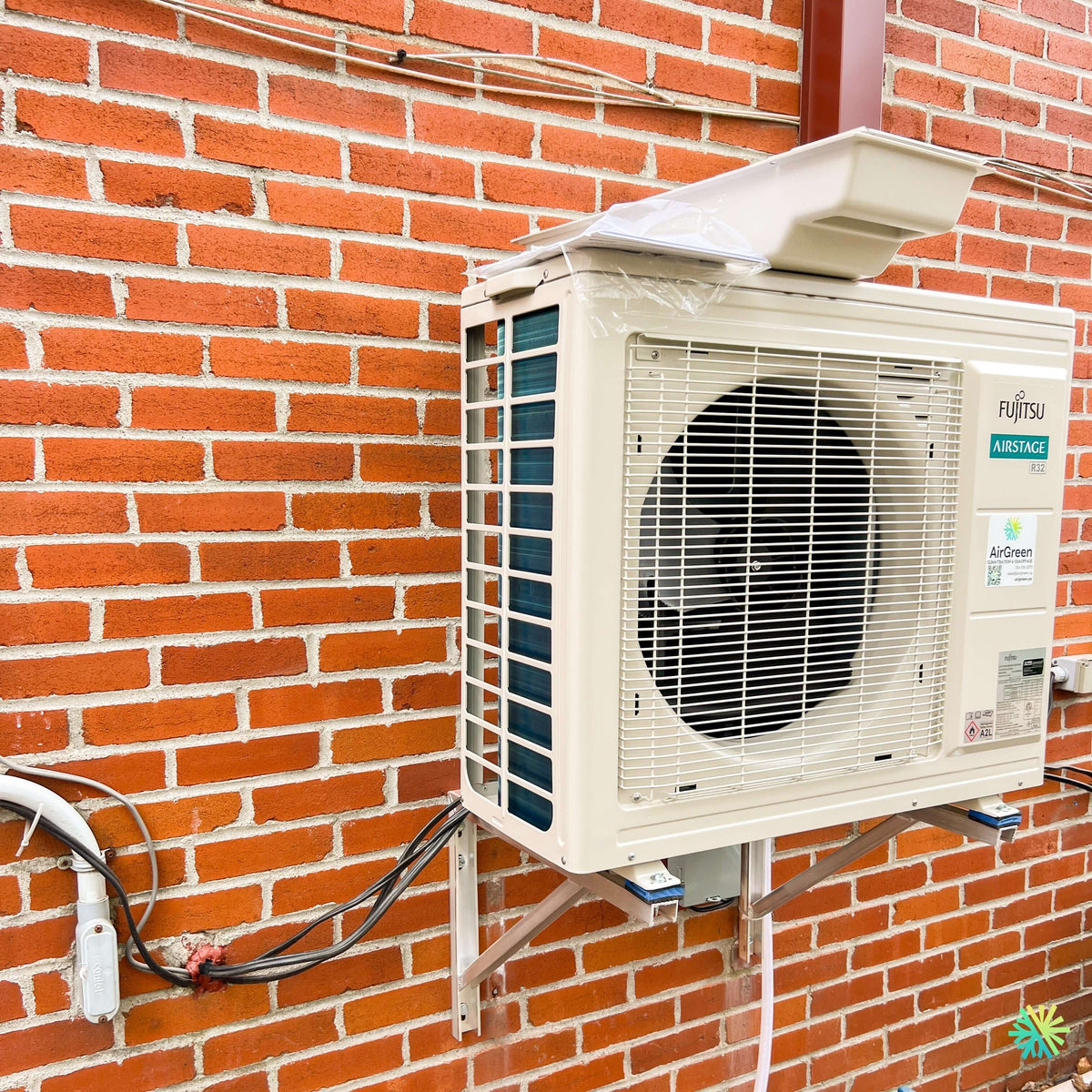
This FUJITSU AIRSTAGE ORION XLTH wall-mounted heat pump installation+ in Saint-Paul-d'Abbotsford features a particularly interesting outdoor configuration: rather than placing the unit on a pad or ground support, we secured it to sturdy wall brackets anchored in the brick masonry.
The photo from our job site shows several details that matter in a professional HVAC installation. The FUJITSU condenser is elevated, the front fan remains completely unobstructed, the feet rest on their support points with visible anti-vibration elements, and the connections are directed toward the building. The AIRSTAGE marking, the R32 identification, and our AirGreen label are clearly visible on the front panel. The photo was also taken while some job-site protections were still present on the upper part of the unit, showing the installation before the final finishing steps.
This type of project clearly reflects the way we work at AirGreen: a heat pump should not only perform well according to its technical specifications. Its placement must be adapted to the home, the available structure, Quebec's climate, and future maintenance.
Why was a wall-mounted installation chosen for the outdoor unit?
In Saint-Paul-d'Abbotsford, as elsewhere in Montérégie, winter conditions are among the first considerations when we determine where to install a heat pump.
An outdoor unit installed too close to the ground can become surrounded by snow, ice, or frozen water from defrost cycles. Here, wall mounting helps maintain a good distance between the condenser and ground level.
This configuration offers several practical advantages:
- it keeps the underside of the unit clear;
- it reduces the risk of accumulated snow quickly reaching the bottom of the unit;
- it facilitates the drainage of defrost water;
- it frees up the ground beneath the heat pump;
- it provides easy visual access to the brackets and connections;
- it avoids installing a pad when the building configuration is better suited to wall mounting.
However, the height should never be chosen at random. We must also consider the wall's load-bearing capacity, the nature of the masonry, the required clearances, and the access needed for future HVAC maintenance.
A brick-wall mounting that requires precision
The visible façade at the site is made of brick. Installing an outdoor unit on this type of wall requires a different approach than installation on a concrete foundation or an independent support.
The brackets must be positioned to create a stable, level base. The quality of the anchoring is essential, as the unit must remain securely in place despite its weight, normal compressor vibrations, and the many hours of operation over the years.
At our Saint-Paul-d'Abbotsford installation, two triangular metal brackets support the condenser. Their design provides a rigid base while leaving ample space beneath the unit. Small anti-vibration components are also visible between the heat pump's feet and the brackets.
Why should vibrations be taken seriously?
A modern heat pump with an Inverter compressor generally operates very smoothly, but any machine containing a compressor and a fan nevertheless produces some mechanical vibrations.
With a wall-mounted installation, it is therefore important to prevent them from being unnecessarily transmitted to the building structure.
We take the following into consideration, among other factors:
- the rigidity of the support;
- the anchor points;
- the level of the unit;
- the presence of anti-vibration components;
- the position of the condenser in relation to the occupied rooms.
These are small details that do not necessarily appear in the price of a heat pump, but they directly influence the quality of the final result.
FUJITSU ORION XLTH+: a series specifically designed for cold-climate heating
Choosing the FUJITSU AIRSTAGE ORION XLTH+ makes perfect sense when examining the temperatures this range is designed to operate in.
According to FUJITSU technical documentation, the series models can operate in heating mode down to -30 °C (-22 °F). The range also uses an Inverter compressor and a base pan heater designed for extremely cold climates.
For a home located in Saint-Paul-d'Abbotsford, this is far more relevant information than its summer cooling capacity alone.
A Quebec heat pump must be evaluated when the temperature drops below zero, not only when it is 30 °C outside.
Three capacities available in the ORION XLTH+ family
The technical data sheet presents three single-zone systems:
FUJITSU 09KTAP1
The 09KTAP1 configuration offers:
- 9,000 BTU/h nominal cooling;
- 12,000 BTU/h nominal heating;
- SEER2 of 33,5;
- HSPF2 Region V of 11,5.
FUJITSU 12KTAP1
The mid-range configuration offers:
- 12,000 BTU/h nominal cooling;
- 15,300 BTU/h nominal heating;
- SEER2 of 31,5;
- HSPF2 Region V of 11,3.
FUJITSU 15KTAP1
The top version in this series is rated at:
- 14,500 BTU/h nominal cooling;
- 17,400 BTU/h nominal heating;
- SEER2 of 28,7;
- HSPF2 Region V of 10,7.
The photo clearly identifies the FUJITSU AIRSTAGE with R-32 family, but it does not show the exact model number on the rating plate clearly enough to read. We therefore do not artificially assign a specific capacity to this installation without model confirmation.
This is an important distinction: several capacities within the same family may have a very similar exterior appearance.
Cold-weather performance: a figure often more revealing than the number of BTUs in the name
FUJITSU documentation provides particularly interesting data on the maximum available output as the temperature drops.
At -30 °C, FUJITSU indicates a maximum heating percentage corresponding to 113% of nominal capacity for the 09KTAP1, 103% for the 12KTAP1, and 101% for the 15KTAP1, according to the test conditions specified by the manufacturer. At -26 °C, these values are 147%, 128%, and 116%, respectively.
These factors explain why we never rely solely on reasoning such as “a given square footage automatically equals a certain number of BTUs.”
A home located in Saint-Paul-d'Abbotsford must be evaluated based on its actual thermal behavior: insulation, windows, orientation, air infiltration, interior volume, number of floors, and room distribution.
Inverter technology that modulates rather than operating only in on/off mode
The ORION XLTH+ uses Inverter technology.
In everyday use, this means the system can adjust its output according to demand rather than constantly operating according to an on/off, full-power logic.
As the home approaches the set temperature, the compressor can reduce its speed. If demand increases, it can speed up.
This modulation helps maintain a more consistent temperature and quieter operation during periods of low demand.
FUJITSU also highlights several indoor fan speeds as well as a quiet mode. The 09KTAP1 and 12KTAP1 models can reach as low as 23 dB(A) indoors, while the 15KTAP1 is rated at 26 dB(A) in quiet mode.
The R-32 visible directly on the installed condenser
In our photo of the project, the symbol R32 is clearly displayed on the outdoor unit.
The ORION XLTH+ series does indeed use R-32 refrigerant. FUJITSU states in its documentation that it has a global warming potential of 675, compared with 2,088 for R-410A, representing an announced 68% reduction in GWP.
Beyond the figure itself, the important point for the owner is that current generations of HVAC equipment use new refrigerant families. Work methods, tools, and installation procedures must therefore be adapted to the system actually being installed.
1/4-inch liquid line and 3/8-inch gas line throughout the series
When replacing an existing heat pump, piping dimensions can become decisive.
The FUJITSU specification sheet indicates the following for the three ORION XLTH+ capacities:
- liquid line of 1/4 po;
- gas line of 3/8 po;
- minimum length of 10 ft;
- maximum length of 66 ft;
- maximum vertical difference of 49 ft.
This information is particularly important when existing lines run through finished walls.
We never assume that old piping is automatically compatible with a new wall-mounted heat pump. The dimensions, condition of the lines, and compatibility with the new system must be verified.
The space in front of the fan has been kept completely clear
A highly visible element in the photo is the large front grille of the FUJITSU unit.
Nothing is placed in front of the fan. This simplicity is important.
A condenser needs to move a significant amount of air through its heat exchanger. A decorative fence, outdoor storage unit, or another obstacle installed too close to the façade can disrupt this airflow.
In this project, the wall-mounted installation gives the fan open space while keeping the condenser close to the building.
This principle must be maintained after we leave. We always advise owners not to gradually turn the area around the heat pump into a storage space.
An interesting detail in the photo: the project had not yet been completely “undressed”
The upper part of the condenser still has a portion of transparent protective film visible in the photo.
This detail provides an authentic glimpse of an installation photographed during its finishing phase.
Once the connections, tests, and checks are complete, the temporary protections are removed and the equipment is left clean. For us, this final phase is just as much a part of the project as securing the brackets or connecting the lines.
A completed installation must be technically correct, but it must also have a neat finish.
This project in Saint-Paul-d'Abbotsford summarizes several best practices for a heat pump intended for Quebec
Elevating the outdoor unit is not merely an aesthetic detail
The main lesson from this project is immediately visible: the outdoor heat pump is intentionally elevated above the ground.
For a unit capable of heating down to -30 °C, this decision is consistent with its winter use.
In heating mode, the system must regularly manage frost and defrost cycles. According to FUJITSU, a basic base-pan heater is integrated into the ORION XLTH+ lineup, but this does not relieve the installer of the need to provide a suitable location for the unit.
The unit and the installation must work together.
Proper sizing remains more important than searching for the “largest model”
A common mistake is to assume that a more powerful heat pump will necessarily be better.
That is not our approach.
A properly sized unit must be able to meet the building’s needs while maintaining good modulation capacity. The choice must therefore be based on the property’s characteristics and intended use.
In some projects, a heat pump primarily serves a large open area. In others, the homeowner wants the heat to reach several rooms or multiple floors.
The same machine will not produce the same result in these two environments.
ENERGY STAR and financial assistance programs: the exact model must be verified
FUJITSU documentation lists the 09KTAP1, 12KTAP1, and 15KTAP1 models with ENERGY STAR ratings, including the designations mentioned for cold climates.
This feature may be relevant when a homeowner compares units as part of financial assistance programs.
However, certification does not automatically mean that a specific amount will be awarded.
At AirGreen, we verify the exact combination of indoor and outdoor models, as well as the criteria of the applicable program at the time of the project. This is the safest way to avoid basing a purchase decision on a rebate that may ultimately not apply to the installed configuration.
Compact dimensions that make façade mounting easier
Depending on capacity, FUJITSU specifies an outdoor unit approximately 799 mm wide for the 09KTAP1 and 820 mm for the 12KTAP1 and 15KTAP1. Outdoor depth ranges from approximately 290 to 315 mm.
This relatively compact design is advantageous in many residential projects where the space between a walkway, fence, window, and other technical installations is limited.
At this Saint-Paul-d'Abbotsford home, the condenser is integrated against the brick façade without taking up additional ground space.
What we aim to achieve before leaving a job site
During an HVAC installation, our work does not stop once the equipment is physically in place.
We specifically check the equipment’s stability, connections, drainage, communication between the units, operation in heating and cooling modes, and response to controls.
We also explain to homeowners how to protect their investment: filter maintenance, keeping the outdoor unit clear, monitoring unusual accumulations of snow or ice, and periodic cleaning.
A good heat pump can provide years of service, but it must be able to breathe and be maintained properly.
AirGreen for your FUJITSU installations in Saint-Paul-d'Abbotsford, Montreal, and Greater Montreal
This FUJITSU AIRSTAGE ORION XLTH+ installed in Saint-Paul-d'Abbotsford represents exactly the type of project where on-site details matter just as much as the equipment’s specifications.
Wall mounting frees up ground space and raises the condenser. The triangulated brackets provide a sturdy installation. The fan has unobstructed clearance. The R-32 system features Inverter technology and a heating capacity designed to operate down to -30 °C. The entire setup is suited to year-round use, for both summer cooling and winter heating.
At AirGreen, we install wall-mounted heat pumps in Montreal, Laval, Longueuil, on the North Shore and South Shore, as well as in many municipalities in Montérégie.
Our priority remains the same from one project to the next: recommend the right equipment, choose the right location, and carry out an installation that takes the building’s reality into account rather than applying the same solution everywhere.
For homeowners currently comparing several heat pump models, the FUJITSU ORION XLTH+ therefore deserves to be evaluated not only for its efficiency ratings, but also for its low-temperature performance, size, sound level, R-32 refrigerant, and ability to integrate cleanly into different types of residential installations.
The job tools
Two quick checks with real numbers: what heat costs, and what your current heaters add up to in BTU/h.
Conversion: 1 W = 3.412 BTU/h. An indication, not a load calculation: baseboards and furnaces are often stronger than the real need, and they can stay as backup. AirGreen confirms the capacity on site.
How the job unfolds
The main steps of this kind of job at AirGreen. Every house has its quirks: the estimate brings them out.
We look at the room, the outside wall, the line route and where the outdoor unit will go. That is where the capacity gets chosen.
Model, capacity and price, in writing. We also check whether the model qualifies for assistance programs.
Floors and furniture protected, wall plate position marked level, wall opening located.
A single opening, with the slope the drain needs to flow outside.
Set on a stand raised above the snow, with the clearances the manufacturer requires.
Connected, insulated and protected. The opening is then sealed against water, cold air and insects.
A dedicated circuit and an accessible disconnect near the outdoor unit.
Leak test, vacuum, then start-up and a check of heating and cooling.
Remote, modes, filters: we show you the essentials before we leave.
- The on-site estimateWe look at the room, the outside wall, the line route and where the outdoor unit will go. That is where the capacity gets chosen.
- The quoteModel, capacity and price, in writing. We also check whether the model qualifies for assistance programs.
- Getting readyFloors and furniture protected, wall plate position marked level, wall opening located.
- The wall openingA single opening, with the slope the drain needs to flow outside.
- The outdoor unitSet on a stand raised above the snow, with the clearances the manufacturer requires.
- Lines, cable and drainConnected, insulated and protected. The opening is then sealed against water, cold air and insects.
- The electrical workA dedicated circuit and an accessible disconnect near the outdoor unit.
- Tests and start-upLeak test, vacuum, then start-up and a check of heating and cooling.
- The walkthroughRemote, modes, filters: we show you the essentials before we leave.
What we check on a job like this one
Each number is a point we check on site. Switch between summer and winter to watch air and heat move.
In summer, the outdoor unit rejects the house's heat outside.
Generic illustration of this type of installation, not a survey of this job site. Tap a number.
Mounted level on a wall plate, high enough for the air to reach the whole room, with enough space around it to slide the filters out easily.
The refrigerant lines, the communication cable and the drain go through the wall in a single opening, sealed against water, cold air and insects.
Two insulated copper pipes connect the two units. Outside, a line cover can protect them from sun, knocks and weather.
A shut-off switch near the outdoor unit isolates it safely for service. It must stay accessible at all times.
The compressor and the fan. In heating mode it captures heat from the outdoor air, even in winter, and moves it inside.
On the ground or on the wall, it keeps the unit above accumulated snow. The unit stays clear and defrost water can drain away.
The fan needs to blow freely. Storage, a fence or a wall too close, and efficiency drops while noise goes up.
Is your home ready?
Check what applies at your place. A "no" is not a refusal: it is what we sort out during the estimate.
Good habits, once the unit is in place
Six simple habits that keep the unit going. Your list stays on this device.
What to do, season by season
Three habits per season for this unit. They take a few minutes and prevent many calls.
- Clean the indoor unit's filters.
- Clear leaves and debris left on the outdoor unit by winter.
- Test cooling before the first hot days.
- Clean the filters more often when the unit runs a lot.
- Keep plants away from the outdoor unit.
- Check that no water drips from the indoor unit.
- Rake the leaves around the outdoor unit.
- Test heating before the first cold days.
- Book periodic maintenance before winter.
- Keep snow away from the stand and the front of the unit.
- Let the unit defrost: it is normal.
- Never hit the ice on the fins; call us if the unit stays iced up.
The right pages, at the right time
Four statements: true or false?
It all comes down to details you have just seen.
1. In heating mode, the outdoor unit can produce water.
During defrost cycles. That water must drain away without forming ice.
2. You pick the capacity with a simple square-footage rule.
Windows, insulation, orientation and how the room is used all count. Capacity is chosen on site.
3. A multi-zone connects several indoor heads to a single condenser.
One head per room, all on the same condenser. Each room keeps its own temperature.
4. The disconnect can sit behind the patio furniture.
It must stay accessible: it is what shuts the unit off for service.
0 / 4 right answers
What people ask us about this kind of work
Does a wall-mounted heat pump heat in winter?
Wall-mounted or multi-zone: how do I choose?
Where does the outdoor unit go?
Are there grants?
Do I need a permit?
How cold can it heat?
How much can I save?
How is the LogisVert assistance calculated?
Is it noisy?
The outdoor unit is covered in ice: is that normal?
Does AirGreen hold the required licences?
Is the estimate free?
No question matches. Write to us: we answer.
More jobs to see, near you
By town, by equipment or by region: browse more than 4,700 published projects.
Each dot: a town where AirGreen has published projects. The glowing dot: this job.
An on-site estimate, the right capacity, the right equipment.
The on-site estimate is free and the quote follows within 24 hours.
Text and photo: a real AirGreen Climatisation & Chauffage job. The diagrams are generic illustrations of the type of installation, not a survey of this job site. Sources of the added figures: airgreen.ca product pages (NEEP / AHRI performance), Hydro-Québec (Heat pumps page, LogisVert, read on 13 October 2026), Régie de l’énergie (rate D as of 1 April 2026).