
Installation of a FUJITSU AIRSTAGE ORION XLTH+ R32 wall-mounted heat pump in Beloeil, on Montreal’s South Shore
In Beloeil, AirGreen installs a FUJITSU ORION XLTH+ R32 on a wall bracket, working around the electrical meter and a basement window: heating down to -30 °C, high efficiency, and a meticulous finish.
Take a tour of the installation
Each number is a point we check on site. Switch between summer and winter to watch air and heat move.
In summer, the outdoor unit rejects the house's heat outside.
Generic illustration of this type of installation, not a survey of this job site. Tap a number.
Mounted level on a wall plate, high enough for the air to reach the whole room, with enough space around it to slide the filters out easily.
The refrigerant lines, the communication cable and the drain go through the wall in a single opening, sealed against water, cold air and insects.
Two insulated copper pipes connect the two units. Outside, a line cover can protect them from sun, knocks and weather.
A shut-off switch near the outdoor unit isolates it safely for service. It must stay accessible at all times.
The compressor and the fan. In heating mode it captures heat from the outdoor air, even in winter, and moves it inside.
On the ground or on the wall, it keeps the unit above accumulated snow. The unit stays clear and defrost water can drain away.
The fan needs to blow freely. Storage, a fence or a wall too close, and efficiency drops while noise goes up.
In Beloeil, an outdoor installation designed around the electrical meter, the basement window, and the realities of Quebec winters
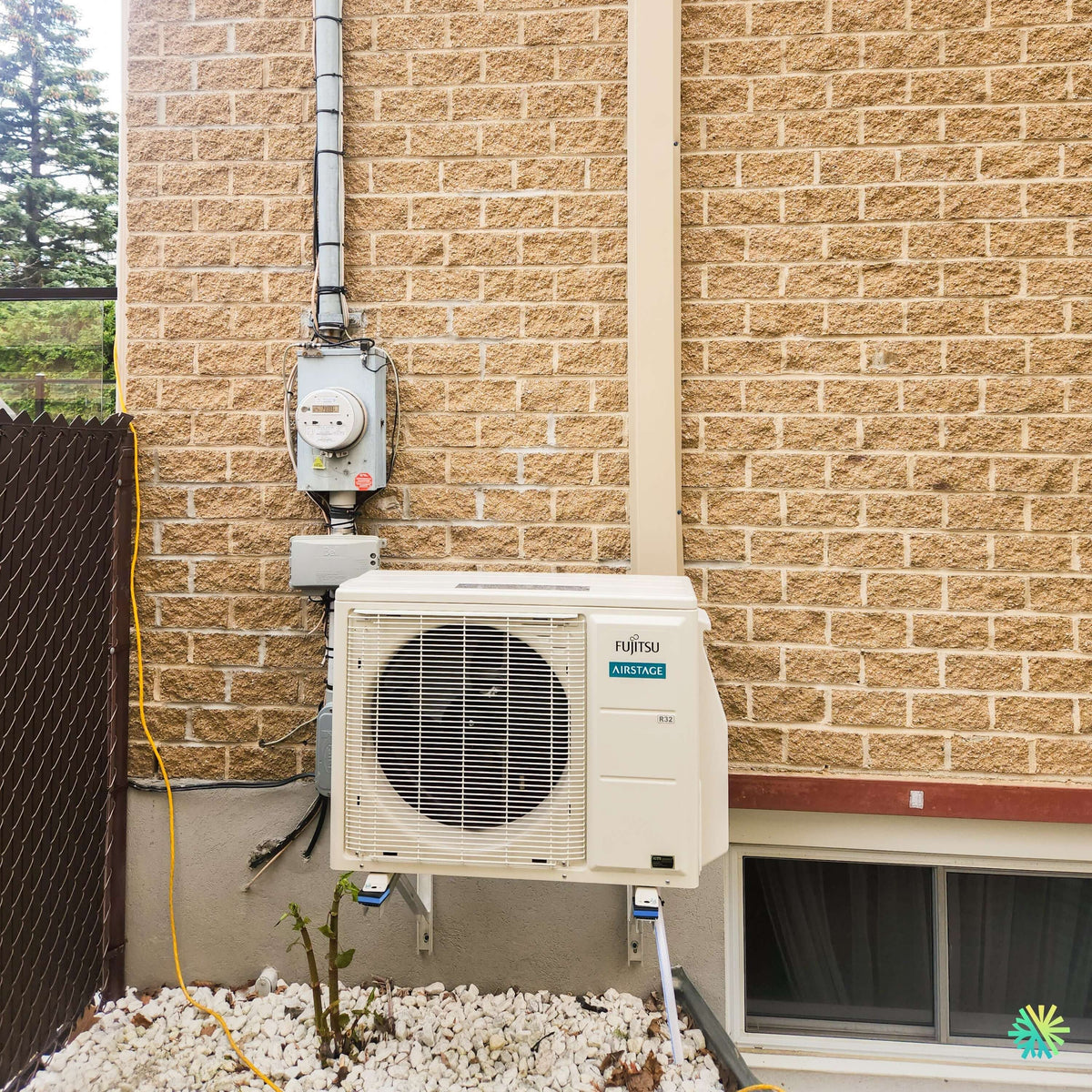
This FUJITSU AIRSTAGE ORION XLTH+ in Beloeil installation is an excellent example of a project where the outdoor unit's location had to be carefully considered. In the photo of our AirGreen project, several constraints come together along a relatively narrow section of the wall: brick siding, the electrical meter and its service connection, a basement window, a side fence, and stone landscaping at ground level.
Rather than treating these elements as simple obstacles, we designed the HVAC installation around them. The FUJITSU AIRSTAGE outdoor unit using R32 refrigerant was installed on wall brackets, well above the ground. This keeps the heat pump clear of the stone landscaping while avoiding placing it directly in front of the basement window. The lines are grouped together and protected in a light-colored vertical line-hide that follows the façade, creating an orderly layout despite the existing electrical installation.
For a homeowner currently comparing heat pumps in Beloeil, Longueuil, or elsewhere on the South Shore, this photo helps illustrate an essential point: the manufacturer's advertised performance matters greatly, but the quality of the result also depends on how well the equipment is adapted to the building.
A FUJITSU ORION XLTH+ designed to do much more than cool
The FUJITSU AIRSTAGE ORION XLTH+ is a single-zone wall-mounted heat pump from the H Series. The range includes the 09KTAP1, 12KTAP1, and 15KTAP1 models and was developed for cold-climate heating.
According to the Fujitsu documentation provided for this installation, all three versions can operate in heating mode down to -30 °C (-22 °F). The manufacturer also indicates that the unit does not have a shutdown device at this minimum operating temperature.
This feature is particularly relevant in Beloeil, where a heat pump is generally not purchased solely to cool the house in July. Many homeowners want to reduce their reliance on traditional electric heating as much as possible during the cold season and are therefore looking for a unit capable of maintaining substantial heating capacity when the outdoor temperature drops significantly.
Three capacities available depending on the building’s needs
The ORION XLTH+ family presented in the Fujitsu data sheet includes:
- the 09KTAP1, with a nominal cooling capacity of 9,000 BTU/h;
- the 12KTAP1, with 12,000 BTU/h;
- the 15KTAP1, with a nominal cooling capacity of 14,500 BTU/h.
The complete combinations are:
- ASUH09KTAS + AOUH09KTAP1;
- ASUH12KTAS + AOUH12KTAP1;
- ASUH15KTAS + AOUH15KTAP1.
In the photo of our installation in Beloeil, the model label is not legible enough to confirm with certainty which of these three capacities was installed. We therefore prefer not to make up a precise capacity based solely on the appearance of the outdoor unit.
This caution is also useful for consumers: two heat pumps from the same series may look almost identical while offering different capacities.
A heating capacity that goes well beyond the BTU number displayed for cooling
One of the interesting features of the ORION XLTH+ lies in its heating figures.
The Fujitsu documentation indicates a nominal heating capacity of:
- 12,000 BTU/h for model 09;
- 15,300 BTU/h for model 12;
- 17,400 BTU/h for model 15.
The published maximum ranges go up to 24,000 BTU/h, 27,300 BTU/h, and 28,000 BTU/h, respectively.
That is why we advise against comparing two heat pumps simply by looking at their “12,000 BTU” or “15,000 BTU” designation. For a home in Beloeil, the unit’s heating performance is at least as important as its nominal cooling capacity.
What really happens when the temperature drops below -20 °C
The Fujitsu technical data sheet also provides particularly relevant information for the climate in Montérégie.
At -21 °C, the manufacturer indicates a maximum heating capacity corresponding to 179% of the nominal capacity for model 09, 156% for model 12, and 138% for model 15.
At -26 °C, the stated values are 147%, 128%, and 116%, respectively.
Even at -30 °C, the chart still shows 113%, 103%, and 101%, depending on the capacity.
These percentages are based on the nominal conditions and capacities defined by Fujitsu; they do not mean that a given heat pump will automatically cover 100% of any home’s heating needs at -30 °C.
At AirGreen, we always distinguish between two questions:
Can the unit operate at very low temperatures?
and
Is its available capacity at this temperature sufficient for this particular residence’s heat loss?
These are two different questions.
Why we installed the outdoor unit on the wall rather than at ground level
In this Beloeil installation, the outdoor unit is clearly elevated on metal supports secured to the building.
This choice offers several practical advantages in our climate.
Keeping the heat pump above ground-level snow accumulations
A heat pump operates by drawing in and expelling a great deal of air through its outdoor coil. An appliance placed too close to the ground can eventually become surrounded by snow after several accumulations or after nearby areas have been cleared.
By placing the unit higher, we create open space beneath the system. This configuration also facilitates the management of water produced during defrost cycles.
According to Fujitsu, the ORION XLTH+ features an automatic defrost function as well as a base pan heater designed for extremely cold climates.
During winter, it is normal for a heat pump to defrost its outdoor coil. The water resulting from this process must be able to drain away without the unit gradually becoming trapped in a mass of ice.
Anti-vibration pads visible beneath the unit
The photo also shows the elements placed between the heat pump’s feet and its supports.
These anti-vibration pads help reduce mechanical transmission to the building structure. This is particularly important when the outdoor unit is mounted directly to the wall rather than placed on an independent ground support.
However, good acoustic installation does not rely on a single piece of rubber. We must consider the choice of wall, the strength of the anchoring, the quality of the supports, the positioning of the lines, and the machine’s sound characteristics simultaneously.
Depending on capacity, the FUJITSU specifications indicate approximate levels for the outdoor unit of:
- 44 dB(A) on model 09;
- 48 dB(A) in cooling mode and 49 dB(A) in heating mode on model 12;
- 51 dB(A) in cooling mode and 49 dB(A) in heating mode on model 15.
An installation completed without blocking the basement window
Another interesting feature of this project is immediately to the right of the heat pump: a basement window.
When a façade has several openings and existing pieces of equipment, it is easy to choose a location that is convenient for the installer but inconvenient for the homeowner. Instead, we try to preserve the building’s normal use as much as possible.
Here, the unit was positioned to the left of the window and high enough not to unnecessarily occupy the area in front of it.
This sometimes requires more preparation, but a successful heat pump installation must work with the home, rather than turning every existing element into a compromise.
The electrical meter: a constraint that must be incorporated into the planning
The meter and several electrical components are visible just above and to the left of the unit.
This type of configuration requires planning the route of the lines before drilling or fastening anything. The installation must remain organized, while avoiding conflicts with existing equipment.
At this Beloeil project, the vertical line set cover allows the heat pump’s connections to be grouped along the wall. The result is much more orderly than leaving cables and lines individually exposed on the brick.
Why the exterior finish really matters
A heat pump is installed for many years.
The homeowners therefore continue to notice its installation long after our technicians have left.
A beautiful finish does not simply mean hiding something. You need to design a route that:
- protects the lines;
- remains accessible when necessary;
- fits into the architecture;
- avoids unnecessary detours;
- meets the machine’s technical requirements.
On a brick wall like the one at this Beloeil residence, a vertically installed line set cover creates a much cleaner and more cohesive line.
Efficiency, R32, quiet operation, and maintenance: what a homeowner should compare before choosing this FUJITSU
Very high energy efficiency across all three capacities
The ORION XLTH+ delivers particularly interesting energy performance.
The Fujitsu technical data sheet provides TRÈS2 values of:
- 33,5 for the 09 model;
- 31,5 for the 12 model;
- 28,7 for the 15 model.
All three versions are also identified in the documentation as ENERGY STAR, ENERGY STAR Cold Climate, and ENERGY STAR Most Efficient 2025.
For a homeowner comparing several wall-mounted heat pumps in Beloeil or on the South Shore, these are important indicators.
Actual consumption will obviously depend on many factors: selected temperature, insulation, heated volume, usage habits, the home’s exposure, and outdoor temperature. A high efficiency rating alone cannot compensate for a home with very high heat losses.
R32: a new generation of refrigerant from FUJITSU
The photographed outdoor unit clearly bears the identification R32.
Fujitsu indicates in its documentation a global warming potential of 675 for R32, compared with 2,088 for R410A, representing an announced 68% reduction in GWP.
R32 is therefore one of the important changes we are currently seeing in new generations of HVAC systems.
For the homeowner, the key point is mainly to choose a contractor who works with current equipment and refrigerants and who follows the appropriate procedures during installation, commissioning, and future servicing.
Inverter technology for modulating capacity
The ORION XLTH+ uses an Inverter compressor.
Rather than operating exclusively at full capacity until reaching the setpoint and then stopping completely, the system can better adjust its output to the space’s needs.
This modulation helps create more consistent comfort, particularly when demand is moderate.
In Beloeil, an October afternoon at 9°C obviously does not represent the same load as a January night at -22°C. An Inverter heat pump has an operating range that allows it to adapt to these changing conditions.
As low as 23 dB(A) indoors
A properly installed outdoor unit is important, but the homeowner primarily lives with the indoor unit.
Fujitsu indicates that indoor sound levels can drop as low as 23 dB(A) in quiet mode for the 09 and 12 models. The 15 model can reach 26 dB(A) at its quietest setting.
The units also offer six fan speeds in addition to automatic mode.
This quiet operation is particularly appreciated when the head is installed in a living room, open-plan area, or near a bedroom.
ProCore copper coils
FUJITSU also states that the indoor unit in this series uses highly corrosion-resistant copper ProCore coils.
This is an invisible feature in a job-site photo, but it matters when comparing two systems whose product specifications initially appear similar.
At AirGreen, we specifically aim to compare more than just the appearance of the units: heat exchanger design, low-temperature heating, sound level, line dimensions, controls, electrical characteristics, and ease of maintenance are all part of the analysis.
Built-in Wi-Fi for remote control
FUJITSU documentation also mentions built-in Wi-Fi connectivity, enabling remote monitoring through the AIRSTAGE mobile app.
This feature is useful when you want to adjust a setting before arriving home or manage the system without having to look for the remote control.
The series can also accommodate several additional accessories and interfaces, particularly for certain BACnet and Modbus applications.
1/4 in. liquid and 3/8 in. gas piping
A particularly useful technical detail about this series concerns the refrigerant lines.
For all three capacities, Fujitsu indicates:
- 1/4 in. liquid side;
- 3/8 in. gas side.
The published minimum length is 3 meters, or approximately 10 feet, while the maximum length can reach 20 meters or 66 feet. The maximum vertical difference is 14.9 meters, or 49 feet.
Why is this information important?
When replacing a heat pump, a homeowner may wish to keep the existing lines. However, an existing line is not automatically compatible with the new unit.
We need to check its dimensions, condition, and the requirements of the installed system before deciding whether to reuse it.
The electrical supply varies according to capacity
All three configurations operate on a 208 to 230 V, single-phase, 60 Hz power supply.
Fujitsu specifies a circuit breaker of:
- 15 A for model 09;
- 20 A for model 12;
- 20 A for model 15.
This is another example of a check that should be completed before the work begins rather than after the equipment arrives.
The heat pump model, available electrical circuit, and the property's physical configuration must be considered as a whole.
An energy certification that may be relevant for financial assistance
FUJITSU documentation identifies all three appliances in this series as certified ENERGY STAR Cold Climate.
This certification is relevant when a homeowner is considering the financial assistance programs available for installing a heat pump in Quebec.
However, we avoid promising a subsidy amount based solely on the series' commercial name. Programs, amounts, and eligibility criteria may change. Eligibility must be verified using the exact model, the indoor/outdoor combination, the applicable certification reference, and the program rules at the time of application.
This is the safest way to compare the actual net cost of several options.
The mistakes we avoid on an outdoor installation like the one in Beloeil
This installation also illustrates several common mistakes.
Install the unit practically at ground level
This solution may seem simple, but it becomes less appealing when snow and defrost cycles arrive. Here, the wall bracket creates clearly visible clearance.
Block an opening in the building
The proximity of the basement window required careful installation. The goal is to preserve the functionality of the existing elements as much as possible.
Ignore existing electrical equipment
The meter and ducts are installed in the same section of the wall. Their presence must be taken into account before making the final decision on the mounting points and routing.
Choose the heat pump only based on the number of square feet
Square footage alone is not enough. A good recommendation also depends on insulation, window configuration, room layout, and actual heat loss.
Buy only based on the advertised minimum temperature
“Operates down to -30 °C” is important information, but you must also check how much heat the unit can actually provide when the temperature approaches that limit.
An installation designed with the following years in mind as well
Once the system is installed, regular HVAC maintenance remains necessary.
Inside, the filters in this series are washable. Outside, it is important to keep the heat exchanger free of obstructions and to monitor any unusual accumulations of snow, leaves, or ice.
The wall-mounted heat pump must also remain accessible for future inspection or service.
The configuration completed in Beloeil keeps the unit visible and accessible while maintaining sufficient clearance from the ground. This is exactly what we look for when the building’s features allow it: not solving today’s problem by creating tomorrow’s.
This Beloeil project sums up our approach at AirGreen
This FUJITSU ORION XLTH+ R32 installation in Beloeil appears simple at first glance: a white outdoor unit mounted on a brick wall.
Yet, on closer inspection, you can understand all the planning behind the result.
We had to work around the electrical meter, the basement window, the side fence, the ground level, and the route of the lines. The unit had to be raised high enough for winter conditions, firmly supported, and positioned to maintain adequate airflow.
We apply this same approach to our wall-mounted heat pump installations in Montreal, Laval, Longueuil, the North Shore, and the South Shore.
At AirGreen, choosing a heat pump therefore does not begin solely with a brand or a price. We look at the building, the available space, heating needs, electrical capacity, line-set length, and how the owner will use the system.
The FUJITSU AIRSTAGE ORION XLTH+, for its part, provides an excellent technical foundation: operation down to -30 °C, Inverter technology, R32, high efficiency, a built-in base pan heater, low noise levels, and several capacities available.
When these features are combined with a building-appropriate installation like the one carried out here in Beloeil, we get exactly the type of system we are looking for: a heat pump designed to operate efficiently, cleanly, and reliably in Quebec’s very real conditions.
The big day, step by step
The main steps of this kind of job at AirGreen. Every house has its quirks: the estimate brings them out.
We look at the room, the outside wall, the line route and where the outdoor unit will go. That is where the capacity gets chosen.
Model, capacity and price, in writing. We also check whether the model qualifies for assistance programs.
Floors and furniture protected, wall plate position marked level, wall opening located.
A single opening, with the slope the drain needs to flow outside.
Set on a stand raised above the snow, with the clearances the manufacturer requires.
Connected, insulated and protected. The opening is then sealed against water, cold air and insects.
A dedicated circuit and an accessible disconnect near the outdoor unit.
Leak test, vacuum, then start-up and a check of heating and cooling.
Remote, modes, filters: we show you the essentials before we leave.
- The on-site estimateWe look at the room, the outside wall, the line route and where the outdoor unit will go. That is where the capacity gets chosen.
- The quoteModel, capacity and price, in writing. We also check whether the model qualifies for assistance programs.
- Getting readyFloors and furniture protected, wall plate position marked level, wall opening located.
- The wall openingA single opening, with the slope the drain needs to flow outside.
- The outdoor unitSet on a stand raised above the snow, with the clearances the manufacturer requires.
- Lines, cable and drainConnected, insulated and protected. The opening is then sealed against water, cold air and insects.
- The electrical workA dedicated circuit and an accessible disconnect near the outdoor unit.
- Tests and start-upLeak test, vacuum, then start-up and a check of heating and cooling.
- The walkthroughRemote, modes, filters: we show you the essentials before we leave.
What would it look like at your place?
Two quick checks with real numbers: what heat costs, and what your current heaters add up to in BTU/h.
Conversion: 1 W = 3.412 BTU/h. An indication, not a load calculation: baseboards and furnaces are often stronger than the real need, and they can stay as backup. AirGreen confirms the capacity on site.
Four mistakes we do not make
Flip each card to see what we do instead.
Your own project, step by step
What to do, season by season
Three habits per season for this unit. They take a few minutes and prevent many calls.
- Clean the indoor unit's filters.
- Clear leaves and debris left on the outdoor unit by winter.
- Test cooling before the first hot days.
- Clean the filters more often when the unit runs a lot.
- Keep plants away from the outdoor unit.
- Check that no water drips from the indoor unit.
- Rake the leaves around the outdoor unit.
- Test heating before the first cold days.
- Book periodic maintenance before winter.
- Keep snow away from the stand and the front of the unit.
- Let the unit defrost: it is normal.
- Never hit the ice on the fins; call us if the unit stays iced up.
Is your home ready?
Check what applies at your place. A "no" is not a refusal: it is what we sort out during the estimate.
Four statements: true or false?
It all comes down to details you have just seen.
1. In heating mode, the outdoor unit can produce water.
During defrost cycles. That water must drain away without forming ice.
2. You pick the capacity with a simple square-footage rule.
Windows, insulation, orientation and how the room is used all count. Capacity is chosen on site.
3. A multi-zone connects several indoor heads to a single condenser.
One head per room, all on the same condenser. Each room keeps its own temperature.
4. The disconnect can sit behind the patio furniture.
It must stay accessible: it is what shuts the unit off for service.
0 / 4 right answers
What people ask us about this kind of work
Does a wall-mounted heat pump heat in winter?
Wall-mounted or multi-zone: how do I choose?
Where does the outdoor unit go?
Are there grants?
Do I need a permit?
How cold can it heat?
How much can I save?
How is the LogisVert assistance calculated?
Is it noisy?
The outdoor unit is covered in ice: is that normal?
Does AirGreen hold the required licences?
Is the estimate free?
No question matches. Write to us: we answer.
More jobs to see, near you
By town, by equipment or by region: browse more than 4,700 published projects.
Each dot: a town where AirGreen has published projects. The glowing dot: this job.
Every house has its constraints. We see them before we install.
The on-site estimate is free and the quote follows within 24 hours.
Text and photo: a real AirGreen Climatisation & Chauffage job. The diagrams are generic illustrations of the type of installation, not a survey of this job site. Sources of the added figures: airgreen.ca product pages (NEEP / AHRI performance), Hydro-Québec (Heat pumps page, LogisVert, read on 13 October 2026), Régie de l’énergie (rate D as of 1 April 2026).