
Installation of a GREE CLIVIA R32 wall-mounted heat pump in Brossard: a high-performance mini-split precisely installed in a confined technical space
AirGreen installs a GREE CLIVIA R32 wall-mounted heat pump in Brossard in a confined technical space: efficient mini-split, meticulous HVAC installation, and reliable comfort.
- City
- Region
- Equipment
- Brand
- Challenges
- Published
The job on one screen
The article, chapter by chapter
An HVAC Installation in Brossard Where Every Inch Counted
In Brossard, on the South Shore, wall-mounted heat pump projects often require a more technical approach than it seems. Houses, condos, plexes, and multi-unit buildings sometimes present space constraints, tight mechanical passages, limited access, or specific requirements related to the location of the outdoor unit. For this installation, our AirGreen team installed a GREE CLIVIA R32 wall-mounted heat pump, also used as a mini-split wall-mounted air conditioner, in a protected and structured space where precision was essential.
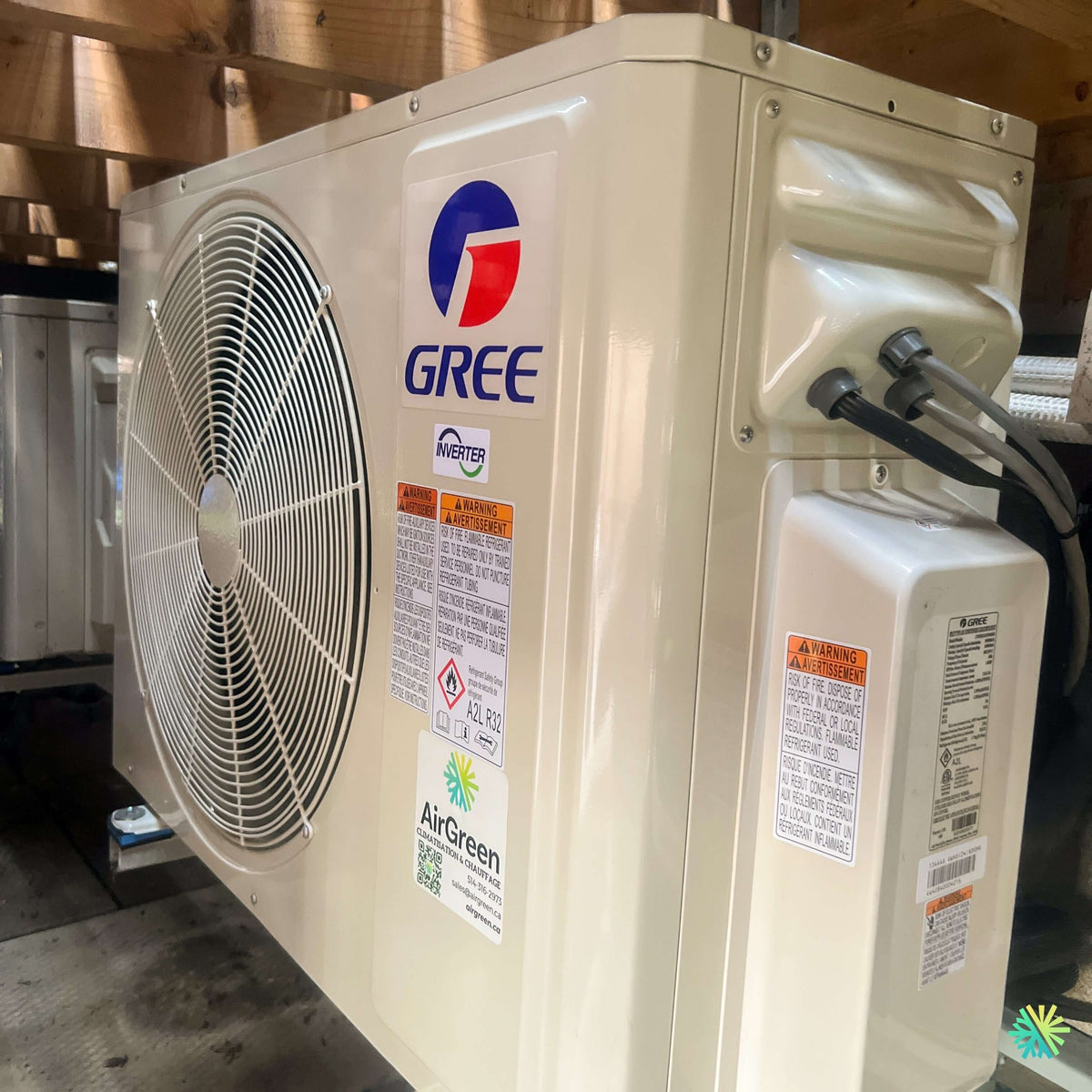
The project photo clearly shows the GREE outdoor unit installed in a confined environment, surrounded by wooden surfaces, supports, conduits, and existing mechanical elements. Unlike a classic ground-level installation or on a completely clear exterior wall, this type of location requires more extensive planning. Considerations must be given to air circulation, unit stability, required clearance for service, routing of refrigerant and electrical lines, as well as long-term equipment protection.
The client was looking for a reliable solution to improve their indoor comfort, both for air conditioning during warm periods and for heating during cooler months. The choice of the GREE CLIVIA R32 met this demand well: a modern, efficient device using R32 refrigerant and designed to offer stable inverter operation. For a residence located in Brossard, where temperature variations can be significant between seasons, this type of system allows for better comfort control without solely relying on traditional heating systems.
This project perfectly illustrates the difference between simply installing equipment and a truly professional HVAC installation. The unit must not only function when the technicians leave but also remain accessible, stable, durable, and efficient over the years.
Why the GREE CLIVIA R32 was suitable for this project
The GREE CLIVIA R32 is an interesting solution for homeowners who want to combine energy efficiency, comfort, and modern technology. Its inverter system adjusts power according to the actual heating or cooling demand. Instead of constantly starting and stopping at full capacity, the unit modulates its operation to maintain a more consistent temperature.
For the client, this generally means:
- a more stable indoor temperature;
- better humidity management in cooling mode;
- quieter operation;
- better controlled consumption;
- a more flexible response to temperature variations;
- more uniform comfort in the serviced area.
R32 refrigerant also represents a significant advantage. It is increasingly used in modern HVAC systems due to its efficient performance and improved environmental profile compared to several older refrigerants. In the context of a residential or semi-residential heat pump, it allows for good heat transfer, both for cooling and heating.
At AirGreen, we always evaluate the model based on the building, not just the technical specifications. The area to be treated, insulation, sun exposure, room configuration, occupancy habits, and available space for the outdoor unit all influence the final choice. In this case, the GREE CLIVIA R32 represented a solid balance between performance, reliability, and possible integration into the available space.
An outdoor unit installed in a protected environment
The image shows an outdoor unit placed in a sheltered space, with a wooden structure above and around the equipment. This type of configuration can offer certain advantages, particularly partial protection against direct weather. However, it also imposes significant requirements: an outdoor heat pump must always have sufficient clearance to properly exhaust and draw in air.
A common mistake is to believe that an outdoor unit can be placed in any space as long as it is protected from rain or snow. In reality, a wall-mounted air conditioner or wall-mounted heat pump unit needs to breathe. If air circulates poorly, performance decreases, cycles become more demanding, the equipment works harder, and indoor comfort can be affected.
In this project in Brossard, our team paid particular attention to several elements:
- clearance in front of the fan;
- access to the service panel;
- routing of pipes on the side of the unit;
- base stability;
- vibration reduction;
- possibility of intervention during future HVAC maintenance.
The unit is installed on suitable supports, with attention paid to leveling. This step is essential to limit vibrations, promote regular operation, and avoid mechanical stress on the connections. A poorly leveled heat pump can produce more noise, transmit vibrations to the structure, or complicate certain maintenance operations.
The importance of refrigerant line routing
In the photo, you can see the lines coming out of the side of the unit. Their path is a central aspect of the installation. Refrigerant lines connect the indoor unit to the outdoor unit and transport the refrigerant necessary for heat transfer. They must be handled with care, bent correctly, adequately insulated, and protected against wear.
In a confined space installation, the most common errors are overly tight bends, stressed lines, poorly sealed insulation, or passages that make service difficult. At AirGreen, we plan the route to reduce stress on connections and maintain system efficiency.
Proper insulation is particularly important. In cooling mode, a poorly insulated cold line can produce condensation. In heating mode, degraded insulation can contribute to efficiency losses. On the South Shore, as in Montreal, Laval, Longueuil and on the North Shore, temperature differences require materials adapted to local conditions.
Commissioning: a step that confirms the quality of work
After the physical installation of the system, commissioning is a crucial step. It should never be treated as a mere formality. For this project, our team performed the necessary checks to ensure that the GREE CLIVIA R32 was operating correctly according to expected parameters.
This phase includes, but is not limited to:
- checking connections;
- checking circuit tightness;
- validating cooling operation;
- validating heating operation;
- observing startup cycles;
- checking for vibrations and noise;
- explaining operation to the client.
This work helps prevent many long-term problems. An installation that appears visually correct can have invisible defects if it is not rigorously tested. At AirGreen, commissioning is integrated into our work method because it confirms that the system is ready for use under good conditions.
What this Brossard installation teaches homeowners
A successful HVAC installation relies on three elements: the right equipment, the right location, and the right execution. If any of these elements are neglected, even a good heat pump can yield disappointing results. This project in Brossard specifically demonstrates how serious planning allows for adapting a modern solution to a more complex technical environment.
Do not choose a heat pump based solely on price
Price is obviously an important factor, but it should never be the only criterion. A cheaper system can become more expensive in the long run if the installation is poorly done, if the model is undersized, or if access for service is compromised. In the field of wall-mounted heat pumps, installation quality directly influences performance and durability.
A client comparing several quotes should carefully examine:
- the exact brand and model proposed;
- the type of refrigerant;
- the recommended capacity;
- the quality of the supports;
- pipe protection;
- warranties;
- the installer's experience;
- after-sales service availability;
- assistance with eligible subsidies.
AirGreen distinguishes itself by a comprehensive approach. We don't just aim to install equipment quickly. We want the system to be consistent with the building, easy to use, well-protected, and compliant with industry best practices.
Avoid overly enclosed locations
Another important lesson from this project concerns the clearance of the outdoor unit. Even if the unit is installed in a sheltered location, it should not be enclosed in too tight a space. A heat pump needs air to exchange heat. If the hot air discharged during cooling or the cold air discharged during heating remains trapped around the unit, performance can decrease.
Before validating a location, our technicians evaluate air circulation and access possibilities. In some cases, a location that seems practical to the homeowner is not technically ideal. Our role is then to clearly explain the reasons and propose a more sustainable solution.
Plan for maintenance from installation
An HVAC system must be maintained. This means that the outdoor unit must remain accessible, service panels must be able to be opened, and pipes must not block interventions. In this project, this reality was taken into account from the outset.
The HVAC maintenance of a system like the GREE CLIVIA R32 generally includes cleaning the indoor unit filters, visual inspection of the outdoor unit, checking drainage, examining connections, and verifying general operation. When the installation is well-designed, these operations are simpler, faster, and more efficient.
Indoor comfort after installation
Once the system is installed and tested, the client can enjoy better control of the indoor temperature. In summer, the wall-mounted air conditioner effectively cools the targeted area. In cooler periods, the heat pump contributes to heating with more controlled consumption than several traditional options, depending on usage and conditions.
The inverter technology of the GREE CLIVIA R32 promotes more stable comfort. Rather than creating sudden variations, the system gradually adjusts its power. This stability is often what clients notice most after a few days of use: the space becomes more pleasant, less humid in summer, and better tempered during seasonal transitions.
Useful expertise for residential and multi-unit projects
AirGreen performs installations of wall-mounted heat pumps, wall-mounted air conditioners, mini-splits, and HVAC systems in a wide variety of contexts: single-family homes, condos, plexes, businesses, offices, mechanical rooms, and buildings with limited access. This experience is particularly useful in cities like Brossard, where established residential neighborhoods and newer constructions can be found.
The challenges are never exactly the same. In Montreal, outdoor space can be limited by alleys, balconies, or co-ownership rules. In Laval, some houses require long pipe runs. In Longueuil and on the South Shore, installations may have to contend with multi-level buildings, additions, terraces, or confined mechanical spaces. On the North Shore, exposure to cold and snow often influences the outdoor installation height.
This project in Brossard fits into this reality: a clean, methodical installation adapted to the immediate environment.
Subsidies and eligibility: a point to validate before purchase
Certain heat pump models may be eligible for subsidy programs depending on their characteristics, energy efficiency, and current criteria. As programs can evolve, we always recommend validating the eligibility of the exact model before finalizing the project.
At AirGreen, we help clients understand the broad outlines of applicable programs and gather the necessary information when their unit is eligible. This can make a significant difference in the net cost of the project, but we always emphasize one point: the subsidy should not replace technical analysis. An eligible unit must also be well-chosen, properly sized, and installed according to industry best practices.
Why choose AirGreen for a GREE installation in Brossard
For this project, our team combined technical knowledge, installation rigor, and adaptation to the site. The GREE outdoor unit visible in the photo is installed neatly, with clean connections and access designed for service. This attention to detail reflects our approach to every project, whether it's a small residential installation or a more complex site.
Choosing AirGreen means benefiting from a team accustomed to the local realities of Montreal, Laval, Longueuil, the North Shore, and the South Shore. We understand the constraints of Quebec buildings, the requirements related to modern heat pumps, homeowner expectations, and the details that make the difference between a correct installation and a durable one.
This installation of a GREE CLIVIA R32 wall-mounted heat pump in Brossard demonstrates that a good result depends as much on the machine as on the quality of the on-site work. In a confined technical space, every decision counts: the unit's orientation, clearance, support, piping, future access, and commissioning. The final result provides the client with an efficient, clean, and suitable solution for their building.
The job tools
Two quick checks with real numbers: what heat costs, and what your current heaters add up to in BTU/h.
Conversion: 1 W = 3.412 BTU/h. An indication, not a load calculation: baseboards and furnaces are often stronger than the real need, and they can stay as backup. AirGreen confirms the capacity on site.
How the job unfolds
The main steps of this kind of job at AirGreen. Every house has its quirks: the estimate brings them out.
We look at the room, the outside wall, the line route and where the outdoor unit will go. That is where the capacity gets chosen.
Model, capacity and price, in writing. We also check whether the model qualifies for assistance programs.
Floors and furniture protected, wall plate position marked level, wall opening located.
A single opening, with the slope the drain needs to flow outside.
Set on a stand raised above the snow, with the clearances the manufacturer requires.
Connected, insulated and protected. The opening is then sealed against water, cold air and insects.
A dedicated circuit and an accessible disconnect near the outdoor unit.
Leak test, vacuum, then start-up and a check of heating and cooling.
Remote, modes, filters: we show you the essentials before we leave.
- The on-site estimateWe look at the room, the outside wall, the line route and where the outdoor unit will go. That is where the capacity gets chosen.
- The quoteModel, capacity and price, in writing. We also check whether the model qualifies for assistance programs.
- Getting readyFloors and furniture protected, wall plate position marked level, wall opening located.
- The wall openingA single opening, with the slope the drain needs to flow outside.
- The outdoor unitSet on a stand raised above the snow, with the clearances the manufacturer requires.
- Lines, cable and drainConnected, insulated and protected. The opening is then sealed against water, cold air and insects.
- The electrical workA dedicated circuit and an accessible disconnect near the outdoor unit.
- Tests and start-upLeak test, vacuum, then start-up and a check of heating and cooling.
- The walkthroughRemote, modes, filters: we show you the essentials before we leave.
What we check on a job like this one
Each number is a point we check on site. Switch between summer and winter to watch air and heat move.
In summer, the outdoor unit rejects the house's heat outside.
Generic illustration of this type of installation, not a survey of this job site. Tap a number.
Mounted level on a wall plate, high enough for the air to reach the whole room, with enough space around it to slide the filters out easily.
The refrigerant lines, the communication cable and the drain go through the wall in a single opening, sealed against water, cold air and insects.
Two insulated copper pipes connect the two units. Outside, a line cover can protect them from sun, knocks and weather.
A shut-off switch near the outdoor unit isolates it safely for service. It must stay accessible at all times.
The compressor and the fan. In heating mode it captures heat from the outdoor air, even in winter, and moves it inside.
On the ground or on the wall, it keeps the unit above accumulated snow. The unit stays clear and defrost water can drain away.
The fan needs to blow freely. Storage, a fence or a wall too close, and efficiency drops while noise goes up.
Is your home ready?
Check what applies at your place. A "no" is not a refusal: it is what we sort out during the estimate.
Good habits, once the unit is in place
Six simple habits that keep the unit going. Your list stays on this device.
What to do, season by season
Three habits per season for this unit. They take a few minutes and prevent many calls.
- Clean the indoor unit's filters.
- Clear leaves and debris left on the outdoor unit by winter.
- Test cooling before the first hot days.
- Clean the filters more often when the unit runs a lot.
- Keep plants away from the outdoor unit.
- Check that no water drips from the indoor unit.
- Rake the leaves around the outdoor unit.
- Test heating before the first cold days.
- Book periodic maintenance before winter.
- Keep snow away from the stand and the front of the unit.
- Let the unit defrost: it is normal.
- Never hit the ice on the fins; call us if the unit stays iced up.
The right pages, at the right time
Four statements: true or false?
It all comes down to details you have just seen.
1. In heating mode, the outdoor unit can produce water.
During defrost cycles. That water must drain away without forming ice.
2. You pick the capacity with a simple square-footage rule.
Windows, insulation, orientation and how the room is used all count. Capacity is chosen on site.
3. A multi-zone connects several indoor heads to a single condenser.
One head per room, all on the same condenser. Each room keeps its own temperature.
4. The disconnect can sit behind the patio furniture.
It must stay accessible: it is what shuts the unit off for service.
0 / 4 right answers
What people ask us about this kind of work
Does a wall-mounted heat pump heat in winter?
Wall-mounted or multi-zone: how do I choose?
Where does the outdoor unit go?
Are there grants?
Do I need a permit?
How cold can it heat?
How much can I save?
How is the LogisVert assistance calculated?
Is it noisy?
The outdoor unit is covered in ice: is that normal?
Does AirGreen hold the required licences?
Is the estimate free?
No question matches. Write to us: we answer.
More jobs to see, near you
By town, by equipment or by region: browse more than 4,700 published projects.
Each dot: a town where AirGreen has published projects. The glowing dot: this job.
An on-site estimate, the right capacity, the right equipment.
The on-site estimate is free and the quote follows within 24 hours.
Text and photo: a real AirGreen Climatisation & Chauffage job. The diagrams are generic illustrations of the type of installation, not a survey of this job site. Sources of the added figures: airgreen.ca product pages (NEEP / AHRI performance), Hydro-Québec (Heat pumps page, LogisVert, read on 13 October 2026), Régie de l’énergie (rate D as of 1 April 2026).